
The Spiritual Life
What Does God Say About Temptation?
What does God say about temptation? That it is not sin but the testing-ground of virtue. We give the Douay-Rheims, the catechisms, and how to resist temptation by prayer, the sacraments, flight, and vigilance.
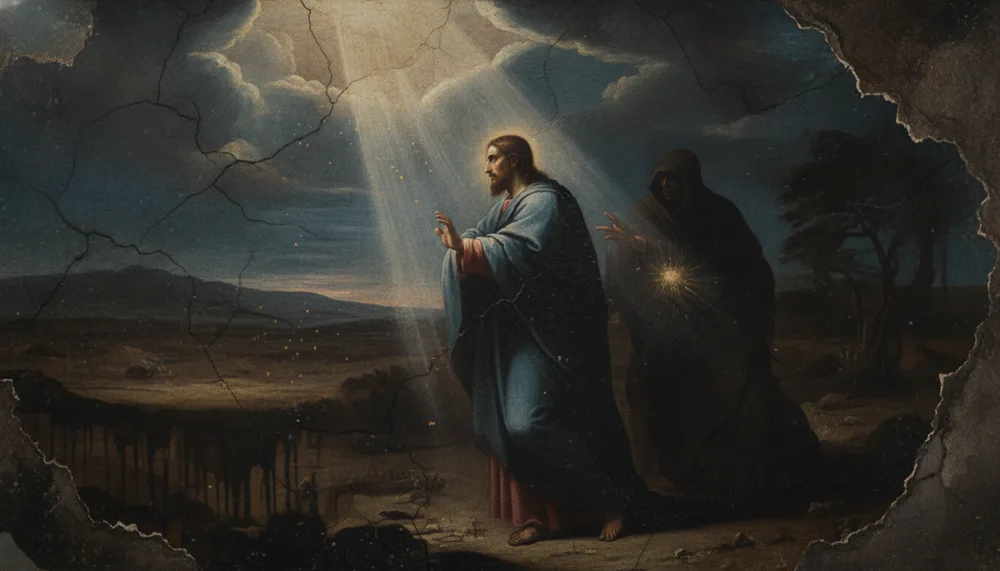
God says that temptation is not sin, but the testing-ground of virtue, and that He will never let it crush you: God is faithful, who will not suffer you to be tempted above that which you are able, but will make also with temptation issue, that you may be able to bear it (1 Cor. x. 13, Douay-Rheims). To be tempted is to be put to the proof; to consent is to sin. The two are not the same, and the whole Catholic answer turns on keeping them apart.
This is why Our Lord taught us to pray lead us not into temptation — not "spare me every assault," but "let me not be overcome." He was Himself led by the spirit into the desert, to be tempted by the devil (Matt. iv. 1), and He did not sin. We set out here what the Bible says about temptation, where it comes from, and how to resist it — grounded in the Douay text and the catechisms the Church gave us before the upheavals of our own day.
Is temptation a sin?
No. The Catechism of St Pius X states it without qualification: "it is not a sin to have temptations, but it is a sin to consent to them or to expose oneself willingly to the danger of consenting to them." A temptation is an incitement to sin — a suggestion, a pull, a movement felt in the soul. Sin begins only where the will assents.
This matters, because two errors prey on troubled souls. The scrupulous man treats every dark thought as a fall and despairs. The careless man, hearing that temptation is no sin, walks straight into the occasions of it. Both are wrong. The Bible holds the line exactly: Blessed is the man that endureth temptation; for when he hath been proved, he shall receive the crown of life (James i. 12). The temptation endured is not the sin; it is the contest in which the crown is won.
So the felt assault — the angry impulse, the impure image, the whisper of doubt — does not stain the soul of itself. What stains is consent, and what invites consent is the deliberate courting of danger. (On the distinction between assenting and merely suffering an impulse, and the disordered appetites that feed it, see The seven deadly sins.)
What does the Bible say about temptation — does God tempt us?
Here Scripture is emphatic, and corrects a common misreading. God does not tempt anyone to evil. St James writes plainly: Let no man, when he is tempted, say that he is tempted by God. For God is not a tempter to evils, and he tempteth no man. But every man is tempted by his own concupiscence, being drawn away and allured (James i. 13–14). God is not the author of sin for anyone, the Catechism of the Council of Trent insists; He hateth all them that work iniquity (Ps. v. 7).
Yet the same Scriptures say the Lord your God tempteth you, that it may appear visibly whether you love Him (Deut. xiii. 3), and that Abraham was tempted when commanded to offer Isaac. The Catechism of Trent unties the knot: to tempt means to put to the proof, and one may prove a man with a view to good or with a view to evil. God proves us for good — to manifest our virtue, to strengthen it, to make us examples and to reward us. The devil tempts for evil — to push us to sin and to our perdition. Scripture names him by the single word: the tempter (Matt. iv. 3).
When we pray lead us not into temptation, then, we do not ask God to stop doing something evil. We ask Him not to permit us to be overcome — to withhold His help is the only sense in which He could be said to "lead" us in, and we beg Him not to withhold it. As the Catechism of Trent says, "we do not ask never to be tempted, for the life of man upon earth is a warfare (Job vii. 1)." (For the wider pattern of reading hard verses in their Catholic sense, see Catholic Bible verses, and on the meaning of each petition of the Our Father, How to pray the rosary.)
Where temptation comes from: the world, the flesh, and the devil
The catechisms name three sources, and the searcher who wants the full picture should know all three. The Catechism of St Pius X teaches that temptation "comes to us either from the devil, or from the wicked, or from our own passions." The older tradition gathers these under the three enemies: the world, the flesh, and the devil — while our soul dwells in this mortal body, says Trent, the flesh, the world, and the devil attack us on every side.
The flesh is the disordered appetite within us, our own concupiscence that draws away and allures (James i. 14) — the pull toward pleasure, ease, anger, vanity. The world is the array of bad example, false maxims, and corrupting men — and above all, Trent warns, the heretics who sit in the chair of pestilence (Ps. i. 1) and spread unsound doctrine. The devil is the personal enemy, your adversary the devil, as a roaring lion, goeth about seeking whom he may devour (1 Pet. v. 8).
But Scripture also sets the devil's power firmly under God's hand. Satan could not touch Job until God permitted it, and could not pass even into the swine without leave. All his power is subordinate to the will of God, says Trent. The enemy is real and hates us, but he is a chained dog. (On the lifelong nature of this warfare, see Spiritual combat.)
How to resist temptation
The Catechism of St Pius X gives four weapons, plainly: "to avoid temptations we must flee dangerous occasions, guard our senses, frequently receive the sacraments, and have recourse to prayer." These are the means, and they are not optional refinements.
Flight. The first defence is to keep clear of the occasion. He who courts danger does not endure temptation; he manufactures it. He that loveth danger shall perish in it (Eccli. iii. 27). Joseph did not argue with Potiphar's wife; he fled and left his garment behind (Gen. xxxix). Against impurity especially, the rule is flight, not debate.
Vigilance. Guard the senses — the eyes, the ears, the tongue — for they are the gates the enemy uses. Watch ye, and pray that ye enter not into temptation (Matt. xxvi. 41), Our Lord said in Gethsemane, adding the reason: the spirit indeed is willing, but the flesh is weak. Trent observes that it is neither by idleness, sleep, wine, good cheer, nor pleasures that one triumphs over Satan, but by prayer, labour, watching, temperance, and purity.
The sacraments. The soul nourished by confession and the Blessed Sacrament fights from strength. Grave sin empties the soul of the very charity by which it resists; absolution restores it, and the Eucharist nourishes the life of the soul. The man who falls should rise at once through confession, not lie in the mire. (On that recovery, see What is confession?; on the life of grace it restores, Sanctifying grace; on the channels of that grace, The seven sacraments.)
Prayer. Above all, prayer — for the strength to resist is God's gift, not our own. Pray, that you enter not into temptation is a command, given twice by Christ. When one temptation presses hard, we turn against it expressly, as David did: Turn away my eyes that they may not behold vanity (Ps. cxviii. 37). And we lean not on our own firmness: St Peter swore he would die rather than deny his Lord, and denied Him within the hour. The lesson is to distrust our own strength and call on God's. (On the prayer that arms the soul, see Mental prayer.)
Christ tempted, and the promise
The ground of our hope is that Our Lord Himself was tempted and did not fall. We have not a high priest who cannot have compassion on our infirmities, but one tempted in all things like as we are, without sin (Heb. iv. 15). In the desert He met the threefold assault — the flesh (turn stones to bread), the world (the kingdoms of the earth), and pride (cast Thyself down) — and answered each with the word of God: It is written (Matt. iv. 4, 7, 10). The soul that would answer likewise must have that word within reach, and the slow, prayed reading of Scripture — lectio divina — is how it is stored there. He is, says Trent, the stronger man who overthroweth the strong man armed, and He has won for His followers the power to conquer in their turn.
So the testing is not a punishment but an honour and a means of merit. The Catechism of St Pius X teaches that God permits temptation to prove our fidelity, to make our virtues grow, and to increase our merits. The crown is given to him that striveth lawfully (2 Tim. ii. 5), and it is given to no one who never strove. This is why we must never call temptation, of itself, a defeat. It is the field on which the victory is won, and the victory is promised: Resist the devil, and he will fly from you (James iv. 7). (For what hangs on this combat in the end, see The four last things.)
We hold, then, what the Church has always held — and what we set out across the questions gathered in What does God say about. Temptation is not sin; it is the proving of the soul. God never permits it beyond our strength and always offers the issue out. The enemy is real but bound, the weapons are flight, vigilance, the sacraments, and prayer, and the victory belongs to Christ, who was tempted and did not yield, and who gives us to conquer in Him.
Frequently Asked Questions
What does God say about temptation?
God says temptation is not sin but the testing-ground of virtue, and that He will never permit it beyond our strength: God is faithful, who will not suffer you to be tempted above that which you are able, but will make also with temptation issue, that you may be able to bear it (1 Cor. x. 13). To be tempted is to be put to the proof; to consent is to sin. Blessed is the man that endureth temptation; for when he hath been proved, he shall receive the crown of life (James i. 12).
Is temptation a sin?
No. The Catechism of St Pius X teaches that "it is not a sin to have temptations, but it is a sin to consent to them or to expose oneself willingly to the danger of consenting to them." A temptation is an incitement to sin — a suggestion or pull felt in the soul — and sin begins only where the will assents. The felt assault does not stain the soul; consent does.
Does God tempt us?
God never tempts anyone to evil: Let no man, when he is tempted, say that he is tempted by God. For God is not a tempter to evils (James i. 13). Where Scripture says God "tempted" Abraham, the Catechism of Trent explains that to tempt means to put to the proof, and God proves us for good — to manifest and strengthen our virtue. The devil, by contrast, tempts for evil, to push us to sin and perdition.
Where does temptation come from?
The Catechism of St Pius X teaches that temptation "comes to us either from the devil, or from the wicked, or from our own passions." The older tradition names these three enemies as the world, the flesh, and the devil. Yet even the devil is bound — he could not touch Job without God's leave — for all his power is subordinate to the will of God (Catechism of Trent).
How do you resist temptation?
The Catechism of St Pius X gives four weapons: "to avoid temptations we must flee dangerous occasions, guard our senses, frequently receive the sacraments, and have recourse to prayer." Flight keeps us from the occasion, as Joseph fled Potiphar's wife; vigilance guards the gates of the senses; the sacraments arm the soul with grace; and prayer obtains the strength to resist, which is God's gift. Watch ye, and pray that ye enter not into temptation (Matt. xxvi. 41).
Why does "lead us not into temptation" not mean God tempts us?
When we pray lead us not into temptation, we do not ask God to stop doing something evil, for He tempts no one. We ask Him not to permit us to be overcome — not to withhold the help by which we stand. As the Catechism of Trent says, "we do not ask never to be tempted, for the life of man upon earth is a warfare (Job vii. 1)."
Was Jesus tempted?
Yes. Our Lord was led by the spirit into the desert, to be tempted by the devil (Matt. iv. 1), and met the threefold assault — flesh, world, and pride — answering each with It is written, yet without sin. We have not a high priest who cannot have compassion on our infirmities, but one tempted in all things like as we are, without sin (Heb. iv. 15). Because He conquered, He gives His followers the power to conquer in Him.
Why does God allow temptation?
The Catechism of St Pius X teaches that God permits temptation "to prove our fidelity, to make our virtues grow, and to increase our merits." The testing is therefore not a punishment but an honour and a means of merit, for the crown is given to him that striveth lawfully (2 Tim. ii. 5) — and to no one who never strove. The victory is promised: Resist the devil, and he will fly from you (James iv. 7).
The Iter Fidei app carries the Douay-Rheims Bible, the catechism, and the prayers. Download it here.
Sources. Holy Scripture (Douay-Rheims): 1 Corinthians x. 13; Matthew iv. 1–11, vi. 13, xxvi. 41; James i. 12–14, iv. 7; 1 Peter v. 8; Hebrews iv. 15; 2 Timothy ii. 5; Deuteronomy xiii. 3; Genesis xxxix; Job vii. 1; Psalms i. 1, v. 7, cxviii. 37; Ecclesiasticus iii. 27. Catechism of St Pius X (1908): Part II, Chapter 2, § 7 — The Sixth Petition ("And lead us not into temptation": temptation defined; that it is not a sin to have temptations; why God permits them; the four means of avoiding them). Catechism of the Council of Trent (1566): Chapter Forty-Fifth — The Sixth Petition ("And lead us not into temptation": the world, the flesh, and the devil; tempting with a view to good and with a view to evil; that God is no tempter to evil; the devil's power subordinate to God; the means and motives of resisting; Christ the conqueror).