
The Last Things
The Four Last Things: Death, Judgment, Heaven, and Hell
The four last things are Death, Judgment, Hell, and Heaven — the traditional Catholic framework for the end that awaits every man, set out from the old catechisms.
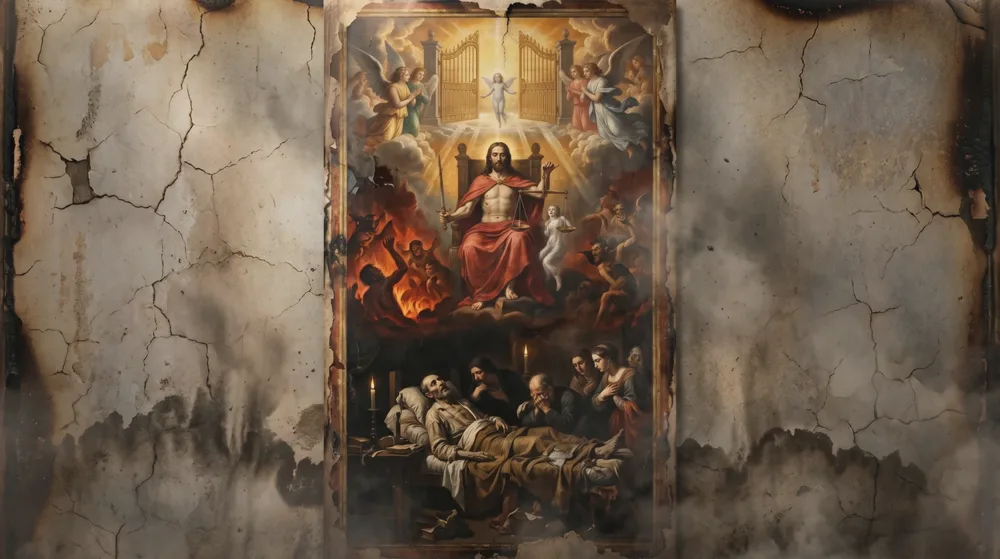
The four last things are Death, Judgment, Hell, and Heaven. They are called the last things because they are the last things that will happen to man: death is the last thing that befalls him in this world, the Judgment of God is the last of the judgments he must undergo, and Hell or Heaven is his final and unending state. The Catechism of St Pius X teaches them plainly under this name, and the whole tradition holds them before the soul as the surest means of avoiding sin.
What are the four last things?
The holy Books call "last things" the last things that will happen to man, and they number four: Death, Judgment, Hell, and Heaven. The Catechism of St Pius X sets them in this order and explains why each bears the name: Death is the last thing that will happen to man in this world; the Judgment of God is the last of the judgments we must undergo; Hell is the extreme evil for the wicked; Heaven is the sovereign good for the good. This is the traditional framework of the four last things — death, judgment, heaven and hell — that every Catholic catechism has set before the faithful.
The reason the Church keeps these four things together is practical. The Catechism of St Pius X tells us it is good to think of the last things every day, particularly in our morning prayers on awakening, in the evening before our rest, and every time we are tempted to do evil, because this thought is most efficacious in making us avoid sin. The four last things are not a morbid curiosity but a daily discipline. We meditate on the end because the end orders the means.
Death — the gate to the rest
Death is the first of the four last things, the last thing that will happen to us in this world. It is the separation of the soul from the body. The body returns to the dust from which it was taken, while the soul, being incorruptible, does not perish but goes immediately to its account. The Roman Catechism, treating of the resurrection, insists on this distinction: of the two parts that compose man, the body alone is subject to corruption and returns to the dust, whereas the soul is absolutely incorruptible. Death ends our time of merit and of trial; what we are at the hour of death, we remain. For what the soul meets at the moment of death, see what happens after death.
Judgment — the particular and the general
The second of the four last things is Judgment, and here the tradition is careful to distinguish two judgments. The Roman Catechism teaches that there are two times in which each of us must appear before God to render an account of all his thoughts, words, and actions.
The particular judgment
The first comes at the very moment we depart this life. At that instant, the Roman Catechism says, each one appears before the tribunal of God and there undergoes a rigorous examination concerning all that he has done, said, and thought during his life. This is the particular judgment. There is no appeal and no delay; the sentence fixes the soul in its eternal state.
The general judgment
The second is the general judgment, at the last day, when our Lord Jesus Christ will judge the whole human race. The Roman Catechism reminds us that Scripture speaks of two comings of the Son of God: the first when He took our nature to save us, the second at the consummation of the ages when He shall come to judge all men, the coming Scripture calls the day of the Lord.
Then all men of all the ages, gathered in one place, shall hear the sentence God has pronounced upon them, and the justice of every life shall be made manifest before all. The just will there find a part of their reward, since their hidden fidelity will be brought to light. This general judgment follows upon the resurrection of the body, which the Roman Catechism calls in some sort the most solid foundation of our heavenly hopes.
Hell — the extreme evil for the wicked
The third of the four last things is Hell, which the Catechism of St Pius X names the extreme evil for the wicked. Hell is the state of those who die in mortal sin, separated from God for ever. We speak of it soberly, as the catechisms do, because it is a revealed truth and not a device of fear.
The Roman Catechism, explaining the article "He descended into hell," distinguishes the places that bear this name. One is the frightful prison where the souls of the damned are tormented with the unclean spirits by a perpetual fire that is never quenched; this is hell properly so called. Another is the fire of Purgatory, where the souls of the just are purified for a determined time until they are worthy to enter heaven, for nothing defiled can enter there — a distinct state set out under what is purgatory. A third was the place where the just of old awaited their Redeemer.
The eternity of hell is itself a revealed truth of faith. Mgr de Ségur, gathering the testimonies of Scripture, recalls the sentence that shall preside over the eternity of us all: "Depart from me, ye cursed, into everlasting fire, prepared for the devil and his angels," and "these shall go into everlasting punishment, but the just into life everlasting." The same Son of God who promised the kingdom pronounced the curse, and the Church has rested upon these words for her teaching on the eternity both of the beatitude of the elect and of the pains of the damned. We treat this more fully in does hell exist.
Heaven — the sovereign good for the good
The fourth of the four last things is Heaven, which the Catechism of St Pius X calls the sovereign good for the good. The Roman Catechism explains the article "I believe in life everlasting" and is careful to say that these words designate not so much the mere eternity of the life of the saints — for the demons and the wicked will also live for ever — as the eternity of their beatitude, a happiness that will fill full all their desires.
This sovereign happiness cannot consist in corporeal and perishable things, which grow old and pass away. The Roman Catechism warns that the more a man lets himself be taken by the love of the world, the more he removes himself from true felicity, for the world passes away and the concupiscence thereof. Heaven is the possession of God Himself, the end and aim of all our thoughts and desires, and the reward the faithful await after the resurrection of the body. We open this further in what is heaven.
Why we meditate on death, judgment, heaven and hell
The four last things are held together because together they govern how a man lives. Mgr de Ségur draws the practical conclusion: these great truths are revealed to us only to inspire that wholesome fear which, with faith, is the foundation of salvation — the fear of God's justice, of the sin that leads to hell, and of an eternity ill spent. Yet, he adds, hope must never be parted from fear, and hope must prevail; fear remains as the foundations of a house, lending the whole edifice its strength. We fear in a holy manner that we may hope in a holy manner. This is the preaching that St Vincent Ferrer, the Dominican of Valencia, carried along the roads of Europe in the last twenty years of his life, calling the crowds to penance before the Judgment.
Hence the old counsel that follows from the four last things: where do you stand, and are you in the state of grace? If there is grievous sin upon the conscience, Ségur urges, do not put off till to-morrow the repentance and the confession you may make to-day, for "what doth it profit a man, if he gain the whole world, and lose his own soul?" The four last things are not meant to crush but to wake — to turn the soul, while there is time, toward the sovereign good.
All our articles on the last things, in order
Death
Judgment and the end of the world
- The resurrection of the body
- What God says about the end times
- What God says about the Antichrist
Hell and purgatory
- Does hell exist?
- What God says about hell
- What is purgatory?
Heaven
- What is heaven?
Frequently Asked Questions
What are the four last things?
The four last things are Death, Judgment, Hell, and Heaven. The Catechism of St Pius X calls them the "last things" because they are the last that will happen to man: Death is the last thing that befalls him in this world, the Judgment of God is the last of the judgments he must undergo, and Hell or Heaven is his final, unending state. The whole tradition holds these four before the soul as the surest means of avoiding sin.
The four last things — death, judgment, heaven and hell — are the last and surest measure of a Christian life. We think on them daily not to be afraid, but to be ready, ordering all our days toward the one end that does not pass away.
To keep these truths before you each day, meditate on the four last things with the Join early access here..
Sources. Catechism of St Pius X, Part V, ch. 7 ("The Last Things"); Catechism of the Council of Trent (Roman Catechism), on the Fifth Article ("He descended into hell"), the Seventh Article ("From thence He shall come to judge"), the Eleventh Article ("the resurrection of the body"), and the Twelfth Article ("life everlasting"); Mgr de Ségur, Hell (on the eternity of the pains of hell; Practical Conclusions).