
Novenas
Novena to St Philomena
The nine-day novena to St Philomena, the Wonder-Worker — including the novena attributed to St John Vianney, the Curé of Ars — prayed for purity, for mothers and children, and for lost and desperate causes.
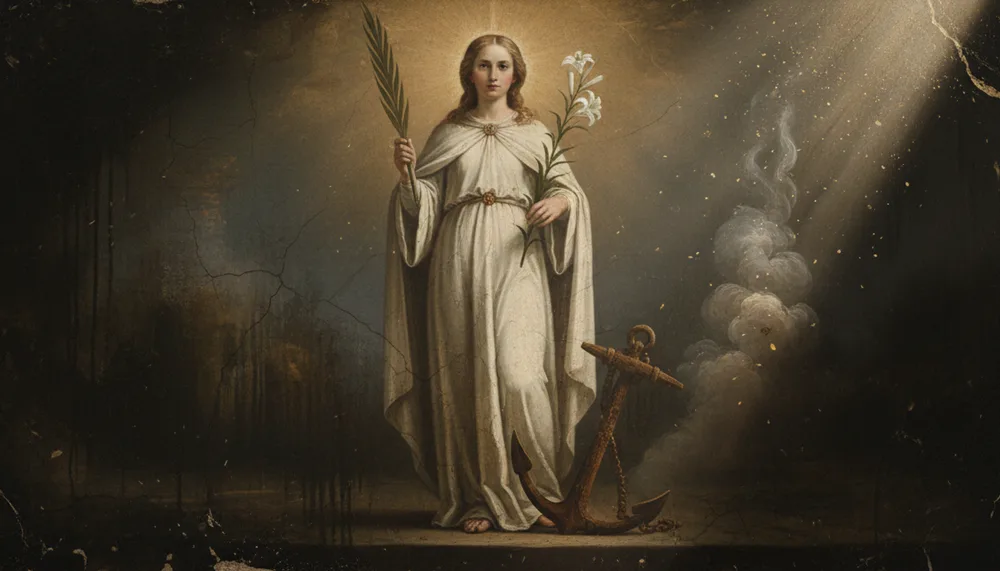
The novena to St Philomena is nine days of prayer to the little virgin-martyr whom the nineteenth century came to call the Wonder-Worker — St Philomena, Thaumaturga, whose relics were found in the Roman catacombs in 1802 and whose miracles were so many that St John Vianney, the Curé of Ars, gave her the credit for the wonders worked through his own hands.
She is invoked above all for purity, for mothers and children, for priests, and for causes the world has abandoned as lost or desperate. Her former feast fell on 11 August (withdrawn from the calendars in 1961, see below), and the usual nine days run from 3 to 11 August. Below we give the full novena — including the one St John Vianney composed — with her story and an honest note on her place in the traditional calendar.
A note on St Philomena and the 1962 calendar
Because ours is a site of the traditional Roman rite, one thing must be said plainly. St Philomena's public veneration was approved by Pope Gregory XVI in 1837, and devotion to her has never been forbidden. But in 1961 the Sacred Congregation of Rites removed her feast from the liturgical calendars, because no historical account of who she was has ever been established apart from private revelations, which the Church obliges no one to believe.
What was withdrawn was the public feast, not the saint: the shrine at Mugnano del Cardinale still stands, her relics are venerated, the indulgences of her cord and prayers were never revoked, and the faithful remain free to invoke her — as generations have, in the novena we give here in full. She is a saint of private devotion rather than of the calendar. If you are new to the practice, see first our guide to what is a novena.
The full novena to St Philomena
There are two forms in common use: the classic novena prayer, prayed once each day with your petition named within it, and — below — the fuller devotion attributed to St John Vianney, with a meditation for each of the nine days.
The daily novena prayer
Say this prayer once on each of the nine days, naming your request within it. These prayers are devotional texts, with no liturgical standing:
Illustrious virgin and martyr, Saint Philomena, behold me prostrate before the throne whereupon it has pleased the Most Holy Trinity to place thee. Full of confidence in thy protection, I entreat thee to intercede for me with God. From the heights of Heaven deign to cast a glance upon thy humble client! Spouse of Christ, sustain me in suffering, fortify me in temptation, protect me in the dangers surrounding me, obtain for me the graces necessary to me, and in particular (here name your request). Above all, assist me at the hour of my death. Saint Philomena, powerful with God, pray for us. Amen.
Many add this second, warmer petition:
O faithful Virgin and glorious Martyr, St Philomena, who works so many miracles on behalf of the poor and sorrowing, have pity on me. Thou knowest the multitude and diversity of my needs. Behold me at thy feet, full of misery, but full of hope. I entreat thy charity, O great Saint! Graciously hear me, and obtain from God a favourable answer to the request which I now humbly lay before thee (name your request). I am firmly convinced that, through thy merits, through the scorn, the sufferings and the death thou didst endure, united to the merits of the Passion and death of Jesus thy Spouse, I shall obtain what I ask of thee; and, in the joy of my heart, I will bless God, who is admirable in His Saints. Amen.
The closing prayer
Each day the novena is closed with the collect of her former feast (removed from the calendars in 1961, and so absent from the Missal of 1962):
O God, who in Thy great might didst raise up martyrs even from among the weaker sex, grant, we beseech Thee, that we who honour Thy blessed Virgin and Martyr Philomena may be led by her example and brought by her to Thee: through Our Lord Jesus Christ, Who with the Father and the Holy Ghost liveth and reigneth, one God, world without end. Amen.
Saint Philomena, pray for us.
The novena to St Philomena by St John Vianney
The novena attributed to the Curé of Ars is the best-known form of this devotion. St John Vianney, the patron of parish priests, attributed his 1843 cure from a grave illness to her, built her a chapel at Ars, and sent his pilgrims to her. To know the Curé himself, see our life of St John Vianney.
The same prayer for each day is said on all nine days, your intention named within it:
O glorious Virgin and Martyr, beloved of God, Saint Philomena! I rejoice with thee in the power which God gave thee for the glory of His Name, for the edification of His Church, and to reward the merits of thy life and death. I rejoice to see thee so great, so pure, so generous, so faithful to Jesus Christ and to His Gospel, and so splendidly rewarded in Heaven and on earth. Attracted by thy example to the practice of solid virtue, and full of hope at the sight of the recompense granted to thy merits, I resolve to follow thee in avoiding all evil and in fully obeying what God commands.
Help me, O great Saint, by thy powerful intercession. Obtain for me particularly a purity inviolable for ever, a strength of soul always invincible in every kind of assault, a generosity which denies no sacrifice to God, and a love as strong as death for the Faith of Jesus Christ, for the Holy Roman Church, and for our Holy Father, the Vicar of Jesus Christ over all the world.
With all the fervour of my soul I implore these graces from thee, and, in addition, I ask these other benefits with equal confidence in obtaining them through thy powerful intercession: (here tell St Philomena what you need, with simplicity, confidence, and humility).
Surely that God so good, for Whom thou didst give thy blood and thy life — that God so good Who has loved me even unto dying for me, even unto giving me Himself under the Eucharistic appearances — surely He will never be deaf to thy prayers nor to my appeals, unless it be that He Himself is in some other way seeking to do me good. Full of confidence, I place all my trust in Him and in thee. Amen.
St John Vianney joined to it a distinct meditation for each of the nine days, each drawing a lesson from her life:
- First Day — She was a virgin in such a world and such an age, in spite of persecution, unto death. Beg her virginal purity.
- Second Day — She remained a virgin by governing the flesh and keeping modesty in her senses, fleeing the world's dangerous occasions. Flee whatever has injured you.
- Third Day — She guarded her chastity by prayer, by the Sacraments, and by knowing her body a temple of the Holy Ghost. Redouble your prayers; say often: my members are those of Jesus Christ.
- Fourth Day — She was a Martyr who had to suffer much, unto death, with invincible patience. Bear patiently the little sorrows the Lord sends you today.
- Fifth Day — She suffered rather than betray her Faith or her Baptismal vows. Against human respect say: it is better to please God than men.
- Sixth Day — She sacrificed everything, however her nature protested, to be worthy of Christ. Seek today to please God alone, and creatures only for His sake.
- Seventh Day — She endured the jeers of her persecutors, joyous in confessing her faith. Do not let biting or offensive words trouble your heart.
- Eighth Day — Dying to this world for love of Christ, she entered eternal life and the crown of justice. Decide today on some voluntary sacrifice, done readily.
- Ninth Day — Having sacrificed all, she received the hundredfold: renown, power, glory, throngs of pilgrims. Thus God keeps His promises. Do some little work of mercy in her honour, and, if you can, approach Confession and Holy Communion.
Each day, after the meditation, the daily prayer, and your intention, the Curé counselled hearing Mass in her honour, or at least visiting one of her images.
The Cord and Chaplet of St Philomena
Alongside the novena, the devotion carries the Cord of St Philomena — a red-and-white cord worn about the waist as a badge of her protection and a help to purity, blessed with the indulgenced blessing proper to the devotion. The little chaplet of St Philomena is counted on it: on three white beads, in honour of the Most Holy Trinity, one says the Our Father, Hail Mary, and Glory Be; then on thirteen red beads, for the thirteen years of her life, a short invocation is repeated, closing with Hail, O holy Virgin and Martyr Philomena, and pray for us. Many wear the cord throughout the nine days.
Variants the faithful ask for
A powerful novena for lost and desperate causes
St Philomena earned a nineteenth-century reputation for the seemingly impossible — cures medicine had given up, conversions long despaired of. This is why she is sought as a powerful novena for lost and desperate causes: bring her the case the world calls hopeless, name it plainly within the daily prayer, and ask in trust. For another sure friend of impossible causes, see the novena to St Jude.
The novena to St Philomena for pregnancy and for children
Because tradition made her the patroness of infants, of youth, and of the Children of Mary, mothers have long brought her their pregnancies and children. To pray the novena for pregnancy — for a safe delivery, a child longed for, a little one in danger — is simply to say the daily prayer above with that intention named. It pairs well with the novena to St Gerard Majella, the traditional patron of expectant mothers.
For purity and against temptation
The heart of the Curé's novena is a plea for purity inviolable and strength of soul — she who chose torment over the loss of her chastity is the natural patroness of any soul fighting for purity: the young, the tempted, those seeking to begin again. Wear her cord, pray her daily prayer, and ask for the "strength of soul invincible in every kind of assault"; her sister St Cecilia may be joined to the intention.
A printable novena / PDF
The whole devotion is on this page: the two daily prayers, the closing collect, and St John Vianney's novena with its nine meditations. Copy the text you mean to use and keep it beside you — no printed leaflet or PDF is needed. Better still, the Iter Fidei app carries the complete novena with day-by-day reminders.
A printed sheet gets lost; the Iter Fidei app keeps the prayer at hand day after day, with a daily reminder and the Latin audio. Join early access here.
How to pray the novena to St Philomena
A novena is nine consecutive days of prayer for a single intention. Choose your form — the classic daily prayer, or the fuller novena of St John Vianney with its meditations — and pray it once each day, naming the one grace you seek. Some keep it morning and night; one faithful recitation a day suffices. For the start date, many begin on 3 August so the ninth day falls on 11 August, her former feast; but you need not wait — begin on any day and pray nine through. Where you can, join it to Holy Mass and Communion, and wear the blessed cord throughout. Above all, ask in submission: Thy will be done.
Who is St Philomena? The story of the Wonder-Worker
On 24 May 1802, in the Catacomb of Priscilla at Rome, workmen came upon a sealed tomb closed with three terracotta tiles. Their inscription, read across the rearranged tiles, gave the words LUMENA PAX TECUM FI — reordered, Pax tecum, Filumena, "Peace be with thee, Philomena." Among the letters were the martyr's symbols: an anchor, arrows, a lance, a palm, and a lily. Within lay the bones of a girl of about thirteen and a small glass vial of dried blood — by the custom of the catacombs, the marks of a virgin who had died for Christ.
Of her actual life nothing certain is known. The traditional narrative — that she was the daughter of a Greek prince, had vowed her virginity to God, and, refusing the Emperor Diocletian, was scourged, cast into the Tiber with an anchor, shot with arrows, and at last beheaded — comes not from the archives but from private revelations given some thirty years later, chiefly to a Neapolitan nun, Sister Maria Luisa di Gesù, in 1833. The Church obliges no one to believe them; we relate the account as a pious tradition, no more.
Beyond dispute is the flowering of miracles that followed. In 1805 Canon Francesco de Lucia carried the remains to Mugnano del Cardinale near Naples, where cures and graces began at once. The most famous was the sudden healing, in 1835, of Venerable Pauline Jaricot, foundress of the Living Rosary, who had come to Mugnano on the point of death. Her cure so moved Pope Gregory XVI that he pronounced it a first-class miracle, authorized St Philomena's public veneration with a proper Mass and Office in 1837, and named her Patroness of the Living Rosary. Later, Pius IX named her Patroness of the Children of Mary, and St Pius X made her Archconfraternity universal.
It is in the Curé of Ars that her story touches the whole Church. Devoted to her beyond telling, he ascribed to "my little saint" the crowds, conversions, and cures of Ars, refusing every wonder for himself: "She can refuse me nothing," he would say. When you pray her novena you stand in that long line — the Curé, Pauline Jaricot, the pilgrims of Mugnano — who found in this hidden martyr a friend of astonishing power with God. For the beads she was given to protect, see how to pray the Rosary.
Frequently Asked Questions
Who was St Philomena?
St Philomena is a virgin-martyr of the early Church whose relics — the bones of a girl of about thirteen, with a vial of her blood — were found in the Catacomb of Priscilla at Rome in 1802. Nothing certain is known of her life; the account of her martyrdom under Diocletian rests on later private revelations. The flood of miracles obtained through her in the nineteenth century earned her the title Thaumaturga, "the Wonder-Worker."
When is the St Philomena novena and what is the start date?
Her former feast is 11 August (withdrawn in 1961), and the usual nine days run from 3 to 11 August, ending on that day; there is also a monthly novena from the 3rd to the 11th of each month. But it may be begun on any day — count nine consecutive days and pray through.
What is the novena to St Philomena by St John Vianney?
It is the fuller form attributed to the Curé of Ars, who credited her with the wonders of his ministry. It joins a single daily prayer — "O glorious Virgin and Martyr, beloved of God, Saint Philomena" — to a distinct meditation for each of the nine days, and closes with the collect of her former feast. Both forms are given in full above.
Can St Philomena's novena be prayed for pregnancy or for a baby?
Yes. She is the traditional patroness of infants, of youth, and of the Children of Mary. Pray the daily prayer with that intention named — for a safe delivery, a child longed for, or a little one in danger. Many join to it the novena to St Gerard Majella, the patron of expectant mothers.
Is St Philomena still a canonized saint after 1961?
Yes. Her public veneration was approved by Pope Gregory XVI in 1837 and never withdrawn. In 1961 the Sacred Congregation of Rites removed her feast from the calendars, because no historical record of her life exists apart from private revelation — but this touched only the public liturgy. Her relics are still venerated at Mugnano, the indulgences stand, and the faithful remain free to invoke her.
What is the Cord of St Philomena?
It is a red-and-white cord worn about the waist as a sign of her protection and a help toward purity, blessed with an indulgenced blessing proper to the devotion. Its chaplet is counted on three white beads for the Holy Trinity and thirteen red beads for the thirteen years of her life. Many wear it through the nine days.
Why is St Philomena called the Wonder-Worker?
Because of the sheer number of miracles attributed to her after her relics reached Mugnano in 1805 — most famously the 1835 healing of Venerable Pauline Jaricot, which Pope Gregory XVI pronounced a first-class miracle. The age came to call her Thaumaturga del secolo XIX, the Wonder-Worker of the nineteenth century.
Pray the novena to St Philomena with day-by-day reminders in the Iter Fidei app, and keep the Wonder-Worker's prayers and cord always at hand. Join early access here.
Sources. The novena and daily prayers to St Philomena, and the novena composed by St John Vianney, Curé of Ars, with its nine meditations and the collect O God, who in Thy great might didst raise up martyrs, as carried in prayer-books; the discovery of the relics in the Catacomb of Priscilla (1802) and their translation to Mugnano del Cardinale (1805); the approbation of her public veneration and proper Mass and Office by Pope Gregory XVI (1837); the decree of the Sacred Congregation of Rites removing her feast from the calendar (1961); Fr Paul O'Sullivan, O.P., Saint Philomena, the Wonder-Worker.