
Novenas
Novena to St Charbel
The full nine-day novena to St Charbel Makhlouf — the daily prayer carried by the Lebanese Maronite Order, the day-by-day devotion, and the healing prayer to the hermit-monk (canonized 1977) at whose tomb many healings are reported.
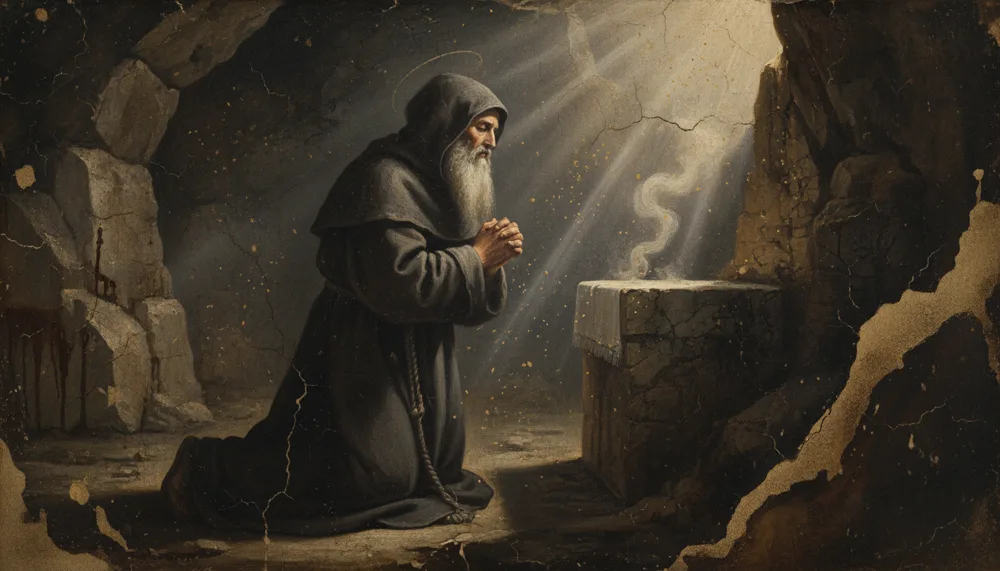
The novena to St Charbel is a nine-day prayer to St Charbel Makhlouf — the Lebanese Maronite monk and hermit whose tomb at Annaya has been the scene of countless reported healings — asking his intercession for some grace, most often the cure of body or soul. It is prayed on any nine consecutive days, and commonly in the nine days before his feast on 24 July (that is, 15–23 July). Below we give the authentic daily prayer, the day-by-day form of the devotion, the healing prayer people most often seek, and the true story of the hidden monk whose intercession draws so many.
A note on this devotion
St Charbel died in 1898, was beatified in 1965 and canonized by Pope Paul VI in 1977; his feast and this novena are modern, and you will not find them in the 1962 books or calendar. We give the devotion in full because it is widely sought, entirely orthodox, and rooted in the oldest thing in the Church — a monk's life of poverty, obedience, chastity and unceasing prayer.
Those attached to the traditional calendar may simply keep it as a private devotion, which it has always been, or bring the same intentions to intercessors the 1962 calendar does keep: the father of Western monks, in our novena to St Benedict (feast 21 March), and, for the sick, the novena to Our Lady of Lourdes (feast 11 February). For what a novena is and why nine days, see our guide to what is a novena.
The novena prayer to St Charbel
This is the authentic prayer at the heart of the devotion, carried by the Lebanese Maronite Order and repeated once on each of the nine days, with your own intention named in the middle:
God, infinitely Holy and glorified in Your saints, You inspired the holy monk and hermit St Charbel to live and to die in a perfect likeness to Jesus. You gave him the strength to detach himself from the world so that the heroism of the monastic virtues of poverty, obedience and chastity might triumph in his hermitage. Grant us, we beseech You, the grace to love and to serve You as he did.
(Here name the grace you ask for.)
Almighty God, who has manifested the power of St Charbel's intercession through his countless miracles and favours, grant us (name the request again) through his intercession. Amen.
St Charbel, pray for us.
Our Father… Hail Mary… Glory be to the Father…
That is the whole of the daily novena: the prayer above, your petition, and the three prayers that close it. Say it once a day for nine days, at a fixed hour if you can. It is short by design — St Charbel was a man of few words and long silences, and the devotion keeps his spirit.
The 9-day novena to St Charbel, day by day
Many prefer to pray the nine days as a progression, keeping the same daily prayer above but joining to it, each day, a distinct intention drawn from the saint's own life. This is the form most people mean by the 9 day novena to St Charbel, and it lets the devotion deepen through the week rather than simply repeat. Keep the daily prayer above throughout; add each day's intention when you name your own.
- Day 1 — for a deeper faith. St Charbel, who left home and family to seek God alone, obtain for me a faith as whole and undivided as yours, and the grace I now ask.
- Day 2 — for healing. St Charbel, through whose intercession the sick are still raised up at Annaya, ask of God the healing of body and soul that I beg for (name it), if it be for God's glory and my salvation.
- Day 3 — for humility. St Charbel, hidden monk who sought no honour and fled all notice, obtain for me a humble and hidden heart, and the favour I ask.
- Day 4 — for love of the Holy Eucharist. St Charbel, whose whole day turned upon the Mass and the Blessed Sacrament, kindle in me a burning love for Our Lord in the Eucharist, and grant my petition.
- Day 5 — for patience in suffering. St Charbel, who bore cold, poverty and long labour without complaint, obtain for me patience under my trials and the grace I seek.
- Day 6 — for the Church and for Lebanon. St Charbel, glory of the Maronite Church, pray for the whole Church, for your suffering homeland, and for the intention I bring today.
- Day 7 — for the spirit of prayer. St Charbel, hermit of ceaseless prayer, teach me to pray as you prayed, in silence and trust, and obtain the favour I ask.
- Day 8 — for purity and detachment. St Charbel, who lived poverty, obedience and chastity to the point of heroism, obtain for me a heart detached from the world and set on God, and grant my request.
- Day 9 — for final perseverance. St Charbel, who died with the name of Jesus on your lips on Christmas Eve, obtain for me the grace of a holy death, perseverance to the end, and the favour for which I have made this novena.
Some Maronite prayer-books add on each day an invocation to Our Lady of Lebanon, under whose patronage St Charbel lived and died, and close with three Hail Marys in her honour. It is a fitting addition and never out of place.
The novena to St Charbel for healing
Of every grace brought to St Charbel, healing is the most sought, and rightly so: the reports that made him known across the world — from the day of his burial, when a strange light was said to shine over his grave, to the cures examined for his beatification and canonization — are almost all cures of the sick. To pray the novena to St Charbel for healing is to use the same daily prayer above, naming plainly the illness, injury, or affliction you or another are carrying, and asking, through the hermit's intercession, the cure that God alone can give.
Ask with confidence, but ask as the Church always teaches us to ask for our bodies: if it be for God's glory and the good of the soul. No saint heals by his own power, and no novena binds God to a cure; St Charbel himself was not spared a hard and painful death. What the devotion obtains is never empty — health where health is best, and where it is not, the far greater healing of the soul and the strength to carry the cross. For other sure intercessors of the sick, see our novena to St Peregrine, patron of those with cancer, and the novena to Our Lady of Lourdes, the great shrine of healing.
The novena to St Charbel Makhlouf
You will see the saint written as St Charbel Makhlouf, Sharbel, or Charbel Maklouf — all the same hermit of Annaya, Makhlouf being his family name (he was born Youssef Antoun Makhlouf). The novena to St Charbel Makhlouf is simply this same devotion under his full name; the prayer, the nine days, and the intentions are one and the same, whether you name him Charbel, Sharbel, or Charbel Makhlouf.
The novena to St Charbel in Arabic, English and other languages
St Charbel was a son of Lebanon, and his devotion first spread in Arabic, the tongue of the Maronite Church whose liturgy also keeps the ancient Syriac. Many seek the novena to St Charbel in Arabic to pray it in the saint's own language, and it is widely prayed today in Arabic, English, Spanish, French and beyond — for a hermit who never left his mountain now has clients on every continent.
The prayer above is the standard English form, and you are free to copy or print it — many keep a printed card or PDF of the novena tucked in a missal — for the devotion is one and the same in any language, and the God who heard Charbel's silence hears every tongue. The Iter Fidei app carries the prayers in your own language with audio, so the novena can be prayed aloud or in the ear wherever you are.
How to pray the novena to St Charbel
A novena is nine consecutive days of prayer for one intention. To pray this one well:
- Choose your nine days. Any nine in a row will do. The natural time is 15–23 July, the nine days ending on his feast of 24 July; but a pressing need — a diagnosis, a surgery, a soul in danger — is reason enough to begin today.
- Name one intention and keep it through all nine days. Write it down. Bring it back to God each day.
- Pray at a fixed hour, if you can, and in a quiet place — St Charbel's whole life was silence and attention. Say the daily prayer, name your request, and close with the Our Father, Hail Mary and Glory Be.
- Join it to the Mass and the sacraments where you can. St Charbel's day turned on the Eucharist; a novena joined to Holy Communion, or at least to a decade of the Rosary, is stronger for it.
- Ask in submission: Thy will be done. Trust the outcome to God, whether He sends the cure you named or the better grace He has chosen.
Who is St Charbel Makhlouf?
He was born Youssef Antoun Makhlouf on 8 May 1828 in Bekaa Kafra, the highest village in Lebanon, the youngest of five children of a poor mountain family. His father, a mule-driver, died when he was three; the boy grew up herding the family cow and praying in a grotto, drawn from childhood to two hermit uncles who lived above the village. In 1851, against his mother's wishes, he left home to enter the Lebanese Maronite Order, and at the monastery of Saint Maron in Annaya he received the habit and a new name — Charbel, after a second-century martyr of Antioch. He made his final vows in 1853 and was ordained a priest in 1859.
For sixteen years he lived the common life of a monk, remarkable only for the completeness of his obedience, poverty and prayer. Then in 1875 he was granted the rare permission to withdraw to the Hermitage of Saints Peter and Paul above the monastery, and there he spent his last twenty-three years as a hermit — sleeping on a mat, eating once a day of what was left over, wearing a single rough habit, and passing the hours in the Mass, the Divine Office, and long silent adoration of the Blessed Sacrament.
He spoke little; men remembered his silence and his eyes. On 16 December 1898, while offering Mass, he was struck down at the very words of the consecration, and he died eight days later, on Christmas Eve, 24 December 1898, with the Holy Name on his lips.
What followed made him known to the world. A light was reported over his grave, and when his body was exhumed months later it was found incorrupt, and said to exude a blood-like fluid — a phenomenon witnessed and recorded again and again over the following decades. Cures were reported at his tomb in such number that Annaya became one of the great places of pilgrimage in the East. Pope Paul VI beatified him in 1965, at the close of the Second Vatican Council, and canonized him in 1977. His feast is kept on 24 July. He left not one written word of his own — only a life, hidden on a mountain, of poverty, obedience, chastity and prayer, which is the oldest sermon in the Church.
Because his whole strength was the monastic life, St Charbel is a fitting patron for anyone drawn to silence, hiddenness and prayer; those who love that ideal will find a kindred spirit in the West's father of monks in our novena to St Benedict. And because he is invoked above all when human medicine has done what it can, many bring him the cases the world has given up — the same trust that has long turned souls to the patron saint of hopeless cases and to the novena to St Jude.
Frequently Asked Questions
What is the novena to St Charbel for?
For any grace asked through his intercession, but above all for healing — of body and of soul. St Charbel is known throughout the world for the cures reported at his tomb, and the sick, and those who love them, are his most frequent clients. He is also invoked for a deeper spirit of prayer, for the grace of a holy death, for the Church and for Lebanon, and for any need where human means have failed and only Providence remains.
How do you pray the novena to St Charbel for healing?
Pray the daily prayer above once on each of nine consecutive days, naming plainly the illness or affliction you are bringing to God. Ask for the cure through St Charbel's intercession, and add the Church's own condition — if it be for God's glory and the good of the soul. Join it to Holy Communion or the Rosary where you can, and trust the outcome to God, who heals the body when it is best and always heals the soul that asks.
When do you pray the novena to St Charbel?
On any nine consecutive days a need arises. The usual time is the nine days before his feast — 15 to 23 July, ending on 24 July, the feast of St Charbel Makhlouf. There is no wrong day to begin; a diagnosis, a surgery, or a soul in danger is reason enough to start at once.
Is there a St Charbel novena for day 1 through day 9?
Yes. The simplest form keeps one daily prayer repeated on all nine days. The fuller form — given above — keeps that same prayer but adds a distinct intention each day, moving from faith (day 1) and healing (day 2) through humility, love of the Eucharist, patience, the Church, the spirit of prayer and purity, to final perseverance and a holy death (day 9). Both are true to the devotion; choose whichever helps you pray.
Is the novena to St Charbel approved by the Church?
St Charbel is a canonized saint of the Catholic Church — beatified by Pope Paul VI in 1965 and canonized by him in 1977 — and his novena is an orthodox private devotion, prayed by Maronite and Latin-rite Catholics alike. It is a modern devotion, kept mainly since the twentieth century, and is not part of the 1962 calendar; but its whole substance is the ancient monastic ideal of poverty, obedience, chastity and prayer, and there is nothing in it a Catholic need hesitate to pray.
Who is St Charbel the patron saint of?
By the pattern of the graces reported through him, St Charbel is invoked above all as an intercessor for the sick and for healing, and as a patron of hermits, monks, and all who seek a hidden life of prayer. He is the great saint of the Maronite Church and of Lebanon, whose people honour him as their own. He holds no ancient title of patronage in the Roman books — his renown is younger than that — but the countless who bring him their illnesses have made him, in fact, one of the most sought healers among the saints.
Can I pray the novena to St Charbel in Arabic?
Yes. The devotion arose in Arabic-speaking Lebanon and is prayed daily in Arabic, in the ancient Syriac of the Maronite liturgy, and now in English, Spanish, French and many tongues besides. The prayer is one and the same in every language; pray it in whichever tongue lets your heart speak most freely to God.
The Iter Fidei app carries the novena to St Charbel — the daily prayer and the nine days — with day-by-day reminders and audio, alongside the whole treasury of Catholic novenas, chaplets and litanies. Join early access here.
Sources. The novena prayer and daily petitions as carried in the prayer-books of the Lebanese Maronite Order; the acts of Pope Paul VI beatifying (1965) and canonizing (1977) St Charbel Makhlouf; the feast of St Charbel (24 July); Holy Scripture; and the traditional Catholic teaching on the invocation of the saints and on prayer for the sick (Catechism of St Pius X, On the Communion of Saints and the Invocation of the Saints).