
Novenas
Novena to St Matthias Apostle
The full novena to St Matthias the Apostle — the apostle chosen by lot to replace Judas — prayed nine days for uprightness of life, perseverance in faith, right choices, and for all who struggle with alcoholism, with the traditional feast on 24 February.
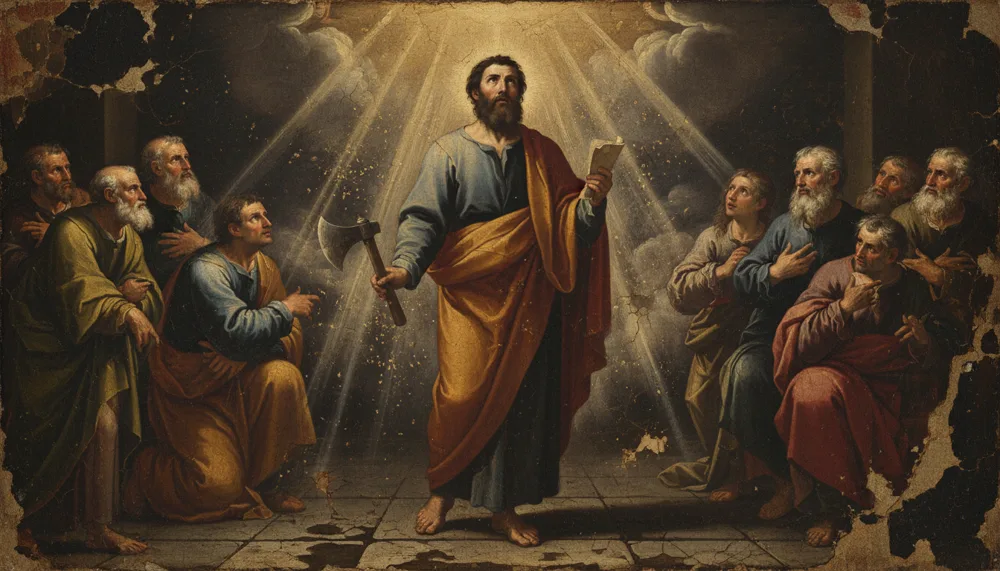
The novena to St Matthias the Apostle is a nine-day prayer to the apostle who was chosen by lot to take the place of Judas among the Twelve — asking his intercession for uprightness of life, for perseverance in the faith, for grace in the choices set before us, and, in a devotion of recent times, for all who struggle with the bondage of drink.
It is prayed above all in the nine days leading to his feast, kept in the traditional Roman calendar on 24 February (25 February in a leap year). Below we give the full novena, the prayer said on each of the nine days, the traditional Collect of his Mass, the story of the one apostle the Church chose after Our Lord had ascended, and answers to the questions most often asked. If you are new to this form of prayer, see first our guide to what is a novena.
The full novena to St Matthias
The heart of the devotion is a single prayer, said once on each of the nine days, with your own intention named where indicated. It is a modern composition in its wording, but wholly orthodox, and it gathers up the two things Scripture tells us the Church looked for in Matthias: the uprightness of his life and the call of the Holy Ghost.
Begin each day with the Sign of the Cross:
In the name of the Father, and of the Son, and of the Holy Ghost. Amen.
Then say the novena prayer:
O glorious St Matthias, in God's design it fell upon you to take the place of the unfortunate Judas, who betrayed his Master. You were chosen by the twofold sign of the uprightness of your life and the call of the Holy Ghost. Obtain for us the grace to practise that same uprightness of life, and to be called by that same Spirit to the wholehearted service of the Church and of the world. Help all who struggle under the addiction of drink to know this same grace, and to come to live in the serenity and joy of a life surrendered to God. Then, after a life of zeal and good works, may we be brought into your company in heaven, to sing for ever the praises of the Father, and of the Son, and of the Holy Ghost.
(Here name your intention.)
St Matthias, chosen apostle of the Lord, pray for us. Amen.
Conclude each day with one Our Father, one Hail Mary, and one Glory Be, and the invocation:
St Matthias, pray for us.
Many add the Collect from the Mass of his feast — a prayer that has come down in the Roman Missal itself and can be said with full confidence:
O God, who didst join blessed Matthias to the company of Thine apostles: grant, we beseech Thee, that by his intercession we may ever feel within us the workings of Thy tender mercy toward us. Through our Lord Jesus Christ, Thy Son, who liveth and reigneth with Thee in the unity of the Holy Ghost, God, world without end. Amen.
The nine days: a Scripture meditation for each
The one prayer above is enough to make a true novena. But because Matthias enters the Gospel through a single, vivid chapter — the election in the upper room, told in the first chapter of the Acts of the Apostles — the nine days lend themselves to a short daily meditation. Read the passage, pray the novena prayer, and dwell for a moment on the day's thought. This is what the best of the old devotions did: they wed the prayer to the Word.
- Day 1 — The upper room. After the Ascension, the eleven, with Our Lady and the women, "were persevering with one mind in prayer" (Acts 1:14). Ask for that same perseverance in your own praying. This waiting company is the setting of the very first novena; see our Pentecost novena.
- Day 2 — The word must be fulfilled. Peter rises and shows that Scripture foretold the fall of Judas and the filling of his place (Acts 1:16-20). Ask to trust that God's word is never spoken in vain.
- Day 3 — A witness of the Resurrection. The one chosen must have companied with the apostles "beginning from the baptism of John, until the day He was taken up" (Acts 1:21-22). Ask for the grace to be, in your own life, a witness to the risen Christ.
- Day 4 — Two men of good report. The Church proposed two: Joseph called Barsabas, and Matthias (Acts 1:23). Ask for the hidden, faithful, unnoticed goodness that made Matthias fit to be chosen.
- Day 5 — Thou, Lord, who knowest the hearts. The apostles pray, "Thou, Lord, who knowest the hearts of all men, show whether of these two Thou hast chosen" (Acts 1:24). Bring to God today a choice you cannot see through, and ask Him to show it.
- Day 6 — The lot fell upon Matthias. "They gave them lots, and the lot fell upon Matthias, and he was numbered with the eleven apostles" (Acts 1:26). Ask to accept the place God gives you, sought or unsought.
- Day 7 — He received the Holy Ghost. With the rest, Matthias received the Spirit at Pentecost and went out to preach. Ask for a fresh coming of the Holy Ghost upon your own soul.
- Day 8 — Mortify the flesh. St Clement of Alexandria records the saying handed down from Matthias: that we must subdue the body and its appetites, and follow the Spirit of the crucified Jesus. Ask for mastery over whatever appetite masters you — and pray here for all who are bound by drink.
- Day 9 — The crown of the martyr. Matthias carried the faith to far and savage lands and died a martyr. Ask for final perseverance, that you too may keep the faith to the end.
The novena to St Matthias for alcoholics and those in bondage
Of all the intentions brought to St Matthias, the one most bound up with his name today is the plea of those who struggle with drink. Popular devotion in recent times has made him a patron of alcoholics — a patronage that no traditional liturgical source gives — and links it to the saying of his preserved by Clement of Alexandria: that the body and its appetites must be wholly subdued and subjected to the Spirit of Christ crucified. Matthias was remembered by the early Church precisely for his insistence on mortifying the flesh — the mastery of self that every soul in bondage most needs.
The novena prayer above carries this petition in its own words; pray it for yourself, or for someone you love who cannot yet pray it for himself, naming him before God. The freedom asked for here is not merely sobriety but "the serenity and joy of a life surrendered to God" — the whole man made new. It is a fitting devotion to join to the aid of St Jude, the apostle of desperate straits, when a case seems past every human help.
The novena for a right choice, a vocation, or an election
Matthias came into the apostolate through a decision — the Church, having prayed, cast lots, and God made His will known. For this reason he is a sure patron in any matter of discernment and choice: a vocation to be weighed, an office to be filled, an election, a decision that no human prudence can settle. When the apostles could not see which of two good men God had chosen, they prayed, "Thou, Lord, who knowest the hearts of all men, show whether of these two Thou hast chosen." Make that prayer your own: bring St Matthias the choice before you, ask him to obtain light, and be willing — as he was — to receive whatever place God assigns.
The short novena to St Matthias
If time is short, the devotion reduces to its essentials without losing anything: the Sign of the Cross, the one novena prayer above with your intention named, and the Our Father, Hail Mary, and Glory Be — said once a day for nine days. The Scripture meditations are an enrichment, not a requirement; a busy soul who says only the prayer, faithfully, for nine days, has prayed the novena to St Matthias in full.
How to pray this novena
A novena is nine days of prayer for a single intention, in imitation of the nine days the apostles and Our Lady spent in prayer between the Ascension and Pentecost — the first novena, in which Matthias himself took part. Pray at a fixed time each day so the nine days are not broken. Name one clear intention and keep to it. Where you can, join the novena to Mass or Holy Communion, or at least to a decade of the Rosary. And ask in submission to God's will: the fruit of a true novena is not that God does our bidding, but that He gives what is best, and draws the soul closer in the asking.
The most fitting time is the nine days before his feast — from 15 to 23 February in the traditional calendar, so that the ninth day closes on the eve of the 24th. But it may be prayed at any time a need arises.
A note on the feast day. In the traditional Roman calendar and the 1962 Missal, St Matthias is kept on 24 February (transferred to the 25th in a leap year). In the calendar revised after the Council his feast was moved to 14 May, so that it might fall in Paschaltide near the account of his election; this is why many modern sites give the later date and begin the novena on 5 May. Both honour the same apostle. Those who follow the traditional books and calendar will keep the 24 February date, and we give it here as the primary one.
Who is St Matthias? The apostle chosen to replace Judas
St Matthias is the thirteenth man to be called an apostle and the only one chosen by the Church after Our Lord had ascended into heaven. Clement of Alexandria, Eusebius, and St Jerome all hand down the tradition that he was one of the seventy-two disciples whom Christ sent out two by two during His public ministry. From the Acts of the Apostles we know that he had followed the Saviour "beginning from the baptism of John" until the day of the Ascension — a witness of the whole of Our Lord's public life, and of His Resurrection.
When, in the days after the Ascension, St Peter declared that the traitor's place among the Twelve must be filled, two men were put forward as most worthy: Joseph called Barsabas, and Matthias. The apostles prayed that God would show His choice, and cast lots; and the lot fell upon Matthias, who was thereupon "numbered with the eleven apostles" (Acts 1:26). It was Peter, the first of the apostles, who led that election; you may read of him in our life of St Peter. Matthias received the Holy Ghost with the rest at Pentecost and threw himself into his mission with zeal, remembered above all for his teaching on the necessity of mortifying the flesh to subdue its appetites — a lesson learnt from Christ and faithfully lived.
The first part of his ministry was spent in Judaea; afterward, the Greek tradition holds, he carried the faith into Cappadocia and to the shores of the Caspian Sea. Among a savage people he endured great persecution and ill-treatment, and at last received the crown of martyrdom at Colchis. The manner of his death is not certainly known — the Greek sources say he was crucified. His relics were long kept at Jerusalem and are said to have been translated thence to Rome by St Helen; a great portion is venerated to this day at Trier, the only tomb of an apostle north of the Alps.
Because so little is written of him, Matthias is easy to overlook among the Twelve. But his place is a peculiar consolation: he is proof that the Church, gathered in prayer and led by Peter, is guided by the Holy Ghost in the choices she makes; and he is the standing reminder that the traitor's empty place can be filled, and a hidden, faithful disciple raised to the highest calling. He stands in the company of the other apostles whose novenas we keep — St John the Apostle and St Paul, whose name completes the Twelve in the Canon of the Mass — and with all of them in the Litany of the Saints.
What is St Matthias the patron saint of?
Popular devotion, especially in recent times, invokes St Matthias for alcoholics and all who fight against intemperance, on account of his teaching on mortifying the appetites of the flesh; no traditional liturgical source gives this patronage. He is honoured above all at Trier, where tradition holds that his relics rest. More widely he is a patron of perseverance and hope, of those in need of a right decision, and of any soul seeking to be a faithful, unnoticed servant of God.
Frequently Asked Questions
Who was St Matthias in the Bible?
St Matthias was the disciple chosen by the early Church to replace Judas Iscariot among the Twelve Apostles. His election is told in the first chapter of the Acts of the Apostles (Acts 1:15-26): after the Ascension, St Peter proposed that the traitor's place be filled by one who had accompanied the apostles from the baptism of John to the Ascension and could witness to the Resurrection. Two were put forward, and after prayer the lot fell upon Matthias. He is not mentioned again by name in Scripture, but tradition records that he preached in Judaea and beyond and died a martyr.
When is the feast of St Matthias?
In the traditional Roman calendar and the 1962 Missal, the feast of St Matthias is kept on 24 February (25 February in a leap year). In the calendar revised after the Second Vatican Council it was moved to 14 May. Both days honour the same apostle; those attached to the traditional books keep the February date, and the novena is prayed in the nine days before it.
Why is St Matthias the patron saint of alcoholics?
The connection lies in a saying handed down from Matthias himself and recorded by St Clement of Alexandria: that we must wholly subdue the body and its appetites, subjecting them to the Spirit of the crucified Jesus. Because he was remembered for this teaching on mortification and mastery of the flesh, popular devotion in recent times has come to invoke him for those in the grip of intemperance — and drink above all — though this is not a patronage given by the Church's liturgy. The novena is therefore prayed with special confidence for alcoholics and all who seek freedom from an appetite that masters them.
How was St Matthias chosen to be an apostle?
He was chosen by lot. The apostles first narrowed the candidates to two men of proven fidelity — Joseph called Barsabas and Matthias — then prayed, "Thou, Lord, who knowest the hearts of all men, show whether of these two Thou hast chosen" (Acts 1:24), and cast lots. The lot fell upon Matthias. The casting of lots here is not superstition but an appeal to God to make His will known, made in prayer and never repeated in the Church once the Holy Ghost was given at Pentecost.
How did St Matthias die?
The manner of his death is not known with certainty. The constant tradition of the Church honours him as a martyr, and the Greek sources say he was crucified after enduring great persecution among the peoples of Colchis, on the far shore of the Black Sea, where he had carried the faith. His relics were kept at Jerusalem and are said to have been brought to Rome by St Helen; a large portion is venerated at Trier to this day.
What is the difference between St Matthias and St Matthew?
They are two different apostles, easily confused because of their similar names. St Matthew was the tax-collector called by Our Lord during His public ministry, and the author of the first Gospel; his feast is 21 September. St Matthias was not called during Our Lord's earthly life but chosen afterward, by lot, to replace Judas among the Twelve; his feast is 24 February in the traditional calendar. Matthew wrote a Gospel; Matthias left no writings, only the saying on mortification preserved by Clement.
Can I pray this novena for someone else?
Yes. A novena may be offered for another soul as readily as for oneself, and the novena to St Matthias is very often prayed by one person for another who is bound by drink or by some other appetite and cannot yet pray for himself. Name that person before God each day where the prayer leaves room for your intention. To pray for another in this way is one of the surest works of charity.
The Iter Fidei app carries the novena to St Matthias, the Collect of his feast, and the prayers of the apostles in Latin and your own language, with audio and day-by-day reminders so the nine days are never broken. Join early access here.
Sources. Acts of the Apostles 1:15-26; the Roman Missal, feast of St Matthias, Apostle (24 February) — Introit (Ps 138:17), Collect Deus, qui beátum Matthíam, Lesson (Acts 1:15-26), and Gospel (Matthew 11:25-30); Butler's Lives of the Saints (St Matthias, Apostle); St Clement of Alexandria, on the tradition and saying of Matthias, as reported by Eusebius and St Jerome; the modern novena prayer to St Matthias as carried in the common prayer-books.