
Novenas
Novena to St Martha Of Bethany
The novena to St Martha of Bethany — the prayer 'St Martha, I resort to thy aid and protection,' the nine days, the Tuesday devotion, and how the friend of Our Lord who overcame the dragon intercedes in difficult and seemingly impossible needs.
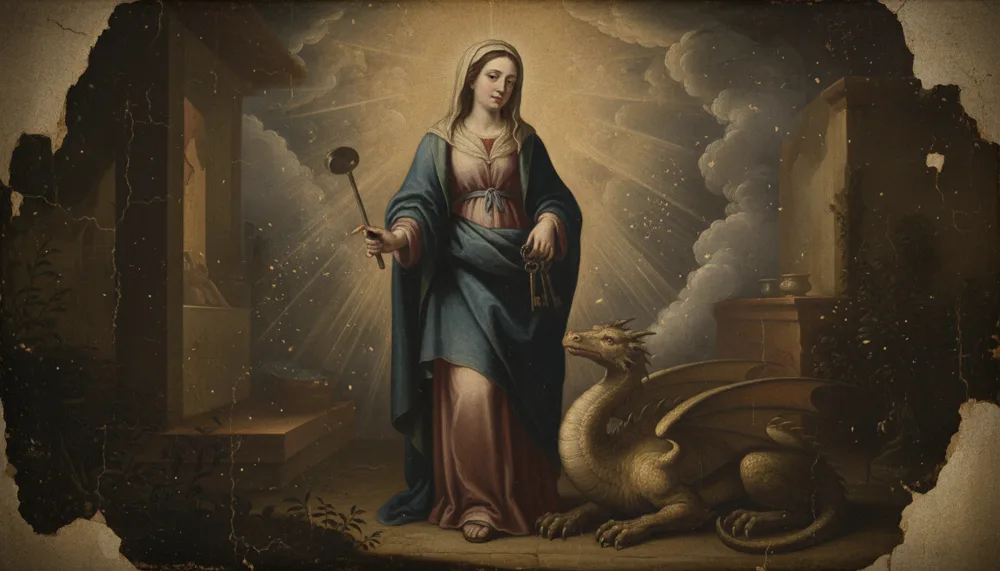
The novena to St Martha of Bethany is nine days of prayer to the woman who welcomed Our Lord into her home, the sister of Mary and Lazarus, asking her intercession for the needs of the household — for daily provision, for difficult and seemingly impossible situations, and for the grace to serve God faithfully in the duties of one's state.
St Martha is honoured on 29 July, and because she alone of the Gospel women is shown busy in active service, she has long been the patroness of those who keep house, cook, wait, travel, and carry the ordinary burdens of family life. Below we give the prayer in full, the nine days, the forms the devotion takes, and the true story of the saint from Butler's Lives of the Saints — with an honest word about the "powerful" version so many search for. Her feast in the 1962 calendar, its collect and her life are set out in our page on St Martha.
A note on the "powerful" novena to St Martha
Many come to this devotion by way of a "powerful" or "miracle" novena to St Martha — a prayer said over a lit candle every Tuesday, promising that she "never fails" to overcome any difficulty. The prayer itself, St Martha, I resort to thy aid and protection, is sound, and we give it in full below. But a caution belongs at the top of the page, because a folk practice has grown up around this saint — sometimes called "Santa Marta the Dominator" — that treats the candle, the day of the week, and the exact repetitions as a mechanism that compels a result, and that is invoked to bend another person's will, especially in matters of love.
That is not Catholic prayer. It is superstition, which the Church condemns as attributing to creatures a power that belongs to God alone, and it has no place in a true devotion. St Martha is a saint of God, not a spell. Pray this novena as you would any other — asking her intercession, naming your need plainly, and submitting the outcome to the will of God — and it is a good and fruitful devotion. Light a candle before her image if you wish, as a sign of faith; but the candle is a token of love, not a lever. If you are new to these devotions, see our guide to what is a novena.
The novena prayer to St Martha
This is the prayer at the heart of the devotion — a devotional composition of the prayer-books, with no liturgical text and no approval of its own that we can cite — said once on each of the nine days, with your intention named:
In the name of the Father, and of the Son, and of the Holy Ghost. Amen.
Saint Martha, I resort to thy aid and protection. As proof of my affection and faith, I offer thee this light, which I shall burn every Tuesday.
Comfort me in all my difficulties, and through the great favours thou didst enjoy when the Saviour was lodged in thy house, intercede for my family, that we be provided for in all our necessities.
I ask of thee, Saint Martha, to overcome all difficulties as thou didst overcome the dragon which thou hadst at thy feet.
(Here name your request.)
In the name of the Father, and of the Son, and of the Holy Ghost. Amen.
Saint Martha, pray for us.
Then say, each day:
Our Father who art in heaven, hallowed be Thy name; Thy kingdom come; Thy will be done on earth as it is in heaven. Give us this day our daily bread; and forgive us our trespasses, as we forgive those who trespass against us; and lead us not into temptation, but deliver us from evil. Amen.
Hail Mary, full of grace, the Lord is with thee; blessed art thou amongst women, and blessed is the fruit of thy womb, Jesus. Holy Mary, Mother of God, pray for us sinners, now and at the hour of our death. Amen.
Glory be to the Father, and to the Son, and to the Holy Ghost; as it was in the beginning, is now, and ever shall be, world without end. Amen.
The nine days
The prayer above is said whole on every one of the nine days; it does not change. But it is a fruitful practice to carry a distinct meditation into each day, drawn from what the Gospels tell us of Martha, so that the devotion forms the soul as it asks. The following cycle keeps to Scripture — Luke 10:38-42 and John 11 — and may be read before the prayer.
Day 1 — Hospitality
"A certain woman named Martha received Him into her house" (Luke 10:38). We ask the grace to welcome Our Lord into our home and our heart as Martha welcomed Him under her roof at Bethany.
Day 2 — Service
Martha "was busy about much serving" (Luke 10:40). We ask to serve God faithfully in the duties of our state, and to see the labour of the household as labour offered to Him.
Day 3 — The one thing necessary
"Martha, Martha, thou art careful and troubled about many things: but one thing is necessary" (Luke 10:41-42). We ask to be freed of anxious distraction, and to seek first the salvation of our soul.
Day 4 — Friendship with Christ
"Now Jesus loved Martha, and her sister Mary, and Lazarus" (John 11:5). We ask the grace of true friendship with Our Lord, who honoured this household with His love.
Day 5 — Prayer in affliction
When Lazarus fell sick, the sisters sent to Jesus: "Lord, behold, he whom Thou lovest is sick" (John 11:3). We bring Him our own sick, our troubles, and our fears, as Martha did.
Day 6 — Faith that runs to meet Him
"Martha, as soon as she heard that Jesus was come, went to meet Him" (John 11:20). We ask a living faith that goes out to Christ in every trial, and does not wait in despair.
Day 7 — Trust when His plans are hidden
"Lord, if Thou hadst been here, my brother had not died. But now also I know that whatsoever Thou wilt ask of God, God will give it Thee" (John 11:21-22). We ask to trust God even when His ways are dark to us.
Day 8 — The great confession
"I have believed that Thou art Christ the Son of the living God, who art come into this world" (John 11:27). We ask to profess our faith as Martha did, plainly and without wavering.
Day 9 — The victory of the Lord of life
At the tomb of Lazarus, "Jesus said: I am the resurrection and the life" (John 11:25), and raised him from the dead. We ask, through Martha's intercession, that Our Lord bring life out of what seems dead in our own affairs.
The novena to St Martha for a specific request
Because St Martha is invoked so often for one pressing need, the novena is naturally prayed for a specific or urgent request — a family provision, a debt, a household in trouble, a matter that must be settled. The prayer above already makes room for it: at the words (Here name your request), name your need plainly and concretely, and keep the same intention through all nine days. Ask with the confidence of a friend of the house — but ask, as Martha learned to, in submission to a wisdom greater than ours. The novena does not force God's hand; it commends a real need to a saint who knew the cares of a real household.
The novena to St Martha for impossible and difficult situations
The line overcome all difficulties as thou didst overcome the dragon which thou hadst at thy feet is why so many bring St Martha their impossible or seemingly hopeless situations. The dragon is the Tarasque — the beast that, in the old Provençal legend, terrorised the country by the Rhône until Martha subdued it with holy water and the sign of the Cross (see the story below). Its meaning is sound: the friend of Christ overcame a monster no one else could master, and so she is asked to help souls overcome the difficulties that overwhelm them. For desperate and impossible causes the Church also sends us to St Jude, the patron of hopeless cases; St Martha's help in trouble sits well beside his.
The novena to St Martha for provision, money and work
The prayer asks St Martha to intercede for my family, that we be provided for in all our necessities, and this is one of the most common intentions brought to her — provision, money, employment, the bread of the household. She fed Our Lord Himself at her table and understands the anxiety of keeping a house. Bring her the empty larder, the unpaid bill, the lost work, and ask her to obtain from her divine Guest what she once set before Him. For the same needs of work and home, the novena to St Joseph, patron of workers and of the household, is a natural companion devotion.
The novena to St Martha for the home and family
St Martha is above all a saint of the home. Where her sister Mary is the model of contemplation, Martha is the model of the active household — of the woman or man whose sanctity is worked out in cooking, cleaning, serving, and caring for the family under one roof. A novena for the peace of the home, the conversion of a family member, the healing of a household division, or simply the grace to serve one's own with love, is fittingly brought to her, and may be joined to the Holy Family novena, for the household of Bethany was the one nearest, in love, to the Holy Family of Nazareth.
The short prayer and the Tuesday devotion
Beyond the nine days, many keep a standing Tuesday devotion to St Martha — Tuesday being the day popularly associated with her — lighting a candle before her image and saying the short prayer St Martha, I resort to thy aid and protection as a weekly remembrance for as long as a need lasts. As with the novena, keep the devotion sound: the candle is an offering of faith, not a charm, and Tuesday is a custom, not a rule that binds God. Prayed so, it is a quiet way to keep a friend in heaven near the daily life of the home.
How to pray this novena
A novena is nine consecutive days of prayer. Choose a fixed hour and keep it each day; the steadiness is part of the offering. Many begin so that the ninth day falls on 29 July, St Martha's feast, praying from 21 to 29 July — but it may be prayed at any time of year, for any pressing need.
On each day, make the Sign of the Cross, read the day's meditation if you keep the cycle above, say the prayer St Martha, I resort to thy aid and protection with your intention named, and close with the Our Father, Hail Mary, and Glory Be. Add a candle before her image if you wish. Above all, name your request plainly and then surrender it: Thy will be done. The soul that asks in that spirit is never sent away empty.
Who is St Martha of Bethany?
St Martha was the sister of Mary and of Lazarus, and lived with them at Bethany, a small town about two miles from Jerusalem, a little beyond the Mount of Olives. In the third year of His public ministry, when Our Lord preached often in Judaea, He would lodge in the house of these three disciples, of whom St John says plainly, "Jesus loved Martha, and her sister Mary, and Lazarus."
Martha seems to have been the eldest, and had the chief care of the household. When Our Lord came, she was all solicitude to serve Him — busy about the meal, anxious that so great a Guest be well received — while her sister Mary sat at His feet, feeding her soul on His words. Such was Martha's love that she thought no service too great for Him, and she asked the Lord to bid Mary help her.
He answered with words the Church has treasured ever since: "Martha, Martha, thou art careful and troubled about many things: but one thing is necessary. Mary hath chosen the best part, which shall not be taken away from her." He did not scorn Martha's active love — He was well pleased with it — but He taught her, and us, that the repose of the soul in God is the higher thing, of which the service of the hands should be the fruit and not the rival.
It was Martha, too, who made one of the great confessions of the Gospel. When Lazarus had died and Our Lord came at last to Bethany, she went out to meet Him, saying, "Lord, if Thou hadst been here, my brother had not died." And when He said, "I am the resurrection and the life," she answered, "Yea, Lord, I have believed that Thou art Christ the Son of the living God, who art come into this world." Then He raised Lazarus from the tomb.
According to the old Provençal legend, after Pentecost Martha, with her sister and brother, came by sea to the south of Gaul and evangelised the region of Tarascon on the Rhône, where — the same tradition holds — she subdued a monstrous dragon, the Tarasque, that ravaged the country, mastering it with holy water and the sign of the Cross where armed men had failed.
Her alleged relics were found at Tarascon in 1187 and enshrined there, where they are still venerated. The Church keeps her feast on 29 July, and honours her as the patroness of housewives, cooks, servants, innkeepers and travellers — of all whose holiness is worked out in the labour of the home and the welcome of the stranger. (In the older tradition her sister Mary of Bethany is often identified with St Mary Magdalen, kept on 22 July.)
Frequently Asked Questions
Who was St Martha in the Bible?
St Martha was the sister of Mary and Lazarus of Bethany, and a friend of Our Lord, who often lodged at their house. The Gospels show her serving Him at table (Luke 10:38-42) and, at the death of her brother, professing her faith that Jesus is "Christ the Son of the living God" before He raised Lazarus (John 11). She is remembered as the model of active service and household devotion.
What is St Martha the patron saint of?
St Martha is the patroness of housewives, homemakers, cooks, servants and domestic workers, innkeepers, and travellers — those whose sanctity is lived out in serving and providing. Because she welcomed Our Lord into her home and fed Him at her table, she is invoked especially for the needs of the family, for provision, and for the peace of the household.
When is St Martha's feast day?
St Martha's feast is kept on 29 July. A novena is often prayed over the nine days leading up to it, from 21 to 29 July, though it may be prayed at any time for a pressing need.
Why is St Martha shown with a dragon?
In the old Provençal legend, St Martha, after coming to Gaul, subdued a fearsome dragon called the Tarasque that terrorised the country by the Rhône, taming it with holy water and the sign of the Cross. She is therefore often depicted with the dragon at her feet, and is invoked to help souls "overcome all difficulties as she overcame the dragon" — to master troubles that seem beyond human strength.
Is the "powerful novena to St Martha" Catholic?
The prayer St Martha, I resort to thy aid and protection is a sound Catholic devotion, and may be prayed with the Tuesday candle as a sign of faith. What is not Catholic is the folk practice, sometimes called "Santa Marta the Dominator," that treats the candle and repetitions as a spell or uses the prayer to bend another person's will — that is superstition, which the Church condemns. Pray it as intercession, name your need, and submit to God's will.
Can I pray the novena to St Martha for a specific or urgent request?
Yes. The prayer leaves room to name your request, and St Martha is invoked precisely for pressing needs — a family provision, a difficult situation, an urgent trouble. Name it plainly, keep the same intention through all nine days, and ask with confidence — while surrendering the outcome to God, who knows what is truly best.
Is there a printable or day-by-day version of the novena?
The full text above — the prayer St Martha, I resort to thy aid and protection, the Our Father, Hail Mary and Glory Be, with a distinct Scripture meditation for each of the nine days — is the complete devotion, and may be copied to keep beside you. The Iter Fidei app also carries it as a guided, day-by-day novena to pray from a phone.
The Iter Fidei app carries the novenas, chaplets, litanies and prayers — including the novena to St Martha — in Latin and your own language, with day-by-day reminders and audio. Join early access here.
Sources. Holy Scripture: the Gospel of St Luke 10:38-42 and the Gospel of St John, ch. 11-12 (the household of Bethany, the raising of Lazarus, Martha's confession of faith); Butler's Lives of the Saints, "St Martha, Virgin" (29 July), with the Provençal legend of Tarascon and the finding of her relics in 1187; the devotional novena prayer St Martha, I resort to thy aid and protection, as carried in Catholic prayer-books; the Our Father, Hail Mary, and Glory Be; on superstition, the Catechism of St Pius X on the First Commandment (superstition as attributing to creatures what belongs to God alone).