
Novenas
The Divine Infant King Novena
The Novena to the Divine Infant King — the prayer attributed to Father Cyril of the Mother of God, 'O Divine Infant Jesus, I have recourse to Thee,' prayed nine days for urgent needs and impossible cases, with the so-called miraculous prayer to the Infant Jesus of Prague.
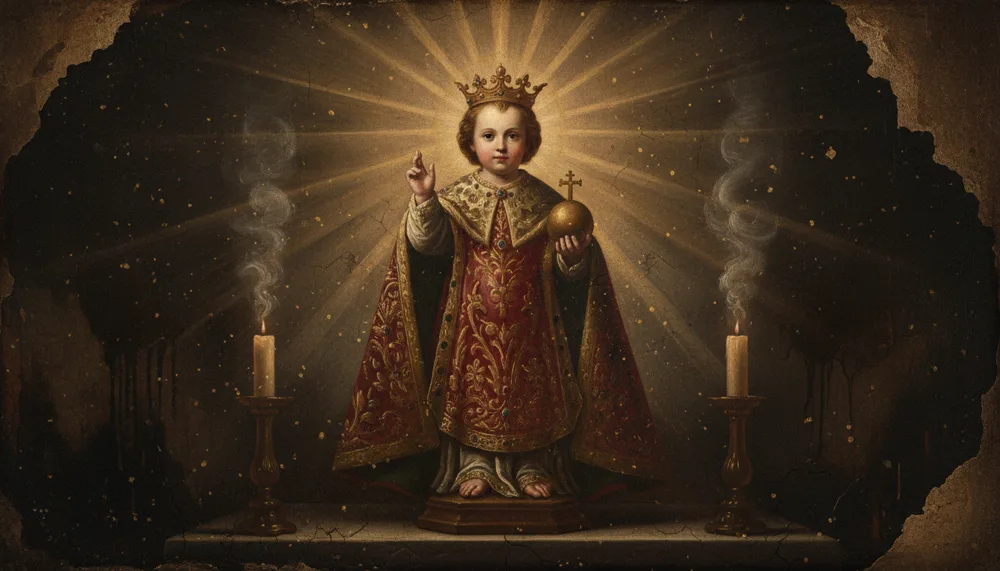
The Novena to the Divine Infant King is the nine-day devotion to the Christ Child as He is honoured under the ancient image of the Infant Jesus of Prague — Jesus in His childhood, robed and crowned as the King of kings. At its heart is the prayer attributed to the Carmelite Venerable Father Cyril, "O Divine Infant Jesus, I have recourse to Thee," said once on each of nine days to ask the Infant King for some grace, most often an urgent need or a cause the world calls impossible.
Commonly it is prayed on the nine days that end on the twenty-fifth of the month — from the 17th to the 25th — supremely in December, the nine days that lead up to Christmas Day itself. Below we give the full prayer, the older Christmas novena to the Divine Infant, the famous "miraculous" Infant Jesus prayers, and the story of the devotion.
Why we pray to the Divine Infant King
It can seem strange to crown a child. But the Church has always seen in the Infant of Bethlehem the whole majesty of God made small: "For a Child is born to us, and a Son is given to us, and the government is upon His shoulder" (Isaias 9:6). To honour Jesus as the Divine Infant King is to adore the almighty God in the very weakness He chose for our sake — the King who reigns from a manger before He reigns from a Cross.
The devotion teaches us to approach that King with the confidence a child shows its father, and to ask great things with a small and trusting heart. For the wider meaning of Christ's kingship, see our guide to the feast of Christ the King; and if you are new to this form of prayer, what is a novena explains the nine days and their purpose.
The Divine Infant does not grant every request in the terms we name it — no novena binds God, and to pray as though words could compel Him would be superstition, which the Church condemns. But of Him it was truly said, "Suffer the little children to come unto me" (Mark 10:14), and the poor, the desperate, and those out of every other help have for four centuries found the Infant King quick to hear them.
The Novena to the Divine Infant King (the prayer of Ven. Father Cyril)
This is the prayer at the heart of the devotion, attributed to Venerable Father Cyril of the Mother of God, the Carmelite to whom the miraculous statue of Prague was entrusted; the attribution is not proved by any document we can cite, and the prayer has no liturgical text and no approval of its own. It is said once on each of the nine days, with your intention named where indicated. Begin, as with any prayer, with the Sign of the Cross.
O Divine Infant Jesus, I have recourse to Thee. Please, through Thy Blessed Mother, assist me in this necessity (here name your request), because I firmly believe that Thy Divinity can help me.
I hope with confidence to obtain Thy holy grace. I love Thee with all my heart and with all the strength of my soul. I repent sincerely of my sins, and I beg Thee, O Good Jesus, to grant me the strength to triumph over them.
I resolve never more to offend Thee, and I come to offer myself to Thee with the intention of enduring everything rather than to displease Thee. Henceforth I desire to serve Thee with fidelity, and, for the love of Thee, O Divine Infant, I will love my neighbour as myself.
All-powerful Infant, O Jesus, I implore Thee again, assist me in this need (name it again). Grant me the grace of possessing Thee eternally with Mary and Joseph, and of adoring Thee with the angels in the heavenly court. Amen.
Many close each day by asking the Infant King for the virtues of His hidden childhood — His humility, His innocence, His meekness, His obedience — and by adding a favourite short prayer to Him, such as Divine Infant Jesus, King of love, have mercy on us. Many ask in particular for the virtues of that childhood — His humility, His innocence, His meekness, His joy, His obedience. The devotion is naturally joined to honour of the Holy Name of Jesus, for it is that Name, given to the newborn King, "at which every knee should bow" (Philippians 2:10).
The miraculous Infant Jesus of Prague prayer
Beside Father Cyril's novena stands the best-loved of all prayers to the Divine Infant — the so-called miraculous prayer, three petitions each built on a word of Our Lord Himself. It is often said as an urgent novena, once a day for nine days, or in pressing need over nine consecutive hours:
O Jesus, who hast said, "Ask and you shall receive, seek and you shall find, knock and it shall be opened to you," through the intercession of Mary, Thy most holy Mother, I knock, I seek, I ask that my prayer be granted. (Make your request.)
O Jesus, who hast said, "All that you ask of the Father in My Name, He will grant you," through the intercession of Mary, Thy most holy Mother, I humbly and urgently ask Thy Father in Thy Name that my prayer be granted. (Make your request.)
O Jesus, who hast said, "Heaven and earth shall pass away, but My word shall not pass away," through the intercession of Mary, Thy most holy Mother, I feel confident that my prayer will be granted. (Make your request.)
It is well to close with an act of thanksgiving and abandonment: Divine Infant Jesus, I know Thou lovest me and wouldst never leave me. I thank Thee for Thy close Presence in my life. Amen. This is the same devotion many know as the Infant of Prague novena; we give the fuller history and the classic Christmas form of it in our guide to the novena to the Divine Infant.
The Divine Infant novena for impossible cases and urgent needs
The Divine Infant King is invoked above all when human means are spent — in sudden emergencies, grave illness, money owed, work lost, a marriage in danger, a soul that will not return. The Divine Infant novena for impossible cases is not a separate text but the same prayer above, said with a plain and urgent intention and with the trust of a child.
The Carmelite account of Prague reports the Infant's promise: "The more you honour Me, the more I will bless you." When the need is truly pressing, the nine-hour novena — the miraculous prayer said once at the top of each hour for nine hours running — is the form many use for emergencies. Whatever form you choose, ask plainly, then add always: Thy will be done. The Infant King answers, but as a King and a God, giving what is best rather than only what is asked. For another sure recourse in desperate straits, the household of Nazareth stands together: the Novena to St Joseph, the Infant's own guardian, carries the same confidence.
The Christmas novena to the Divine Infant
An older form of this devotion is the Christmas novena to the Divine Infant, prayed on the nine days that close on the Nativity (17–25 December); prayer-books report that Pope Pius IX attached an indulgence to it, a reference we have not been able to verify. It meditates on the mystery of the Saviour's birth in five daily offerings:
First. Eternal Father, I offer to Thy honour and glory, and for my own salvation and that of the whole world, the mystery of the birth of our Divine Saviour.
Second. I offer Thee the poverty, the toils, and the anguish which Mary and Joseph endured on their journey to Bethlehem, and the affliction of their hearts when they found no shelter there.
Third. I offer Thee the sufferings of the Infant Jesus in the poor stable — His cold, His tears, and the tender cries with which He, the Word made flesh, began His work of our redemption.
Fourth. I offer Thee the pain He deigned to suffer at His circumcision, and that Precious Blood which then, for the first time, He shed for the salvation of the whole human race.
Fifth. I offer Thee the virtues of the Child Jesus — His humility, His mortification, His patience, His charity — and I give Thee thanks for the ineffable mystery of the Incarnation of the Word of God.
Each of the five is followed by a Glory be to the Father, and the whole is concluded with a versicle and collect of the Nativity. This is the form to keep in Advent; the daily prayer of Father Cyril above serves for any month of the year. Advent souls often join it to another nine-day preparation for Christmas, the beloved Novena to St Andrew (the Christmas novena).
How to pray the Divine Infant King novena
The devotion is famously a monthly one: the nine days that close on the twenty-fifth of each month — the 17th through the 25th — in memory of the twenty-fifth of December on which the King was born. The Institute of Christ the King Sovereign Priest, which has spread the devotion widely, keeps it so. To pray it well:
- Choose your nine days. For the monthly form, begin on the 17th of the month and finish on the 25th, the day of the King's birth — the way the Institute of Christ the King keeps it. For the great annual novena, begin on 17 December so that the ninth day falls on Christmas Day itself. You may also begin on any day for a pressing need.
- Pray once a day, at a fixed hour, saying Father Cyril's prayer with your intention named. For a grave emergency, the nine-hour form uses the miraculous prayer instead.
- Name one intention and keep to it through all nine days.
- Add, if you can, a decade of the Rosary, or attend Mass, and honour an image of the Infant King in your home.
- Ask as a child asks — with confidence, and in submission to the Father's will.
Who is the Divine Infant King? The story of the Infant Jesus of Prague
The Divine Infant King is Our Lord Jesus Christ Himself, honoured in His sacred childhood. The devotion is bound to a small wax-coated statue, about eighteen inches high, showing the Child Jesus vested as a king, His right hand raised in blessing, His left holding a globe surmounted by a cross — the whole world in the hand of a Child.
The image came from Spain to Bohemia, and in 1628 the noble lady Polyxena of Lobkowicz gave it to the Discalced Carmelites of Our Lady of Victory in Prague, saying: "I give you what I prize most highly in the world. As long as you venerate this image, you will not want." Among the friars was the novice Venerable Cyril of the Mother of God, who was devoted to it. In the miseries of the Thirty Years' War the friars were scattered, the statue was thrown aside and forgotten, and in the disorder its hands were broken off; for seven years it lay hidden in the rubble behind the altar.
When Father Cyril found it again in 1637 and set it up to pray before it, he heard, according to the Carmelite account (a private revelation), the Child say to him: "Have pity on Me, and I will have pity on you. Give Me My hands, and I will give you peace. The more you honour Me, the more I will bless you." The hands were restored, and from that hour the graces began — healings, deliverances, and answered prayers without number — until the little King of Prague became one of the most loved images in all the Church. The devotion spread from that shrine across Bohemia, into the Spanish and Portuguese worlds, and at last to every land.
There is no separate feast of the "Divine Infant King" on the traditional calendar; the devotion belongs to the great Christmas mysteries and to the Holy Name of Jesus. Its patronage, as the centuries have shown, is universal: children and childless couples, the sick, the poor, families in need, and all who face what seems impossible and must learn again to trust like a child.
Frequently Asked Questions
What is the Divine Infant King novena?
It is a nine-day devotion to Jesus Christ honoured in His sacred childhood as the King of kings, under the image of the Infant Jesus of Prague. Its central prayer, "O Divine Infant Jesus, I have recourse to Thee," is attributed to the Carmelite Venerable Father Cyril of the Mother of God and is said once daily for nine days with one intention.
When do you pray the Divine Infant King novena?
Commonly on the nine days that close on the twenty-fifth of any month — beginning on the 17th and ending on the 25th — in memory of the 25th of December, the day of Christ's birth. The greatest of these is the annual Christmas novena, from 17 December to Christmas Day. In urgent need it may be begun on any day.
Is the Divine Infant King the same as the Infant of Prague?
Yes. "The Divine Infant King" and "the Infant Jesus of Prague" name the same devotion — Our Lord adored in His childhood, robed and crowned as King, under the famous statue kept by the Carmelites in Prague since 1628. The titles differ; the King is one and the same.
What is the miraculous prayer to the Infant Jesus?
It is the three-part prayer built on Our Lord's own words — "Ask and you shall receive," "All that you ask of the Father in My Name," and "Heaven and earth shall pass away, but My word shall not pass away" — each followed by a petition made through the intercession of His Mother. It is said as a nine-day, or in pressing need a nine-hour, novena, and is the best-loved prayer of this devotion.
Can I pray the Divine Infant novena for impossible cases?
Yes; that is one of its chief uses. The desperate and those out of every other help have long brought the Infant King their impossible causes, trusting His promise, "The more you honour Me, the more I will bless you." Ask plainly, keep the nine days, and submit the outcome to God's will — the King gives what is truly best, which is not always the thing we named.
What is the nine-hour novena to the Divine Infant?
For grave emergencies, many pray the miraculous prayer once at the beginning of each of nine consecutive hours in a single day, rather than over nine days. It is a form of urgent, concentrated pleading for a pressing need, and is prayed with the same confidence and the same resignation to the will of God.
What is the Divine Infant King the patron of?
The devotion has no formal patronage in the calendar, but by long experience the Infant King is invoked for children and for couples longing for children, for the sick and the poor, for families in material need, for peace in trouble, and for causes the world calls hopeless — always with a child's trust in the God who became a Child.
The Iter Fidei app carries this novena — the prayer of the Divine Infant King and the miraculous Infant Jesus prayers — with day-by-day reminders and audio, in Latin and your own language, so you can keep all nine days without a printed sheet. Join early access here.
Sources. Holy Scripture (Isaias 9:6; Mark 10:14; Matthew 7:7; John 16:23; Matthew 24:35; Philippians 2:10); the Novena prayer to the Divine Infant King attributed to Venerable Cyril of the Mother of God, O.C.D.; the "miraculous" prayer to the Infant Jesus of Prague; the Christmas novena to the Divine Infant (indulgence of Pius IX as reported by prayer-books); the history of the Infant Jesus of Prague and the words of the Child to Father Cyril (1637), as preserved in Carmelite accounts and prayer-books.