
Novenas
The Infant Of Prague Novena
The Infant Jesus of Prague novena — the powerful nine-hour (or nine-day) prayer for urgent need, with the full 'O Jesus, who hast said' text, the chaplet, and how to pray it.
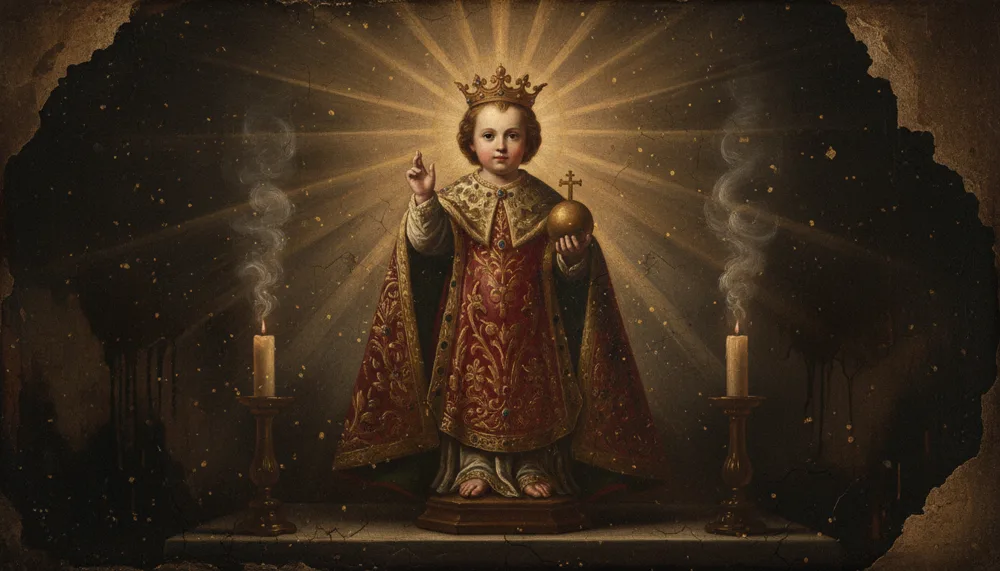
The Infant of Prague novena is a much-loved prayer said to the Child Jesus under the title of His miraculous statue in Prague, most often for a pressing, urgent need — the kind that will not wait. It has two forms: the famous nine-hour novena, prayed once every hour for nine hours all in a single day (which is why it is also called the storm or flying novena), and the ordinary nine-day form.
Its heart is three short petitions built on the very words of Our Lord — "Ask and you shall receive" — and it is prayed in every kind of distress: for money and debt, for a sick child, before an operation or an exam, in danger, in any necessity where every human means is spent. Below we give the full authentic text, the chaplet, the story of the statue, and how to pray it well.
The Infant of Prague novena prayer
This is the heart of the devotion. It is composed of three petitions, each drawn from a promise Christ Himself made in the Gospel, each asked through the intercession of His Mother. After each petition you name your need in your own words.
O Jesus, who hast said, "Ask and you shall receive, seek and you shall find, knock and it shall be opened to you," through the intercession of Mary, Thy most holy Mother, I knock, I seek, I ask that my prayer be granted. (Here name your request.)
O Jesus, who hast said, "All that you ask of the Father in My Name, He will grant you," through the intercession of Mary, Thy most holy Mother, I humbly and urgently ask Thy Father in Thy Name that my prayer be granted. (Name it again.)
O Jesus, who hast said, "Heaven and earth shall pass away, but My word shall not pass," through the intercession of Mary, Thy most holy Mother, I feel confident that my prayer will be granted. (Name it a third time.)
Then close with the invocation:
Infant Jesus of Prague, have mercy on us.
That is the whole of the novena prayer. It is a devotional prayer found in prayer-books, with no liturgical text and no approval of its own that we can cite. Whether you pray it hour by hour through one day or once a day for nine days, this is what you say. It is short by design: this is a devotion for the hour of need, meant to be prayed with confidence rather than at length. If you are new to this kind of prayer, see our guide to what is a novena — nine days (or here, nine hours) of persevering prayer, in imitation of the Apostles who waited nine days with Our Lady between the Ascension and Pentecost.
The nine-hour novena (the "storm" or "flying" novena)
The form most people mean by the Infant of Prague novena is the nine-hour one. You pray the three petitions above once every hour, on the hour, for nine consecutive hours, all on the same day — for example beginning at eight in the morning and ending at four in the afternoon. Because the prayers rise up so quickly and so insistently, it is popularly called the storm novena or the flying novena: your petitions "storm" or "fly" to heaven for an urgent cause.
This is the classic recourse for an emergency — a novena to the Infant Jesus of Prague in urgent need: news that cannot wait a week, a crisis of health or money, a soul in danger. You need not stop your work; the prayer is short enough to say at your desk, in the car, wherever the hour finds you. If nine set hours are impossible, the same devotion is prayed once each day for nine days with equal confidence. The nine-hour form is the one most associated with urgent need, but the nine-day form is in no way lesser. For another sure friend when a cause seems hopeless, many join this to the novena to St Jude, patron of desperate cases, or to a swift novena to St Expeditus, invoked for causes that admit no delay.
The nine-day novena to the Infant of Prague
Prayed over nine days, the novena is the same three petitions said once each day, at a fixed hour, with your intention named throughout. Many keep alongside the three petitions the older prayer to the Infant of Prague that bears the name of Father Cyril of the Mother of God, which draws together confidence, contrition, and love:
O Infant Jesus, I have recourse to Thee. I beseech Thee, by Thy holy Mother, assist me in this necessity, for I firmly believe that Thy Godhead can succour me. (Here name your need.)
I hope with confidence to obtain Thy holy grace. I love Thee with all my heart and with all the strength of my soul. I sincerely repent of my sins, and I beseech Thee, O good Jesus, to give me the strength to overcome them. I purpose never more to offend Thee, and I come to offer myself to Thee, resolved to suffer all things rather than displease Thee. Henceforth I desire to serve Thee faithfully; for love of Thee, O divine Child, I will love my neighbour as myself. O Jesus, Child all-powerful, again I entreat Thee, assist me in this need; grant me the grace of possessing Thee eternally with Mary and Joseph, and of adoring Thee with the holy angels of the heavenly court. Amen.
The Infant Jesus is said to have promised the Carmelites of Prague, "The more you honour Me, the more I will bless you." That promise is the ground of the whole devotion.
The novena for financial help and freedom from debt
The Infant of Prague is asked for every need, but popular devotion brings Him money troubles above most: unpaid debt, the loss of work, a household that cannot make ends meet, the fear of want. There is a homely custom of keeping a statue of the Infant in the home — often with a coin placed beneath it — as a sign of confidence that the Child who holds the whole world in His hand will provide for those who trust Him. Pray the three petitions above and name your need plainly: the debt you must pay, the work you need, the provision your family lacks.
A word of care belongs here. The coin under the statue is meant as a token of trust, not a charm that compels a result; to treat any statue or custom as a mechanism that forces God's hand is superstition, which the Church condemns. Honour the Infant, bring Him your need, and leave the outcome to His fatherly wisdom. So prayed, the novena for financial help is a true devotion and not a talisman.
The Chaplet of the Infant Jesus of Prague
Besides the novena there is the Chaplet of the Infant Jesus of Prague, sometimes called the Little Crown, which comes from a private revelation reported by Venerable Sister Margaret of the Blessed Sacrament, a Carmelite of Beaune who died in 1648. It is made of fifteen beads: three in honour of the Holy Family — Jesus, Mary, and Joseph — and twelve in honour of the twelve years of the Holy Childhood.
On the medal, one begins:
Divine Infant Jesus, I adore Thy Cross, and I accept all the crosses Thou wilt be pleased to send me. Adorable Trinity, I offer Thee, for the glory of the Holy Name of God, all the adorations of the Sacred Heart of the Holy Infant Jesus.
On the three beads (the Holy Family), before each, say "And the Word was made flesh," then pray the Our Father.
On the twelve beads (the years of the Holy Childhood), before each, say "And the Word was made flesh, and dwelt amongst us," then pray the Hail Mary.
At the close, a Glory be to the Father, and:
Holy Infant Jesus, bless and protect us.
The chaplet may be prayed on its own or joined to the novena as a longer meditation on the mystery it honours — that the eternal Word became a little child. It sits naturally beside the wider devotion to the Divine Infant King and the novena to the Divine Infant.
How to pray the Infant of Prague novena
The devotion is simple, and its power lies in trust rather than in exactness. In brief:
- Choose your form. Either the nine-hour novena — the three petitions once every hour for nine hours on a single day — or the nine-day novena, once each day for nine days. The nine-hour form is the swiftest, for the most urgent needs; the nine-day form is equally trusted.
- Name your intention. After each of the three petitions, state your need in your own words. Ask plainly and specifically.
- Pray with confidence, and submit. The whole spirit of this novena is childlike trust in the Child. Ask boldly — "I feel confident that my prayer will be granted" — but always within Thy will be done, ready to receive either the favour you named or the better thing God chooses to send.
- Give thanks. Devotees ask that when the prayer is answered you thank the Infant and make the devotion known to others, so that more souls may come to Him.
When does the Infant of Prague novena start? It has no fixed date on the calendar: it is prayed whenever an urgent need arises. Where a set day is kept, many begin the nine days so as to end on a feast of the Holy Childhood — the statue in Prague is venerated especially at Christmas and on the anniversary of its solemn crowning of 1655, commemorated on the first Sunday of May — but you need wait for no feast. The Child Jesus is ready to be asked at any hour.
The story of the Infant of Prague
Devotion to the image reaches back to the seventeenth century. The image itself is a small wax-coated statue, about nineteen inches high, of the Child Jesus vested as a king: in one hand He holds a globe surmounted by a cross, in sign of His dominion over the whole world, and His right hand is raised in blessing. It came from Spain into Bohemia through a noble marriage, and, according to a pious tradition we cannot verify, once belonged to St Teresa of Ávila herself — a fitting link, for the statue would find its home among her Carmelites; those drawn to the great foundress may read the life of St Teresa of Avila.
In 1628 the widowed Princess Polyxena of Lobkowicz gave the statue to the Discalced Carmelite friars at the Church of Our Lady Victorious in Prague, with the words: "I give you what I prize most highly in the world. As long as you venerate this image you will not be in want." The friars, and especially Father Cyril of the Mother of God, honoured the Child before it, and graces followed.
Then came trial. In 1631, during the Thirty Years' War, the Saxon and later Swedish armies overran Prague; the friars fled, the monastery was plundered, and the statue was thrown behind an altar amid the rubble, its hands broken off. For years it lay forgotten.
In 1637 Father Cyril found it again, and as he prayed he heard the Child say to him: "Have pity on Me, and I will have pity on you. Give Me My hands, and I will give you peace. The more you honour Me, the more I will bless you." The hands were restored, the devotion revived, and miracle upon miracle was reported — the city and the monastery spared in plague and siege where trust in the little King was kept. In 1655 the statue was solemnly crowned. From Prague the devotion spread across the whole Catholic world, and the Infant of Prague is today one of the most widely honoured images of Our Lord's childhood, kept in countless homes and churches.
Its whole message is the Gospel of the Holy Childhood: that Almighty God made Himself a little child, poor and dependent, so that we might come to Him with a child's boldness and a child's trust. It is the same spirit St Thérèse would later call her "little way," and those who love it will find kinship in the novena to St Thérèse of Lisieux and in the tender devotion to the Holy Face she also cherished. To honour the Infant of Prague is to trust the King who reigns from a manger.
Frequently Asked Questions
What is the Infant of Prague novena?
It is a novena prayed to the Child Jesus under the title of His miraculous statue at the Carmelite church in Prague. Its heart is three short petitions taken from Christ's own promises in the Gospel — "Ask and you shall receive," "All that you ask of the Father in My Name," "Heaven and earth shall pass away but My word shall not pass" — each asked through the intercession of the Blessed Virgin Mary, with your own intention named after each. It is prayed above all for urgent needs.
How do you pray the Infant of Prague novena?
Pray the three petitions above, naming your request after each, and close with the invocation Infant Jesus of Prague, have mercy on us. You may pray it in either of two ways: the nine-hour form — once every hour, on the hour, for nine hours in a single day — or the nine-day form, once each day for nine days. Pray at a fixed time, ask plainly, and end with Thy will be done.
What is the nine-hour (storm or flying) novena?
It is the swiftest form of the devotion: you say the novena prayer once every hour for nine consecutive hours, all on the same day. It is called the storm or flying novena because the petitions rise so swiftly and insistently to heaven. It is the classic recourse for an emergency that cannot wait nine days; if the nine set hours are impossible, the same prayer is said once daily for nine days.
Is the Infant of Prague novena for urgent needs?
Yes — it is one of the Church's favourite prayers for pressing, immediate necessity: a crisis of health, money, or safety; a soul in danger; any need where every human means has run out. That is exactly why the nine-hour form exists, so the whole novena can be completed in a single day of trust.
Can I pray the Infant of Prague novena for financial help?
Yes. Debt, the loss of work, and the fear of want are among the needs most often brought to the Infant of Prague, who holds the whole world in His hand. Name your need plainly in the petitions. The custom of keeping His statue in the home, sometimes with a coin beneath it, is a sign of trust that He will provide.
Who is the Infant of Prague?
The Infant of Prague is Our Lord Jesus Christ Himself, honoured as a child and king under the title of a small seventeenth-century statue kept by the Discalced Carmelites at the Church of Our Lady Victorious in Prague. Given to the friars by Princess Polyxena of Lobkowicz in 1628 and venerated especially through the labours of Father Cyril of the Mother of God, the image — the Child vested as a king, holding a cross-topped globe and raising His hand in blessing — became famous for miracles and is honoured across the Catholic world.
When does the Infant of Prague novena start?
There is no fixed date: it is prayed whenever an urgent need arises. The nine-hour form is completed in one day; the nine-day form may be begun on any day. Where a set feast is kept, many time the nine days to end at Christmas or on the anniversary of the statue's crowning in May, but you need not wait — the Child Jesus may be asked at any hour.
Pray this novena with day-by-day (or hour-by-hour) reminders and audio, in Latin and your own language, in the Iter Fidei app. Join early access here.
Sources. Holy Scripture (Matthew 7:7; John 16:23; Matthew 24:35); the devotional novena to the Infant Jesus of Prague and its nine-hour ("storm") form, as carried in prayer-books; the Chaplet (Little Crown) of the Infant Jesus of Prague, from the revelation to Venerable Margaret of the Blessed Sacrament (d. 1648); the prayer and the words of the Infant to Father Cyril of the Mother of God, O.C.D., and the history of the statue given to the Discalced Carmelites of Prague by Princess Polyxena of Lobkowicz (1628) and crowned (1655), as carried in Carmelite accounts and prayer-books; on superstition, the Catechism of St Pius X on the First Commandment.