
Novenas
Novena to St Anthony
The novena to St Anthony of Padua — the miracle prayer 'O wonderful St Anthony,' the Responsory 'If then you ask for miracles,' and the Thirteen Tuesdays — prayed for lost things, employment, a spouse, and every seemingly impossible need.
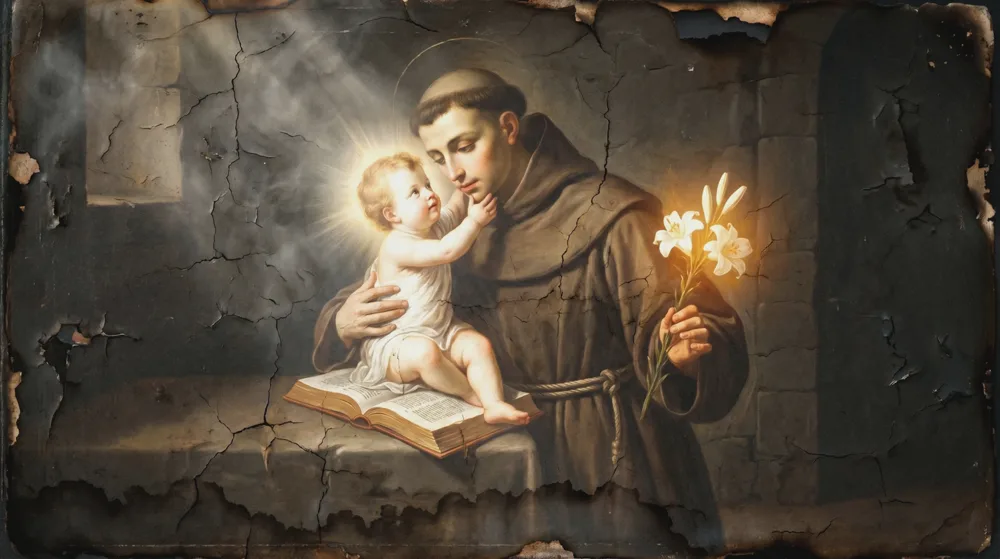
The novena to St Anthony of Padua is nine days of prayer to the great Franciscan wonder-worker — most often said for a lost or stolen thing, for work and daily bread, for a good spouse, or for any need the world has already given up as hopeless. It leans on the countless favours recorded at his tomb, which is why Padua calls him simply il Santo, "the Saint," and the Wonder-worker. His feast falls on 13 June, and the nine days before it — 4 to 12 June — are the classic time to pray this novena, though it may be prayed at any time of year, and is prayed especially on Tuesdays. Below we give the full prayers, the daily texts, the famous Responsory, and the variants the faithful use.
The full novena to St Anthony
The heart of the devotion is one prayer, said once on each of the nine days with your intention named plainly, followed by an Our Father, three Hail Marys and a Glory Be in his honour, and by the Responsory of St Anthony. This is the daily prayer of the nine-day novena as our app gives it. The daily prayer is a devotional composition, with no liturgical text and no approval of its own; the Responsory, its versicle and the collect of his feast are the texts of the Church's Office and Missal.
The daily novena prayer
O glorious St Anthony, whose heart overflowed with compassion for all the afflicted, cast upon me a look of kindness. Thou whom God hath made so mighty to succour in the most pressing necessities, I know that thou art never invoked in vain: wherefore, in all confidence, I beg thee to pray for me and to obtain of the Lord the grace I ask in this novena. (Here name your request, the same throughout the nine days.)
Obtain it for me, if it be conformable to the most holy will of God and to the salvation of my soul; and obtain for me above all to find again and to keep that most precious good, the grace of God, which sin maketh the soul to lose. St Anthony of Padua, pray for us. Amen.
Then say, in honour of St Anthony:
Our Father… Hail Mary (three times)… Glory be to the Father…
This is said on all nine days. Many keep the same intention throughout, as the tradition of the novena asks — the word itself, from the Latin novem, "nine," means nine days of steady, unbroken asking. If you would like the whole meaning of the practice, see our guide to what is a novena.
The Miraculous Responsory: "If then you ask for miracles"
To the daily prayer is joined the Responsory of St Anthony, the Si quaeris miracula, composed about 1233, scarcely two years after his death, by his brother Franciscan Julian of Speyer, and long attributed to St Bonaventure. It is the most famous of all the prayers to the Saint, sung at Padua ever since and, every Tuesday, in churches without number. English prayer books often print it in a rhymed paraphrase beginning "If then you ask for miracles"; here is the Latin with a close English rendering:
Si quaeris miracula,
mors, error, calamitas,
daemon, lepra fugiunt,
aegri surgunt sani.Cedunt mare, vincula,
membra resque perditas
petunt et accipiunt
iuvenes et cani.Pereunt pericula,
cessat et necessitas:
narrent hi qui sentiunt,
dicant Paduani.Gloria Patri, et Filio, et Spiritui Sancto.
Cedunt mare, vincula,
membra resque perditas
petunt et accipiunt
iuvenes et cani.℣. Ora pro nobis, beate Antoni.
℟. Ut digni efficiamur promissionibus Christi.
If then thou seekest miracles: death, error, all calamities, the demon and the leprosy flee away, and the sick arise made whole.
The sea gives way, the fetters break; the lost of limb and the lost of goods ask and receive again, both young and old.
Perils perish, want departs: let them tell it who have felt it, let the men of Padua say it.
Glory be to the Father, and to the Son, and to the Holy Ghost.
The sea gives way, the fetters break; the lost of limb and the lost of goods ask and receive again, both young and old.
℣. Pray for us, O blessed Anthony.
℟. That we may be made worthy of the promises of Christ.Let us pray. O God, may the votive solemnity of blessed Anthony, Thy confessor and doctor, gladden Thy Church; that she may ever be defended by spiritual succours, and merit to enjoy everlasting joys. Through Our Lord Jesus Christ, Thy Son, who liveth and reigneth with Thee, in the unity of the Holy Ghost, world without end. Amen.
The prayer Let us pray is the collect of his feast in the Roman Missal: Ecclesiam tuam, Deus, beati Antonii Confessoris tui atque Doctoris solemnitas votiva laetificet: ut spiritualibus semper muniatur auxiliis, et gaudiis perfrui mereatur aeternis.
O wonderful St Anthony
Many prayer books add, or use in place of the daily prayer, this older petition, short enough to be said several times a day:
O wonderful St Anthony, glorious on account of the fame of thy miracles, and through the condescension of Jesus in coming in the form of a little child to rest in thy arms, obtain for me of His bounty the grace which I ardently desire from the depths of my heart. (Here name your request.)
Thou who wast so compassionate toward miserable sinners, regard not the unworthiness of those who pray to thee, but the glory of God, that it may once again be magnified by the granting of the particular request which I now ask for with persevering earnestness. Amen.
The miracle prayer to St Anthony
Where the novena is said for a single grave need — a miracle, a thing that will not be found by any human means — many use the beloved older petition known simply as the miracle prayer, said with the nine days:
O Holy St Anthony, gentlest of saints, thy love for God and charity for His creatures made thee worthy, when on earth, to possess miraculous powers. Miracles waited on thy word, which thou wast ever ready to speak for those in trouble or anxiety. Encouraged by this thought, I implore of thee to obtain for me (name your request).
The answer to my prayer may require a miracle; even so, thou art the Saint of miracles. O gentle and loving St Anthony, whose heart was ever full of human sympathy, whisper my petition into the ears of the sweet Infant Jesus, who loved to be folded in thy arms, and the gratitude of my heart will ever be thine. Amen.
The novena to St Anthony for lost things
More than any other need, people bring St Anthony their lost and stolen things — keys, rings, papers, money, and things far dearer than these. The custom is old and has a reason: while he was using a valuable psalter at his studies, a novice ran off with it, and at the Saint's prayer the young man was driven back by a vision to return it. From that day St Anthony has been the finder of what is lost. The little rhyme every Catholic child learns —
Tony, Tony, look around,
something's lost and must be found —
is only a homely echo of a serious devotion. To pray the novena for lost things, use the daily prayer above, name plainly the thing that is gone, and add the verse of the Responsory: "the lost of limb and the lost of goods ask and receive again, both young and old." Ask, then look with a quiet heart; St Anthony is not a charm but a father in heaven who delights to restore what his children have lost — and who, above all, restores to God the souls that are lost, which is the finding he cares for most.
The novena to St Anthony for employment, money, and daily bread
St Anthony is the patron of the poor, and alms given to obtain his help are still called St Anthony's Bread. He denounced usury from the pulpit and won from the state of Padua a law to free debtors who gave up their goods to pay what they owed; the poor and the burdened were his particular care.
So the novena for employment, for money owed, for a household that cannot make ends meet, is entirely in keeping with who he is. Name the work you need or the debt that presses, and ask him — as the poor of Padua asked him — to provide. Those praying for steady work may wish to join to St Anthony the great patron of workers and providers, St Joseph, who fed the Holy Family by the labour of his hands.
The novena to St Anthony for love, a husband, or a spouse
An old and tender custom brings St Anthony the search for a good spouse. In Portugal, Italy, and Spain he is the marriage-maker and the patron of the young who hope to wed, and brides still ask his help; there is a whole folklore of maidens petitioning "St Anthony, St Anthony, please come around" for a husband. To pray the novena for love or for a spouse, ask him plainly and purely — not to bend another's will, which prayer must never do, but to lead you, if it be God's will, to a holy and lasting marriage. Those praying for a good husband have long joined to St Anthony the mother of Our Lady, St Anne, the traditional patroness of women seeking a worthy spouse.
The Thirteen Tuesdays novena to St Anthony
Beside the nine-day form stands the Thirteen Tuesdays devotion. Its beginnings are told in two ways: the people of Padua kept Tuesday in his honour from the time of his burial, and a seventeenth-century tradition from Bologna tells of a childless wife who obtained a child after visiting his image on successive Tuesdays; from there the custom spread through the whole Church. The number thirteen recalls the day of his death, 13 June. (The Italian Tredicina is a related but distinct devotion: the thirteen days of prayer from 1 to 13 June.)
The devotion is kept on thirteen consecutive Tuesdays (often the thirteen Tuesdays before the feast, or simply thirteen Tuesdays running for a grave need), each Tuesday adding a meditation on the Saint's life to the Responsory and the daily prayer. Tuesday itself is dear to his clients because, by tradition, he was buried on a Tuesday and the first miracles at his tomb were reported on that day — which is why, in shrines from Padua to India, the great St Anthony novena is prayed every Tuesday of the year.
The Chaplet of St Anthony
The chaplet of St Anthony is a small string of thirteen groups of three beads, thirty-nine in all, the number thirteen again recalling his feast. On the first bead of each group one says an Our Father, on the second a Hail Mary, and on the third a Glory Be, in memory of the Saint's life and virtues; the Responsory closes it. It is a natural companion to the Thirteen Tuesdays or to the nine-day novena, for those who wish to pray St Anthony on beads as the Rosary is prayed.
How to pray the novena to St Anthony
A novena is measured not by its words but by the soul that says them. Pray at a fixed hour each of the nine days; name your intention plainly and keep it the same throughout; say the daily novena prayer, the Our Father, three Hail Marys and the Glory Be, and the Responsory. Join your asking, if possible, to Mass and Holy Communion, or at least to a decade of the Rosary. Above all, ask in submission: Thy will be done. St Anthony obtains miracles, but he obtains them for the glory of God and the good of the soul — never as a reward for a formula rightly recited. Ask boldly, and leave the outcome in the hands of the Providence he served.
When does the St Anthony novena start? The classic nine days run from 4 June to 12 June, ending on the eve of his feast on 13 June — so to finish on the feast, begin on the 4th. But the novena may be begun on any day of the year when a need arises, and the Thirteen Tuesdays may be started on any Tuesday.
Who is St Anthony of Padua?
He was born at Lisbon in 1195 and baptised Ferdinand, the son of Portuguese nobility. At fifteen he joined the Canons Regular of St Augustine, and after eight years of prayer and study near Coimbra — where his extraordinary memory won him a rare mastery of Holy Scripture — his heart was set on fire by the relics of five Franciscans lately martyred in Morocco. Longing to give his own life for Christ, he left the canons, took the Franciscan habit, and the name Antony, and sailed for Morocco to preach to the Moors. Illness forced him home; a storm drove his ship to Sicily; and so he came, unlooked-for, to the great Franciscan chapter of 1221, where St Francis himself sat at the feet of the assembly.
No one suspected the gifts of the sickly young friar, who was sent to a lonely hermitage and set to washing the pots. His hidden light broke out by accident: at an ordination where no one was prepared to preach, Antony was told to say whatever the Holy Ghost put into his mouth — and astonished all who heard him. From that hour he was a preacher, and there has scarcely been his equal.
He converted heretics by the thousand across northern Italy, reasoning from the Scriptures he knew by heart; St Francis himself appointed him the first lector in theology of the Order. Crowds so pressed to hear him that men closed their shops and women kept watch overnight in the churches; he preached in the squares when no church could hold them; hardened sinners fell to their knees at the mere sight of him. He settled quarrels, freed prisoners, and made the rich restore what they had wrongly taken.
Worn out by his labours, he retired in the spring of 1231 to a woodland retreat, and died on the way back to the city he loved, at Arcella on the edge of Padua, on 13 June 1231 — he was only thirty-six. Within a single year Pope Gregory IX canonised him, intoning himself the anthem O doctor optime; and in 1946 Pope Pius XII declared him a Doctor of the Church. He is shown holding the Infant Jesus, whom (a later story tells) a host once saw him cradle in his arms, and holding a lily and a book — the book of the Scriptures he made his own.
Patron of the poor, of the lost and stolen, of travellers, and of those who seek a spouse, he is above all the Wonder-worker, and it is the ceaseless favours he has won for his clients since his death that keep his tomb at Padua one of the most visited in the world. For the wider family of Franciscan intercessors, see also the life of St Francis of Assisi, whose Order the Wonder-worker adorned.
Frequently Asked Questions
How do you pray the novena to St Anthony?
Pray it over nine consecutive days. Each day, say the novena prayer O glorious St Anthony, naming your intention plainly and keeping the same intention throughout; then an Our Father, three Hail Marys and a Glory Be in his honour; and the Responsory Si quaeris miracula, "If then you ask for miracles." Keep to a fixed hour, join it to Mass or the Rosary if possible, and always ask in submission to God's will.
When does the St Anthony novena start?
The usual nine days run from 4 June to 12 June, so that the novena ends on the eve of his feast, 13 June. To finish on the feast itself, begin on the 4th. The novena may also be prayed at any time of year, and the Saint is honoured with special devotion every Tuesday.
What is the novena to St Anthony prayed for?
For lost and stolen things, for which he is most famous; for work, money, and the needs of the poor, for he is the patron of the poor and of St Anthony's Bread; for a good spouse; for the sick; and for any grave or seemingly impossible need. He is called the Wonder-worker because of the many miracles obtained through him.
Does the St Anthony novena always work?
No prayer compels God, and to pray as though the right words could force an outcome would be superstition, which the Church condemns. The novena "does not fail" in the sense that it never returns empty: St Anthony always obtains what is truly best for the soul, even when that is not the exact thing we named. Ask with confidence and with resignation to God's will, and trust the Saint who has obtained so much for so many.
What is the Thirteen Tuesdays novena to St Anthony?
It is an old devotion of thirteen consecutive Tuesdays in honour of St Anthony, the number recalling the day of his death, 13 June. Each Tuesday joins a meditation on his life to the Responsory and the daily prayer. Tuesday is kept because, by tradition, he was buried on a Tuesday and the first miracles at his tomb were reported on that day.
Is there a St Anthony Christmas novena?
The famous Christmas novena — the one beginning "Hail and blessed be the hour and moment," said fifteen times a day from 30 November to Christmas — is properly the St Andrew Christmas Novena, named for the apostle on whose feast it begins, not for St Anthony. Some devout people keep a novena to St Anthony in Advent as well, using the ordinary prayers above; but if the Christmas devotion is what you are seeking, follow the St Andrew novena.
Is this St Anthony of Padua or St Anthony the Great?
These are two different saints. This novena is to St Anthony of Padua, the Franciscan Wonder-worker (1195–1231), whose feast is 13 June. St Anthony the Great — also called St Anthony of the Desert, St Anthony the Abbot, or St Anthony of Egypt — is the third-century father of monks, whose feast is 17 January; he is invoked against disease and for animals. If you are looking for the finder of lost things and the patron of the poor, you want St Anthony of Padua.
Which prayer is the St Anthony miracle prayer?
Two go by that name. The Responsory, Si quaeris miracula, "If then you ask for miracles," is the ancient one, composed about 1233 and sung ever since. The other, "O Holy St Anthony, gentlest of saints," is the beloved petition used when asking a single grave favour that would take a miracle to grant. Both are given in full above, and either may be prayed with the nine days.
The Iter Fidei app carries the novena to St Anthony — the daily prayer, the Responsory and the meditation of each day — in Latin and your own language, with day-by-day reminders and audio. Join early access here.
Sources. Butler's Lives of the Saints, "St Antony of Padua, Doctor of the Church" (13 June); the Responsory Si quaeris miracula ("If then you ask for miracles"), by Julian of Speyer, with its versicle and collect from the Office of St Anthony; the collect of his feast, Roman Missal (13 June); the devotional prayers O wonderful St Anthony and O Holy St Anthony, gentlest of saints; the Thirteen Tuesdays and Chaplet of St Anthony, as carried in Franciscan prayer-books; the proclamation of St Anthony as Doctor of the Church by Pope Pius XII (1946); on superstition, the Catechism of St Pius X on the First Commandment.