
The Saints
St Francis of Assisi
St Francis of Assisi is the patron saint of animals, the poor, and Italy — his life, what he is patron of, a traditional prayer of St Francis, and his feast day on 4 October.
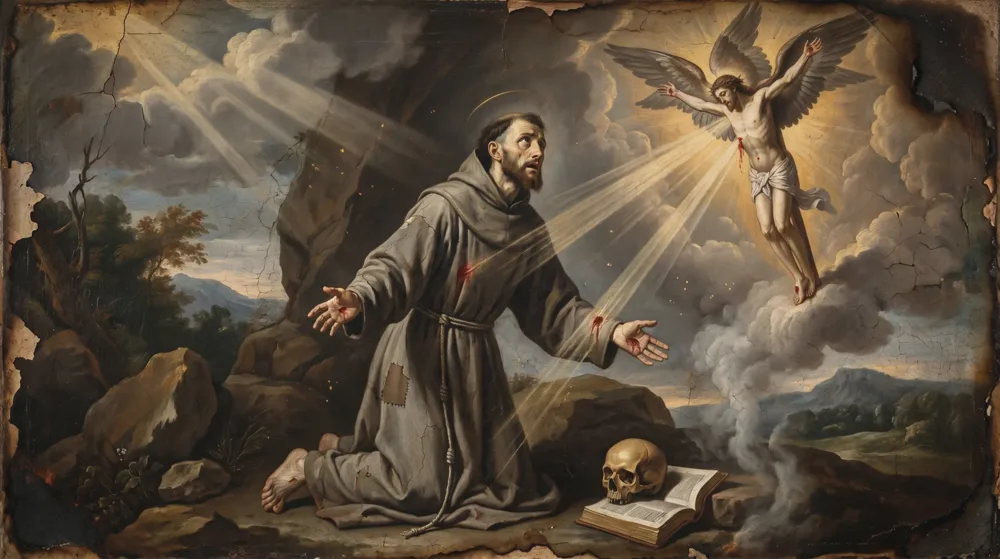
St Francis of Assisi is the founder of the Friars Minor and one of the best-loved saints of the Western Church, honoured as patron saint of animals and of the poor, and principal patron of Italy. The Church keeps his feast on 4 October, and the faithful still turn to a traditional prayer of St Francis in seeking the peace and poverty of spirit he lived. His holiness was not sentiment but a literal following of the poor and crucified Christ, sealed in his flesh by the wounds of the stigmata. He is not to be confused with St Francis de Sales, the later Bishop of Geneva and Doctor of the Church who bears the same name.
Who St Francis of Assisi was
Francis was born at Assisi, in Umbria, about the year 1182, the son of a prosperous cloth merchant named Pietro Bernardone. His youth was spent in the easy pleasures and ambitions of a rich man's son, and he dreamed for a time of winning glory as a soldier. A serious illness and a long interior struggle turned him from these things to God. The decisive moment came when, praying before the crucifix in the half-ruined church of San Damiano, he heard the words, "Go, repair my house, which is falling into ruin." He took them first of the stone walls before him, and only afterward understood that the house to be repaired was the Church herself.
His conversion was stark and complete. Renouncing his inheritance, he stripped off his very clothes before the bishop of Assisi and his own father, and gave himself to absolute poverty, begging his bread and tending lepers whom once he could not bear to look upon. Others were drawn to follow him, and in 1209 he obtained from the Holy See the approval of a rule of life founded on poverty, humility, and the literal observance of the Gospel. This was the beginning of the Order of Friars Minor, the "lesser brothers," whose name itself expresses the lowliness Francis sought. With St Clare he founded a second order for women, the Poor Clares, and a third order for those living in the world.
Francis took the Gospel without gloss. He embraced poverty not as a hardship to be tolerated but as a bride to be loved, and he called it Lady Poverty. The same singleness of heart that emptied him of possessions filled him with charity toward every creature, for he saw in all things the handiwork of one Father. This is the root of the affection that surrounds his memory, and the foundation of what he is patron of.
What St Francis is patron saint of
St Francis is honoured by popular devotion as patron saint of animals. (The title "patron of ecology" is recent: it was given by John Paul II in 1979 and belongs to the period after the Council, not to the tradition.) The accounts of his life are full of his gentleness toward beasts and birds, of which the most famous is his sermon to the birds, who are said to have gathered and listened until he blessed them and bade them go.
He called the creatures his brothers and sisters, not from any confusion of man with beast, but because he saw every creature as the work and gift of God, made to give Him glory. His "Canticle of the Creatures," which praises God through Brother Sun and Sister Moon, through wind and water and fire and the earth our sister, is the clearest expression of this vision: the creature is loved for the Creator's sake, never in His place.
He is honoured as principal patron of Italy, declared so by Pope Pius XII in 1939 together with St Catherine of Siena, and the town of Assisi has remained for centuries a place of pilgrimage. Beyond these, the faithful invoke him as patron of the poor, in keeping with the poverty he made his rule, and of merchants, the trade of the father whose inheritance he gave up. The more recent custom of blessing animals on or near his feast day grew from his love of every living thing, though the heart of his patronage is never the beast itself but the praise of God that the beast was made to render.
The same instinct that turns the faithful to a particular saint for a particular need — to St Anthony for what is lost, to St Francis for the creatures of God — is the Church's old confidence in the communion of saints, exercised soberly. Those who would walk his road further will find that it passes through self-denial; the spirit of Lady Poverty is one with the older teaching on Christian mortification, the daily dying to self without which his joy cannot be understood.
The stigmata
Two years before his death, in August 1224, Francis withdrew to pray on the lonely summit of Mount La Verna in the Apennines, with Brother Leo and a few companions. About the feast of the Exaltation of the Holy Cross, while he was in prayer, he was transported by a tender compassion of charity into Him who out of love was crucified for us. He saw a seraph with six shining wings bearing down toward him, between whose wings appeared the figure of a man crucified. A sudden joy mingled with sorrow filled his heart, and he understood that he was to be transformed into a resemblance of Jesus Christ crucified.
When the vision passed, the marks of the nails began to appear in his hands and feet, with a red wound in his side that often shed blood. His is the most famous and best-attested case of stigmatization, and the only one commemorated in the universal Roman calendar, on 17 September (a commemoration in the 1962 calendar). Of the later stigmatists, the best known is a son of his own Franciscan family, the Capuchin friar Padre Pio, who bore the wounds for fifty years. The man who had loved the poor and crucified Christ was at last conformed to Him in his very flesh.
He died on the evening of 3 October 1226, having asked to be laid on the bare ground, and was canonized within two years. His memory belongs with the great penitent founders the Church holds up for imitation, as does that of his own son in religion, the preacher St Anthony of Padua, whom Francis himself appointed to teach theology to the brethren.
A traditional prayer of St Francis
The prayer most often associated with him, the "Peace Prayer," is in fact of modern origin and is not from his hand. The traditional prayer that the Church places on his own lips, and which best carries his spirit, is the act of self-offering he is said to have made before the crucifix of San Damiano at the outset of his conversion:
Most High, glorious God,
enlighten the darkness of my heart,
and give me true faith, certain hope,
and perfect charity,
sense and knowledge, Lord,
that I may carry out
Thy holy and true command. Amen.
A second and venerable form is the collect of his feast in the Roman Missal:
Deus, qui Ecclesiam tuam, beati Francisci meritis, fetu novae prolis amplificas: tribue nobis; ex eius imitatione, terrena despicere et caelestium donorum semper participatione gaudere. Per Dominum nostrum Iesum Christum, Filium tuum, qui tecum vivit et regnat in unitate Spiritus Sancti Deus, per omnia saecula saeculorum. Amen.
O God, who by the merits of blessed Francis dost enlarge Thy Church with a new offspring: grant us, after his example, to despise the things of earth and ever to rejoice in the sharing of heavenly gifts. Through our Lord Jesus Christ, Thy Son, who liveth and reigneth with Thee in the unity of the Holy Ghost, God, world without end. Amen.
Both ask the one thing Francis sought: to be emptied of self that Christ might fill the place.
The "Peace Prayer" of St Francis
The prayer that begins "Lord, make me an instrument of Thy peace" is the one most people mean when they speak of the prayer of St Francis, and it is right to be honest about it. It is not his. It appears for the first time in a French devotional magazine in 1912, nearly seven centuries after his death, and was only later attached to his name. We give the text because it is loved and because nothing in it is false, but the faithful should know that it expresses the Franciscan spirit at second hand and is not a prayer the saint composed:
Lord, make me an instrument of Thy peace.
Where there is hatred, let me sow love;
where there is injury, pardon;
where there is doubt, faith;
where there is despair, hope;
where there is darkness, light;
and where there is sadness, joy.
O Divine Master, grant that I may not so much seek
to be consoled as to console;
to be understood as to understand;
to be loved as to love.
For it is in giving that we receive;
it is in pardoning that we are pardoned;
and it is in dying that we are born to eternal life. Amen.
For a prayer that is truly from his hand, return to the act of self-offering of San Damiano given above, or to his "Canticle of the Creatures." These carry his voice; the Peace Prayer carries only his name.
A prayer of St Francis for animals and the blessing of animals
Because St Francis loved every creature as the work of one Father, the custom grew of asking his intercession for the beasts in our care, and of bringing animals to be blessed on or near his feast on 4 October. There is no prayer of St Francis "for animals" from his own pen. The older tradition attached the blessing of animals above all to St Anthony the Abbot (17 January), whom the Rituale Romanum invokes in its blessing of horses and other beasts; the Ritual's blessing of sick animals opens with these versicles from the Psalms:
V. Men and beasts Thou wilt save, O Lord.
R. According as Thou hast multiplied Thy mercy, O God.
V. Thou openest Thy hand.
R. And fillest every living creature with blessing.
The blessing of animals is a true sacramental, given by a priest. It does not sanctify the beast, which has no soul to save, but blesses God's creature for the good of man and asks His protection upon it. The heart of the custom is never sentiment toward the animal but thanksgiving to its Creator, and to keep it rightly is to guard against the modern error that would set the love of creatures above, or in place of, the love of God.
The statue of St Francis
The familiar statue of St Francis shows him in the brown or grey habit of the Friars Minor, girt with the knotted cord of the three vows, often with a bird on his hand or shoulder and sometimes with the marks of the stigmata in his hands. Such an image is a sacramental and a reminder. A statue of St Francis set in a garden is rightly understood as a sign that points to the saint and through him to God, and an occasion of prayer. Placed well, it does what every holy image is meant to do: it lifts the mind from the creature to the Creator whom Francis spent his life praising. St Francis of Assisi takes his place among the saints of the year in our guide to the Catholic saints, listed by feast day.
The feast day of St Francis
The feast of St Francis of Assisi, Confessor, is kept on 4 October; in the 1962 Roman calendar it is a feast of the third class, in white vestments. The Church gives him the office of a Confessor — one who bore witness to Christ by a holy life rather than by martyr's blood — and the commemoration of the Sacred Stigmata on 17 September recalls the wounds of La Verna. To keep his feast rightly is not to admire a lover of nature from a distance, but to be drawn by his example toward the poverty, humility, and conformity to the Cross in which his whole holiness consisted.
Frequently Asked Questions
Who was St Francis of Assisi?
St Francis of Assisi was a thirteenth-century Italian saint, born about 1182 at Assisi in Umbria, the son of the cloth merchant Pietro Bernardone. After a worldly youth he renounced his inheritance for absolute poverty and founded the Order of Friars Minor, the Franciscans. He is one of the best-loved saints of the Western Church, conformed to the poor and crucified Christ even to the wounds of the stigmata in his own flesh.
What is St Francis of Assisi known for?
He is known above all for his radical poverty, his founding of the Friars Minor and the Poor Clares, and his literal following of the Gospel without gloss. He is famous too for his love of every creature as the work of one Father, for his "Canticle of the Creatures," and for the stigmata he received on Mount La Verna in 1224, the most famous and best-attested in the Church.
What is St Francis of Assisi the patron saint of?
St Francis is honoured by popular devotion as patron saint of animals; the title "patron of ecology" dates only from 1979 (John Paul II) and is not part of the tradition. He is also principal patron of Italy, declared so by Pius XII in 1939 together with St Catherine of Siena, and invoked as patron of the poor and of merchants. The heart of his patronage is never the creature itself but the praise of God that every creature was made to render.
When was St Francis of Assisi born?
Francis was born at Assisi, in Umbria, about the year 1182. The exact day is not recorded, the early accounts being concerned with his holiness rather than with dates. He was the son of a prosperous cloth merchant, Pietro Bernardone, and spent his youth in the easy pleasures of a rich man's son before his conversion to God.
How did St Francis of Assisi die?
He died on the evening of 3 October 1226, at about forty-four years of age, worn out by penance, illness, and the wounds of the stigmata he had borne since 1224. At his own request he was laid upon the bare ground, stripped of all things as he had lived, and he passed to God while the brethren chanted the psalms. He had embraced "Sister Death" as he had embraced Lady Poverty, in conformity to the poor and crucified Christ.
When is St Francis of Assisi feast day?
The feast of St Francis of Assisi, Confessor, is kept on 4 October; in the 1962 Roman calendar it is a feast of the third class, in white vestments. The Impression of the Sacred Stigmata, commemorating the wounds of La Verna, is commemorated on 17 September.
When was St Francis of Assisi canonised?
Francis was canonised within two years of his death, in 1228, by Pope Gregory IX, who had known him in life. So manifest was his holiness and so numerous the wonders attributed to him that the Church did not delay the act by which she set him among the saints to be venerated by the faithful.
Is the Peace Prayer really by St Francis?
No. The prayer beginning "Lord, make me an instrument of Thy peace" first appears in a French devotional magazine in 1912, almost seven hundred years after the saint's death, and was attached to his name only afterward. Nothing in it is contrary to the faith, and it expresses his spirit, but it is not a prayer he composed. The genuine prayers of St Francis are the act of self-offering of San Damiano and his "Canticle of the Creatures."
What is the prayer of St Francis for animals?
There is no ancient prayer "for animals" from the saint's own hand. The faithful ask his intercession for their animals, and a priest may give the Church's blessing of animals from the Roman Ritual, which opens with the versicle "Men and beasts Thou wilt save, O Lord." That blessing is a sacramental: it does not sanctify the beast but blesses God's creature for the good of man, and its heart is thanksgiving to the Creator, not sentiment toward the animal.
Why are animals blessed on St Francis's feast day?
The custom grew from the saint's love of every living thing as the work of one Father, and it is kept on or near his feast on 4 October; the older tradition kept it above all on the feast of St Anthony the Abbot, 17 January. A priest gives the blessing of animals from the Roman Ritual, which asks God's protection upon His creatures for the good of man. The Church permits and blesses the practice, but warns against the modern error that would set love of animals above, or in place of, the love of God.
What does a statue of St Francis represent?
It shows him in the Franciscan habit, girt with the knotted cord of poverty, chastity, and obedience, often with a bird and sometimes with the wounds of the stigmata, and it represents his love of every creature as a sign of God's. A statue is a sacramental and a reminder that lifts the mind to God.
The Iter Fidei app carries the prayers to the saints, the litanies, and the traditional calendar of feasts, so that the prayer of St Francis and the propers of his day are at hand wherever the faithful pray. Join early access here.
Sources. Butler, Lives of the Saints (St Francis of Assisi, 4 October; the Sacred Stigmata, 17 September); the Roman Martyrology (4 October); Roman Missal of 1962, proper of 4 October; Rituale Romanum, blessings of animals; Pius XII, declaration of the patrons of Italy (1939).