
The Saints
Padre Pio of Pietrelcina: Life, Stigmata, and Prayers
Padre Pio of Pietrelcina (1887-1968), the Capuchin friar who bore the stigmata for fifty years - his life, the Holy Office years, his prayers and novena, and his feast day, September 23.
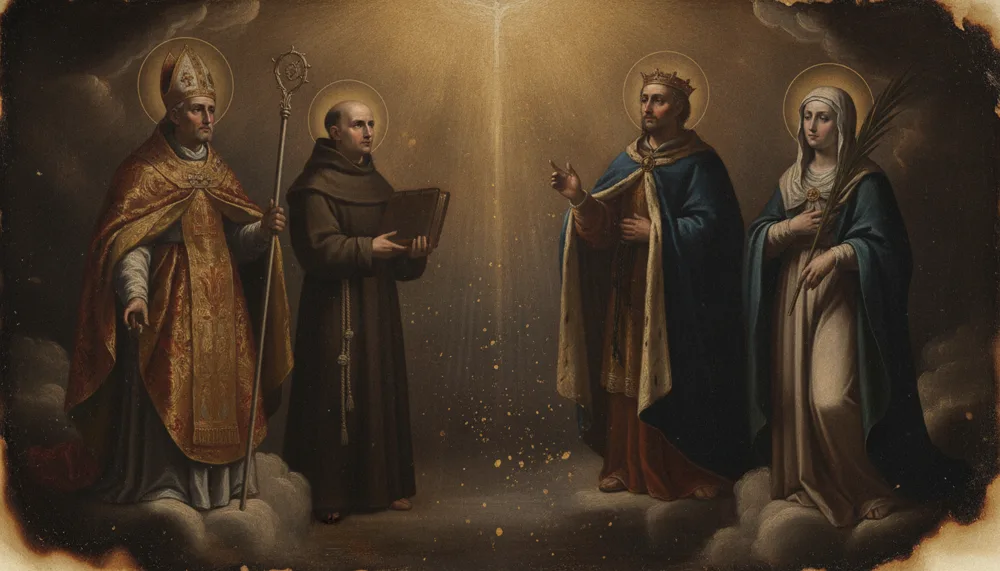
Padre Pio of Pietrelcina (1887-1968) was a Capuchin friar of southern Italy who bore the stigmata for fifty years, spent long hours daily in the confessional, and offered the traditional Latin Mass throughout his priesthood. He died on 23 September 1968 and was canonized by the Holy See in 2002; his feast is kept on 23 September. We set out his life as the documents record it, including the years in which the Holy Office restrained him, and the practices he left to the faithful.
The life of Padre Pio de Pietrelcina
Francesco Forgione was born on 25 May 1887 at Pietrelcina, a farming town in the province of Benevento. In 1903, at fifteen, he entered the novitiate of the Capuchin Franciscans at Morcone and received the name Pio: not a monk but a friar, a religious of the mendicant Order of Friars Minor Capuchin, vowed to poverty, penance, and prayer.
It was the order of St Fidelis of Sigmaringen, killed for the faith at Seewis in 1622 and honoured as the first martyr of the Congregation de Propaganda Fide. His health was poor from youth. He was ordained priest on 10 August 1910 in the cathedral of Benevento, and in 1916 his superiors sent him to the small friary of Our Lady of Grace at San Giovanni Rotondo, in Apulia, where he remained, almost without leaving it, for the rest of his life.
The stigmata of Padre Pio
On 20 September 1918, while making his thanksgiving after Mass before a crucifix in the choir of the friary, Padre Pio received the visible stigmata — the five marks of Our Lord's Passion. He reported the fact to his spiritual director in obedience, asked that it be kept hidden, and bore the marks for fifty years, covering his hands with half-gloves except at the altar.
The Church did not take the matter on trust. His religious superiors sent physicians to examine him, among them Dr. Luigi Romanelli and Dr. Giorgio Festa, in 1919 and 1920; both reported wounds that were real, stable, and not explained by any cause or treatment they knew. They remained for five decades and disappeared shortly before his death, leaving no trace.
The Holy Office years, 1923-1933
Claimed mystical phenomena are tested, not applauded, and Padre Pio was tested severely. Rome inquired, and from 1923 the Holy Office imposed one restriction after another, until in 1931 he was left with no priestly faculty but the celebration of Mass, offered privately, with no faithful present. He could not hear confessions or preach.
He obeyed. For two years he said Mass alone, prayed, and kept silence, without a public word against the Holy See. When the measures were lifted, he took up his ministry again without complaint. Obedience under trial is a surer sign of the Spirit of God than any extraordinary gift, and he gave it.
The confessional, the Mass, and the Rosary
What filled the years at San Giovanni Rotondo was not the extraordinary but the ordinary means of grace, practised without measure. Padre Pio commonly spent ten hours a day hearing confessions, and penitents waited days for their turn. His confessional is the plainest instruction he left: whoever would honour him should make a good Confession, integrally and with true sorrow.
His daily Mass — the traditional Latin Mass, which he offered throughout his priesthood — often lasted well over an hour, because he did not hurry the Canon: the Mass shows forth the death of the Lord until He come (1 Corinthians 11:26, Douay-Rheims). The third practice was the Rosary, which he prayed almost continually, beads in hand; he called it his weapon. Those who asked him for a rule of life received, in substance, these three things: Confession, the Mass, and the Rosary.
The prayers of Padre Pio
Padre Pio's prayer after Communion: Stay with me, Lord
The best known Padre Pio prayer is the thanksgiving after Holy Communion that bears his name. Its refrain is the plea of the two disciples at Emmaus: "Stay with us, because it is towards evening, and the day is now far spent" (Luke 24:29, Douay-Rheims). We give it in full, in the English in which the Capuchins of his own order circulate it:
Stay with me, Lord, for it is necessary to have You present so that I do not forget You. You know how easily I abandon You.
Stay with me, Lord, because I am weak and I need Your strength, that I may not fall so often.
Stay with me, Lord, for You are my life, and without You, I am without fervor.
Stay with me, Lord, for You are my light, and without You, I am in darkness.
Stay with me, Lord, to show me Your will.
Stay with me, Lord, so that I hear Your voice and follow You.
Stay with me, Lord, for I desire to love You very much, and always be in Your company.
Stay with me, Lord, if You wish me to be faithful to You.
Stay with me, Lord, for as poor as my soul is, I want it to be a place of consolation for You, a nest of love.
Stay with me, Jesus, for it is getting late and the day is coming to a close, and life passes; death, judgment, eternity approaches. It is necessary to renew my strength, so that I will not stop along the way and for that, I need You. It is getting late and death approaches, I fear the darkness, the temptations, the dryness, the cross, the sorrows. O how I need You, my Jesus, in this night of exile!
Stay with me tonight, Jesus, in life with all its dangers. I need You. Let me recognize You as Your disciples did at the breaking of the bread, so that the Eucharistic Communion be the Light which disperses the darkness, the force which sustains me, the unique joy of my heart.
Stay with me, Lord, because at the hour of my death, I want to remain united to You, if not by communion, at least by grace and love.
Stay with me, Jesus, I do not ask for divine consolation, because I do not merit it, but the gift of Your Presence, oh yes, I ask this of You!
Stay with me, Lord, for it is You alone I look for, Your Love, Your Grace, Your Will, Your Heart, Your Spirit, because I love You and ask no other reward but to love You more and more. With a firm love, I will love You with all my heart while on earth and continue to love You perfectly during all eternity. Amen.
It belongs first to the quarter of an hour after Communion, alongside the classical thanksgivings given in our page of prayers before and after Communion, and it may equally be prayed before the tabernacle in Eucharistic adoration.
The novena to Padre Pio and his Sacred Heart novena
Since his canonization, a novena to Padre Pio — nine days of prayer asking his intercession — is commonly made from 15 to 23 September, ending on his feast. But the novena most truly his is the one he himself prayed: the Efficacious Novena to the Sacred Heart of Jesus, three petitions grounded in Our Lord's promises ("Ask, and it shall be given you," Matthew 7:7), which he recited daily for all who asked his prayers. This is the prayer most often circulated as the Padre Pio healing prayer; whoever seeks healing through his intercession does well to pray as he prayed, with submission to God's will.
Padre Pio quotes and sayings
His counsels were short and sober. The saying most constantly attached to him is: "Pray, hope, and do not worry." Of the Rosary he said, in substance, that it is the weapon for the present combat; to souls anxious over past confessions he counselled abandonment to the mercy of God. None of his counsel is novel; it repeats the common ascetical doctrine of the Church, which is precisely its worth.
San Giovanni Rotondo: shrine and tomb
Padre Pio is buried at San Giovanni Rotondo, where his tomb is among the most visited pilgrimage shrines in the world. There too stands the Casa Sollievo della Sofferenza, the hospital he founded, opened in 1956. In the United States, the National Centre for Padre Pio at Barto, Pennsylvania, holds relics and promotes the devotion. A pilgrimage there has one right end: Confession, Mass, and prayer.
Feast day and canonization
Padre Pio died at San Giovanni Rotondo on 23 September 1968, aged eighty-one. He was beatified in 1999 and canonized on 16 June 2002; the Church venerates him as St. Pio of Pietrelcina, and his feast day is 23 September, the day of his death. For the other saints of the traditional calendar, month by month, see our guide to the Catholic saints.
Through the eyes of tradition
Padre Pio died in 1968, and every step of his cause belongs to the years after the 1962 liturgical books. He was beatified on 2 May 1999 and canonized on 16 June 2002, and his memorial on 23 September was added to the general calendar only after the canonisation. The 1962 Roman calendar, which we follow, keeps that day as the feast of St Linus, Pope and Martyr, the first successor of St Peter, with a commemoration of St Thecla, Virgin and Martyr. Whoever prays the Divine Office of the 1962 Breviary or follows the 1962 liturgical calendar will therefore find no proper Mass or Office for him on that date; private devotion to him, and the Padre Pio novena made before 23 September, belong to the domain of personal piety.
The measures of the Holy Office deserve to be stated as they were. On 31 May 1923 the Holy Office declared that it was not established that the phenomena attributed to him were supernatural, and asked the faithful to conduct themselves in conformity with that declaration. Further restrictions followed, culminating in 1931, when he was confined to the private celebration of Mass. Pius XI lifted these measures in 1933, and his faculty to hear confessions was restored in 1934. The Church judged first with severity and only later with approval; the friar submitted at every stage, and that submission is the lesson tradition most readily draws from his life.
The same graces that drew the crowds to San Giovanni Rotondo are honoured in saints whom the traditional calendar does keep. On 17 September the 1962 calendar commemorates the Impression of the Sacred Stigmata of St Francis of Assisi, the father of the whole Franciscan family to which Padre Pio belonged, wounded on Mount La Verna in 1224. On 30 April it keeps St Catherine of Siena, who received the stigmata at Pisa in 1375 and by her own prayer had them hidden from sight while she lived.
And for the long hours in the confessional there is no better model than St John Vianney, the Curé of Ars, canonized in 1925 and kept on 8 August in the 1962 calendar, who heard confessions up to eighteen hours a day. Those who love Padre Pio lose nothing by keeping these feasts; they find in them the same Cross, honoured by the Church for centuries.
Frequently Asked Questions
Who is Padre Pio?
Padre Pio (1887-1968), born Francesco Forgione at Pietrelcina in southern Italy, was a Capuchin friar and priest of San Giovanni Rotondo. He bore the visible stigmata from 1918 until his death, was renowned as a confessor, and was canonized in 2002.
What is Padre Pio the patron saint of?
Since his canonization he has been named patron of the civil defence volunteers of Italy. The faithful invoke him especially for healing, for the grace of a good Confession, and for perseverance under trial.
Did Padre Pio have the stigmata?
He bore the visible stigmata from 20 September 1918 until shortly before his death in 1968 — fifty years. The physicians his superiors sent to examine him in 1919 and 1920 described real, lasting wounds that no natural cause they knew explained.
When did Padre Pio die?
He died on 23 September 1968 at San Giovanni Rotondo, aged eighty-one. His feast day is kept on 23 September, the day of his death.
Is Padre Pio a saint?
He was beatified in 1999 and canonized by the Holy See on 16 June 2002, under the name St. Pio of Pietrelcina. His feast is kept on 23 September in the calendar of 2002 onward; it does not appear in the 1962 Roman calendar.
Where is Padre Pio buried?
His tomb is at San Giovanni Rotondo, in Apulia in southern Italy, at the sanctuary around the friary of Our Lady of Grace where he lived from 1916 until his death.
The Iter Fidei app carries the traditional Mass, the Rosary, and an examination of conscience for Confession — the three practices of Padre Pio's rule. Join early access here.
Sources. Douay-Rheims Bible (Luke 24:29; 1 Corinthians 11:26; Matthew 7:7). Declaration of the Holy Office concerning Padre Pio, 31 May 1923 (Acta Apostolicae Sedis 15), with the measures of 1931 and their revocation under Pius XI in 1933. The letters of Padre Pio of Pietrelcina, 1910-1922, and the Prayer of St Pio after Holy Communion. Decree of canonization of St Pio of Pietrelcina, 16 June 2002. Breviarium Romanum and Missale Romanum (1962), calendar for 30 April, 8 August, 17 September and 23 September. Butler's Lives of the Saints (St Francis of Assisi, St Catherine of Siena, St John Vianney).