
The Saints
St Rita of Cascia, Saint of the Impossible
St Rita of Cascia, the saint of the impossible — her life as wife, mother, widow, and Augustinian nun, what she is patron of, a traditional prayer to her, and her feast day.
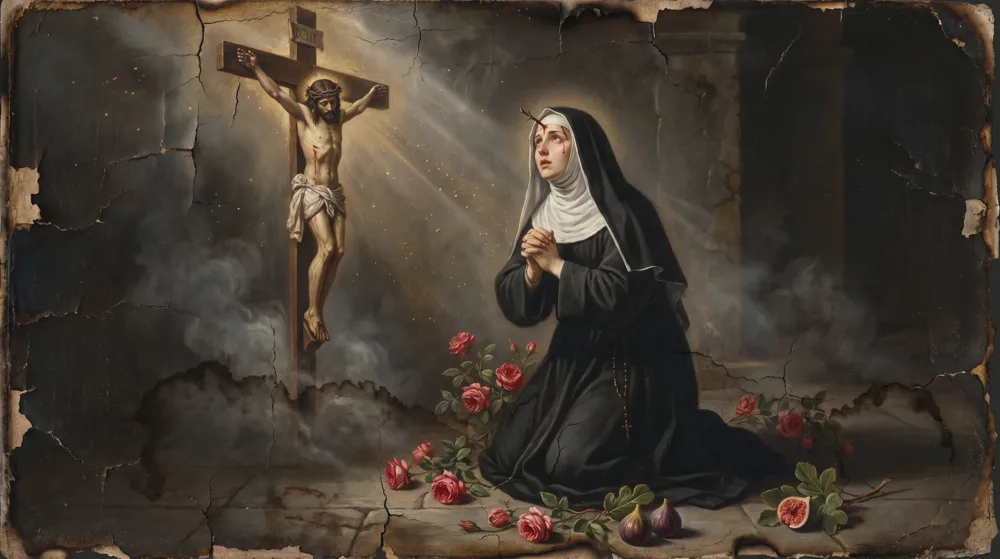
St Rita of Cascia is the saint to whom Catholics turn in desperate and seemingly hopeless cases; she is known above all as the patron of impossible causes and of difficult marriages. An Augustinian nun of fifteenth-century Umbria who had first been a long-suffering wife and a bereaved mother, Saint Rita of Cascia was raised to the altars by Pope Leo XIII in 1900, and her feast is kept on the 22nd of May.
Who St Rita was
Rita was born about 1381 at Roccaporena, a hamlet near Cascia in the mountains of Umbria, to Antonio and Amata Lotti. From childhood she desired to give herself to God in religion. Her parents, however, who were aged and feared to leave her unprotected, gave her in marriage. Her husband was a man of harsh and violent temper, and for eighteen years Rita bore his cruelty with patience, answering his outbursts with gentleness and prayer. By degrees this constancy wore down his hardness, and he was reconciled both to her and to God. He was then murdered in one of the family feuds that disfigured the country, and his death threatened to draw their two sons into the obligation of revenge.
Rita, dreading for their souls more than for their lives, begged God rather to take them than to let them stain themselves with blood. Both sons fell ill and died, forgiving their father's murderers. Left alone, a widow without children, Rita sought to enter the Augustinian convent of St Mary Magdalen at Cascia. Three times she was refused, partly because the house received only virgins and partly on account of the feud that still divided the town. When at length the enmity was composed and she was admitted, she lived for some forty years in obedience, penance, and prayer.
Towards the end of her life, while she prayed before a crucifix, she asked to share in the sufferings of her Lord. A thorn, as it were, detached itself from the crown of the image and pierced her forehead, leaving a wound that remained open until her death — a partial stigma she bore as a hidden honour. She died at Cascia in 1457. Her body was found incorrupt, and many cures and conversions were attributed to her intercession. She was beatified by Urban VIII and canonized by Leo XIII in the Holy Year 1900.
What St Rita is the patron saint of
The two titles most firmly attached to her are drawn from her own life rather than from legend. She is invoked as the patron saint of impossible and desperate causes — of the situations in which human means have run out — and as a patron of difficult marriages and of suffering wives.
The first title rests on the whole shape of her life: a marriage she did not choose, a violent husband she could not change by her own strength, the loss of that husband and then of both her children, and a religious vocation refused her again and again. In each case the door was shut, and in each case it was opened — not by her contriving, but by God answering a patience that did not give up.
The Church holds her out, therefore, not as a worker of magic but as a witness that no cause is beyond God's reach, and that the prayer of the lowly is not despised. From this she is often coupled with the Apostle invoked in the same straits; readers who carry such burdens may also turn to St Jude, the patron of hopeless cases.
The second title belongs to her years as a wife. Rita did not leave her difficult marriage; she sanctified it from within, by patience, by prayer, and by the slow conversion of a hard man through gentleness. She is thus a fitting patron for those who bear with a trying spouse or who pray for the conversion of a husband or wife, and a model of what the Church teaches about the indissolubility and the cross of Catholic marriage. She is named as well a patroness of widows, of mothers who grieve their children, and, from the wound in her forehead, of those afflicted with bodily ills — a charge she shares with the martyr St Sebastian, whom the faithful invoke against plague and in time of epidemic.
A traditional prayer to St Rita
Saint Rita is honoured with her own litanies and novenas, but the simplest and most common invocation gathers her titles into a single petition. It may be prayed for oneself or for another in distress:
O holy patroness of those in need, Saint Rita, whose pleadings before thy Divine Lord are almost irresistible, who for thy lavishness in granting favours hast been called the Advocate of the Hopeless and even of the Impossible; Saint Rita, so humble, so pure, so mortified, so patient, and of such compassionate love for thy crucified Jesus that thou couldst obtain from Him whatsoever thou didst ask, on account of which all confidently have recourse to thee, expecting, if not always relief, at least comfort: be propitious to our petition, showing thy power with God in behalf of thy suppliant. Be lavish to us, as thou hast been in so many wonderful cases, for the greater glory of God, for the spreading of thine own devotion, and for the consolation of those who trust in thee. We promise, if our petition is granted, to glorify thee by making known thy favour, to bless and sing thy praises forever. Relying then upon thy merits and power before the Sacred Heart of Jesus, we pray thee grant that (here name the petition). Obtain for us our request by the singular merits of thy childhood, by thy perfect union with the Divine Will, by thy heroic sufferings during thy married life, by the consolation thou didst experience in the conversion of thy husband, by the sacrifice of thy children rather than have them offend God, by thy miraculous entrance into the convent, by thy daily penances, by the painful wound in thy forehead, by the Heavenly food which sustained thee, and by the happiness with which thou didst part from thy trials to join thy Divine Spouse. Pray for us, O holy Saint Rita, that we may be made worthy of the promises of Christ. Amen.
A shorter ejaculation often used is simply: Saint Rita, advocate of the impossible, pray for us. As with all the saints, the prayer asks not that Rita act in God's place but that she carry our petition to Him; this is the order of intercession set out in the Litany of the Saints, where the whole Church on earth calls upon the whole Church in heaven.
The novena to St Rita
A novena is nine successive days of prayer for a single intention, made in imitation of the nine days the Apostles and Our Lady spent in prayer between the Ascension and Pentecost. A St Rita novena is most often begun nine days before her feast — that is, on the 13th of May, ending on the 22nd — but it may be made at any time of year for a marriage in difficulty, a cause that seems lost, a grave illness, or the conversion of a loved one.
The novena needs no elaborate form. On each of the nine days one may say, before a crucifix or an image of the saint, the traditional prayer to St Rita given above, joined to the Our Father, the Hail Mary, and the Glory Be, and closing with the petition for the favour sought. Where a fuller order is desired, each day adds a short prayer recalling one of the trials of her life — her childhood, her difficult marriage, the conversion of her husband, the loss of her children, her threefold refusal at the convent door, the wound in her forehead — so that the one praying ascends, day by day, the same hard road by which Rita herself reached God.
The novena's purpose is not to wring a result from heaven by repetition, but to school the heart in the very perseverance that marked her life: a patience that keeps knocking until the door is opened.
The shrine of St Rita at Cascia
The chief place of her devotion is the Basilica and National Shrine of St Rita at Cascia in Umbria, where her incorrupt body rests in a glass reliquary and remains an object of pilgrimage. Nearby, at Roccaporena, the hamlet of her birth, pilgrims still visit the house where she lived as wife and mother and the rock to which she was said to withdraw for prayer. In the United States her cult is honoured at the National Shrine of St Rita of Cascia in Philadelphia, an Augustinian church raised in her name. Such shrines are not destinations of magic but places set apart for prayer, where the faithful ask her intercession and give thanks for favours received; the Church has from antiquity venerated the relics of the saints and the places sanctified by their lives.
Her feast day
The feast of St Rita of Cascia is kept on the 22nd of May. In many places her day is marked by the blessing of roses, recalling an account that, as she lay dying in the cold of winter, she asked a kinswoman to bring her a rose from the garden at Roccaporena, and one was found in bloom — a small sign of the constancy that ran through her whole life, that what seemed impossible was not so to God.
Those who keep her feast do well to honour her as the Church honours her: not as a charm against misfortune, but as one of the cloud of witnesses who proved, in marriage and in widowhood, in the cloister and in long affliction, that grace is sufficient and that perseverance is heard. For the other saints of the traditional calendar, month by month, see our guide to the Catholic saints.
Frequently Asked Questions
Who is St Rita of Cascia?
St Rita of Cascia (c. 1381–1457) was an Augustinian nun of Umbria who had first been a long-suffering wife and a bereaved mother. She bore for eighteen years the cruelty of a violent husband, won him at last to God, and after his murder and the death of her two sons entered the convent of St Mary Magdalen at Cascia, where she lived some forty years in penance and prayer. She bore a wound in her forehead from the crown of thorns of a crucifix, and was canonized by Pope Leo XIII in 1900.
What is St Rita the patron saint of?
St Rita is invoked above all as the patron saint of impossible and desperate causes — the situations in which human means have run out — and as a patron of difficult marriages and of suffering wives. She is named as well a patroness of widows, of mothers who grieve their children, and of those afflicted with bodily ills. Both titles are drawn from her own life rather than from legend.
How do you pray a novena to St Rita?
A novena to St Rita is nine successive days of prayer for a particular intention, often a marriage in difficulty or a cause that seems lost. The traditional prayer to St Rita, the "Advocate of the Hopeless and of the Impossible," may be repeated on each of the nine days, joined to the Our Father, the Hail Mary, and the Glory Be. As with all the saints, the prayer asks not that Rita act in God's place but that she carry our petition to Him.
Why is St Rita called the saint of the impossible?
Because the whole shape of her life was a series of shut doors that God opened: a marriage she did not choose, a violent husband she could not change by her own strength, the loss of husband and children, and a religious vocation refused her three times. In each case the door was opened — not by her contriving, but by God answering a patience that did not give up. She is held out as a witness that no cause is beyond God's reach.
When is the feast day of St Rita?
The feast of St Rita of Cascia is kept on the 22nd of May. In many places her day is marked by the blessing of roses, recalling the rose found in bloom in the winter cold at her request as she lay dying — a sign that what seemed impossible was not so to God.
What is a short prayer to St Rita?
The simplest invocation is the ejaculation "Saint Rita, advocate of the impossible, pray for us." It may be said at any moment of distress, alone or repeated through the day. The longer traditional prayer to St Rita, the "Advocate of the Hopeless and of the Impossible," is given in full above and is the one most used in her novena.
Where is the shrine of St Rita?
Her chief shrine is the Basilica and National Shrine of St Rita at Cascia in Umbria, Italy, where her incorrupt body rests, with the nearby hamlet of Roccaporena where she was born. In the United States the National Shrine of St Rita of Cascia, an Augustinian church, stands in Philadelphia. These are places of pilgrimage and prayer, where the faithful ask her intercession.
Why is St Rita associated with roses and bees?
Two signs are traditionally told of her. The rose recalls the bloom found in the winter garden at Roccaporena at her dying request, and is why her feast is kept with the blessing of roses. The bees recall an account of her infancy, when white bees were said to have settled about the cradle without harming her — a sign read by the faithful as a token of the sweetness and labour of the life to come. Such stories are received as pious tradition, not as articles of faith.
The Iter Fidei app carries the prayers to the saints, the litanies, and the traditional calendar of feasts. Join early access here.
Sources. Roman Martyrology, 22 May (entry for St Rita of Cascia). Alban Butler, The Lives of the Fathers, Martyrs, and Other Principal Saints, under 22 May, St Rita of Cascia, Widow. Acts of the canonization of St Rita by Pope Leo XIII, 24 May 1900.