
The Saints
St Jude the Apostle: Life, Feast and Patronage
St Jude Thaddeus, Apostle and martyr: who he was in Scripture, why he is not Judas Iscariot, his epistle, his mission and martyrdom in Persia, his relics, his feast on 28 October, and how he became patron of hopeless causes.
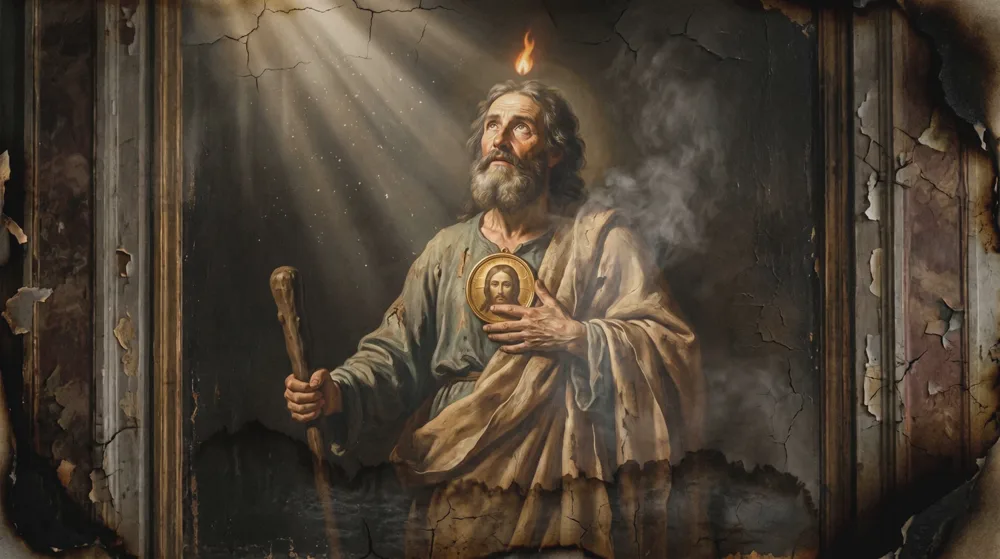
St Jude, called also Thaddeus, is one of the twelve Apostles of Our Lord, "the brother of James", the author of the short canonical Epistle that bears his name, and a martyr who, with St Simon, gave his life for Christ in Persia. The Church keeps the two Apostles together on 28 October. In popular devotion he is the patron of hopeless and desperate cases; this page tells who he was.
Who St Jude was
The Apostle Jude, Judas in the older spelling, appears in every list of the Twelve. St Matthew and St Mark call him Thaddeus (Matthew x. 3; Mark iii. 18); St Luke calls him "Jude the brother of James" in his Gospel and in the Acts (Luke vi. 16; Acts i. 13). Butler's Lives of the Saints notes that he is "usually regarded as the brother of St James the Less", and that it is not known when or how he became a disciple of Christ: the Gospels say nothing of him before naming him among the Apostles. Through St James he is reckoned among the "brethren", that is the kinsmen, of the Lord.
After the Ascension he persevered in prayer with the other Apostles and with Our Lady in the upper room, where St Luke names him last of the eleven:
And when they were come in, they went up into an upper room, where abode Peter and John, James and Andrew, Philip and Thomas, Bartholomew and Matthew, James of Alpheus and Simon Zelotes and Jude the brother of James. (Acts i. 13, Douay-Rheims)
Not Judas Iscariot
The same name, Judas, belonged to the traitor, and the Evangelists take care that the two should never be confused. St Luke writes, in the list of the Twelve:
And Jude the brother of James, and Judas Iscariot, who was the traitor. (Luke vi. 16, Douay-Rheims)
St John, recording his only recorded words, adds "not the Iscariot". For the same reason the faithful have long preferred the double name Jude Thaddeus, which leaves no room for doubt. The usual explanation of his patronage of hopeless cases starts from this very likeness of names, as we explain further down.
His question at the Last Supper
Scripture preserves a single saying of St Jude. When Our Lord, after the Last Supper, promised to manifest Himself to those who love Him, it was Jude who asked why not to the world:
Judas saith to him, not the Iscariot: Lord, how is it that thou wilt manifest thyself to us, and not to the world? Jesus answered and said to him: If any one love me, he will keep my word. And my Father will love him and we will come to him and will make our abode with him. (John xiv. 22-23, Douay-Rheims)
The question receives, in answer, the promise of the indwelling of the Holy Trinity in the soul that loves God. It is fitting that the Apostle now invoked in the darkest straits should be remembered for that answer.
The Epistle of St Jude
His name is borne by one of the seven Catholic Epistles, a single chapter, addressed to no particular church. He calls himself simply "Jude, the servant of Jesus Christ and brother of James" (Jude 1). Its burden is a warning against false teachers who had crept in among the faithful, and an exhortation to hold fast:
Dearly beloved, taking all care to write unto you concerning your common salvation, I was under a necessity to write unto you: to beseech you to contend earnestly for the faith once delivered to the saints. (Jude 3, Douay-Rheims)
He bids the faithful to keep themselves "in the love of God, waiting for the mercy of our Lord Jesus Christ, unto life everlasting" (Jude 21), and closes with a doxology to "him who is able to preserve you without sin and to present you spotless before the presence of his glory with exceeding joy" (Jude 24). Butler remarks that the Epistle has much in common with the Second Epistle of St Peter.
Mission and martyrdom
Of his life after Pentecost little is certain, and Butler is frank that the traditions cannot all be reconciled. The tradition received in the Roman liturgy is that given by the Breviary in the lessons of his feast: Thaddeus, "called also in the Gospel Judas the brother of James, and the writer of one of the Catholic Epistles", preached the Gospel in Mesopotamia, while Simon preached in Egypt; the two met afterwards in Persia, spread the faith among its peoples, and "glorified together by their teaching and miracles, and, in the end, by a glorious martyrdom, the most holy name of Jesus Christ". For this reason the West keeps them on one day, while the East honours them separately.
Butler adds two notes. First, St Jude was often confused with the Thaddeus of the Edessa legend of King Abgar, who was said to have died in peace; the medallion with the face of Christ that St Jude carries in his pictures is usually explained by that legend of the miraculous image of Edessa. Second, Eusebius records that two grandsons of St Jude, poor working peasants, were brought before the Emperor Domitian as descendants of David's royal house, and dismissed with contempt when he saw that the kingdom they looked for was not of this world. In art St Jude is also commonly shown with a club or a halberd, held in tradition to be the instrument of his martyrdom, and with a flame over his head, recalling Pentecost.
His relics
The relics of Saints Simon and Jude are venerated in St Peter's Basilica in Rome, beneath the altar of St Joseph in the left transept, where the two Apostles rest together, as they are honoured together on their feast. Other churches claim portions of their relics as well.
The feast day of St Jude
In the traditional Roman calendar the feast of Saints Simon and Jude falls on 28 October, a feast of the second class in the Missal of 1962, kept in red vestments. The Mass is of the Apostles, with the Gospel "These things I command you, that you love one another" (John xv. 17-25), and its Collect asks that we may celebrate their glory by advancing in virtue:
Deus, qui nos per beátos Apóstolos tuos Simónem et Judam ad agnitiónem tui nóminis veníre tribuísti: da nobis eórum glóriam sempitérnam et proficiéndo celebráre, et celebrándo profícere. Per Dóminum nostrum.
O God, who by Thy blessed Apostles Simon and Jude hast brought us to the knowledge of Thy name: grant us both to celebrate their everlasting glory by advancing in virtue, and by celebrating it to advance. Through our Lord.
The faithful who wish to prepare for the feast pray the St Jude novena from 19 to 27 October. Among the other Apostles honoured in the same way, see the novena to St Andrew the Apostle and the St James novena.
How St Jude became patron of hopeless causes
Butler records the invocation of St Jude "as believed to have special efficacy in desperate cases", citing the Bollandists' Acta Sanctorum. The explanation commonly given is a pious one, not a defined one: because his name recalled the traitor's, the faithful long hesitated to invoke him, and the "forgotten" Apostle came to be sought for the causes others had given up. In the English-speaking world the devotion took its modern form in the twentieth century.
In 1929 the Claretian Father James Tort, pastor of Our Lady of Guadalupe Church in South Chicago, a parish of steelworkers, established a shrine there, held the first solemn novena on 17 February 1929, and saw an overflow crowd at the close of the solemn novena that ended on the feast, 28 October 1929; from there the devotion spread through the years of the Depression.
The patronage itself, and the soul in which to ask for his help, are the subject of our page on the patron saint of hopeless cases; the prayer most widely used is given in our prayer to St Jude, patron of hopeless causes. To invoke him is to ask an Apostle to bear our cause before God, as we ask the prayers of a friend, joined to the Sacraments and to the ordinary means; the Church prays in the same spirit to the whole company of heaven on All Saints' Day. St Jude takes his place among the saints of the year in our guide to the Catholic saints, listed by feast day.
Frequently Asked Questions
Who was St Jude?
One of the twelve Apostles, called also Thaddeus, "the brother of James" and usually regarded as the brother of St James the Less. He wrote the Epistle of St Jude, preached according to tradition in Mesopotamia, and was martyred with St Simon in Persia.
Is St Jude the same as Judas Iscariot?
No. They are two different Apostles who bore the same name. St Luke distinguishes "Jude the brother of James, and Judas Iscariot, who was the traitor" (Luke vi. 16), and St John writes "Judas... not the Iscariot" (John xiv. 22).
Why is St Jude also called Thaddeus?
St Matthew and St Mark name him Thaddeus in their lists of the Apostles, while St Luke calls him Jude the brother of James. The Church has always understood these names to belong to one man, and "Jude Thaddeus" keeps him clearly apart from the traitor.
How did St Jude die?
The tradition followed by the Roman Breviary holds that he was martyred in Persia together with St Simon, after preaching in Mesopotamia. The details are uncertain; in art he is shown with a club or halberd, held in tradition to be the instrument of his death.
When is the feast day of St Jude?
On 28 October, together with St Simon, a feast of the second class in the Roman calendar of 1962, kept in the red vestments of the martyrs.
Where are the relics of St Jude?
In St Peter's Basilica in Rome, beneath the altar of St Joseph in the left transept, together with those of St Simon.
What is St Jude the patron saint of?
Of hopeless and desperate cases, the causes almost despaired of. Butler records the belief in the special efficacy of his intercession in desperate cases; the devotion spread widely in the twentieth century, notably from the Chicago shrine founded in 1929.
Why does St Jude carry an image of Christ?
The medallion with the face of Christ is usually explained by the Edessa legend of King Abgar and the miraculous image of Our Lord, with which a Thaddeus is associated; Butler notes that St Jude was often confused with that Thaddeus. The flame over his head recalls the descent of the Holy Ghost at Pentecost.
The Iter Fidei app carries the Roman Missal and Breviary of 1962 and the traditional calendar, so that St Jude may be honoured on his feast and through the year. Join early access here.
Sources. Holy Scripture, Douay-Rheims version (Matthew x. 3; Mark iii. 18; Luke vi. 16; Acts i. 13; John xiv. 22-23; John xv. 17-25; the Epistle of St Jude, vv. 1, 3, 21, 24); the Roman Breviary, lessons of the second nocturn of 28 October; the Roman Missal of 1962, Mass of Saints Simon and Jude (Collect); Butler's Lives of the Saints, "SS. Simon and Jude, or Thaddeus, Apostles" (28 October); Eusebius, Ecclesiastical History.