
The Liturgical Year
All Saints' Day
All Saints' Day, kept on November 1, is the Catholic holy day of obligation that honours all the saints in heaven, the known and the countless unknown.
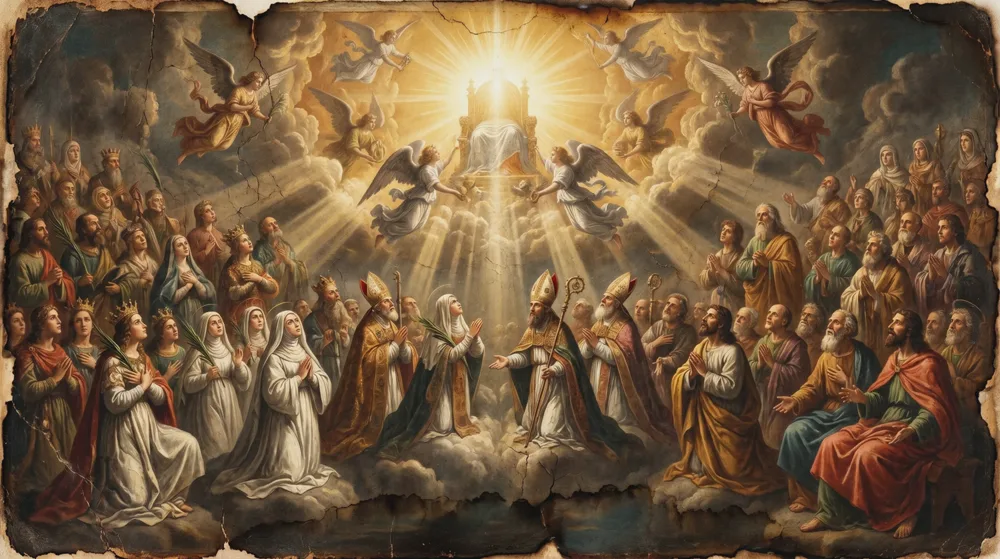
All Saints' Day is the Catholic feast, kept on November 1, that honours all the saints in heaven together — the great ones named in the calendar and the far greater multitude whom no calendar records. It is a holy day of obligation, on which the Church bids us lift our eyes from the saints we know by name to the whole company of the blessed who now reign with Christ.
What is All Saints' Day?
The feast of All Saints gathers into one solemnity the honour due to every soul that has reached heaven. The Church canonises only a fraction of her glorified children; the rest — the obscure martyrs of the early centuries, the hidden penitents, the faithful poor — have no day of their own. All Saints' Day is theirs. It is the feast of holiness itself, of the end for which every Christian was made.
The day has a long pedigree. Dom Guéranger records that in 609 Pope Boniface IV had the relics of the martyrs borne up from the catacombs and dedicated the old Pantheon of Agrippa to the holy martyrs. From honouring the martyrs collectively grew the desire to honour year by year all who had died for the Lord. In 732 Gregory III dedicated at St Peter's an oratory in honour of the Saviour, his blessed Mother, the Apostles, and all the holy Martyrs, Confessors, and perfect Just of the whole world; from then the solemnity began to be kept on the first of November. In 835, at the request of Gregory IV and with Louis the Pious, its celebration was made obligatory and welcomed by the whole Church (Dom Guéranger, The Liturgical Year).
The feast of all the saints, known and unknown
Why a single feast for all of them at once? Because the saints in heaven are too many to number. The liturgy of the day takes its great image from the Apocalypse: a multitude which no man could number, of all nations and tribes and peoples and tongues, standing before the throne and before the Lamb, clothed in white robes (Apoc. 7). The named saints — Peter, the Virgin Mother, the doctors and virgins and confessors — are the visible peaks; All Saints' Day honours the whole mountain.
Cardinal Schuster notes how fitting the season is. The fall of the leaves and the long cycle of Sundays after Pentecost turn the mind toward eternity, and on this day the Seer of Patmos lifts a corner of the veil to show the Church triumphant in her splendour (Cardinal Schuster, The Sacramentary). The feast crowns and closes the liturgical cycle: it shows us the harvest of the whole year of grace, the homeland and the fellow citizens toward whom the Church on earth is journeying. (For how this day stands within the wider cycle, see our overview of the liturgical year.)
What the Church teaches: the Communion of Saints
To understand All Saints' Day rightly, one must hold the article of the Creed it makes visible: the Communion of Saints. The Catechism of St Pius X teaches that by these words the Creed declares that, in virtue of the intimate union among all the members of the Church, the spiritual goods that belong to them are held in common. This communion is not confined to earth. It "extends also to heaven and to purgatory, because charity unites the three Churches: Triumphant, Suffering, and Militant; and the Saints pray to God for us and for the souls in purgatory" (Catechism of St Pius X, On the Ninth Article).
The Roman Catechism of the Council of Trent describes the same reality under the figure St Paul gives it — the body. As the human body has many members animated by one soul, so the mystical Body of Christ has many members quickened by one charity, sharing each other's goods. The Church triumphant, it teaches, is "that Society so brilliant and so happy" of all who have carried off the victory over the world, the flesh, and the devil, and now enjoy eternal blessedness (Roman Catechism, On the Ninth Article). All Saints' Day is the Church Militant turning, for one day, to salute the Church Triumphant — to which she is bound by living charity, not by mere memory.
This is why we may honour and invoke the saints. The Catechism of St Pius X teaches that it is very useful to pray to the saints and that every Christian ought to do so, marking the difference plainly: we pray to God as the author of grace, that He may give us good things; we pray to the saints that, by their intercession, they may obtain those things for us from God (Catechism of St Pius X, On the Invocation of the Saints). The saints are not rivals to the one Mediator but His friends, who plead our cause before Him. We treat this article more fully in our study of the Communion of Saints.
The Rank of the Feast of All Saints
In the traditional calendar of the Roman Rite of 1962 All Saints is a feast of the first class, the highest rank a feast can hold, kept with the fullest ceremony the liturgy affords; the calendar reformed in 1969 renamed that rank "solemnity", which is why the day is now often called the Solemnity of All Saints: All Saints stands in rank beside the greatest days of the year. The feast long carried an octave, eight days prolonging the celebration to November 8, until the octave was suppressed in the calendar reform of 1955. The rank is itself a lesson: the Church sets the honour of all her glorified children beside the chief mysteries of the Lord, because the saints are the fruit of those mysteries — the harvest of the Redemption made visible.
A holy day of obligation
All Saints' Day is one of the Church's holy days of obligation, on which the faithful are bound to assist at Mass and to abstain from servile work as on a Sunday. The obligation is itself a teaching: the Church holds the honour of the blessed and the hope of our own glory weighty enough to interrupt the working year. (For the place of November 1 among the others, see holy days of obligation.)
The Church does not let the feast stand alone. November 1 looks immediately to November 2, the commemoration of all souls: having honoured the Church Triumphant, we turn at once to the Church Suffering and pray for the holy souls in purgatory, who cannot yet help themselves. The two days are one movement of charity across the whole Communion of Saints — first the crowned, then the still-purifying — and both rest on the same article of the Creed.
The most fitting prayer of the feast is the Church's own great roll-call of her glorified children, the Litany of the Saints, in which she names her champions one after another and, having named those she can, commends herself to all ye holy men and women, saints of God. It is All Saints' Day set to prayer: the known invoked by name, and the unknown gathered in.
When is All Saints' Day? (November 1, every year)
All Saints' Day is always kept on November 1. The date does not move with the year as the moveable feasts do; the first of November is fixed, so the answer to "is today All Saints' Day?" is simply whether the calendar reads November 1. In 2025 All Saints' Day falls on Saturday, November 1; in 2026 it falls on Sunday, November 1. The date has stood since the eighth century, when Gregory III dedicated an oratory at St Peter's in honour of the Saviour, his blessed Mother, the Apostles, and all the holy Martyrs, Confessors, and perfect Just of the whole world, and the solemnity began to be kept on the first of November (Dom Guéranger, The Liturgical Year). The feast keeps a vigil on October 31 and is followed at once by November 2.
All Saints' Day and All Souls' Day: what is the difference?
The two days are often spoken of together, and many ask which is which. The difference is exact and rests on the same article of the Creed, the Communion of Saints.
All Saints' Day (November 1) honours the Church Triumphant — the souls already in heaven, the named and the unnamed, who reign with Christ. We do not pray for them, for they have no further need; we honour them and ask their intercession.
All Souls' Day (November 2) commemorates the Church Suffering — the holy souls in purgatory who are saved but not yet purified, and who cannot help themselves. On this day we do not invoke them; we pray for them, that our suffrages may hasten their entrance into glory.
So the order is a single movement of charity: first we salute the crowned, then we relieve the still-purifying. All Saints looks up; All Souls looks across to those in need. Both are the work of one body united by one charity (Roman Catechism, On the Ninth Article).
An All Saints' Day prayer
The proper Collect of the Mass of All Saints is the Church's own prayer for the day. It asks that the merits and intercession of all the saints, gathered into one feast, may obtain for us the abundance of God's mercy:
Almighty and everlasting God, who hast granted us to venerate in one solemnity the merits of all Thy Saints: we beseech Thee that, as our intercessors are multiplied, Thou wouldst pour forth upon us the abundance of Thy mercy so long desired. Through our Lord Jesus Christ. Amen.
The fullest prayer of the feast is the Church's Litany of the Saints, in which she names her champions one by one and then gathers the rest in the cry all ye holy men and women, saints of God, intercede for us. A short private aspiration for the day may simply be: All ye saints of God, known and unknown, pray for us, that we may one day join your company.
Some quotations for All Saints' Day
The Church's tradition is rich in sentences fit for the feast. They are not slogans but the witness of those who looked toward the same heaven:
- "There is a multitude which no man could number, of all nations and tribes and peoples and tongues, standing before the throne and before the Lamb, clothed in white robes." — Apocalypse 7:9, the Epistle of the day.
- "We give Thee thanks... that Thou hast made us worthy to share in the lot of the saints in light." — drawn from Colossians 1:12.
- "The saints are not rivals to the one Mediator, but His friends, who plead our cause before Him." — the constant teaching set out in the Catechism of St Pius X, On the Invocation of the Saints.
These say in few words what the whole feast proclaims: that holiness is the one thing necessary, and that the blessed who attained it are nearer to us, not farther, now that they reign.
The Mass of All Saints' Day
Because November 1 is a holy day of obligation, the faithful assist at Mass as on a Sunday. The Mass of All Saints, Gaudeamus omnes, begins with a summons to joy — "Let us all rejoice in the Lord, keeping holiday in honour of all the Saints." Its Epistle is the vision of the white-robed multitude from the Apocalypse; its Gospel is the Beatitudes (Matt. 5), the very charter of sanctity, so that the Church places before us at once the saints in glory and the road by which they reached it (Cardinal Schuster, The Sacramentary). To keep the feast well is to hear that Gospel as addressed to oneself: the Beatitudes are not a portrait of strangers but the map of the way home.
Happy All Saints' Day is no empty greeting, then. The joy of the feast is real, for it is the Church on earth rejoicing that so many of her children have finished the course and that the same crown is held out to us.
Conclusion
All Saints' Day is the feast of the finished work — the saints brought home, the harvest of grace complete, the multitude no man can number standing before the Lamb. It honours the holiness to which every baptised soul is called and shows the Church on earth her own destination. The named and the nameless, the crowned and those still in our own ranks, are one body in one charity; on November 1 we keep the day on which that body sees its own glory.
Frequently Asked Questions
Is All Saints' Day a holy day of obligation?
Yes. All Saints' Day, November 1, is one of the Church's holy days of obligation, on which the faithful are bound to assist at Mass and to abstain from servile work as on a Sunday. The Church judges the honour of the blessed and the hope of our own glory weighty enough to interrupt the working year.
What is All Saints' Day?
All Saints' Day is the Catholic feast, kept on November 1, that honours all the saints in heaven together — the great ones named in the calendar and the far greater multitude whom no calendar records. It is the feast of holiness itself, of the end for which every Christian was made, and it makes visible the article of the Creed we call the Communion of Saints. On it the Church Militant turns to salute the Church Triumphant, the multitude no man could number, standing before the throne and before the Lamb (Apoc. 7).
When is All Saints' Day?
All Saints' Day is always kept on November 1. The feast has been fixed on that date since the eighth century, when Gregory III dedicated an oratory at St Peter's in honour of the Saviour, his blessed Mother, the Apostles, and all the holy Martyrs, Confessors, and perfect Just of the whole world.
What day is All Saints' Day?
It falls on November 1 every year, the day after the vigil of the feast and immediately before November 2, the commemoration of all souls. The two days form one movement of charity across the Communion of Saints — first the crowned, then the still-purifying in purgatory.
What is the difference between All Saints' Day and All Souls' Day?
All Saints' Day (November 1) honours the Church Triumphant — the souls already in heaven, named and unnamed — whose intercession we ask. All Souls' Day (November 2) commemorates the Church Suffering — the holy souls in purgatory — for whom we pray, that our suffrages may hasten their entry into glory. The first looks up to the crowned; the second looks across to those still being purified. Both are one movement of charity within the Communion of Saints. See all souls day.
What does All Saints' Day mean?
All Saints' Day means the feast of holiness itself: it gathers into one solemnity the honour due to every soul that has reached heaven, especially the countless saints who have no day of their own in the calendar. It makes visible the article of the Creed called the Communion of Saints and shows the Church on earth her own destination — the multitude no man could number, standing before the throne and before the Lamb (Apoc. 7).
What is the Solemnity of All Saints?
"Solemnity of All Saints" is the name given to the feast in the calendar reformed in 1969, where "solemnity" designates the highest rank of feast. In the traditional calendar of 1962 the day is a feast of the first class, kept on November 1 with a vigil on October 31; it formerly enjoyed an octave, suppressed in 1955. The name and the rank say the same thing — the Church counts the glory of all her saints among the greatest celebrations of the year.
Is today All Saints' Day? When does it fall in 2025 and 2026?
It is All Saints' Day only on November 1, which is fixed and does not move from year to year. In 2025 it falls on Saturday, November 1; in 2026 on Sunday, November 1. The feast keeps a vigil on October 31 and is followed by the commemoration of all souls on November 2.
What is a good All Saints' Day prayer?
The Church's own prayer of the day is the Collect of the Mass: "Almighty and everlasting God, who hast granted us to venerate in one solemnity the merits of all Thy Saints: we beseech Thee that, as our intercessors are multiplied, Thou wouldst pour forth upon us the abundance of Thy mercy so long desired." The fullest prayer is the Litany of the Saints; a short aspiration is simply, "All ye saints of God, known and unknown, pray for us."
Why do Catholics pray to saints on All Saints' Day?
Catholics do not adore the saints, which would belong to God alone; we ask their intercession, that by their prayers they may obtain from God the good things we need. The Catechism of St Pius X teaches plainly that "it is very useful to pray to the saints," marking the difference: we pray to God as the author of grace, and to the saints that they may obtain those gifts for us by their pleading before Him. This rests on the Communion of Saints, the living charity that binds the Church on earth to the Church in heaven; the saints are not rivals to the one Mediator, Christ, but His friends. See why do Catholics pray to saints.
The Iter Fidei app carries the prayers, the traditional calendar of feasts, and the catechism, so that the day and its devotions are always at hand. Join early access here.
Sources. Catechism of the Council of Trent (Roman Catechism, 1566), On the Ninth Article of the Creed — the Church, the Communion of Saints; Catechism of St Pius X (1908), On the Ninth Article of the Creed (the Communion of Saints) and On the Invocation of the Saints; Dom Prosper Guéranger, The Liturgical Year (Feast of All Saints); Cardinal Ildefonso Schuster, The Sacramentary (Feast of All Saints); the Apocalypse of St John, ch. 7 (Douay-Rheims).