
The Saints
St Cecilia, Patron of Music
St Cecilia is the patron saint of music and musicians — her life as a Roman virgin and martyr, what she is patron of, the collect of her feast, and her feast on 22 November.
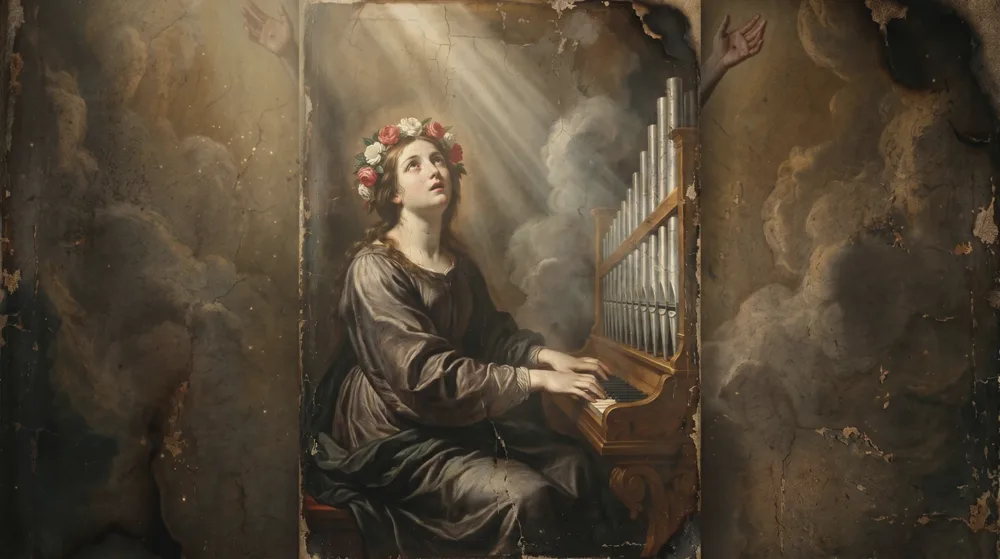
St Cecilia is the patron saint of music and of musicians, a Roman virgin and martyr of the early Church whose feast the Church keeps on 22 November. She is the saint to whom singers, organists, choirs, and composers turn, honoured as patron precisely because, as her ancient legend says, she "sang in her heart to the Lord alone" on the very day of her wedding. Her name stands in the Canon of the Mass among the holy women, and her witness is one of the oldest the Roman Church possesses.
Who St Cecilia was
St Cecilia belonged to a noble Roman family and, according to the tradition received and read in the Church, was a Christian from her infancy. Though she had vowed her virginity to God, she was given in marriage by her parents to a young pagan named Valerian. On her wedding day, while the instruments played, she sang inwardly to God alone and begged Him to keep her body and soul unstained.
When she was left alone with her husband, she told Valerian that she was guarded by an angel of God, who would not suffer her purity to be touched. Valerian asked to see this angel; Cecilia answered that he could not see what belonged to God until he was cleansed of the idols and washed in the font of baptism. She sent him to find the bishop, St Urban, who was then hiding among the tombs of the martyrs on the Appian Way for fear of the persecution. Valerian was instructed, believed, and was baptized. Returning, he found Cecilia at prayer with the angel beside her, who held two crowns of roses and lilies and set them on the heads of husband and wife.
Valerian's brother Tiburtius was converted in his turn, and the two brothers gave themselves to the burial of the martyrs whose bodies the persecutors left exposed. For this they were arrested, refused to sacrifice to the idols, and were put to death, together with an officer named Maximus, whom their constancy had won to the faith. Cecilia buried them, and then her own hour came.
The prefect Almachius condemned her for her faith and for the goods she had given to the poor. She was ordered to be suffocated by the heat of her own bath-house, but the fire and steam did her no harm. The prefect then sent an executioner to behead her. He struck three times, as the law allowed, and could not sever her head; he left her half-killed.
She lived three days, gave away all she had to the poor, commended her household to Pope Urban that her house might be made a church, and so went to God. Her body was buried in the catacomb of St Callistus and afterward translated by Pope Paschal I to the church that still bears her name in the Trastevere quarter of Rome, built over her own house. When her tomb was opened in 1599, her body was found incorrupt, lying on its side as if asleep, and the sculptor Stefano Maderno carved her so, exactly as she lay.
The Roman Martyrology records her on 22 November in these terms: at Rome, the birthday of the holy virgin and martyr Cecilia, who brought her husband Valerian and his brother Tiburtius to the faith of Christ and exhorted them to martyrdom; she herself, under the emperor Marcus Aurelius Severus Alexander, after being commended to the prince of the apostles by the bishop Urban, was crowned with martyrdom.
What St Cecilia is patron saint of
St Cecilia is, before all else, the patron saint of music, of sacred music, and of those who make it — singers, organ-builders and organists, choirs, instrument-makers, and composers. Academies, choral societies, and church choirs across Christendom have taken her as their patroness, and her feast has long been kept by musicians as their own.
The reason lies in a single line of her ancient legend, taken up into the liturgy of her feast. As the Office of St Cecilia has the faithful sing: Cantantibus organis, Caecilia Domino decantabat dicens: Fiat cor meum immaculatum, ut non confundar — "While the instruments played, Cecilia sang in her heart to the Lord alone, saying: Let my heart be undefiled, that I be not confounded." It is from this antiphon, and the wedding music it describes, that the Christian centuries made her the saint of singers. The point of the image is not that she was herself a musician, but that in the midst of worldly festivity her whole soul was turned, in song, to God. That is what sacred music is for, and so she became its patroness.
This is the proper Catholic understanding of music: not a thing pleasing in itself, but a voice lifted to God. The Church's own song, the Gregorian chant, exists for the same end St Cecilia kept on her wedding day — to give the heart a voice in worship and to draw it away from confusion toward God. To take her as patron of music is to ask that all singing be ordered to that end.
She is invoked as well by virgins and by those who, like her, must keep a vow of chastity in the midst of the world — the same conviction that holiness is possible in every state of life which St Francis de Sales would later set out in the Introduction to the Devout Life. The Church names her among the holy women in the Canon of the Mass, and her name is sung in the Litany of the Saints, where the faithful call on her with the whole company of heaven.
The prayer of the Church to St Cecilia
The surest prayer to St Cecilia is the prayer of the Church on her feast, the Collect of her Mass in the Roman Missal of 1962:
Collect of the feast, 22 November
Deus, qui nos ánnua beátæ Cæcíliæ Vírginis et Mártyris tuæ sollemnitáte lætíficas: da, ut, quam venerámur offício, étiam piæ conversatiónis sequámur exémplo. Per Dóminum nostrum Jesum Christum, Fílium tuum: qui tecum vivit et regnat in unitáte Spíritus Sancti Deus, per ómnia sǽcula sæculórum. Amen.
O God, Who gladden us by the annual feast of blessed Cecilia, Your Virgin and Martyr, grant, we beseech You, that we may by virtuous conduct follow her whom we venerate in this sacred rite. Through Jesus Christ, thy Son our Lord, Who liveth and reigneth with thee, in the unity of the Holy Ghost, God, world without end. Amen.
This collect may be said on her feast and on any day, and especially by those who sing or play in the service of the altar. Those who wish to entrust a longer intention to her may make the novena to St Cecilia, praying in her honour on nine consecutive days.
The feast of St Cecilia
The feast of St Cecilia falls on 22 November, the day the Roman Church has kept her memory from antiquity. In the Roman calendar of 1962 her feast is of the third class (a Double before the reform of 1960), celebrated with the Mass Loquebar of a virgin martyr with her own collect, secret and gradual, and her proper Office, in which the antiphon Cantantibus organis and the account of her martyrdom are sung. Her name in the Canon of the Mass, her ancient church in the Trastevere, and the day of choirs and musicians all carry her witness forward.
Hers is one of the oldest cults in the Roman Church, and it has never lost its hold. The virgin who sang to God alone on her wedding day, and who would not be parted from Him by marriage, persuasion, fire, or the sword, remains what she has always been: the saint of those who lift their voices, and their hearts, to the Lord.
The Church of St Cecilia in Trastevere (Santa Cecilia)
The mother church dedicated to her is the Basilica of Santa Cecilia in Trastevere, in Rome, raised over the house where, by ancient tradition, she lived and died. The first church on the site goes back to the early centuries; it was rebuilt by Pope Paschal I in the ninth century, who brought her relics there from the catacomb of St Callistus, and it has been adorned and restored many times since.
Beneath the high altar lies Stefano Maderno's white marble image of the saint, carved to show her body exactly as it was found incorrupt in 1599 — lying on her side, the head turned away, the marks of the executioner's three strokes upon the neck. It remains one of the most visited and most loved of the Roman tituli, and it is the church from which the name "St Cecilia Catholic Church" descends to every later dedication.
Because of this, the countless parishes and churches that bear her name across the world — every St Cecilia Catholic Church, every Santa Cecilia and Saint Cecilia parish — look back to that one church in the Trastevere as their source. They share her patronage of sacred music and her witness of virgin martyrdom, and on 22 November they keep her feast as their patronal day.
St Cecilia's Cathedral and her dedications
Beyond parish churches, St Cecilia is the titular patron of cathedrals — a cathedral being the church that holds the cathedra, or seat, of a bishop. Where a diocese has placed itself under her patronage, the cathedral bears her name and keeps her feast as its own solemnity.
A St Cecilia's cathedral is, like every dedication to her, an act of placing a local Church under the protection of the virgin who sang to God alone; the music of such a cathedral, its choir and its organ, falls under the patronage of the very saint to whom the building is given. To worship in a church dedicated to St Cecilia is to be reminded that the whole purpose of sacred song is the one she kept on her wedding day: Fiat cor meum immaculatum — let my heart be undefiled.
The Dominican Sisters of St Cecilia
Among the religious communities that have taken her as patroness are the Dominican Sisters of St Cecilia, a congregation of teaching sisters in the Dominican tradition who bear her name. Their choice of St Cecilia is fitting on two counts: she is the patroness of sacred music, which has always held a high place in Dominican life and in the chanted Divine Office, and she is a virgin consecrated to God, which is the state the sisters themselves embrace.
Communities of consecrated virgins and sisters naturally look to St Cecilia, who gave God "the first and the whole of her love" and kept her vow of virginity in the midst of the world — the same vocation, lived now under religious vows. Her patronage of such communities is one more form of the single thing she signifies: a life turned wholly, in song and in chastity, to God. St Cecilia takes her place among the saints of the year in our guide to the Catholic saints, listed by feast day.
Frequently Asked Questions
Who was St Cecilia?
St Cecilia was a noble Roman virgin and martyr of the early Church, a Christian from her infancy who had vowed her virginity to God. Given in marriage to a pagan named Valerian, she won him and his brother Tiburtius to the faith, and after their martyrdom was herself put to death for Christ. Her witness is one of the oldest the Roman Church possesses, and her name stands in the Canon of the Mass.
What is St Cecilia the patron saint of?
She is the patron saint of music and of musicians — singers, organists, choirs, instrument-makers, and composers. The patronage comes from a line of her ancient legend taken into the liturgy: on her wedding day, while the instruments played, "Cecilia sang in her heart to the Lord alone." She is also invoked by virgins and those who keep a vow of chastity in the world.
How did St Cecilia die?
She was condemned by the prefect Almachius for her faith. Ordered to be suffocated by the heat of her own bath-house, she took no harm; the executioner then struck three times at her neck, as the law allowed, but could not sever her head and left her half-killed. She lived three days, gave all she had to the poor, and so went to God.
When was St Cecilia born?
The tradition does not record the year of her birth. She lived in the early Roman persecutions, and the Roman Martyrology names the emperor Marcus Aurelius Severus Alexander in connection with her martyrdom. What the Church has always kept is the day of her death, her dies natalis into heaven, on 22 November.
When is the feast of St Cecilia?
Her feast falls on 22 November, the day the Roman Church has kept her memory from antiquity. In the traditional Roman calendar it is a Double, celebrated with her own proper Mass and Office, in which the antiphon Cantantibus organis and the account of her martyrdom are sung.
Where is the Church of St Cecilia?
The mother church dedicated to her is the Basilica of Santa Cecilia in Trastevere, in Rome, built over the house where tradition holds she lived and died. It was rebuilt by Pope Paschal I in the ninth century, who brought her relics there from the catacomb of St Callistus. Every later St Cecilia Catholic Church, Santa Cecilia, and Saint Cecilia parish across the world takes its name and patronage from that Roman church.
Why is St Cecilia the patron saint of music?
The patronage rests on a single line of her ancient legend, taken into the liturgy of her feast: on her wedding day, while the instruments played, "Cecilia sang in her heart to the Lord alone." The point is not that she was a musician, but that amid worldly festivity her whole soul turned, in song, to God — which is exactly what sacred music is for. From this the Christian centuries made her the patroness of singers, organists, choirs, instrument-makers, and composers.
What does the name Cecilia mean?
The name has long been read in the Church through the Latin caecus, "blind," and other pious etymologies, but the saint herself comes from the noble Roman gens Caecilia. The liturgy and her Acts dwell less on the name than on what she did: she "sang in her heart to the Lord alone," and the Church honours her by the deed, not the etymology.
Why do the Dominican Sisters take the name of St Cecilia?
She is the patroness of sacred music, which holds a high place in Dominican life and the chanted Divine Office, and she is a virgin consecrated to God — the very state the sisters embrace under religious vows. A community that gives God the first and whole of its love, in song and in chastity, fittingly looks to the virgin who did the same.
The Iter Fidei app carries the prayers to the saints, the litanies, and the traditional calendar of feasts. Join early access here.
Sources. Butler, Lives of the Saints, 22 November (St Cecilia, Virgin and Martyr); the Roman Martyrology, 22 November; the Roman Missal and Roman Breviary, Proper of Saints, feast of St Cecilia (antiphon Cantantibus organis); the Acts of St Cecilia as received in the Roman liturgy; the Canon of the Mass (Nobis quoque peccatoribus); the history of the Basilica of Santa Cecilia in Trastevere and the translation of her relics by Pope Paschal I.