
Novenas
Novena to St Cecilia
The traditional nine-day novena to St Cecilia, virgin and martyr and patroness of musicians and singers — the full prayer and litany of invocations, said in the days before her feast on 22 November.
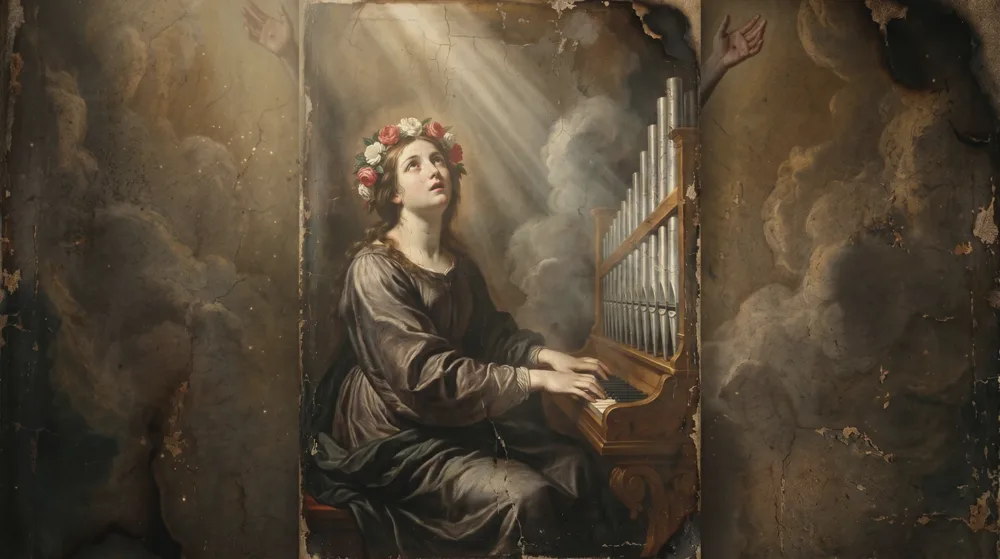
The novena to St Cecilia is the nine-day prayer to the Roman virgin and martyr whom the Church honours as the patroness of music, of musicians and singers, and of all who make and love sacred song. It is prayed for nine days running to ask her intercession — most often by musicians, choirs and students, but by any soul who wishes to keep faith and purity as she did unto death — and it is traditionally said in the days leading up to her feast on 22 November. Below is the complete traditional novena, the litany of invocations at its heart, the story of St Cecilia herself from the old accounts, and how to pray it well. If you are new to this kind of prayer, see first our guide to what is a novena.
The novena to St Cecilia in full
The traditional novena is short and may be said in a few minutes. It is prayed once on each of the nine days, with your own intention named at the start. Each day carries the same prayer: an invocation of the Holy Trinity, a litany of praises to St Cecilia, the Agnus Dei, and the closing collect. Say it slowly, and name what you ask.
In the name of the Father, and of the Son, and of the Holy Ghost. Amen.
Lord, have mercy on us.
Christ, have mercy on us.
Lord, have mercy on us.
Christ, hear us.
Christ, graciously hear us.God the Father of Heaven, have mercy on us.
God the Son, Redeemer of the world, have mercy on us.
God the Holy Ghost, have mercy on us.
Holy Trinity, one God, have mercy on us.Holy Mary, Mother of God, pray for us.
St Cecilia, pray for us.
St Cecilia, wise virgin, pray for us.
St Cecilia, whose heart burned with the fire of divine love, pray for us.
St Cecilia, apostle by thy zeal and charity, pray for us.
St Cecilia, who didst convert thy spouse and procure for him the crown of martyrdom, pray for us.
St Cecilia, who by thy pleadings didst move the hearts of pagans and bring them into the true Church, pray for us.
St Cecilia, who didst unceasingly see thy guardian angel by thy side, pray for us.
St Cecilia, who didst mingle thy voice with the celestial harmonies of the virgins, pray for us.
St Cecilia, who by thy melodious accents didst celebrate the praises of Jesus, pray for us.
St Cecilia, illustrious martyr of Jesus Christ, pray for us.
St Cecilia, who during three days didst suffer most excruciating torments, pray for us.
St Cecilia, consolation of the afflicted, pray for us.
St Cecilia, protectress of all who invoke thee, pray for us.
St Cecilia, patroness of holy canticles, pray for us.
St Cecilia, special patroness and advocate of all singers, musicians, authors, and students, pray for us.Lamb of God, who takest away the sins of the world, spare us, O Lord.
Lamb of God, who takest away the sins of the world, graciously hear us, O Lord.
Lamb of God, who takest away the sins of the world, have mercy on us.V. God glorified St Cecilia.
R. And He crowned her virtues.Let us pray. O eternal God, who didst give us, in the person of St Cecilia, a powerful protectress: grant that, after having faithfully passed our days like her in innocence and holiness, we may one day attain the land of beatitude, where, in concert with her, we may praise and bless Thee for evermore in eternity. Through Christ our Lord. Amen.
(Here name the grace you ask through her intercession.)
Many close the ninth day, or every day, with an Our Father, a Hail Mary and a Glory Be for their intention, offered to God through St Cecilia's prayers.
The St Cecilia novena for musicians
Because St Cecilia is above all the patroness of music and musicians, the novena is prayed most often by choirs, organists, singers, composers, choir directors and church musicians — and by students of music — asking that their art may serve God and not vanity. The tradition rests on the old account of her wedding day: while the instruments played, cantantibus organis, Cecilia sang in her heart to God alone, keeping her soul fixed on Him amid the noise of the world.
That is the grace the musician asks in this novena — not merely skill, but the pure intention that made her singing holy. The invocations above already name her "patroness of holy canticles" and "advocate of all singers, musicians, authors, and students"; a musician need only add, at the close, the particular petition of his craft: that his playing and singing may give glory to God and lift souls to Him. For those who lead sacred music in the Church, it pairs naturally with a right love of the Church's chant and with the Litany of the Saints, long sung in the sacred liturgy.
The St Cecilia novena for students and authors
The same litany names St Cecilia "special patroness and advocate of all singers, musicians, authors, and students," and she has long been invoked by those who study and those who write — poets especially, for whom music and verse are close kin. If you keep the novena for an examination, a course of study, a book or a work of art, name that intention plainly at the close. St Cecilia is one of several holy patrons of learning; see also the patron saint of students for the wider tradition, and the virgin martyr St Catherine of Alexandria, patroness of philosophers and scholars.
The St Cecilia novena for purity and fidelity
Cecilia was a virgin who consecrated herself to Christ and kept that vow within her very marriage, converting her husband Valerian to share it. So the novena is also prayed for the grace of purity, chastity and faithfulness — by the young, by the engaged and married, by those who have made vows of religion, and by any soul asking to "faithfully pass our days like her in innocence and holiness," as the closing prayer says. Prayed with this intention, it stands beside the novenas to the other great virgin martyrs — St Lucy, St Agatha and St Philomena — whose feasts the old Roman Canon still names together at the altar.
How to pray the nine-day novena to St Cecilia
A novena is nine days of the same prayer for one intention — the word comes from the Latin novem, "nine," after the nine days the Apostles and Our Lady spent in prayer between the Ascension and Pentecost. To keep the St Cecilia novena:
- Choose your intention. Name it clearly before you begin — a musical vocation, an examination, purity, a grace for someone you love, or simply the desire to serve God as she did.
- Pray the same prayer each day for nine days without breaking the chain. Say the full text above, adding your petition, an Our Father, a Hail Mary and a Glory Be.
- Time it to her feast. The traditional custom is to begin on 13 November, so that the ninth day falls on the eve of her feast, and to complete it on 22 November, the feast of St Cecilia. But the novena may be prayed at any time of year that a need arises.
- Pray with disposition, not as a formula. A novena does not compel God; it is nine days of trustful asking, made through the prayers of a saint who is close to Him. Ask in submission — Thy will be done — and, where you can, join your novena to Holy Mass, Confession and Communion, or to a decade of the Rosary.
Who was St Cecilia?
St Cecilia was a Roman maiden of a noble family, and one of the most venerated of all the virgin martyrs of the early Church — her name is spoken every day in the Canon of the traditional Mass, among Agatha, Lucy, Agnes and Anastasia. The old accounts, gathered in Butler's Lives of the Saints, tell that she was brought up a Christian from the cradle and vowed her virginity to God, wearing a coarse garment of penance beneath her rich robes and carrying always the Gospel of Christ near her heart.
Her parents gave her in marriage to a young pagan nobleman named Valerian. On the wedding night, while the musicians played and the guests feasted, Cecilia "sang in her heart to the Lord alone" — the phrase from her office, cantantibus organis Caecilia Domino decantabat, from which springs her patronage of music. Alone with her husband, she told him that an angel of God watched over her and guarded her purity, and that he would see the angel if he were purified by Baptism. Valerian sought out Pope Urban, was baptised, and returning saw the angel crown Cecilia and himself with roses and lilies from Paradise. Valerian's brother, Tiburtius, was converted in his turn, and the two brothers gave themselves to burying the bodies of the martyrs, until they too were seized and put to death for the Faith.
Cecilia was then arrested. The old account says she was condemned to be suffocated by the heat of her own bath-house, but remained unharmed amid the fire and steam; an executioner was then sent to behead her, and struck her three times with the sword, yet could not sever her head. She lived on three days, giving away her goods to the poor and asking Pope Urban to consecrate her house as a church — the Basilica of St Cecilia in Trastevere, in Rome, which stands to this day over the place of her home. She died confessing the Blessed Trinity, her fingers held out — three on one hand, one on the other — as a last profession of the faith for which she gave her life.
More than five centuries later her body was found incorrupt, and again in the year 1599, when it was seen lying as she had died and was set in the beautiful marble figure that still lies beneath her altar. St Cecilia is the patroness of music, of musicians, singers, poets and organ-builders, and her feast is kept on 22 November. For her whole life and her place in the Church's devotion, see our fuller account of St Cecilia.
Frequently Asked Questions
When is the St Cecilia novena prayed?
By tradition it is prayed in the nine days before her feast, beginning on 13 November and ending on 22 November, the feast of St Cecilia. But a novena may be made at any time of year; the nine days need only run consecutively, whenever the need arises.
What is St Cecilia the patron saint of?
St Cecilia is the patroness of music and musicians — of singers, choirs, organists, composers, poets and organ-builders — because of the old account that she sang in her heart to God at her wedding while the instruments played. The novena's litany also names her advocate of "authors and students." More widely she is a patroness of purity and fidelity, being one of the Church's great virgin martyrs.
Why is St Cecilia the patron of musicians?
The patronage comes from a single line in her ancient office: on her wedding day, cantantibus organis — "while the instruments were playing" — Cecilia "sang in her heart to the Lord alone," keeping her soul fixed on God amid the music of the feast. From the fifteenth century onward artists depicted her at the organ, and academies and guilds of music took her as their patroness. Her feast on 22 November is still kept as a day of sacred concerts and Masses for musicians.
How do I pray the St Cecilia novena for a musical intention?
Pray the full novena above once a day for nine days, and at the close — where it says to name your grace — ask plainly for what you seek: that your playing or singing may glorify God, for a vocation in sacred music, for success in a performance or examination, or for a choir or school of music. Ask for the pure intention that made her song holy, not merely for skill, and end with Thy will be done.
Is there a printable PDF of the 9-day novena to St Cecilia?
The complete text of the novena is given in full above and may simply be copied out or printed to keep beside you for the nine days — there is nothing more to it than the one prayer, said daily, with your intention named. The Iter Fidei app also carries the whole devotion with audio, so it can be prayed from a phone without a printed sheet.
How did St Cecilia die?
According to the traditional account she was first condemned to die by the heat of her own bath-house but was preserved unharmed; an executioner then struck her three times with the sword and failed to behead her, and she lived on three days before dying of her wounds, having asked that her house be made a church. She is honoured as a martyr, and her body was later found incorrupt and now rests in the Basilica of St Cecilia in Trastevere in Rome.
Can I pray the St Cecilia novena at any time of year?
Yes. Though the custom is to keep it before her feast on 22 November, a novena binds to no date; any nine consecutive days will serve. What matters is that the days run unbroken and that the prayer is made with faith and a settled intention.
Pray this novena to St Cecilia with day-by-day reminders and audio, alongside the traditional novenas, litanies and chaplets, in the Iter Fidei app. Download it here.
Sources. Butler's Lives of the Saints, 22 November, St Cecilia, Virgin and Martyr; the Roman Martyrology and the Canon of the Roman Mass (the Nobis quoque peccatoribus, naming Cecilia among the virgin martyrs); the antiphon of her office, Cantantibus organis, Caecilia Domino decantabat; the traditional novena to St Cecilia and its litany of invocations, with the collect O eternal God, who didst give us in the person of St Cecilia a powerful protectress, as carried in the older prayer-books.