
Novenas
Novena to St Lucy
The traditional nine-day novena to St Lucy, protector of the eyes — the full prayer for eyesight and faith, said the nine days before her feast on 13 December, with the story of the virgin-martyr of Syracuse.
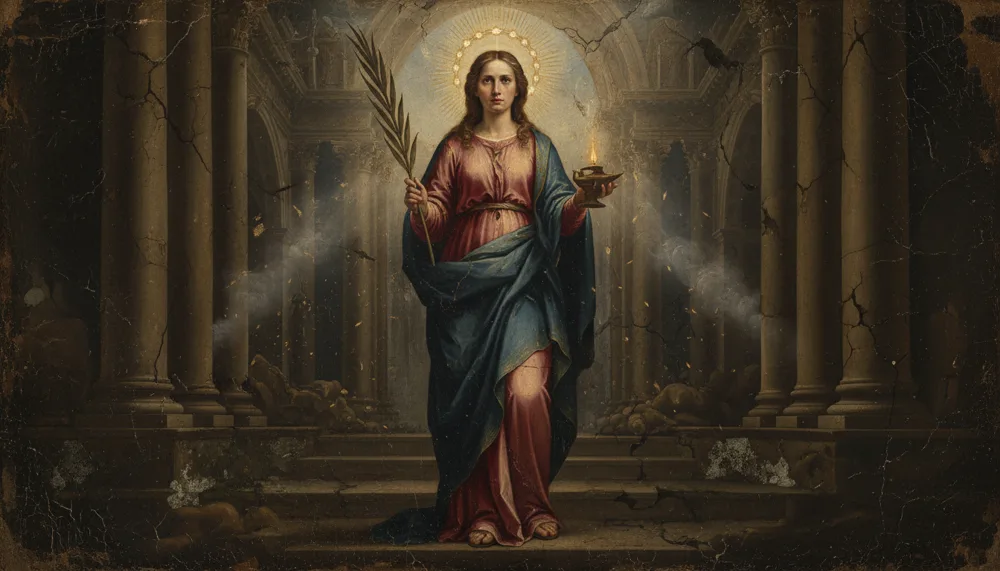
The novena to St Lucy is a nine-day prayer to the virgin-martyr of Syracuse, invoked above all as the protector of the eyes and the patron of all who suffer in their sight or fear to lose it. It is prayed for the healing of the eyes of the body and, no less, for the eyes of the soul — the light of the Faith — and is traditionally kept during the nine days leading up to her feast on 13 December, in the heart of Advent, when her very name, Lucia, "light," shines against the year's longest nights.
Below we give the full novena from the Raccolta, the Church's own collection of indulgenced prayers, the way to pray it, and the story of the saint. For her life and patronages at more length, see our page on St Lucy of Syracuse.
The full novena prayer to St Lucy
The prayers below are those of the Raccolta (no. 523 in the English edition of Ambrose St John), indulgenced by Pope Leo XIII on 27 February 1886. They are said once on each of the nine days: three meditations on St Lucy's faith, hope and charity, each followed by an Our Father, a Hail Mary and a Glory Be, then a petition for the eyes, a versicle and the prayer of her feast. Name your intention at the start; the text is the same every day, and the constancy is the point.
In the name of the Father, and of the Son, and of the Holy Ghost. Amen.
We contemplate with wonder, O glorious virgin and martyr, St Lucy, that light of living faith which God in His mercy was pleased to infuse into thy fair soul. By the light of this faith thou didst know how to despise the vain and fleeting things of this miserable world, and to keep thy eyes fixed on heaven, for which alone we were created. The honours, riches, and pleasures of this seductive world did not obscure thy mind, much less corrupt thy heart, to the injury of thy faith and of divine grace; so that far from consenting to the wicked proposals of the unjust judge, thou didst fearlessly and resolutely encounter even death rather than be unfaithful to thy celestial Lord. What shame for us, who, illumined also by faith and strengthened by grace, know not at all how to resist our guilty passions, despise the perverse maxims of the world, or frustrate the wiles of our enemy the devil! Therefore we beseech thee, dear Saint, to obtain for us greater light from God to understand better that we are not made for earthly things, but for the things of heaven.
Our Father, Hail Mary, Glory Be.
Victorious martyr, St Lucy, admirable was thy virtue of hope, which kept alive in thee the desire of heaven and nourished that filial confidence in God, our most loving Father, which possessed thy heart. Animated with this virtue, while praying fervently for thy mother at the tomb of St Agatha, thou didst obtain for her health in sickness. Full of trust in God, in order to become more completely detached from the things of this earth, thou didst willingly distribute to the poor whatever still remained to thee of earthly treasure; and if courage and strength never failed thee in resisting the tyrant, and in standing firm in the faith in the midst of unspeakable torments, it was solely because thou didst place thy hope in Him who has promised never to abandon us in dangers, but to be to us a shield of defence, ready to work even miracles, such as actually happened in thy glorious martyrdom. Let us then freely confess that too great an attachment to things here below and too little confidence in God harden our hearts, and so deprive us of courage that we often miserably succumb to occasions of danger. Obtain for us, we beseech thee, O blessed St Lucy, a more firm trust in our Lord and God, that we may deserve in every untoward event of our lives to have Him for our helper and consoler.
Our Father, Hail Mary, Glory Be.
Glorious martyr of Jesus Christ, St Lucy, thy living faith and firm hope could not be separated from the fire of most ardent charity which inflamed thy heart, and made thee so ready to shed thy blood and sacrifice thy life for thy spouse Jesus. No wonder the flame of material fire which was applied to thy body by order of the tyrant could not penetrate it or reduce it to ashes. This fire was too weak beside that which burnt in thy breast; and so the impious prefect, seeing that his efforts were vain, ordered that thy throat should be completely severed with a sharp sword. Then it was that thy beautiful soul took its flight to heaven, there to repose on the breast of thy Jesus, and enjoy His heavenly delights for ever. Alas! we love creatures, and so weary ourselves on their account that we find our poor hearts not only void of consolation, but overwhelmed with bitterness. Obtain for us, dear Saint, we beseech thee, that we may be persuaded, once for all, that our true happiness should begin on this earth, in the love of that God who will be the true and the sole object of our perfect and eternal beatitude in heaven.
Our Father, Hail Mary, Glory Be.
Here name your intention, and lay it before her:
Full of confidence in thy powerful intercession, O glorious martyr St Lucy, we beseech thee to intercede with thy divine spouse Jesus, that it may please Him to keep ever healthy the light of our bodily eyes, giving us at the same time the grace to make good use of them, so that on the day of the general resurrection they may become radiant with that heavenly light which will fit them to behold the ineffable beauties of the country of the blessed. Amen.
V. Pray for us, St Lucy.
R. That we may be made worthy of the promises of Christ.Let us pray. Hear our prayers, O God our Saviour, that as we rejoice in the constancy in the faith of the blessed St Lucy, virgin and martyr, so we may be filled with pious and devout affections. Through Christ our Lord. Amen.
In the name of the Father, and of the Son, and of the Holy Ghost. Amen.
The closing prayer is the Raccolta's rendering of the Collect of St Lucy's Mass in the Roman Missal: Exaudi nos, Deus, salutaris noster: ut, sicut de beatae Luciae Virginis et Martyris tuae festivitate gaudemus; ita piae devotionis erudiamur affectu.
That is the whole of it. There are no separate texts for Day 1, Day 2 or Day 5: the same prayers are repeated for all nine days, which is the traditional form. If you have not prayed a novena before, our short guide to what is a novena explains the nine days and their meaning.
A shorter prayer to St Lucy
On days when the full novena cannot be said, the Raccolta gives a second, short prayer (no. 524, indulgenced by St Pius X on 29 December 1907), which may also be added each day after the novena:
O Saint, named from the light, full of confidence we present ourselves before thee, to ask of thee a holy light, which may render us cautious in avoiding the ways of sin and escaping the darkness of error. We beg also, through thy intercession, for the preservation of the light of our eyes, together with abundant grace to use it always in accordance with the will of God and without injury to our souls. Grant, O blessed Lucy, that, after venerating and thanking thee for thy powerful patronage on earth, we may come at last to rejoice with thee in the paradise of the eternal light of the divine Lamb, thy sweet spouse Jesus. Amen.
The popular "O St Lucy" prayer
Many people looking for the St Lucy novena know another prayer, which begins "O St Lucy, you preferred to let your eyes be torn out instead of denying the faith…" and asks her to "preserve the light of my eyes… preserve also the eyes of my soul, the faith." It is a popular modern prayer, translated from the Italian and widely printed on holy cards; it has no older source we can name, and it is not in the Raccolta. It may of course be said with devotion, but the prayers given above are the Church's tested form, and we recommend them for the novena itself.
Novena to St Lucy, protector of the eyes
The most-sought form of this devotion is the novena to St Lucy, protector of the eyes, and it is simply the prayer above prayed with that intention foremost. St Lucy is honoured throughout the Church as the patroness of those afflicted in their sight because of the ancient tradition that her eyes were torn out in her martyrdom and miraculously restored by God — a tradition that fixed her, in the mind of Christendom, as the saint to whom the blind, the failing-sighted, and the fearful turn. When you pray this novena for the eyes, name the affliction plainly: cataracts, glaucoma, macular degeneration, an operation ahead, a child born with weak sight, or the simple dread of the dark. She knew what it was to lose the light and to have it given back.
Novena to St Lucy for eyesight and for the eyes of the soul
It is right and good to beg St Lucy for the healing of failing eyesight — the Church has never been ashamed to ask her saints for the health of the body. But the prayer itself teaches us not to stop there. The Raccolta's petition asks that we "make good use" of our eyes, so that at the resurrection "they may become radiant with that heavenly light" — and this is the deeper petition. A man may keep perfect sight to the grave and yet be blind to God; another may lose his eyes and see Heaven clearly.
So while we pray for the eyesight, we pray still more for that "greater light from God" which the novena begs, to know "that we are not made for earthly things, but for the things of heaven" — that the light of the Faith, which alone shows us the way home, never go out in us. Prayed this way, the novena is a school of hope for the sick, well joined to the novena to St Peregrine for the gravely ill and to the novena to St Raphael the Archangel, who in the Book of Tobias healed the blindness of the elder Tobias.
How to pray the novena to St Lucy
A novena is nine days of steady, trusting prayer, not a formula that binds God. To pray this one well:
- Choose your days. The natural time is the nine days before her feast — begin on 4 December to finish on the eve, or on 5 December to close on the feast of 13 December itself. In 2026 the 13th falls on the Third Sunday of Advent, Gaudete Sunday; in the 1962 calendar the Sunday takes precedence and St Lucy is commemorated in its Mass, so the novena ends on a day already full of Advent joy. The novena may also be prayed at any time of year, whenever the need arises.
- Pray at a fixed hour each day, so the devotion holds its place against a busy life, and say the whole novena above — the three prayers with their Our Father, Hail Mary and Glory Be, the petition for the eyes, and the closing prayer.
- Name one intention and keep to it through all nine days.
- Ask in submission. Add always, spoken or unspoken, Thy will be done. We beg St Lucy for our sight; we leave to God whether the light restored will be of the body, of the soul, or of both. A novena is heard not because it wrings a favour from Heaven but because it commends a soul to a friend of God — and St Lucy does not forget the needy who call on her.
Many join the novena to the daily Rosary; if you would learn or renew that prayer, see how to pray the Rosary.
Who is St Lucy? The virgin-martyr of Syracuse
St Lucy — Lucia — was born at Syracuse in Sicily in the later third century, of a noble Christian family. Her father died when she was a small child, leaving her to be raised by her mother, Eutychia. From her youth Lucy consecrated her virginity to Christ in secret, though her mother, not knowing this, had promised her in marriage to a young pagan.
When Eutychia fell ill with a long affliction, Lucy took her on pilgrimage some forty miles north to Catania, to the tomb of St Agatha, the great virgin-martyr who had suffered there half a century before. There, tradition holds, St Agatha appeared to Lucy and foretold both her mother's healing and Lucy's own coming martyrdom. Her mother was cured, and in thanksgiving Lucy obtained leave to give her dowry to the poor and to keep her vow of virginity.
The rejected suitor, in bitterness, denounced her as a Christian to Paschasius, the governor, in the fierce persecution of the Emperor Diocletian (about the year 304). When she would not sacrifice to the idols, the judge ordered her carried off to a house of shame; but by the power of God she was made immovable, so that neither the guards nor a team of oxen could stir her from the spot. They heaped fire about her and it would not burn her.
At the last, a sword was thrust into her throat, and so she gave her soul to God, having first foretold peace to the Church at the death of the persecuting emperors. The tradition that her eyes were plucked out — and afterward restored by God more beautiful than before — grew up in later ages and joined her forever to the sight she is asked to protect; her name itself, Lucia, means light.
St Lucy's feast has been kept on 13 December since the early centuries, and her name is one of the seven women martyrs — Felicity, Perpetua, Agatha, Lucy, Agnes, Cecilia, Anastasia — named in the Canon of the Mass, spoken at every traditional Mass. She is the patroness of the eyes and of the blind, and is invoked also against diseases of the throat. As one of the most beloved of the virgin-martyrs, she stands with St Agatha (whose novena many also pray), St Cecilia, and St Catherine of Alexandria among the maiden witnesses who chose death before the loss of their faith.
Frequently Asked Questions
What is St Lucy the patron saint of?
St Lucy is the patron saint of the eyes and of the blind, invoked by all who suffer diseases of the sight or fear to lose it — because of the ancient tradition that her own eyes were taken in her martyrdom and restored to her by God. She is also invoked against ailments of the throat (the manner of her death), and is the patroness of her native Syracuse. Her name, Lucia, means "light."
How many days is the St Lucy novena?
It is a nine-day novena — the word novena comes from the Latin for "nine." The same prayers, those of the Raccolta, are said once on each of the nine days, with your intention named throughout. There are no separate texts for each day.
When should I pray the novena to St Lucy?
The most fitting time is the nine days before her feast on 13 December — beginning on 4 December to end on the eve, or on 5 December to close on the feast day itself, in the heart of Advent. In 2026 the feast falls on Gaudete Sunday, so St Lucy is commemorated in the Sunday Mass. But the novena may be prayed at any time of the year, whenever you have need of her intercession for the eyes or the faith.
When is the feast of St Lucy?
The feast of St Lucy is 13 December, kept on that day since the early centuries and honoured in the traditional 1962 calendar as a feast of the third class, of a Virgin and Martyr; when it falls on a Sunday of Advent, as in 2026, it is commemorated in the Sunday Mass. In the northern countries her day, falling near the winter solstice, became a festival of light — a fitting echo of her name.
Why is St Lucy the protector of the eyes?
Because of the tradition that her eyes were torn out during her passion and afterward miraculously restored by God, sound and perfect. This story, joined to the meaning of her name — light — made her from early times the saint to whom Christians turn for the healing and protection of their sight, both the eyes of the body and the "eyes of the soul," which is the Faith.
Is the novena to St Lucy for physical eyesight or for faith?
For both, and the Raccolta prayers ask for both together. They beg her to "keep ever healthy the light of our bodily eyes," and to obtain "greater light from God" for the soul. We rightly ask her for the health of the body; but the deeper petition is that the light of faith, by which alone we find the road to God, never fail in us.
Can I pray the St Lucy novena for someone else?
Yes. A novena may be offered for another as readily as for oneself — for a parent losing their sight, a child born with weak eyes, a friend facing an operation, or a soul who has lost the light of faith. Name them in your intention and carry them through the nine days.
Pray this novena to St Lucy with day-by-day reminders and audio, in Latin and your own language, in the Iter Fidei app. Join early access here.
Sources. Butler's Lives of the Saints, 13 December, St Lucy, Virgin and Martyr; the Roman Martyrology and the Canon of the Roman Mass (St Lucy among the holy virgins); The Raccolta, tr. Ambrose St John (11th ed., 1930), nos. 523 (Leo XIII, 27 February 1886) and 524 (St Pius X, 29 December 1907); the Roman Missal, Collect Exaudi nos of St Lucy; the Book of Tobias (healing of the elder Tobias's blindness); the feast of St Lucy (13 December).