
Novenas
Novena to St Therese Of Lisieux
The full St Therese of Lisieux novena — the nine-day prayer, the Memorare of the Carmel of Lisieux, the collect of her feast and the Twenty-Four Glory Bes — with the meaning of the rose and her story.
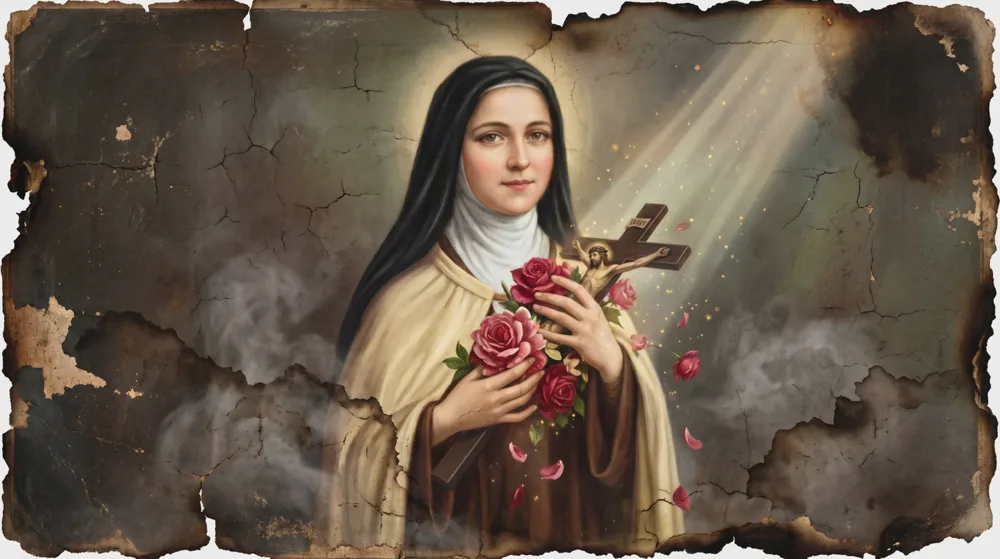
The novena to St Therese of Lisieux is a nine-day prayer to the young Carmelite of the Little Way, St Therese of the Child Jesus, asking her to lay our petition before God — and, by a popular custom, to send us a rose from heaven as the sign that she has heard. It is prayed at any time of need, but above all in the nine days before her feast, kept on 3 October in the traditional calendar (1 October in the newer one).
She herself promised, in her last illness, "After my death I will let fall a shower of roses" and "I will spend my heaven doing good upon earth" — and so the faithful have brought her their favours ever since. Below we give the full novena, the Memorare of the Carmel of Lisieux, the collect of her feast and the famous Twenty-Four Glory Bes, with her story and how to pray each one.
The novena prayer to St Therese
This is the novena as our app gives it — a devotional composition, with no liturgical text and no approval of its own that we can cite; the Church's prayer is the collect of her feast, given below — said once on each of the nine days with your request named in the middle; a short meditation on her life may be read before it each day, followed by three Hail Marys and a Glory Be. Because the prayer does not change, Day 1, Day 3, Day 4 and the rest are all prayed alike: the labour is in the constancy of the nine days, not in the length of the words.
O holy Thérèse! I come to thy feet full of confidence to ask thee for graces. The cross of this life presseth heavily upon me, and between its arms I find nothing but thorns. Little Flower of Jesus, send down upon my soul a shower of flowers of grace and of virtue, that I may climb the Calvary of life made fragrant with their perfume. Send me a smile from thy lips of Heaven and a glance from thy fair eyes: thy caresses are worth more than all the joys the world containeth.
O my God, by the intercession of St Thérèse, give me strength to fulfil my duty exactly, and grant me the grace that I ask of Thee in this novena. (Here name your request, the same throughout the nine days.)
Grant it me, O Lord, if it be conformable to Thy most holy will and to the good of my soul; and if Thou grant it not, obtain for me, O holy Thérèse, that I may abandon myself as thou didst into the arms of my Father in Heaven. St Thérèse of the Child Jesus and of the Holy Face, pray for us. Amen.
Each day closes with this prayer:
O glorious saint! I hope with confidence that thou wilt obtain for me of God the particular grace I ask of thee in this novena. In return I promise to imitate with all my strength thy heroic examples, and to make my own the pages of thy lovely life, that I may have the happiness of enjoying God in thy company in the homeland of the saints. Meanwhile I would, like thee, strew upon earth the petals of my little acts of love at the feet of the Love of loves. Amen.
If you are new to this kind of prayer and wonder why nine days, see our guide to what is a novena.
The Memorare to St Therese and the prayer of her feast
The novena may be crowned each day with the Memorare composed at the Carmel of Lisieux by Mother Isabelle of the Sacred Heart, which recalls her promise of roses, and with the collect of her feast from the Roman Missal of 1962:
Remember, O mighty little Queen, sweet mirror of the merciful Virgin Mary, remember the revelation which thou thyself didst make to us, that never is any man's prayer to thee in vain, and that no one who calleth upon thee is ever forsaken by thee. Filled with the tenderest confidence, I come to put thee in mind of thy promise to spend thy heaven doing good upon earth; I come to beseech thee to pour down upon me, and upon all for whom I implore thy protection, an abundant shower of roses, a torrent of heavenly graces. Make haste to answer my call, vouchsafe to come down to me, to set me on fire with divine love and to hear my humble prayer. Amen.
℣. Pray for us, O holy Thérèse of the Child Jesus.
℟. That we may be made worthy of the promises of Christ.Let us pray. O Lord, who hast said: Unless ye become as little children, ye shall not enter into the kingdom of Heaven: grant us, we beseech Thee, so to follow in the footsteps of the Virgin St Thérèse with humility and simplicity of heart, that we may attain unto the everlasting rewards. Who livest and reignest world without end. Amen.
In Latin the collect runs: Domine, qui dixisti: Nisi efficiamini sicut parvuli, non intrabitis in regnum caelorum: da nobis, quaesumus; ita sanctae Teresiae Virginis in humilitate et simplicitate cordis vestigia sectari, ut praemia consequamur aeterna.
The "Rose Novena" and the sign of a rose
Many people looking for the St Therese novena know a short modern prayer that asks her to "pick a rose from the heavenly gardens" and send it as a message of love. It is a popular holy-card prayer of recent date, with no older source we can name, and we do not reproduce it here; the novena above asks the same thing in the old words, a "shower of flowers of grace and of virtue."
The rose itself goes back to her own words. On her deathbed St Therese said that she would let fall "a shower of roses," and that her heaven would be spent doing good on earth. Ever since, those who pray to her have watched for a rose, offered by a stranger or found unexpectedly, as a token that their prayer has been carried. Her promise is of her intercession, not of a flower: the grace asked is often granted in a form we did not expect, and the prayer is worth no less if no rose comes.
The Twenty-Four Glory Bes (the "Miraculous Novena")
The other great form is the Novena of the Twenty-Four Glory Bes, sometimes called the Miraculous Novena. As its story is usually told, it was begun by a Jesuit, Father Putigan, on 3 December 1925, the year of her canonisation: for nine days he thanked the Holy Trinity twenty-four times, once for each of the twenty-four years St Therese lived on earth, asking for a rose as a sign that his prayer was heard; and a rose was brought to him. Each day, say the invocation, then twenty-four Glory Bes:
Holy Trinity, God the Father, God the Son, and God the Holy Ghost, I thank Thee for all the blessings and favours Thou hast showered upon the soul of Thy servant Therese of the Child Jesus, during the twenty-four years she spent here on earth; and in consideration of the merits of this Thy most beloved Saint, I beseech Thee to grant me this favour (name it), if it be in accordance with Thy most holy Will and is not an obstacle to my salvation.
Then pray the Glory Be twenty-four times, Glory be to the Father, and to the Son, and to the Holy Ghost; as it was in the beginning, is now, and ever shall be, world without end. Amen, adding after each, if you wish, Saint Therese of the Child Jesus, pray for us. It may be said at any time of year; many who keep it make it from the ninth to the seventeenth of the month, so as to join in spirit with all others making it at the same time.
Variants people search for
The 5-day novena to St Therese
Some keep a shorter five-day prayer to St Therese, using the novena prayer above once each day. A novena is properly nine days; but private devotion is free, and a five-day prayer said with faith is worth more than nine said absently. If you begin late, the five days may serve as a shorter preparation for her feast.
A novena for a specific intention
Every form above leaves a place to name your own request. St Therese is invoked for the missions and for priests above all — she is the Patroness of the Missions — but also for the sick (she died of tuberculosis), for those seeking their vocation or facing a decision, for florists and gardeners, and for any soul who wishes to learn her Little Way of trust. Name the favour plainly, and add it to a Mass or a Communion where you can. For a decision or a burden you can no longer carry, her own Little Way is the answer: the abandonment of a child into the arms of the Father, which the novena prayer above asks in so many words.
A printable novena / PDF
We do not offer a PDF. The full text of the novena is given above and prints as it is; the Iter Fidei app holds the whole devotion, with the meditation proper to each of the nine days.
Rather than a loose printout, carry it in the Iter Fidei app: each day's text, a reminder at the hour you choose, offline, in Latin and in English. Join early access here.
How to pray the novena to St Therese
A novena is nine days of the same prayer, said once each day, with one intention held throughout. Choose your form — the novena prayer above, or the Twenty-Four Glory Bes — and keep to it for the nine days. Pray at a fixed hour; name your request the same way each day; where you can, add a decade of the Rosary or attend Mass. Above all, ask as St Therese herself did, in the confidence of a child who trusts a Father: not my will but Thine.
When to start. The novena may be prayed at any time, but the most fitting is the nine days leading to her feast. In the traditional calendar her feast is 3 October, so the nine days run 24 September to 2 October; in the newer calendar the feast is 1 October, and the novena is commonly begun on 22 September. Watch, if you like, for a rose in those days — but do not make the sign the measure of the prayer. St Therese of the Child Jesus and the Holy Face was a Carmelite of the Holy Face devotion; those drawn to her are often drawn also to that older Carmelite treasury and to her great namesake, St Teresa of Avila.
Who is St Therese of Lisieux? The story of the Little Flower
Marie-Françoise-Thérèse Martin was born at Alençon in Normandy on 2 January 1873, the youngest of the nine children of Louis and Zélie Martin, of whom five daughters lived — and all five entered religious life. Her mother died when Thérèse was four, and the sensitive, tearful child was raised at Lisieux by her father and elder sisters. On Christmas night of 1886, at not quite fourteen, she received what she called her "complete conversion," a sudden gift of strength that turned her out of her childish over-sensitiveness; from that hour she burned to give herself wholly to God.
She wished to enter the Carmel of Lisieux, where two of her sisters were already nuns, but was refused for her youth. On a pilgrimage to Rome in 1887 she dared, against all decorum, to kneel before Pope Leo XIII and beg his leave to enter at fifteen; he answered only that she would enter if it were God's will. And so, by the bishop's permission, she entered the Carmel of Lisieux on 9 April 1888, taking the name Sister Thérèse of the Child Jesus and the Holy Face.
Her nine years in Carmel were outwardly without event — the ordinary round of a cloistered nun, hidden, poor, and small. But within them she discovered and lived her "Little Way" of spiritual childhood: since she could not do the great deeds of the saints, she would become holy by doing the smallest things — a kind word, a hidden mortification, a smile to a sister who annoyed her — with the greatest love, trusting God as a little child trusts to be carried up the stairs its own legs cannot climb. At the command of her superiors she wrote the story of her soul, the autobiography known as Story of a Soul (Histoire d'une âme), which after her death would carry her Little Way across the whole world.
In 1896 she began to cough blood — the first sign of the tuberculosis that would kill her. She bore a long and painful final illness, and a dark trial of faith, with heroic patience and trust. She died at Lisieux on 30 September 1897, aged twenty-four, with the words "My God, I love Thee" on her lips. Near the end she made the promises that founded her whole cult: "I will spend my heaven doing good upon earth," and "After my death I will let fall a shower of roses."
The roses came. Favours and cures multiplied so swiftly that Rome could not ignore them: she was beatified in 1923 and canonised by Pope Pius XI on 17 May 1925, barely twenty-eight years after her death. In 1927 the same Pope declared her Patroness of the Missions, with St Francis Xavier — a cloistered girl who never left her convent, made patroness of the Church's far-flung missionaries, because she had offered her whole hidden life for them. (In 1997 she was further named a Doctor of the Church, a modern honour later than the 1962 books, but wholly in keeping with the wisdom of her Little Way.)
She is honoured as the Little Flower, patroness of the missions and of France, of florists and gardeners, and of the sick — and she remains one of the most beloved and most quickly answered of all the Church's intercessors. For another great missionary intercessor, see the Novena to St Francis Xavier; for the confidence her Little Way teaches, the Novena to the Sacred Heart.
Frequently Asked Questions
What is the novena of St Therese of Lisieux?
It is a nine-day prayer asking St Therese of the Child Jesus to place a particular petition before God. Its prayer, said once a day, asks her to send down "a shower of flowers of grace and of virtue," recalling her promise to let fall "a shower of roses" from heaven; many close it with the Memorare of the Carmel of Lisieux and the collect of her feast. Another well-known form is the Twenty-Four Glory Bes. All are prayed for nine days with one intention named throughout.
How do you pray the novena to St Therese of Lisieux?
Choose one form — the novena prayer above is the simplest — and pray it once on each of nine consecutive days, naming your request the same way each day and holding the one intention throughout. Keep a fixed hour, and add a decade of the Rosary or a Mass where you can. Pray in the trust of a child, asking that God's will, not merely your own, be done. Some watch for a rose as a sign, but the prayer's worth does not depend on receiving one.
When should I start the novena, and what is the start date?
You may pray it at any time of need. The usual time is the nine days before her feast: her feast is 3 October in the traditional calendar (nine days: 24 September to 2 October), and 1 October in the newer calendar, for which the novena is usually begun on 22 September. The Twenty-Four Glory Bes are especially prayed on the ninth to the seventeenth of any month.
What does the rose mean in the St Therese novena?
The rose recalls St Therese's deathbed promise to "let fall a shower of roses" — to send graces from heaven. Many who pray her novena receive an unexpected rose, from a stranger or found by chance, and take it as her sign that the prayer has been heard. Ask for it in trust, and if none comes, trust still that she has carried your petition.
Is St Therese of Lisieux the same as St Teresa of Avila?
No. St Therese of Lisieux (1873–1897), the "Little Flower," was a young French Carmelite of the Little Way. St Teresa of Avila (1515–1582) was a sixteenth-century Spanish Carmelite, the great reformer of the order, declared a Doctor of the Church in 1970. Both are Carmelites and both are named Teresa/Therese, which is why they are often confused, but they are two different saints who lived three centuries apart. Each has her own devotion; see St Teresa of Avila.
What is St Therese the patron saint of?
St Therese of Lisieux is the Patroness of the Missions (declared by Pope Pius XI in 1927, with St Francis Xavier) and a patroness of France. She is also invoked as patron of florists and gardeners — for the roses — of the sick, especially those suffering from tuberculosis, of the works for Russia, and of any soul seeking to grow in trust through her Little Way. She is a favourite intercessor for priests and for those discerning their vocation.
How many days is the St Therese novena — nine or five?
The proper novena is nine days, from the Latin for "nine." Some keep a shorter five-day form using the same prayer, when time is short or a shorter preparation for her feast is wished. Both are prayed once a day with a single intention held throughout; choose the nine-day form when you can, the five-day form when you must.
Pray this novena to St Therese with day-by-day reminders and audio in the Iter Fidei app — the nine days with their meditations, the Memorare and the collect of her feast, in Latin and your own language. Join early access here.
Sources. Butler's Lives of the Saints, 3 October, St Teresa of Lisieux; the devotional novena to St Therese of the Child Jesus and the Memorare of Mother Isabelle of the Sacred Heart (Carmel of Lisieux); the Roman Missal (1962), collect Domine, qui dixisti (3 October); the Novena of the Twenty-Four Glory Bes (Fr Putigan, S.J., 1925); St Therese of Lisieux, Story of a Soul (Histoire d'une âme), and her deathbed promise to "let fall a shower of roses"; the canonisation of St Therese by Pope Pius XI (17 May 1925) and her proclamation as Patroness of the Missions (1927); the feast of St Therese of the Child Jesus (3 October, traditional calendar).