
Novenas
Novena to St Catherine Of Alexandria
The nine-day novena to St Catherine of Alexandria — the full prayers, prayed for wisdom, purity, students and scholars, and a good death, leading to her feast on 25 November.
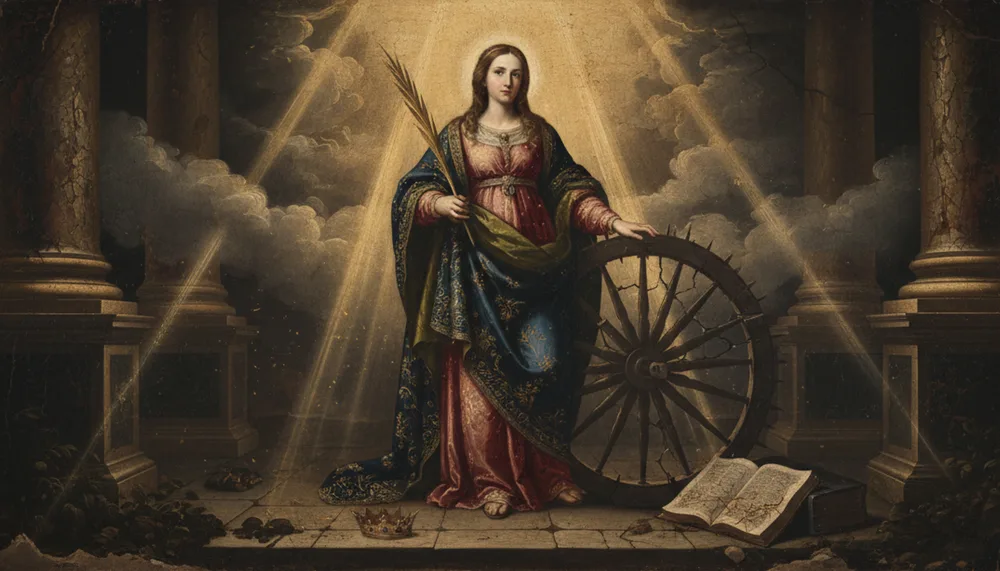
The novena to St Catherine of Alexandria is a nine-day prayer to the fourth-century virgin and martyr whose wisdom, according to her ancient Acts, silenced fifty pagan philosophers and whose purity made her a spouse of Christ — asked most often for wisdom in study, constancy in the Faith, holy purity, and a good death. She is the great patroness of students, scholars, and apologists, and one of the Fourteen Holy Helpers, and her feast falls on 25 November, so the novena is commonly begun on 16 November. Below we give the complete authentic prayers, the intentions the devotion carries, how to keep the nine days, and the story of the saint from the old accounts.
Who St Catherine is, and why we ask her
According to her Acts — late texts, of which no fact can be proved from early documents — St Catherine of Alexandria was a young noblewoman of the early fourth century, learned above all the philosophers of her city, who confessed Christ before a persecuting emperor, out-argued the fifty wise men sent to refute her, was condemned to the wheel and beheaded for her faith.
From that combat comes everything the novena asks of her: she is invoked for wisdom because she confounded the learned, for holy purity because she was a virgin-martyr and spouse of Christ, for students and scholars because she is their patroness, and for a victorious death because she went to hers unshaken. If you are new to this form of prayer, see our guide to what is a novena; and because she is invoked above all by those who study, our page on the patron saint of students belongs beside this one.
She is fully at home in the traditional calendar: her feast, 25 November, is kept in the 1962 Missal, and she stands among the Fourteen Holy Helpers, the band of saints whose collective intercession the Church has commended for centuries in every grave need — a company that includes St Blaise and St George. The novena below follows the classic form used for the Holy Helpers.
The full novena to St Catherine of Alexandria
The following prayers are said once on each of the nine days, from 16 to 24 November, ending on the eve of her feast — though the novena may be prayed at any time of year for any worthy intention. Name your petition at the opening prayer and again at the close. Each day is the same. These prayers come from the devotion to the Fourteen Holy Helpers (see Sources); they are not a liturgical text, and the Church's prayer for her feast is the collect of 25 November, given on our page on St Catherine of Alexandria.
Opening Prayer
Almighty and eternal God! With lively faith and reverently worshipping Thy divine Majesty, I prostrate myself before Thee and invoke with filial trust Thy supreme bounty and mercy. Illuminate the darkness of my intellect with a ray of Thy heavenly light and inflame my heart with the fire of Thy divine love, that I may contemplate the great virtues and merits of Saint Catherine of Alexandria in whose honor I make this novena, and following her example imitate, like her, the life of Thy divine Son.
Moreover, I beseech Thee to grant graciously, through the merits and intercession of this powerful Helper, the petition which through her I humbly place before Thee, devoutly saying, Thy will be done on earth as it is in heaven. (Here name your request.) Vouchsafe graciously to hear it, if it redounds to Thy greater glory and to the salvation of my soul. Amen.
Prayer in Honor of St Catherine
O God, Who didst distinguish Thy holy virgin and martyr Catherine by the gift of great wisdom and virtue, and a victorious combat with the enemies of the Faith; grant us, we beseech Thee, through her intercession, constancy in the Faith and the wisdom of the saints, that we may devote all the powers of our mind and heart to Thy service. Through Christ our Lord. Amen.
Invocation of St Catherine
St. Catherine, glorious virgin and martyr, resplendent in the luster of wisdom and purity: thy wisdom refuted the adversaries of divine truth and covered them with confusion; thy immaculate purity made thee a spouse of Christ, so that after thy glorious martyrdom angels carried thy body to Mount Sinai. Implore for me progress in the science of the saints and the virtue of holy purity, that vanquishing the enemies of my soul, I may be victorious in my last combat and, after death, be conducted by the angels into the eternal beatitude of heaven. Amen.
Concluding Prayer
My Lord and my God! I offer up to Thee my petition in union with the bitter passion and death of Jesus Christ, Thy Son, together with the merits of His immaculate and blessed Mother, Mary ever virgin, and of all the saints, particularly with those of the holy Helper in whose honor I make this novena.
Look down upon me, merciful Lord! Grant me Thy grace and Thy love, and vouchsafe to hear my prayer. Amen.
Then say:
Our Father … Hail Mary … Glory Be …
St Catherine of Alexandria, pray for us!
Many join to the novena a decade of the Rosary, or the Litany of the Saints, and offer a Mass or Holy Communion on one of the nine days — the surest way to bring any petition before God.
The intentions the novena carries
St Catherine has been asked, through all the centuries of her cultus, for a handful of graces above the rest.
For wisdom and for students
Because she out-reasoned the fifty philosophers of Alexandria, St Catherine is the patroness of students, scholars, theologians, and apologists — of all who must think, learn, teach, or defend the Faith. Students facing examinations, scholars at their work, teachers, and those who must give an answer for their belief have prayed her novena for centuries. The Prayer in Honor asks precisely this: "constancy in the Faith and the wisdom of the saints, that we may devote all the powers of our mind and heart to Thy service." For this intention she is naturally invoked alongside St Thomas Aquinas, the patron of Catholic schools, and with St John Cantius, the professor of the University of Cracow; she is not to be confused with the later Dominican, St Catherine of Siena — two great women, two distinct saints.
For holy purity
A virgin-martyr and spouse of Christ, St Catherine is invoked for the grace of holy purity — by the young, by the unmarried, and by all who ask to keep chastity of body and heart. The Invocation begs "the virtue of holy purity" in her own words, and joins that petition to the plea that we may vanquish "the enemies of my soul." In this she keeps company with the other great virgin-martyrs whose novenas the faithful love, among them the Novena to St Philomena.
For a good death
Every part of this novena ends with an eye on the last hour: "that I may be victorious in my last combat and, after death, be conducted by the angels into the eternal beatitude of heaven." St Catherine died her martyr's death without flinching, and as a Holy Helper she is invoked for the grace of a holy and unshaken death — that we, too, may hold the Faith to the end. For unmarried women there is also an old and homely custom of asking her intercession in the choice of a good and Christian spouse.
For desperate and difficult causes
As one of the Fourteen Holy Helpers, St Catherine is among the saints the Church commends in grave trouble, when a soul needs a powerful advocate. Her novena is rightly prayed in hard and seemingly hopeless matters — though for the classic "impossible cause" many turn as well to the Novena to St Jude, the apostle of lost causes.
How to pray this novena
A novena is nine days of steady, trusting prayer, not a formula that compels God. To keep this one well:
- Choose your days. The usual nine are 16–24 November, so that the novena ends on the eve of her feast, 25 November. But it may be prayed in any nine consecutive days you need it.
- Name one intention and hold to it through all nine days — at the Opening Prayer and again wherever you wish. Ask in submission: Thy will be done.
- Say the prayers once each day at a fixed hour, unhurried. The four prayers above, with the Our Father, Hail Mary, and Glory Be, are the whole of it.
- Add the Mass and the Rosary where you can. A novena joined to Holy Communion, even once in the nine days, is the strongest way to bring a petition before God.
- Wait in trust. The grace asked is not always the grace given; a true novena receives either the favour it named or the better thing God chooses to send.
The story of St Catherine of Alexandria
Her feast, its collect in the 1962 Missal and her patronages are set out in our page on St Catherine of Alexandria; here is the story in brief.
According to the ancient accounts, Catherine was born of a noble, perhaps royal, family of Alexandria at the close of the third century, and surpassed all the learning of that most learned of cities. Converted to Christ — tradition tells of a vision of the Blessed Virgin and the Child Jesus, who took her as His spouse — she gave the whole force of her mind to the Faith.
When the emperor Maxentius raised a persecution and commanded the Christians of Alexandria to sacrifice to the idols, the young Catherine went before him and rebuked him boldly for his cruelty. He could not answer her, and summoned fifty of the ablest philosophers to confute her. She met them all, and by the wisdom God gave her overcame them, so that they confessed Christ — and the enraged emperor had them burned to death, the first martyrs of her witness.
Maxentius then tried to win Catherine with the offer of a place at his side; she refused with scorn, professing herself the spouse of Christ. He had her scourged and cast into prison, where — while he was away — his own wife, the empress Faustina, the officer Porphyry, and two hundred soldiers of the guard came to her, were converted, and afterward gave their lives. At the last the emperor condemned her to a horrible death upon a spiked wheel; but when she was bound to it, her bonds were loosed and the wheel flew to pieces, its iron spikes striking down the bystanders. She was then beheaded, and, the old tradition says, angels bore her body to Mount Sinai, where the great monastery that bears her name stands to this day.
For all these reasons the Church honours St Catherine as one of the Fourteen Holy Helpers, keeps her feast on 25 November, and gives her as patroness to students, philosophers, apologists, theologians, unmarried women, nurses, wheelwrights, and craftsmen — and the spinning firework called the Catherine wheel still carries the memory of her martyrdom. Whatever a modern hand may make of the details of so old a story, the Church has venerated her from antiquity, named her in the litanies of the Helpers, and set her before the faithful as a model of wisdom armed for God and purity that feared no emperor.
Frequently Asked Questions
When do you pray the novena to St Catherine of Alexandria?
The usual time is the nine days from 16 to 24 November, ending on the eve of her feast, 25 November. But the novena is not bound to those dates — it may be prayed in any nine consecutive days for any worthy intention: before an examination, in a hard cause, or for the grace of purity and a good death.
What is St Catherine of Alexandria the patron saint of?
She is the patroness of students, scholars, philosophers, theologians, and apologists — of all who study or defend the Faith — because she out-argued fifty pagan philosophers. She is also patroness of unmarried women, nurses, wheelwrights, spinners, and craftsmen, and she is one of the Fourteen Holy Helpers. Students and teachers pray to her especially for wisdom and success in learning.
When is St Catherine of Alexandria's feast day?
Her feast is 25 November, kept on that day in the traditional Roman calendar and the 1962 Missal. This is why the novena is commonly begun on 16 November, so that the ninth day falls on the eve of the feast.
How did St Catherine of Alexandria die?
She was condemned by the emperor Maxentius to be broken on a spiked wheel; but the wheel miraculously shattered when she was bound to it, and so she was beheaded. Tradition holds that angels then carried her body to Mount Sinai. The revolving firework known as the "Catherine wheel" takes its name from the instrument of her martyrdom.
Is St Catherine of Alexandria the same as St Catherine of Siena?
No — they are two different saints. St Catherine of Alexandria was a virgin-martyr of the early fourth century, patroness of students and one of the Holy Helpers. St Catherine of Siena (1347–1380) was a Dominican tertiary and mystic, declared a Doctor of the Church in 1970. You can read about the later saint on our page for St Catherine of Siena.
Why is St Catherine invoked for wisdom and study?
Because, according to the ancient account, the emperor sent fifty of the wisest philosophers to refute her, and by the wisdom God gave her she overcame them all — so that they themselves confessed Christ. From that victory the Church has long invoked her for clarity of mind, success in study, and constancy in defending the Faith, making her the natural patroness of students, scholars, and apologists.
Can I pray this novena for a particular intention, like an exam or a job?
Yes. Name your intention at the Opening Prayer — an examination, a difficult study, a decision, a grave need — and hold to it through the nine days, always adding Thy will be done. St Catherine, patroness of students and a Holy Helper in every trouble, is a fitting advocate; the novena commends your cause to God through her, and leaves the outcome to His wisdom.
The Iter Fidei app carries this novena — and the litanies, chaplets and prayers of the traditional treasury — in Latin and your own language, with day-by-day reminders and audio, so you can keep all nine days from your phone. Join early access here.
Sources. The novena prayers as given in the traditional devotion to the Fourteen Holy Helpers (Bonaventure Hammer, O.F.M., The Fourteen Holy Helpers); Butler's Lives of the Saints and the traditional Acts of St Catherine of Alexandria, virgin and martyr; the Roman Martyrology and the Roman Missal (1962) for the feast of 25 November.