
The Saints
Saint George and the Dragon
Who Saint George is, the legend of Saint George and the dragon, a traditional prayer and novena to St George, what he is the patron saint of, and his feast day, from traditional Catholic sources.
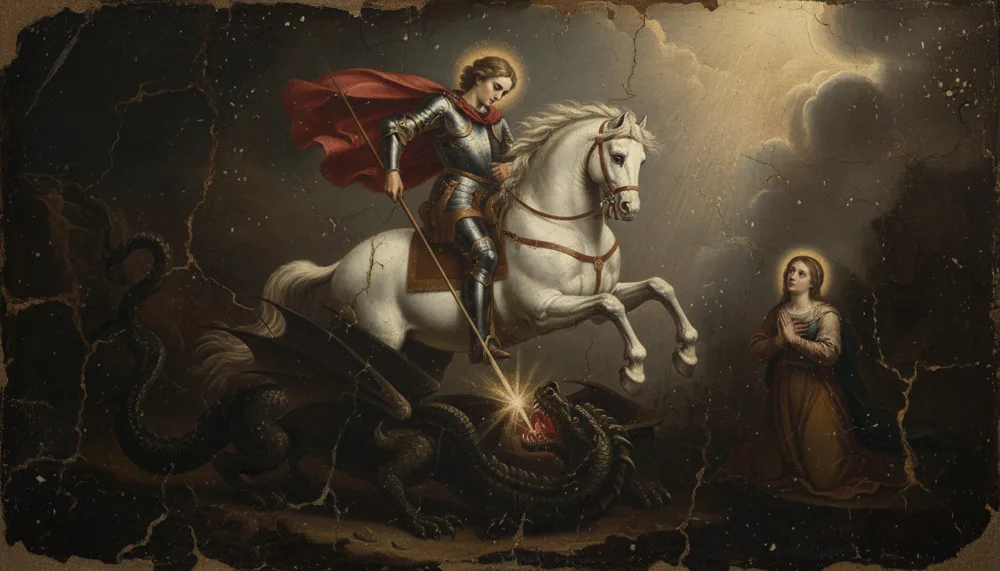
Saint George was a soldier and martyr of the early fourth century, a Christian officer in the Roman army who was put to death for the faith under the persecution of Diocletian, and who is best remembered in legend as the knight who slew a dragon and rescued a maiden. He is the patron of England, of soldiers, and of all who do battle against evil, and his feast falls on the twenty-third of April. Below we set out who Saint George is, the meaning of the legend of Saint George and the dragon, a traditional prayer and novena to St George, what he is the patron saint of, and his feast day, drawn from the traditional lives of the saints.
Who is Saint George
Saint George is one of the most ancient and most universally honoured of the holy martyrs, venerated in the East and the West alike from very early times. The older accounts, which Alban Butler followed, tell us that he was born of noble Christian parents in Cappadocia toward the end of the third century, that after his father's death his mother took him to Palestine, where she had her own lands, and that, coming to manhood, he followed the profession of arms and rose to high rank in the army of the Emperor Diocletian. The later editors of Butler's Lives warn that the Cappadocian birth probably comes from a confusion with another George of Cappadocia, the Arian intruder into the see of Alexandria.
When in the year 303 Diocletian published his edicts against the Christians, ordering the churches to be destroyed and the faithful compelled to sacrifice to the idols, George did not hide his faith. According to the old narrative he came boldly before the rulers, professed himself a Christian, and rebuked the cruelty of the persecution. For this he was seized, racked with grievous torments, cast into prison, and at length beheaded for Christ, so winning the crown of martyrdom. The Church has always counted him among the great soldier-martyrs, and the Greeks have honoured him from of old by the title Megalomartyr, the Great Martyr.
Much in the detailed histories of his sufferings is later and legendary, and the Church has never bound the faithful to the particulars. What is certain is the substance: George was a real martyr who shed his blood for Christ at Lydda (Diospolis) in Palestine, probably before the reign of Constantine; pilgrims from the sixth to the eighth century speak of Lydda as the seat of his cult and the resting place of his relics (Butler, Lives of the Saints, 23 April). It is this firm fact of his martyrdom, not the embroidery of the storytellers, that the Church proposes for our devotion.
The legend of Saint George and the dragon
The famous legend of Saint George and the dragon belongs to the Middle Ages (there is no sure trace of it before the twelfth century) and was spread above all by the Golden Legend of Blessed Jacobus de Voragine. It runs thus. Near a certain city there dwelt in a lake a fearful dragon, whose breath poisoned all who came near. To appease it the townsfolk gave it first their sheep, and then, when these failed, their own children chosen by lot, until at last the lot fell upon the king's daughter.
As she went out, arrayed as a bride, to be devoured, George the knight came riding by. Making the sign of the cross, he charged the dragon, pierced it with his lance, and bound it with the maiden's girdle, leading it captive into the city. There he told the people that he had conquered the beast in the power of Christ, and that if they would be baptized he would slay it. They believed; many thousands received baptism, and George struck off the dragon's head.
The story is not to be taken as sober history, and the traditional writers knew it. Its worth is that of a parable in pictures. The dragon is the ancient serpent, the devil; the maiden is the soul, or the Church herself; the knight who delivers her by the sign of the cross and the lance is the Christian soldier fighting under Christ against the powers of darkness.
So understood, the legend simply clothes in vivid colours the truth of which George's martyrdom is the reality, that the faithful man, armed with grace, overcomes the evil one. It is the same warfare of which Scripture speaks plainly: And there was a great battle in heaven, Michael and his angels fought with the dragon, and the dragon fought and his angels: and they prevailed not (Apocalypse 12:7-8, Douay-Rheims). The image of Saint George trampling the serpent is, in this sense, an image of every Christian's calling to the spiritual combat.
What is Saint George the patron saint of
Saint George is the patron saint of soldiers and of all who must fight, which befits his own profession of arms and his martyr's courage. From the time of the Crusades, when Western knights came to know and love his shrine in the East, he was taken as the model of Christian chivalry, the very pattern of the soldier who serves God before his earthly king.
Above all he is the patron of England. The crusaders brought home a great confidence in his intercession; the synod of Oxford in 1222 made his day a holiday, King Edward III placed his Order of the Garter under his patronage in the fourteenth century, and Pope Benedict XIV recognised him as Protector of the Kingdom (Butler, Lives of the Saints, 23 April). He is likewise venerated as patron of Portugal, of Georgia, of Catalonia, of Genoa, and of many other lands and cities, and is invoked by horsemen, archers, and armourers. Wherever men have had to stand and fight for what is right, they have looked to Saint George.
The cross of Saint George
The cross of Saint George is a plain red cross upon a white field. It became the saint's emblem in the age of the Crusades and was carried as the badge of England, where it remains the cross of the national flag. As a Christian symbol it speaks for itself: the red of the martyr's blood laid upon the white of innocence and faith, the Cross of Christ borne openly into battle. To the Christian eye the banner of Saint George is first of all a profession that the victory is won by the Cross, and not by the strength of arms alone.
A prayer to Saint George
The following traditional prayer asks the great martyr to obtain for us his own courage in the warfare of the soul.
Faithful servant of God and invincible martyr, Saint George, favoured by God with the gift of faith, and inflamed with an ardent love of Christ, thou didst fight valiantly against the dragon of pride, falsehood, and deceit. Neither pain nor torture, sword nor death, could part thee from the love of Christ. I fervently implore thee, for the sake of this love, to help me by thy intercession to overcome the temptations that surround me, and to bear bravely the trials that oppress me, so that I may patiently carry the cross which is placed upon me; and let neither distress nor difficulties separate me from the love of our Lord Jesus Christ. Valiant champion of the faith, assist me in the combat against evil, that I may win the crown promised to them that persevere unto the end. Amen.
This may be joined to a prayer for protection and, fittingly for a soldier-saint, to the prayer to St Michael, the prince of the heavenly host who likewise casts down the dragon.
A novena to Saint George
A novena is nine days of prayer made in preparation for a feast or for some particular intention. To make a novena to Saint George for his feast, one prays for nine consecutive days, from the fourteenth to the twenty-second of April, so that the novena ends on the eve of the feast. On each of the nine days the following invocation is said, the intention is named, and an Our Father and a Glory Be are added; the novena in the Iter Fidei app gives a short meditation on his life for each day.
Glorious St George, faithful soldier of Christ, thou who didst not fear to confess His Name before the mighty and didst give thy life in martyrdom, turn upon us thy gaze of kindness. Thou whom tradition depicts as conqueror of the dragon, obtain for us to vanquish sin and the snares of the enemy of souls; clothe us in the armour of faith, that we may fight the good fight and remain faithful to God in every trial. By the merits of Jesus Christ our Lord, obtain for us courage to serve the good, loyalty in our duties, and perseverance of soul unto the end.
(Here name the intention, the same throughout the nine days.)
St George, martyr and soldier of Christ, pray for us. Amen.
The novena closes with the collect of his feast from the Roman Missal:
O God, who dost gladden us by the merits and intercession of blessed George, Thy Martyr: mercifully grant that we who ask Thy benefits through him may obtain them by the gift of Thy grace. Through our Lord Jesus Christ, Thy Son, who liveth and reigneth with Thee in the unity of the Holy Ghost, God, world without end. Amen.
Those who wish to learn the practice more fully may read our guide to what a novena is.
The feast day of Saint George
The feast of Saint George is kept on the twenty-third of April. In the 1962 Roman calendar it is a commemoration in the universal Church (before the rubrical reform of 1960 it was a simple feast), while in England, where he is the national patron, it is kept as a feast of higher rank. The Roman Martyrology announces his heavenly birthday on this day. Since the twenty-third of April almost always falls in Eastertide, his commemoration is usually kept with the alleluias of the Paschal season.
To keep the day well, the faithful may assist at Mass where it is offered in his honour, make the prayer or novena above, and call to mind that the courage of the martyrs is asked of every Christian in his measure. Saint George belongs in the company of the great soldier-saints and martyrs of the Church, beside St Joan of Arc, the patroness of soldiers, and beside all the holy ones gathered in the communion of saints and named in the Litany of the Saints. Our guide to the Catholic saints sets St George in the company of the other saints of the traditional calendar, month by month.
Frequently Asked Questions
Who is Saint George?
Saint George was a Christian soldier in the Roman army who was martyred for the faith about the year 303, under the persecution of the Emperor Diocletian, and who is venerated at Lydda in Palestine, where his tomb was honoured from very early times. In legend he is the knight who slew a dragon, and he is the patron of England and of soldiers.
Did Saint George really kill a dragon?
The dragon is a legend, not history. The famous tale spread in the Middle Ages through the Golden Legend and is best understood as a parable: the dragon stands for the devil, and George for the Christian soldier who conquers evil by the power of Christ and the sign of the Cross. What the Church holds as certain is that George was a true martyr who died for the faith.
What is Saint George the patron saint of?
Saint George is the patron saint of soldiers, of England, and of Christian chivalry, and he is also honoured as patron of Portugal, Georgia, Catalonia, Genoa, and many other lands. He is invoked by all who must fight, and as a model of courage in the warfare of the soul.
When is the feast of Saint George?
The feast of Saint George is celebrated on the twenty-third of April. In the 1962 Roman calendar it is a commemoration in the universal Church, kept with greater solemnity in England, where he is the national patron.
What is the cross of Saint George?
The cross of Saint George is a red cross on a white field. It became the saint's emblem during the Crusades and is the cross of England. As a Christian symbol it joins the red of the martyr's blood to the white of faith, and proclaims the victory of the Cross of Christ.
Iter Fidei serves the prayers, the Divine Office and the liturgical calendar, in Latin and English with audio. Join early access here.
Sources. Butler, Lives of the Saints (23 April); Roman Missal of 1962 (collect of St George); Jacobus de Voragine, The Golden Legend; the Sacred Scriptures in the Douay-Rheims version (Apocalypse 12).