
Novenas
Novena to Our Lady Of Sorrows
The novena to Our Lady of Sorrows from the Raccolta — the nine days on her Seven Sorrows, the daily prayers, the start date before September 15, and the promises attributed to St Bridget for those who honour her tears.
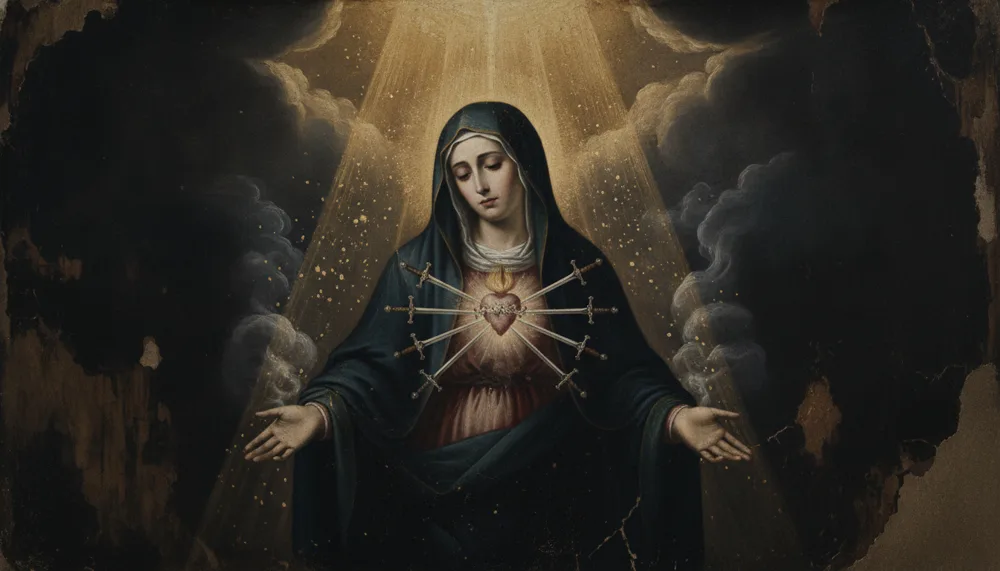
The novena to Our Lady of Sorrows is nine days of prayer at the side of the Mother of God as she stood beneath the Cross, made to honour the Seven Sorrows — the seven swords that pierced her heart from Simeon's prophecy to the burial of her Son — and to ask, through her compassion, the graces we most need. It is prayed above all in the nine days before her feast on 15 September, the feast of the Seven Dolours. Below we give the complete traditional novena from the Raccolta, the daily prayers day by day, the shorter and rosary forms, and the graces popularly said to be promised to those who keep her sorrows before their eyes.
The full novena to Our Lady of Sorrows (from the Raccolta)
This is the authentic traditional form, enriched with indulgences by Pope Pius VII in 1815. It may be said as a nine-day novena, or as a companion to the daily seven Hail Marys offered in honour of Our Lady's Sorrows.
Each day begin with:
V. O God, come to my assistance;
R. O Lord, make haste to help me.
V. Glory be to the Father, and to the Son, and to the Holy Spirit.
R. As it was in the beginning, is now, and ever shall be, world without end. Amen.
The First Sorrow — the Prophecy of Simeon.
I grieve for thee, O Mary most sorrowful, in the affliction of thy tender heart at the prophecy of the holy and aged Simeon. Dear Mother, by thy heart so afflicted, obtain for me the virtue of humility and the Gift of the holy Fear of God. (Pray one Hail Mary.)
The Second Sorrow — the Flight into Egypt.
I grieve for thee, O Mary most sorrowful, in the anguish of thy most affectionate heart during the flight into Egypt and thy sojourn there. Dear Mother, by thy heart so troubled, obtain for me the virtue of generosity, especially toward the poor, and the Gift of Piety. (Pray one Hail Mary.)
The Third Sorrow — the Loss of the Child Jesus in the Temple.
I grieve for thee, O Mary most sorrowful, in those anxieties which tried thy troubled heart at the loss of thy dear Jesus. Dear Mother, by thy heart so full of anguish, obtain for me the virtue of chastity and the Gift of Knowledge. (Pray one Hail Mary.)
The Fourth Sorrow — Mary meets Jesus carrying the Cross.
I grieve for thee, O Mary most sorrowful, in the consternation of thy heart at meeting Jesus as He carried His Cross. Dear Mother, by thy heart so troubled, obtain for me the virtue of patience and the Gift of Fortitude. (Pray one Hail Mary.)
The Fifth Sorrow — the Crucifixion and Death of Jesus.
I grieve for thee, O Mary most sorrowful, in the martyrdom which thy generous heart endured in standing near Jesus in His agony. Dear Mother, by thy heart afflicted in such wise, obtain for me the virtue of temperance and the Gift of Counsel. (Pray one Hail Mary.)
The Sixth Sorrow — the Piercing of the Side and the Descent from the Cross.
I grieve for thee, O Mary most sorrowful, in the wounding of thy compassionate heart, when the side of Jesus was struck by the lance and His Heart was pierced. Dear Mother, by thy heart thus transfixed, obtain for me the virtue of fraternal charity and the Gift of Understanding. (Pray one Hail Mary.)
The Seventh Sorrow — the Burial of Jesus.
I grieve for thee, O Mary most sorrowful, for the pangs that wrenched thy most loving heart at the burial of Jesus. Dear Mother, by thy heart sunk in the bitterness of desolation, obtain for me the virtue of diligence and the Gift of Wisdom. (Pray one Hail Mary.)
Conclude each day:
V. Pray for us, O Virgin most sorrowful,
R. That we may be made worthy of the promises of Christ.Let us pray. Let intercession be made for us, we beseech Thee, O Lord Jesus Christ, now and at the hour of our death, before the throne of Thy mercy, by the Blessed Virgin Mary, Thy Mother, whose most holy soul was pierced by a sword of sorrow in the hour of Thy bitter Passion. We ask this through Thee, Jesus Christ, Saviour of the world, who with the Father and the Holy Ghost livest and reignest, world without end. Amen.
For why the Church asks nine days, see our guide to what is a novena. Many add here the Memorare, which fits the Sorrowful Mother perfectly: Remember, O most gracious Virgin Mary, that never was it known that anyone who fled to thy protection, implored thy help, or sought thy intercession was left unaided.
The novena day by day (Our Lady of Sorrows novena, Day 1 to Day 9)
Many prefer to keep the nine days by taking one sorrow each day — day 1, day 2, and so on, the way the novena is most often searched. This spreads the seven sorrows over the first seven days and closes with two days on the Cross and the feast. Each day, say the opening versicle, meditate on that day's sorrow with the prayer above, pray the Hail Mary, and end with the concluding versicle and collect.
- Day 1 — The Prophecy of Simeon (Luke 2:34-35): ask for humility and holy fear.
- Day 2 — The Flight into Egypt (Matthew 2:13-14): ask for generosity and piety.
- Day 3 — The Loss of the Child Jesus (Luke 2:43-45): ask for chastity and knowledge.
- Day 4 — Mary meets Jesus on the road to Calvary (John 19:17): ask for patience and fortitude.
- Day 5 — The Crucifixion (John 19:25): ask for temperance and counsel.
- Day 6 — The Piercing of His Side and the taking down from the Cross (John 19:34, 38): ask for charity and understanding.
- Day 7 — The Burial of Jesus (John 19:40-42): ask for diligence and wisdom.
- Day 8 — The Exaltation of the Holy Cross: honouring the Cross on which her sorrow and our salvation met; renew all seven petitions.
- Day 9 — The Feast of Our Lady of Sorrows: with the whole devotion made, commend the intention finally to her Sorrowful and Immaculate Heart.
For a fuller meditation on Mary's heart at the foot of the Cross, our reflection on the Immaculate Heart of Mary is a fitting companion.
When to pray it: the start date and the feast day
The feast of Our Lady of Sorrows falls on 15 September, the day after the Exaltation of the Holy Cross — a placing that is no accident, for her sorrow is inseparable from His Cross. To finish the novena on the eve of the feast, begin on 6 September (the nine days 6-14 September, with the feast itself on the 15th); to finish on the feast day, begin on 7 September. Either reckoning is sound.
The Roman calendar of 1962 in fact keeps Our Lady's Sorrows twice: the September feast of the Seven Dolours (second class), and, on the Friday of Passion Week, a commemoration of the older feast (reduced to a commemoration in 1960) — the Friday before Palm Sunday, at the threshold of Holy Week. The novena may be prayed toward either, and, being a devotion of the heart rather than the calendar, it may be said in any time of grief, danger, or need.
The traditional Seven Sorrows devotion (chaplet and rosary)
Behind the novena stands the great devotion of the Seven Sorrows — also called the Seven Dolours — far older than any modern booklet and at the root of every version now searched. In its chaplet form, one meditates on each of the seven sorrows and prays seven Hail Marys after each, so that the whole makes forty-nine Aves, closed with three in honour of Mary's tears. This is the "rosary of the Seven Sorrows" long carried by the Servite Order. We give the beads and their prayers in full in our guide to the Seven Sorrows Chaplet; praying it daily keeps the novena's spirit alive all year.
The devotion's own prayer is the Stabat Mater — At the Cross her station keeping, stood the mournful Mother weeping — the medieval sequence sung on her feast, and the Litany of Our Lady of Sorrows, in which she is hailed as Queen of Martyrs, Comfort of the sorrowful, and Health of the sick. Any of these may be joined to the nine days.
A short novena to Our Lady of Sorrows
When the day is full, a short form keeps the devotion faithfully. On each of the nine days, pray the opening versicle, then the seven Hail Marys — one for each sorrow, recalling the sorrow's name as you begin each — and close with Pray for us, O Virgin most sorrowful, that we may be made worthy of the promises of Christ. This is the daily practice of the seven Aves, the devotion to which the promise below is attached.
The "irresistible" novena and Our Lady's seven graces
The devotion is often called an "irresistible" novena to Our Lady of Sorrows or one "that never fails." The words are devout, not magical: no novena binds God, and to pray as though words could compel Him would be superstition. What gives this devotion its confidence is a promise popularly attributed to St Bridget of Sweden (1303-1373), to whom the fifteen prayers on the Passion are also ascribed — an attribution we cannot verify in a text of her Revelations: Our Lady, it is said, would obtain seven graces for the souls who honour her daily by meditating on her tears and dolours and praying seven Hail Marys:
- Peace in their families.
- Light to understand the divine mysteries.
- Consolation in their trials, and her own company in their labours.
- As much as they ask, so far as it accords with the will of her Divine Son and the sanctification of their souls.
- Defence in their spiritual battles and protection at every instant of their lives.
- Visible help at the hour of death — they shall see the face of their Mother.
- That those who spread this devotion shall be delivered from their sins and be her Son's eternal consolation and joy.
These promises are the ground of the devotion's reputation. Note the fourth: not whatever we want, but as much as we ask, so far as it accords with God's will and our salvation. That is the disposition of every true novena — to ask boldly and receive, always, the better thing. The same Sorrowful Mother is honoured at Fatima, where she asked for reparation to her Immaculate Heart.
The 54-day novena to Our Lady of Sorrows
Some seek a 54-day novena to Our Lady of Sorrows. Properly speaking, the fifty-four-day novena is a rosary devotion — twenty-seven days of petition and twenty-seven of thanksgiving, six novenas of nine days made through the Blessed Virgin. It is not a separate Sorrows novena but the ordinary 54-Day Rosary Novena offered with Our Lady of Sorrows as its patroness; one prays the Rosary each day, dedicating the intention to her Sorrowful Heart, and may add the Seven Sorrows chaplet. For a shorter, more focused petition, the nine-day novena above is the classic form.
Saint Gabriel of Our Lady of Sorrows
The tail rightly asks after St Gabriel of Our Lady of Sorrows (St Gabriel Possenti), the great modern saint of this devotion — the young Passionist who took Mary's sorrows as his whole spirituality and his very name in religion. Born Francis Possenti at Assisi in 1838, the eleventh of thirteen children of a distinguished papal official, he lost his mother at four and was educated by the Jesuits at Spoleto.
By nature he was warm-tempered, fond of dress, of the theatre and of gaiety, and by his own later account in real danger of losing his soul in the world's amusements. Twice gravely ill, twice he vowed to enter religion and drew back — until in September 1856, with the full approval of his Jesuit confessor, he chose the Passionists and received the name Gabriel of Our Lady of Sorrows.
In the cloister the change was total. He gave himself to hidden obedience and to a tender, constant devotion to the Sorrows of Mary, which he made the school of his own short life. Consumption took him before he could be ordained; he died at Isola del Gran Sasso on the morning of 27 February 1862, not yet twenty-four years old, with the sorrows of his Mother on his lips. He was canonized in 1920 and is honoured in the traditional calendar on that same day, 27 February — patron of youth, of students, and of clerics. A novena to St Gabriel of Our Lady of Sorrows is nine days asking his intercession, most fittingly joined to the Seven Sorrows themselves, since it was by them that he became a saint.
How to pray the novena to Our Lady of Sorrows
A novena is measured not by its words but by the soul that says them. A few counsels follow.
- Keep your nine days unbroken — 6-14 September before the feast, the nine days before the Friday of Passion Week, or any nine days of need — and pray at a fixed hour each day.
- Name your intention plainly at the start, and again in the Memorare, but ask always in submission: Thy will be done.
- Meditate, do not merely read — pause at each sorrow long enough to stand there with her; and add what you can, a decade of the Rosary, the Seven Sorrows chaplet, or Holy Communion on the feast.
So prayed, the novena is not a technique for extracting favours but a school of compassion — learning to weep with the Mother, that we may rejoice with the Son.
Frequently Asked Questions
How do you pray the novena to Our Lady of Sorrows?
Pray it for nine consecutive days. Each day, begin with O God, come to my assistance; meditate on the Seven Sorrows using the prayers above — either all seven each day, or one sorrow per day over the first seven days — praying a Hail Mary after each, and close with Pray for us, O Virgin most sorrowful and the collect. Name your intention and keep the nine days unbroken.
When should I start the novena to Our Lady of Sorrows?
To finish on the eve of the 15 September feast, begin on 6 September; to finish on the feast day itself, begin on 7 September. The traditional calendar also keeps the Sorrows on the Friday of Passion Week (before Palm Sunday), so the nine days leading to that Friday are another classic time. Outside these seasons it may be started on any day of need — the devotion is not bound to the calendar.
What are the Seven Sorrows of Mary?
They are: (1) the Prophecy of Simeon; (2) the Flight into Egypt; (3) the Loss of the Child Jesus in the Temple; (4) Mary meets Jesus carrying the Cross; (5) the Crucifixion and Death of Jesus; (6) the Piercing of His side and the taking down from the Cross; and (7) the Burial of Jesus. Meditation on these seven, honoured in the Church since at least the fourteenth century, is the heart of this novena.
Is there a difference between "Our Lady of Sorrows" and "Our Lady of Seven Sorrows"?
None. "Our Lady of Sorrows," "Our Lady of Seven Sorrows," and "Our Lady of the Seven Dolours" are the same title of the Blessed Virgin, honouring the Mother who shared her Son's Passion. The number seven counts the traditional sorrows meditated in the chaplet and novena; the 15 September feast is one and the same under all these names.
What graces does Our Lady of Sorrows promise?
To St Bridget of Sweden, Our Lady revealed seven graces for those who honour her sorrows daily: peace in their families; light in the divine mysteries; consolation and her company in their trials; what they ask, so far as it accords with God's will and their salvation; defence in spiritual battle; visible help at the hour of death; and deliverance from sin for those who spread the devotion. These are graces, not guarantees of any particular favour — asked and given always according to God's will.
Who is Saint Gabriel of Our Lady of Sorrows?
He is St Gabriel Possenti (1838-1862), a young Italian Passionist who took the Sorrows of Mary as his name and his whole devotion. Converted from a worldly youth, he entered religion at eighteen and died of consumption at twenty-three, before ordination. Canonized in 1920 and kept on 27 February, he is the patron of youth and students — living proof that devotion to Our Lady's sorrows makes saints.
Where can I get the novena to Our Lady of Sorrows as a PDF or printable?
The complete text is given above and may be copied to keep beside you for the nine days. Rather than a loose sheet, the Iter Fidei app carries the whole novena — the daily prayers, the Seven Sorrows chaplet, and the Litany — in Latin and your own language, with audio and a day-by-day reminder for each of the nine days.
Pray this novena with day-by-day reminders and audio in the Iter Fidei app. Join early access here.
Sources. Holy Scripture (Luke 2:34-35, 43-45; Matthew 2:13-14; John 19:17, 25-42); the Novena to Our Lady of Sorrows and the devotion of the Seven Sorrows as enriched with indulgences by Pope Pius VII (Audience of 14 January 1815), from the Raccolta; the Stabat Mater and Litany of Our Lady of Sorrows; the seven graces popularly attributed to the revelations of St Bridget of Sweden; the Seven Dolours in the Roman calendar of 1962 (feast of 15 September; commemoration on the Friday of Passion Week); the life of St Gabriel of Our Lady of Sorrows (Gabriel Possenti) in Butler's Lives of the Saints.