
Novenas
The 54 Day Rosary Novena
The complete Miraculous 54 Day Rosary Novena to Our Lady — twenty-seven days in petition and twenty-seven in thanksgiving, with the full 'crown of roses' prayers, the mystery for each day, how to pray it, and the story behind it.
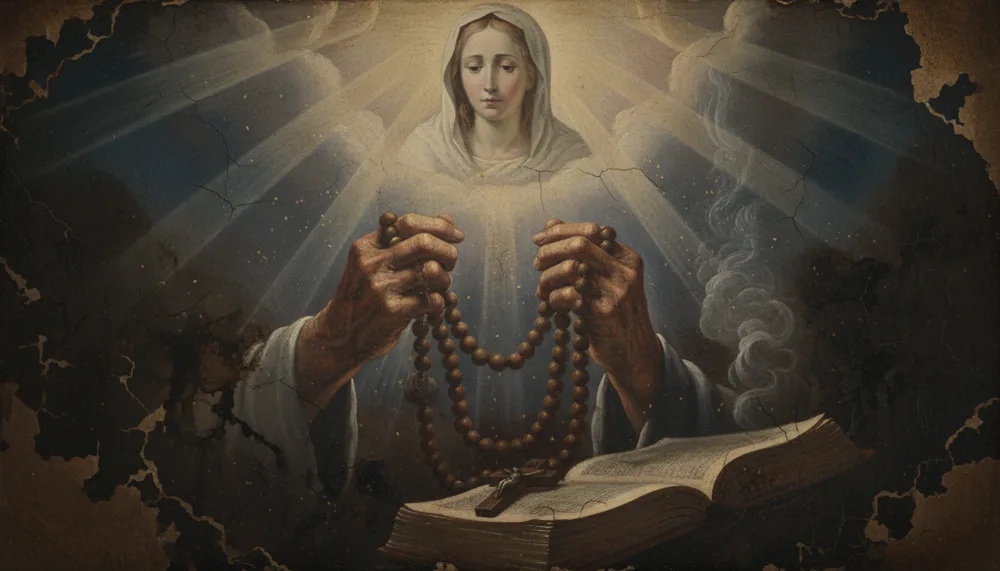
The 54 Day Rosary Novena is a great Marian devotion in which five decades of the Rosary are prayed every day for fifty-four days running — twenty-seven days in petition, asking Our Lady for a grace, and twenty-seven days in thanksgiving, praising her for it whether or not it has yet been granted. Those fifty-four days are really six ordinary nine-day novenas joined end to end, prayed to the Blessed Virgin Mary under her title Queen of the Most Holy Rosary. Below is the complete devotion — the full "crown of roses" prayers, the mystery for each day, how and when to begin, and the story behind it. If you are new to the practice, see first our guide to what is a novena.
What is the 54 Day Rosary Novena?
The devotion rests on a promise Our Lady is said to have made at Naples in 1884: "Whoever desires to obtain favors from me should make three novenas of the prayers of the Rosary, and three novenas in thanksgiving." Three novenas of petition and three of thanksgiving come to six nines — fifty-four days. On each day one prays five decades of the Rosary, and the three sets of Mysteries — Joyful, Sorrowful, Glorious — rotate one set forward each day across the whole fifty-four.
It is often called the Miraculous 54 Day Rosary Novena because of the cure that first attended it (told in full below), and it belongs to the same family of Rosary devotions as the Miraculous Medal Novena and the Novena to Our Lady of Lourdes. What sets it apart is its length: no other common novena carries the soul through so long a discipline of asking and then, before the answer is seen, giving thanks in pure trust.
How the fifty-four days are ordered
The 54 days divide into two halves:
- Days 1–27 — in petition. The first three of the six nine-day novenas (twenty-seven days) are prayed asking for the grace you seek.
- Days 28–54 — in thanksgiving. The last three novenas (twenty-seven days) are prayed thanking Our Lady for the same grace, whether or not it has yet been granted — this act of thanksgiving-before-the-answer is the heart of the devotion.
Within each half the Mysteries rotate in threes, beginning with the Joyful:
- Day 1: Joyful Mysteries
- Day 2: Sorrowful Mysteries
- Day 3: Glorious Mysteries
- Day 4: Joyful — and so on, the same three-day wheel turning for all fifty-four days.
The 1926 booklet carries this rotation straight through — Joyful, Sorrowful, Glorious, repeating — from Day 1 to Day 54, so the Mystery for any day is fixed simply by counting from the first.
A note on the Luminous Mysteries. The authentic devotion uses only the three ancient sets, for it was given in 1884, long before the Luminous Mysteries were proposed in 2002; a "54 day rosary novena with luminous mysteries" is a modern adaptation that breaks the three-day pattern the devotion depends on (see the FAQ below).
The full novena prayers
The prayers below are those of the booklet Rosary Novenas to Our Lady by Charles V. Lacey, published in New York by Benziger Brothers in 1926 with the imprimatur of Cardinal Hayes. Each day follows the same order:
- Sign of the Cross, then a Hail Mary.
- The opening offering — the "crown of roses" prayer — in petition (Days 1–27) or in thanksgiving (Days 28–54), in the form proper to that day's Mysteries.
- The Apostles' Creed, Our Father, three Hail Marys and Glory Be.
- The five decades of the day's Mysteries (see how to pray the Rosary); after each decade, the short offering of the virtue proper to that Mystery (see below). The booklet also sets a brief meditation before each decade.
- The act of Spiritual Communion, then the "Sweet Mother Mary" prayer in petition or in thanksgiving, followed by a Hail Mary.
- The closing prayer, "O God! Whose only-begotten Son…"
- "May the divine assistance remain always with us. Amen. And may the souls of the faithful departed, through the mercy of God, rest in peace. Amen. Holy Virgin, with thy loving Child, thy blessing give to us this day (night)", and the Sign of the Cross.
The opening offering — in petition (Days 1–27)
On the days of petition, offer the day's Rosary with the prayer proper to its Mysteries. Each set of Mysteries has its own roses.
On Joyful days:
Hail, Queen of the Most Holy Rosary, my Mother Mary, hail! At thy feet I humbly kneel to offer thee a Crown of Roses –– snow-white buds to remind thee of thy joys –– each bud recalling to thee a holy mystery; each ten bound together with my petition for a particular grace. O Holy Queen, dispenser of God's graces, and Mother of all who invoke thee! thou canst not look upon my gift and fail to see its binding. As thou receivest my gift, so wilt thou receive my petition; from thy bounty thou wilt give me the favor I so earnestly and trustingly seek.
I despair of nothing that I ask of thee. Show thyself my Mother!
On Sorrowful days, the roses become blood red roses to remind thee of the passion of thy divine Son, with Whom thou didst so fully partake of its bitterness –– each rose recalling to thee a holy mystery; the rest of the prayer is unchanged.
On Glorious days, they become full-blown white roses, tinged with the red of the passion, to remind thee of thy glories, fruits of the sufferings of thy Son and thee –– each rose recalling to thee a holy mystery; the rest is unchanged.
The opening offering — in thanksgiving (Days 28–54)
On the days of thanksgiving, the same three kinds of roses follow the same rotation, but the offering is made gratefully:
Hail, Queen of the Most Holy Rosary, my Mother Mary, hail! At thy feet I gratefully kneel to offer thee a Crown of Roses –– snow-white buds to remind thee of thy joys –– each bud recalling to thee a holy mystery; each ten bound together with my petition for a particular grace.
O Holy Queen, dispenser of God's graces, and Mother of all who invoke thee! thou canst not look upon my gift and fail to see its binding. As thou receivest my gift, so wilt thou receive my thanksgiving; from thy bounty thou hast given me the favor(s) I so earnestly and trustingly sought.
I despaired not of what I asked of thee, and thou hast truly shown thyself my Mother.
On Sorrowful and Glorious days the roses change exactly as in the petition.
The Hail, Holy Queen
The 1926 booklet does not set the Hail, Holy Queen in the order of the novena: after the fifth decade it passes straight to the Spiritual Communion. Its 1954 edition adds, among the Rosary prayers printed at the end, the text of the Hail, Holy Queen and the ordinary way of saying the Rosary, which closes with it after the last decade. Those who are used to ending their Rosary so may keep it:
Hail, holy Queen, Mother of mercy, our life, our sweetness, and our hope. To thee do we cry, poor banished children of Eve; to thee do we send up our sighs, mourning and weeping in this valley of tears. Turn, then, most gracious advocate, thine eyes of mercy toward us, and after this our exile show unto us the blessed fruit of thy womb, Jesus. O clement, O loving, O sweet Virgin Mary. Pray for us, O holy Mother of God, that we may be made worthy of the promises of Christ. Amen.
The Spiritual Communion and the concluding prayer
The wreath of roses is bound with a Spiritual Communion:
MY JESUS, really present in the most holy Sacrament of the Altar, since I cannot now receive Thee under the sacramental veil, I beseech Thee, with a heart full of love and longing, to come spiritually into my soul through the immaculate heart of Thy most holy Mother, and abide with me forever; Thou in me, and I in Thee, in time and in eternity, in Mary. Amen.
In petition (Days 1–27):
Sweet Mother Mary, I offer thee this Spiritual Communion to bind my bouquets in a wreath to place upon thy brow.
O my Mother! look with favor upon my gift, and in thy love obtain for me (specify request).
In thanksgiving (Days 28–54):
Sweet Mother Mary, I offer thee this Spiritual Communion to bind my bouquets in a wreath to place upon thy brow in thanksgiving for (specify request) which thou in thy love hast obtained for me.
Then say a Hail Mary.
The closing prayer
O God! Whose only-begotten Son, by His life, death, and resurrection, has purchased for us the reward of eternal life; grant, we beseech Thee, that, meditating upon these mysteries of the Most Holy Rosary of the Blessed Virgin Mary, we may imitate what they contain and obtain what they promise. Through the same Christ our Lord. Amen.
Neither edition of the booklet contains the Fatima prayer — O my Jesus, forgive us our sins, save us from the fires of hell, and lead all souls to Heaven, especially those in most need of Thy mercy. It is no part of the novena; those who already say it after each decade of their Rosary need not drop it here. On that devotion, see the Novena to Our Lady of Fatima.
The 54 Day Rosary Novena in petition and in thanksgiving
The two "phases" people search for — the 54 day rosary novena in petition (days 1–27) and the 54 day rosary novena in thanksgiving (days 28–54) — are simply the two halves already described: the same Rosary, the same rotation of Mysteries, and the same intention carried throughout. Its genius is that you begin thanking Our Lady on Day 28 even before any answer is seen — not pretending, but faith, as a child thanks a good mother before the gift is unwrapped.
The virtues asked with each Mystery
After each decade the booklet has the soul offer that decade as a bouquet, with a petition for the virtue its Mystery teaches, so that the fifty-four days become a small school of the Christian life. On Joyful days the formula runs:
I bind these snow-white buds with a petition for the virtue of humility and humbly lay this bouquet at thy feet.
On Sorrowful days one says "I bind these blood-red roses…", and on Glorious days "I bind these full-blown roses…", each time naming the virtue of the Mystery:
- Joyful Mysteries — humility (the Annunciation), charity (the Visitation), detachment from the world (the Nativity), purity (the Presentation), and obedience to the will of God (the Finding in the Temple).
- Sorrowful Mysteries — resignation to the will of God (the Agony), mortification (the Scourging), humility (the Crowning with Thorns), patience in adversity (the Carrying of the Cross), and love of our enemies (the Crucifixion).
- Glorious Mysteries — faith (the Resurrection), hope (the Ascension), charity (the Descent of the Holy Ghost), union with Our Lord Jesus Christ (the Assumption), and union with Our Lady herself (the Coronation).
How to pray the 54 Day Rosary Novena
The devotion is simple in shape, long in discipline. In brief:
- Choose your intention — one grace you will carry through all fifty-four days: marriage, a future spouse, a child, the conversion of a loved one, health, our nation and the Church, or any good end.
- Pray five decades of the Rosary each day for fifty-four days running.
- Days 1–27: use the petition prayers. Follow the Mystery rotation (Joyful, Sorrowful, Glorious, repeating).
- Days 28–54: use the thanksgiving prayers, continuing the same rotation, thanking Our Lady whether or not you have yet received the grace.
- Keep the same intention throughout, and end each day resigned to God's will.
You need not kneel throughout, nor pray aloud, nor finish in one sitting — though praying at a fixed hour helps greatly, and a novena app can remind you at that hour each day. What matters is the daily fidelity and the trust behind it.
When to start, and start dates
Any day may serve to begin, for the devotion sanctifies whatever fifty-four days you give it. Many, however, like to end on a feast of Our Lady, and simply count back fifty-four days to find their start. A well-loved arrangement begins on 15 August, the Assumption, and ends exactly on 7 October, the feast of Our Lady of the Rosary — fifty-four days to the day.
Others count back from the Immaculate Conception (8 December), from Our Lady of Lourdes (11 February), or from Our Lady of Fatima (13 May). To find any start date, take the feast you wish to end on and count back fifty-three days; that earlier day is your Day 1. There is nothing magical in the dates — they are simply a devout way of laying the whole novena, like a wreath, at Our Lady's feet on her feast.
If you miss a day
No rule of the Church settles the question, and the 1926 booklet says nothing about it. In Poland, where the novena is prayed with all fifteen mysteries each day, those who spread it counsel beginning again from Day 1, since the devotion is by nature fifty-four consecutive days; they allow a day's prayer cut short by something wholly beyond one's control, such as a loss of consciousness, to be finished the next day. That is counsel, not law. Keep the right measure: a novena is not a magic formula, and an involuntary interruption is no fault. What would be wrong is to treat the count as a mechanism.
The story of the Miraculous 54 Day Rosary Novena
The devotion comes from Naples in the 1880s and is bound up with Bartolo Longo, founder of the great shrine of Our Lady of the Rosary at Pompeii — a man who in his youth had fallen into spiritism and even a mock satanic "ordination" before he was rescued from that darkness and gave the rest of his life to spreading the Rosary. (Longo died in 1926, was beatified by Pope John Paul II in 1980 and canonized on 19 October 2025, so his title "Saint" is a modern honour, later than 1962; the devotion itself goes back to 1884.)
The account reproduced in the 1926 booklet runs as follows; it is a private revelation, never the object of a judgment of the Church that we can cite. In February 1884 a young woman of Naples, Fortuna Agrelli, lay gravely ill. For more than a year she had suffered dreadful cramps and convulsions; the most celebrated physicians had given her up. On the sixteenth of February she and her family began a novena of Rosaries, begging the intercession of Our Lady. On 3 March 1884 the Blessed Virgin appeared to her, seated upon a high throne, the Divine Child on her lap and a Rosary in her hand, attended by Saint Dominic and Saint Catherine of Siena. Fortuna implored her cure, and Our Lady answered: "Make three novenas, and thou shalt obtain all."
It was at a later apparition that Our Lady gave the words on which the fifty-four days rest: "Whoever desires to obtain favors from me should make three novenas of the prayers of the Rosary, and three novenas in thanksgiving." Fortuna obeyed and was restored to health, and "this miracle of the Rosary," as the old account calls it, made a very deep impression on Pope Leo XIII, the great "Rosary Pope."
From that time the Miraculous 54 Day Rosary Novena has been prayed by Catholics the world over. The prayers given above are later still: they come from the booklet Rosary Novenas to Our Lady, compiled by Charles V. Lacey and first published in 1926, with a preface by Rev. Raymond P. Lawrence. But the devotion, and the promise behind it, come from that Neapolitan sick-room in Lent of 1884.
Does the 54 Day Rosary Novena "never fail"?
It is sometimes called the novena that "never fails," and countless testimonies attend it — conversions, healings, marriages, children granted after long waiting. But no novena binds God, and to pray as though a fixed number of days could compel Him would be superstition, which the Church condemns. The devotion is powerful not because fifty-four is a magic number, but because it is fifty-four days of the Rosary — of turning the whole heart to Christ through His Mother. Our Lady's promise is to obtain favours for those who pray it faithfully; the grace she gives is always the one truly best for the soul, not always the exact thing we named. Prayed in that spirit, it does not fail to draw down a blessing.
Frequently Asked Questions
What is the 54 Day Rosary Novena?
It is a Marian devotion in which five decades of the Rosary are prayed every day for fifty-four consecutive days — twenty-seven in petition and twenty-seven in thanksgiving — to obtain a grace through Our Lady, Queen of the Most Holy Rosary. The fifty-four days are six nine-day novenas joined together, following a promise Our Lady made at Naples in 1884.
How do you pray the 54 Day Rosary Novena?
Choose one intention and pray five decades of the Rosary each day for fifty-four days: days 1–27 use the petition prayers, days 28–54 the thanksgiving prayers. The Mysteries rotate in a three-day cycle throughout — Joyful, Sorrowful, Glorious, repeating — beginning with the Joyful on Day 1. Each day opens with the "crown of roses" offering; after the five decades come the Spiritual Communion with the "Sweet Mother Mary" prayer and a Hail Mary, the closing prayer, and the final blessing.
Who is Our Lady of Pompeii?
She is Our Lady of the Rosary, honoured under the title of the Italian shrine in the Valley of Pompeii. It is not an apparition or a new title: it is the painting Bartolo Longo had placed there in 1875, in which the Virgin, seated with the Child, hands the Rosary to Saint Dominic and Saint Catherine of Siena — the two saints seen at her feet. The title comes from a place and an image, not from a revelation.
Why is it called the Miraculous 54 Day Rosary Novena?
Because of the cure that first attended it. According to the account printed in the 1926 booklet, in 1884 Our Lady appeared to a gravely ill young woman of Naples, Fortuna Agrelli, and told her to make three novenas; at a later apparition she asked for three novenas of the Rosary and three in thanksgiving. Fortuna obeyed and was restored to health.
When should I start the 54 Day Rosary Novena?
Any day may serve, but many like to end on a feast of Our Lady and count back fifty-three days to find their Day 1. Beginning on the Assumption (15 August) ends the novena on Our Lady of the Rosary (7 October), exactly fifty-four days later. Others count back from the Immaculate Conception (8 December) or Our Lady of Fatima (13 May).
What happens if I miss a day?
No rule of the Church fixes it, and the 1926 booklet is silent. Those who spread the novena in Poland counsel beginning again from Day 1 to keep the fifty-four days unbroken, unless the day was interrupted by something wholly beyond your control. A novena is not a magic formula, and an involuntary interruption is no fault.
Can I pray it in petition and in thanksgiving at the same time?
No — they are the two halves of one novena, prayed in order: the first twenty-seven days in petition (asking), the last twenty-seven in thanksgiving (giving thanks, even before the grace is seen). The whole power of the devotion lies in that sequence — you learn to thank Our Lady in trust, before the answer comes.
Does the traditional 54 Day Rosary Novena use the Luminous Mysteries?
No. The authentic devotion, given in 1884, uses only the three ancient sets — Joyful, Sorrowful, and Glorious — in a three-day rotation; the Luminous Mysteries were proposed only in 2002. Those who keep the traditional Rosary should pray it as it was given, with the three sets alone, since adding a fourth breaks the three-day pattern the devotion is built on. If you pray from your phone, our comparison of the best rosary apps notes which ones let you keep to the fifteen mysteries.
What can I pray the 54 Day Rosary Novena for?
For any good intention: a marriage or a future spouse, a child (see our prayer for children), the conversion of a loved one, health, employment, peace in a family, the good of the Church and one's nation, or a cause the world calls impossible. Carry one intention through all fifty-four days, and leave the outcome to God's will.
The Iter Fidei app gathers traditional prayers and novenas. Join early access here.
Sources. Charles V. Lacey, Rosary Novenas to Our Lady (Benziger Brothers, 1926), for the crown-of-roses prayers in petition and thanksgiving, the virtues of the Mysteries, the Spiritual Communion, the closing prayer and final blessing, and the account of the apparitions to Fortuna Agrelli at Naples (1884), with the edition of 1954 for the Rosary prayers it appends, the Salve Regina (Hail, Holy Queen) among them; the Holy Rosary and its Mysteries; the apostolic letter Rosarium Virginis Mariae (2002) on the Luminous Mysteries; the Rosary encyclicals of Pope Leo XIII; on superstition, the Catechism of the Council of Trent on the First Commandment.