
Novenas
Novena to Our Lady Of The Rosary
The nine-day novena to Our Lady of the Most Holy Rosary — the 'Queen of the Most Holy Rosary' prayer and the Fatima Rosary novena in full, for the feast of 7 October, with the Pompeii and San Nicolás variants.
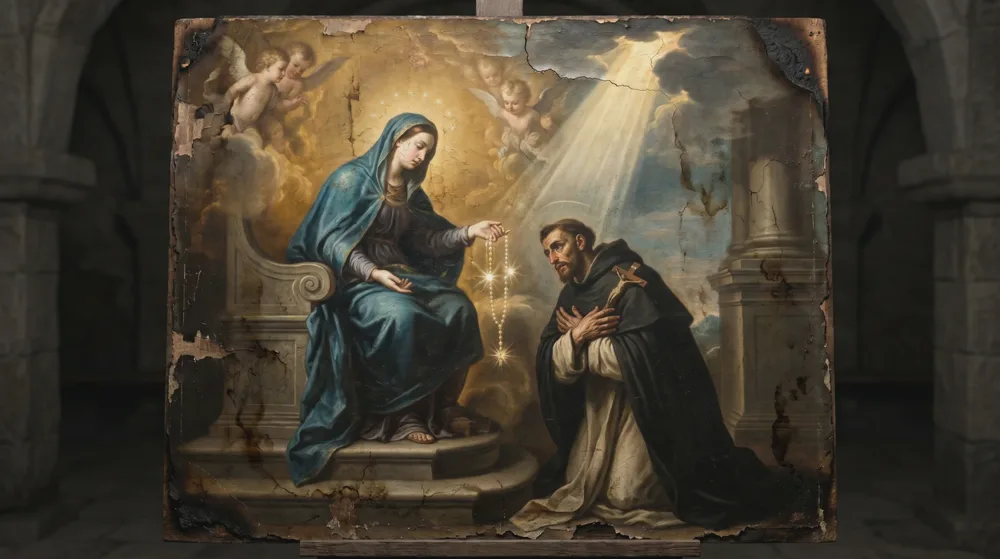
The novena to Our Lady of the Rosary is a nine-day prayer to the Blessed Virgin under her ancient title of Queen of the Most Holy Rosary, made in the days leading up to her feast on 7 October — the day the Church keeps in thanksgiving for the victory of Lepanto, won in 1571 while all Christendom prayed the Rosary. It is offered for every need a soul can bring to its Mother: for the Church in her conflicts, for the conversion of sinners, for peace, and for the one favour a suppliant names in his heart. Below we give the full novena in both of its common forms — the Queen of the Most Holy Rosary prayer and the Fatima Rosary novena (twentieth century) — together with the Pompeii and San Nicolás variants.
When to pray the novena to Our Lady of the Rosary
Because the feast falls on 7 October, the nine days of the novena are ordinarily prayed from 28 September through 6 October, ending on the eve of the feast; some keep it from 29 September to 7 October, so that the last day is the feast itself. Either is right. The heart of the devotion is not the calendar but the daily Rosary: on each of the nine days you pray five decades of the Rosary and add the novena prayer, naming your intention. If the meaning of the nine days is new to you, see our guide to what is a novena; and if you would set the beads in your hand more surely, how to pray the Rosary.
The novena prayer: "Queen of the Most Holy Rosary"
This is the prayer of the novena found in older prayer-books. It is a devotional prayer, not a liturgical text, and we cannot cite an exact reference for an approval of its own; the Church's prayer for the feast is the collect given below. It begs Our Lady, the powerful vanquisher of heresies, to defend the Church in her conflict — the very grace for which Lepanto is remembered. It is said once on each of the nine days:
Queen of the most holy Rosary, in these times of such brazen impiety, manifest thy power with the signs of thine ancient victories, and from thy throne, whence thou dost dispense pardon and graces, mercifully regard the Church of thy Son, His Vicar on earth, and every order of clergy and laity, who are sore oppressed in the mighty conflict.
Do thou, who art the powerful vanquisher of all heresies, hasten the hour of mercy, even though the hour of God's justice is every day provoked by the countless sins of men.
For me who am the least of men, kneeling before thee in supplication, do thou obtain the grace I need to live righteously upon earth and to reign among the just in heaven, the while in company with all faithful Christians throughout the world, I salute thee and acclaim thee as Queen of the most holy Rosary. (Here name your request.)
Queen of the most holy Rosary, pray for us!
Many close each day with the collect of the feast, said by the Church at Mass on 7 October:
O God, whose only-begotten Son, by His life, death, and resurrection, hath purchased for us the rewards of eternal life: grant, we beseech Thee, that meditating upon these mysteries of the most holy Rosary of the Blessed Virgin Mary, we may imitate what they contain and obtain what they promise. Through the same Christ our Lord. Amen.
The Our Lady of the Rosary of Fatima novena
The most-sought form of this devotion binds it to Fatima, where in October 1917 the Blessed Virgin named herself: "I am the Lady of the Rosary." This is the daily prayer of the Our Lady of the Rosary of Fatima novena, offered with the Rosary in accordance with her requests at the Cova da Iria. It too is said once on each of the nine days:
My dearest Mother Mary, behold me, your child, in prayer at your feet. Accept this Holy Rosary, which I offer you in accordance with your requests at Fatima, as a proof of my tender love for you, for the intentions of the Sacred Heart of Jesus, in atonement for the offenses committed against your Immaculate Heart, and for this special favor which I earnestly request in my Rosary Novena. (Here name your request.)
I beg you to present my petition to your Divine Son. If you will pray for me, I cannot be refused. I know, dearest Mother, that you want me to seek God's holy Will concerning my request. If what I ask for should not be granted, pray that I may receive that which will be of greater benefit to my soul.
I offer you this Spiritual Bouquet of Roses because I love you. I put all my confidence in you, since your prayers before God are most powerful. For the greater glory of God and for the sake of Jesus, your loving Son, hear and grant my petition. Sweet Heart of Mary, be my salvation. Amen.
Because Our Lady of Fatima is Our Lady of the Rosary, this novena joins naturally to the wider Fatima devotion — the First Saturdays of reparation to her Immaculate Heart and the fuller novena to Our Lady of Fatima. Both prayers above are authentic; pray whichever draws your heart, or pray the Queen of the Most Holy Rosary prayer on the days of petition and the Fatima prayer when you would place your Rosary expressly in her Fatima requests.
The nine days: intentions of the Rosary novena
The novena carries no set of nine wholly separate prayers; its nine days are marked instead by the Rosary itself, whose mysteries turn on the day of the week. Where a suppliant wishes to give each day a theme, the intentions suggested here — drawn from Our Lady's own concern for the Church — are these:
- Day one — in reparation for sin, and for our own conversion of heart.
- Day two — for the conversion of sinners and of those who have left the Faith.
- Day three — for peace among nations, and against the enemies of the Church.
- Day four — for love of the Holy Rosary and faithfulness in praying it.
- Day five — for purity of heart and holiness of life.
- Day six — for the Holy Father, the bishops, and all the clergy.
- Day seven — for the souls in danger of being lost, and for the dying.
- Day eight — for the poor souls in Purgatory.
- Day nine — for the triumph of the Immaculate Heart and the peace Our Lady promised at Fatima.
On each day, name your own petition as well; the novena is offered both for these great intentions and for the private favour you seek.
Which mysteries to pray each day
Pray the full Rosary daily, taking the set of mysteries proper to the day. In the traditional 1962 books the Rosary has fifteen mysteries in three sets — the Joyful, the Sorrowful, and the Glorious — and the old custom assigns them so: the Joyful on Monday and Thursday, the Sorrowful on Tuesday and Friday, and the Glorious on Wednesday, Saturday, and Sunday. (Some tails ask after "rosary novenas including the mysteries of light": the Luminous mysteries were added in 2002 and are not part of the fifteen-decade Rosary handed down in the 1962 tradition; those attached to the older books simply keep the three sets above.) For the meditations themselves, see the mysteries of the Rosary.
The novena to Our Lady of the Rosary of Pompeii
A distinct and beloved variant honours Our Lady of the Rosary of Pompeii, whose shrine in Italy was raised by St Bartolo Longo (canonized on 19 October 2025) — a lawyer who had fallen into the occult and, converted, gave the rest of his life to spreading the Rosary. Longo wrote a nine-day novena of petition to Our Lady of Pompeii (1879) and a novena of thanksgiving (1889), as well as the Supplication to Our Lady of Pompeii (1883). From the same devotion came the great 54-day Rosary novena.
In 1884 the Queen of the Holy Rosary is said to have appeared on 3 March to the sick Fortuna Agrelli at Naples and bidden her make three novenas; at a later apparition she said, "Whoever desires to obtain favors from me should make three novenas of the prayers of the Rosary, and three novenas in thanksgiving." The form of the 54-day novena prayed in English, with its "crown of roses" prayers, comes from Charles V. Lacey's booklet Rosary Novenas to Our Lady (1926); the full practice is on its own page.
The novena to Our Lady of the Rosary of San Nicolás
Some seek the novena to Our Lady of the Rosary of San Nicolás, tied to reported apparitions in San Nicolás, Argentina, beginning in 1983, in which the Blessed Virgin appeared holding the Child and a Rosary. A note in honesty: this is a modern devotion, and its apparitions received local ecclesiastical approval only in 2016; we mention it because it is widely searched and its message — Rosary, conversion, fidelity to the Church — is sound, but those attached to the 1962 books and calendar may prefer to keep the feast of 7 October under its ancient title, praying the traditional Queen of the Most Holy Rosary prayer given above.
How to pray this novena well
Choose your nine days so that they lead to 7 October. Each day, at a fixed hour if you can, pray the five decades of the Rosary with the mysteries proper to the day, and add the novena prayer, naming your intention plainly. Where you are able, join the novena to Mass and Holy Communion. Close, if you wish, with the Hail, Holy Queen or the Litany of the Blessed Virgin Mary. And pray as the Fatima prayer itself teaches — asking your favour, yet leaving to God whether to grant it or send instead "that which will be of greater benefit to my soul." A Rosary novena is never wasted, for it is nine days spent in the school of Mary, learning Christ.
The story of Our Lady of the Rosary
The feast we keep on 7 October was born of a battle. In 1571 the fleet of the Holy League met the Ottoman armada at Lepanto, in the Gulf of Corinth, in what all Europe feared might be the ruin of Christendom by sea. Pope St Pius V, a Dominican and a son of the Rosary, called the whole Church to pray the Rosary for victory, and enrolled the confraternities to storm heaven while the ships closed.
On that day the Christian fleet, outnumbered and against the wind, won an overwhelming triumph. St Pius V — who is said to have known of the victory by a vision in Rome in the very hour it was won, far before any messenger could reach him — instituted a feast of Our Lady of Victory in thanksgiving, ascribing the deliverance not to arms but to the intercession of the Mother of God besought through her Rosary.
His successor Gregory XIII renamed the feast Our Lady of the Rosary and fixed it on the first Sunday of October; Clement XI, after a second great victory over the Turks at Peterwardein in 1716, extended it to the whole Church. Pope Leo XIII, who loved the Rosary above every private devotion, raised its rank and wrote encyclical after encyclical urging the beads upon the faithful, ordering the Rosary and the Litany said in churches throughout October. In the calendar of 1962 the day is kept as the feast of the Most Holy Rosary of the Blessed Virgin Mary, a feast of the second class (a double of the second class before 1960).
Behind the feast stands the devotion itself, given — the Dominican tradition holds — to St Dominic in the thirteenth century as a weapon against heresy, and confirmed through the centuries at Lepanto, at Pompeii, and at Fatima, where Our Lady named herself the Lady of the Rosary and asked its daily recitation for the peace of the world. To pray this novena is to take up that same weapon, and to honour the Queen whose ancient victories the Church has never forgotten. It joins fittingly to the devotion of the Immaculate Heart of Mary, which Fatima set at the centre of these last times. Among the first friars to take the habit of St Dominic's Order, St Hyacinth carried its preaching from Kraków across Poland and the North.
Frequently Asked Questions
When is the feast of Our Lady of the Rosary?
The feast of Our Lady of the Most Holy Rosary is kept on 7 October, the anniversary of the victory of Lepanto in 1571. The novena is therefore prayed in the nine days leading up to it — most often from 28 September to 6 October, ending on the eve of the feast.
What is the difference between the Our Lady of the Rosary novena and the Fatima Rosary novena?
They are two forms of one devotion, for Our Lady of Fatima called herself "the Lady of the Rosary." The classic form uses the Queen of the Most Holy Rosary prayer, which begs Mary to defend the Church as she did at Lepanto; the Fatima form uses the prayer beginning "My dearest Mother Mary, behold me, your child," which offers the Rosary according to her Fatima requests. Both are authentic and given in full above.
How many days is the novena to Our Lady of the Rosary?
It is nine days, the meaning of novena — one Rosary and one novena prayer on each of the nine days, with your intention named throughout. The separate 54-day Rosary novena of Pompeii is a longer devotion of six nine-day novenas, three of petition and three of thanksgiving.
Which mysteries of the Rosary should I pray during the novena?
Pray the set proper to the day: the Joyful mysteries on Monday and Thursday, the Sorrowful on Tuesday and Friday, and the Glorious on Wednesday, Saturday, and Sunday. This is the traditional arrangement of the fifteen mysteries kept in the 1962 books.
Is there a printable PDF of the novena to Our Lady of the Rosary?
The complete text is on this page — the Queen of the Most Holy Rosary prayer, the Fatima Rosary prayer, the nine days' intentions, and the closing collect — which you may copy and keep beside you for the nine days. The Iter Fidei app carries the whole novena with the Rosary and audio, so it can be prayed from a phone without a printed sheet.
A printed sheet gets lost; the Iter Fidei app keeps the prayer at hand day after day, with a daily reminder and the Latin audio. Join early access here.
Who was Our Lady of the Rosary of Pompeii?
It is the title under which the Blessed Virgin is honoured at the shrine of Pompeii in Italy, built by St Bartolo Longo (canonized in 2025), a convert from the occult who devoted his life to the Rosary. The 54-day Rosary novena goes back to the cure of Fortuna Agrelli at Naples in 1884, and Longo's Supplication to Our Lady of Pompeii is one of the great Marian prayers.
Can I pray this novena for a specific personal intention?
Yes. Both prayers make room for a request named in the heart — a healing, a conversion, a need of the family or the Church. Ask it plainly, and, as the Fatima prayer counsels, leave to God whether to grant the thing named or to send what is better for your soul.
The Iter Fidei app carries the novena to Our Lady of the Rosary — with the Rosary, day-by-day reminders, and audio in Latin and your own language. Join early access here.
Sources. The feast of the Most Holy Rosary (7 October) and its institution by Pope St Pius V after the victory of Lepanto (1571), extended by Clement XI (1716) and raised by Leo XIII; Butler's Lives of the Saints; the collect of the feast (O God, whose only-begotten Son…); the devotional Queen of the most holy Rosary prayer of older prayer-books; the Fatima Rosary novena prayer (My dearest Mother Mary…), and the words of Our Lady of Fatima, "I am the Lady of the Rosary" (October 1917); the novenas of petition (1879) and thanksgiving (1889) and the Supplication (1883) of St Bartolo Longo; Charles V. Lacey, Rosary Novenas to Our Lady (1926), for the 54-day Rosary novena; Leo XIII's encyclicals on the Holy Rosary.