
Novenas
Novena to Our Lady of Perpetual Help
The traditional Redemptorist novena to Our Lady of Perpetual Help (Perpetual Succour) — the full indulgenced prayers, the perpetual Wednesday novena of Baclaran, the story of the icon, and how to pray the nine days for urgent and impossible needs.
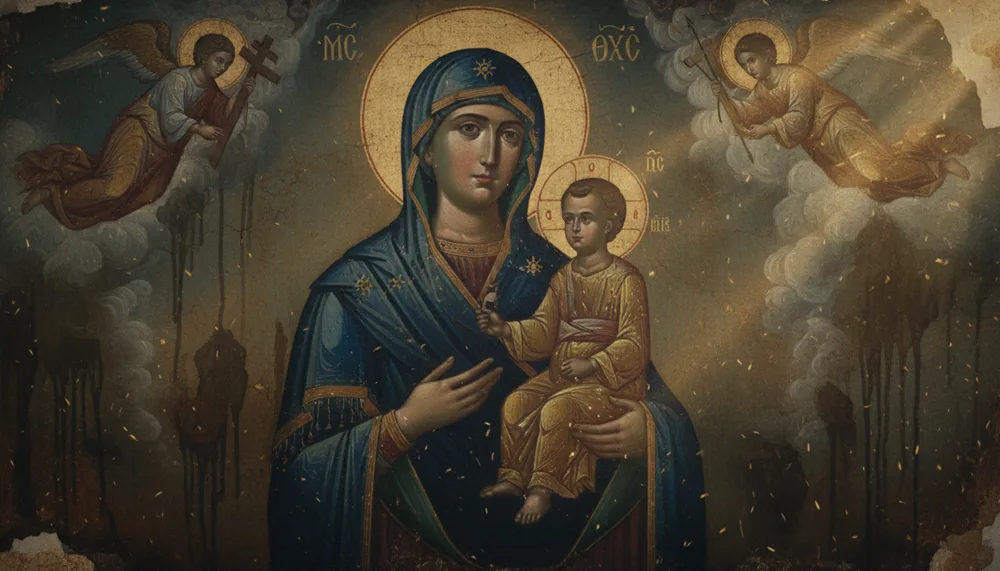
The novena to Our Lady of Perpetual Help is the old Redemptorist devotion said before the wonder-working icon of Our Lady — the picture of the Mother of God holding the Christ Child, with the archangels bearing the instruments of His Passion — begging her, as the dispenser of all the gifts which God grants to us, to carry some grace to her Son.
It is prayed for nine days (or every Wednesday, in the "perpetual novena" made famous at Baclaran and in Redemptorist churches the world over), most often for urgent, desperate, or seemingly impossible needs. Below we give the complete, indulgenced prayers exactly as they come down from the Raccolta of Pope Pius IX (1866), together with the story of the icon and the way to pray the nine days. If you are new to this form of prayer, see first our guide to what is a novena.
The full Novena to Our Lady of Perpetual Help
The classic Redemptorist novena is not a set of nine different prayers but one short office of three prayers, prayed each day of the nine — or each Wednesday of the perpetual novena — with your intention held in the heart throughout. These are the prayers "reprinted from the Raccolta," indulgenced by Pope Pius IX by rescript of 17 May 1866. Begin with the sign of the Cross, name your intention, and pray:
Opening prayer
Behold at thy feet, O Mother of Perpetual Help, a wretched sinner who has recourse to thee and confides in thee. O Mother of Mercy, have pity on me. I hear thee called by all the Refuge and the Hope of sinners: be, then, my refuge and my hope. Assist me, for the love of Jesus Christ; stretch forth thy hand to a miserable fallen creature who recommends himself to thee, and who devotes himself to thy service for ever. I bless and thank Almighty God, who in His mercy has given me this confidence in thee, which I hold to be a pledge of my eternal salvation. It is true, dearest Mother, that in the past I have miserably fallen into sin, because I had not recourse to thee. I know that with thy help I shall conquer. I know, too, that thou wilt assist me, if I recommend myself to thee; but I fear, dear Mother, that in time of danger I may neglect to call on thee, and thus lose my soul. This grace, then, I ask of thee, and this I beg, with all the fervour of my soul, that in all the attacks of hell I may ever have recourse to thee. O Mary, help me; O Mother of Perpetual Help, never suffer me to lose my God. Amen.
Here five Hail Marys are said.
The prayer to her most powerful name
O Mother of Perpetual Help, grant that I may ever invoke thy most powerful name, which is the safeguard of the living and the salvation of the dying. O purest Mary, O sweetest Mary, let thy name henceforth be ever on my lips. Delay not, O Blessed Lady, to help me whenever I call on thee; for, in all my temptations, in all my needs, I shall never cease to call on thee, ever repeating thy sacred name, Mary, Mary. Oh, what consolation, what sweetness, what confidence, what emotion fills my soul when I utter thy sacred name, or even only think of thee! I thank the Lord for having given thee, for my good, so sweet, so powerful, so lovely a name. But I will not be content with merely uttering thy name: let my love for thee prompt me ever to hail thee, Mother of Perpetual Help. Amen.
Here five Hail Marys are said.
The prayer to the dispenser of graces
O Mother of Perpetual Help, thou art the dispenser of all the gifts which God grants to us miserable sinners; and for this end He has made thee so powerful, so rich, and so bountiful, in order that thou mayest help us in our misery. Thou art the advocate of the most wretched and abandoned sinners who have recourse to thee; come to my aid, dearest Mother, for I recommend myself to thee. In thy hands I place my eternal salvation, and to thee I entrust my soul. Count me among thy most devoted servants; take me under thy protection, and it is enough for me. For, if thou protect me, dear Mother, I fear nothing: not from my sins, because thou wilt obtain for me the pardon of them; nor from the devils, because thou art more powerful than all hell together; nor even from Jesus, my Judge, because by one prayer from thee He will be appeased. But one thing I fear: that in the hour of temptation I may through negligence fail to have recourse to thee, and thus perish miserably. Obtain for me, therefore, the pardon of my sins, love for Jesus, final perseverance, and the grace to have recourse to thee, O Mother of Perpetual Help. Amen.
Here five Hail Marys are said.
The closing oration
V. Thou hast been made for us, O Lady, a refuge.
R. A helper in need and tribulation.Let us pray. O Lord Jesus Christ, who didst give to us thy Mother Mary, whose renowned image we venerate, to be a mother ever ready to help us, grant, we beseech thee, that we who constantly implore her aid may merit to enjoy perpetually the fruits of thy Redemption; who livest and reignest for ever and ever. Amen.
That is the whole novena. Because the same three prayers are repeated, the devotion is easy to keep by heart and easy to carry through nine consecutive days or nine consecutive Wednesdays. Many add the Memorare at the close, or Saint Alphonsus Liguori's own prayer "Most holy Immaculate Virgin and my Mother Mary," which the old Redemptorist booklets print after the oration — a fitting addition, for it was Saint Alphonsus who founded the order to which Pope Pius IX later entrusted the icon.
The perpetual novena — the Wednesday novena of Baclaran
The phrase perpetual novena puzzles many who search for it, since a novena is by definition nine days. It means something particular here: a public novena that never ends, prayed week after week, every Wednesday, before the icon. It was not born in the East but in the twentieth century among the Redemptorists — first at their church in Saint Louis, Missouri (1922), then spreading across the world.
Its most famous home is the National Shrine of Our Mother of Perpetual Help at Baclaran, in Parañaque near Manila, where the Australian Redemptorist Leo J. English led the first Wednesday novena on 23 June 1948 with seventy people. The following week the number doubled; within a year sessions had to be multiplied, and "Baclaran Day" — Wednesday — entered the vocabulary of Filipino Catholic life. The shrine has kept the novena unbroken ever since, drawing tens of thousands each Wednesday.
To pray the perpetual novena at home, you simply keep the same three prayers above every Wednesday, with the week's petitions and thanksgivings — for many families it becomes a lifelong weekly appointment with Our Lady rather than a single nine-day exercise.
Variants the faithful ask for
For urgent and impossible needs
Our Lady of Perpetual Help is, by long devotion, the mother invoked when a need is urgent, desperate, or humanly impossible — sickness that will not turn, a marriage near breaking, a soul that will not come home. This is written into the very words of the novena: "come to my aid, dearest Mother… in thy hands I place my eternal salvation." Pray the full novena above, and name the impossible thing plainly. When the case is truly hopeless, the faithful often join her intercession to that of the great patrons of desperate causes — see our novena to St Jude, apostle of the impossible, and the novena to St Rita, saint of the cases everyone else has given up.
For financial needs and employment
There is no separate "money novena" — and rightly so, for the devotion asks first for the soul. But it is wholly fitting to bring Our Lady of Perpetual Help a need for work, for bread, for the paying of a debt, for the keeping of a household. She who provided a home for the Christ Child understands the anxiety of providing. Pray the novena as given, and in the space for your intention ask plainly for the work or the provision you need, adding always: if it be God's will, and for the good of my soul. For the ancient patron of workers and of daily provision, many pair this with the novena to St Joseph.
The short prayer and the chaplet
For those who cannot keep the full form, there is a beloved short invocation drawn from the second prayer above:
O Mother of Perpetual Help, grant that I may always invoke thy most powerful name, for thy name is the help of the living and the salvation of the dying.
The chaplet of Our Lady of Perpetual Help is a related devotion — three Our Fathers, three Hail Marys and three Glorias in honour of her power, wisdom, and mercy — but it is not itself the novena. A chaplet is a short set of beads said once; a novena is a petition sustained over nine days. You may certainly pray the chaplet as your daily prayer through the nine days, but the two are distinct.
How to pray this novena
A novena is nine days of steady asking, in imitation of the nine days the Apostles and Our Lady spent in prayer between the Ascension and Pentecost — the pattern of every novena, treated more fully in our Pentecost novena. To pray this one well:
- Choose your nine days. You may pray any nine consecutive days; but the natural time is the nine days ending on 27 June, the feast of Our Lady of Perpetual Help. Others keep it as nine consecutive Wednesdays, in the perpetual-novena tradition.
- Pray at a fixed hour each day, before an image of the icon if you have one.
- Say the three prayers above in order, with the Hail Marys, and name your one intention throughout.
- Add a Mass, a Communion, or a Rosary where you can — the novena is strongest joined to the sacraments. If you wish to learn or deepen the Rosary, see how to pray the Rosary.
- Ask in submission. Name the grace you long for, but leave the outcome to God: the novena does not compel Him, it commends your need to the mother He gave you from the Cross.
The story of the icon and the devotion
Our Lady of Perpetual Help — Perpetual Succour, in the older English — is not a modern apparition but an ancient icon, a Byzantine painting of the Cretan school made somewhere between the fourteenth and fifteenth centuries. It shows Our Lady in the red robe of imperial dignity, holding the Christ Child; the two archangels, Michael and Gabriel, hover bearing the instruments of the Passion — the lance and sponge, the cross and nails. The Child, having glimpsed His future suffering, clutches His Mother's hand, and one small sandal hangs from His foot as though it had slipped in His fright — a tender detail the faithful have loved for centuries, an image of the humanity of God who ran to His Mother for refuge.
Tradition tells that a merchant stole the picture from a church in Crete and brought it to Rome in the late fifteenth century, and that Our Lady herself, in a vision, asked that it be enthroned in the church of San Matteo on the Esquiline hill. There, from 1499, it was venerated for nearly three hundred years and worked many miracles. When the armies of the French Revolution demolished San Matteo in 1798, Augustinian friars rescued the icon and kept it, half-forgotten, in a private oratory nearby.
It was returned to the light by the Redemptorists, the missionary order founded by Saint Alphonsus Liguori. When they built their church of Sant'Alfonso on the very ground where San Matteo had stood, they learned that the ancient image belonged there. In December 1865 Pope Pius IX granted them the icon with words that became the charter of the whole devotion: "Make her known throughout the world." The picture was given back to the Redemptorists in January 1866, borne in solemn procession to Sant'Alfonso on 26 April 1866, and crowned by the Vatican Chapter on 23 June 1867. From that day the Redemptorists have carried copies of Our Lady of Perpetual Help to every land they evangelised, and her Wednesday novena has followed. Her feast is kept on 27 June.
The title itself is the heart of it. She is Perpetual Help — not help for one crisis, but a mother's help that never ends, "in all the changes of this life." That is why the devotion took the form of a novena that never closes, and why the poorest and most desperate have always found in her their surest advocate.
Frequently Asked Questions
Who is Our Lady of Perpetual Help?
Our Lady of Perpetual Help — also called Our Lady, or Our Mother, of Perpetual Succour — is the Blessed Virgin Mary honoured under a particular ancient icon: a Byzantine painting of the Mother of God holding the Christ Child, flanked by the archangels Michael and Gabriel bearing the instruments of the Passion. She is not a separate person or apparition but Mary herself, venerated under this title as the mother who helps her children at all times and never ceases to intercede for them.
When is the feast of Our Lady of Perpetual Help?
Her feast is kept on 27 June, the date fixed after the solemn crowning of the icon in 1867. The nine days leading up to 27 June are the natural time to pray this novena, though it may be prayed at any need.
How do you pray the novena to Our Lady of Perpetual Help?
You pray the three traditional Redemptorist prayers given above — the opening prayer "Behold at thy feet," the prayer to her powerful name, and the prayer to the dispenser of graces, each followed by five Hail Marys and closed with the oration — once each day for nine consecutive days (or nine Wednesdays), naming a single intention throughout, and joining the prayer to Mass or the Rosary where you can.
How many days is the novena — and what is a "perpetual" novena?
The novena proper is nine days, from the Latin novem, "nine." A perpetual novena is a public devotion that repeats the same prayers every Wednesday without end, as at the shrine of Baclaran; it is called perpetual not because it lasts nine weeks but because it never stops. You may pray either form at home.
Is the Our Lady of Perpetual Help chaplet the same as the novena?
No. The chaplet is a short set of prayers said on beads — three Our Fathers, Hail Marys and Glorias — that can be completed in a few minutes. The novena is a petition sustained over nine days. You may pray the chaplet within your novena, but they are distinct devotions.
What is Our Lady of Perpetual Help the patron of?
By long devotion she is invoked in urgent, desperate, and impossible needs, for the sick and the dying, for sinners far from God, and for the daily cares of provision and family. She is a patroness of the Redemptorist order, of Haiti, of the Philippines (where her Baclaran shrine is a national centre of prayer), and of countless dioceses and families who keep her Wednesday novena.
Is there a PDF or printed booklet of the novena?
The complete, authentic text is the three prayers reproduced above, taken from the indulgenced Redemptorist booklet of the Raccolta — you may copy it to keep beside you for the nine days. Rather than print a sheet, you can also pray the whole novena from your phone: the Iter Fidei app carries it in full, in Latin and your own language, with audio and a reminder for each of the nine days.
Better than a PDF: the Iter Fidei app sets the right text before you each day and reminds you to pray it, even without a connection. Join early access here.
Does the novena really work?
The novena is not a charm, and no prayer compels God. What it does, infallibly, is place your need in the hands of the mother Christ gave you from the Cross, who "never fails to help those who invoke her." The grace asked is not always the grace given — but a soul that prays this novena in trust never prays it in vain, for Our Lady obtains what is truly best, and her help, as her title says, is perpetual. For the wider tradition, see our novena to the Immaculate Heart.
Pray this novena with a reminder for each of the nine days and the traditional prayers read aloud in Latin and your own language, in the Iter Fidei app. Join early access here.
Sources. The novena prayers as given in the Raccolta, indulgenced by Pope Pius IX (rescript of 17 May 1866); the prayer "Most holy Immaculate Virgin and my Mother Mary" of St Alphonsus Liguori; the history of the holy icon and its feast (27 June) — its Byzantine origin, the church of San Matteo in Rome, and Pope Pius IX's charge to the Redemptorists (1865–66, "make her known throughout the world") with the solemn crowning of 1867.