
Novenas
Novena to St Andrew The Apostle
The nine-day novena to St Andrew the Apostle — the full daily prayer and the nine days' intentions — prayed for faith, missionary zeal and courage in suffering, and leading to his feast on 30 November.
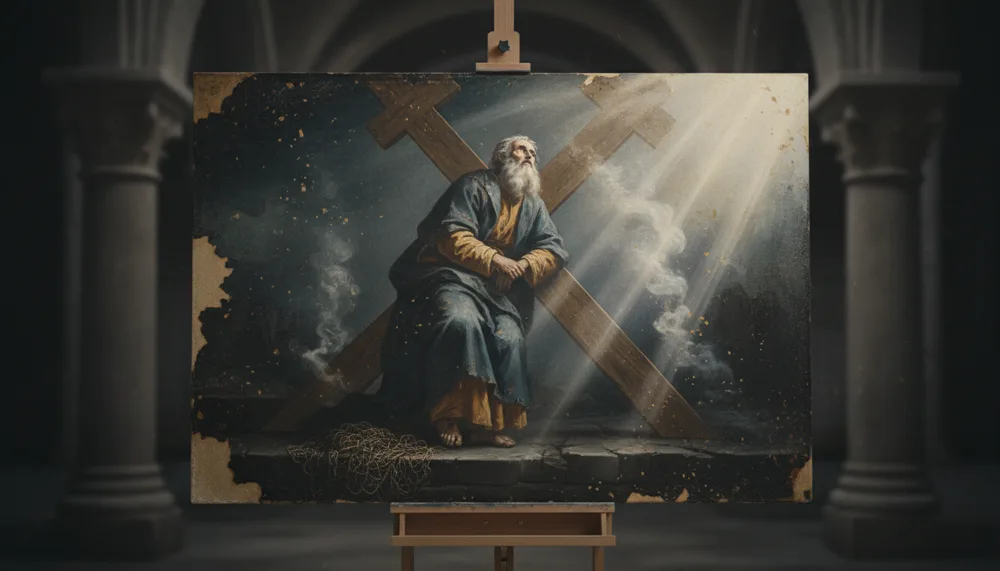
The novena to St Andrew the Apostle is nine days of prayer asking the intercession of the first man Our Lord called — the fisherman of Bethsaida who left his nets, followed the Lamb of God, and brought his brother Simon Peter to Christ. It is prayed above all for a living faith, for zeal in leading others to Jesus, and for courage under suffering, after the pattern of an apostle who embraced his cross with joy.
His feast falls on 30 November, so the novena is most fittingly begun on 21 November and finished on the eve of his feast. Below we give the full daily prayer, the nine days' distinct intentions, how to pray it, and the life of the saint himself; his feast, his cross and the O bona Crux are treated at length in our page on St Andrew the Apostle. If you are new to this form of prayer, see first our guide to what is a novena.
The daily novena prayer to St Andrew
This prayer is said once on each of the nine days. It gathers the whole of Andrew's life — his call, his zeal for souls, and his cross — into a single petition, and it is the heart of the devotion. It is a modern devotional composition, with no liturgical text and no approval of its own; the Church's prayer for his feast is the collect of 30 November, given on our page on St Andrew the Apostle.
In the Name of the Father, and of the Son, and of the Holy Spirit. Amen.
Glorious St. Andrew, you were the first to recognize and follow the Lamb of God. With your friend, St. John, you remained with Jesus for that first day, for your entire life, and now throughout eternity.
As you led your brother, St. Peter, to Christ, and many others after him, draw us also to Him. Teach us to lead others to Christ solely out of love for Him and dedication to His service.
Help us to learn the lesson of the Cross, and to carry our daily crosses without complaint, so that they may carry us to God the Almighty Father. Amen.
After this prayer, name your intention, and close each day with an Our Father, a Hail Mary, and a Glory Be, adding: St. Andrew the Apostle, pray for us. Many join to it a decade of the Rosary or the Litany of the Saints.
The nine days: the intentions
The strength of this novena is that it walks, day by day, through the virtues Andrew shows us in the Gospel and in his martyrdom. On each day, after the daily prayer above, pause on that day's intention and ask the apostle for that particular grace.
Day 1 — Readiness to serve
Andrew was standing with St John the Baptist when the Baptist pointed to Jesus and said, "Behold the Lamb of God" (John 1:36). He left at once and followed. We ask for that same readiness — to answer God's call without delay or condition.
Day 2 — Virtue in daily work
Andrew was a fisherman who laboured with his hands before he was made a "fisher of men" (Matthew 4:19). We ask the grace to do our ordinary work faithfully and for the glory of God, as he did.
Day 3 — Faith that follows
Andrew followed Christ into the unknown, leaving his nets without knowing where the road would lead. We ask for an unreserved faith that trusts God even in fear, uncertainty, and the prospect of suffering.
Day 4 — Friendship with Christ
Andrew remained close to Jesus through His public ministry, and it was he who brought forward the boy with the loaves and fishes (John 6:8-9). We ask for a deep, personal friendship with Our Lord and a place near His heart.
Day 5 — Zeal for souls
The first thing Andrew did after finding the Messiah was to fetch his brother: "He first findeth his own brother Simon... and he brought him to Jesus" (John 1:41-42). We ask for a burning zeal to bring others to Christ.
Day 6 — Reverence for the Holy Eucharist
Andrew was present at the Last Supper, when Our Lord gave His own Body and Blood. We ask for a deep reverence and love for the Blessed Sacrament, the same gift he received from the Lord's own hands.
Day 7 — Courage to preach
Andrew carried the Gospel to Scythia and Greece against every obstacle and every danger. We ask for courage to confess and preach the faith when the world is hostile to it.
Day 8 — Strength in suffering
Andrew endured crucifixion for the name of Jesus, and did not flinch. We ask for courage amid our own trials, and the grace, if God should ask it, to be faithful even unto death.
Day 9 — Humility before God
Held by tradition to have thought himself unworthy to die on a cross of the same shape as his Master's, Andrew asked for the X-shaped cross on which he suffered. We ask for that same humility, which counts nothing owed to God as too much to give.
Variants people search for
The novena prayer to St Andrew (short form)
If you cannot keep the full nine intentions, the daily prayer above — "Glorious St. Andrew, you were the first to recognize and follow the Lamb of God" — is itself the whole novena in short form. Say it once a day for nine days with your intention named, and you have prayed the novena. This is the "novena prayer to St Andrew" many are looking for: one prayer, nine days, one intention.
For a specific intention
A novena to St Andrew may be offered for any worthy need — for the conversion of a family member, for a brother or sister who has fallen away (Andrew brought his own brother to Christ), for missionaries and the spread of the faith, for fishermen and those who work the sea, or for the grace to carry a heavy cross. Name your intention plainly after the daily prayer, and add it to a Mass or Holy Communion where you can.
The St Andrew Christmas Novena (a different devotion)
Many searching for a "St Andrew novena" in fact want the famous St Andrew Christmas Novena — the beautiful "Hail and blessed be the hour and moment" prayer, said fifteen times a day from the feast of St Andrew on 30 November until Christmas. That is a distinct devotion, an Advent preparation for the birth of Our Lord that merely begins on Andrew's feast; it is not addressed to the apostle himself. We give it in full, with its history and how to pray it, in our guide to the St Andrew Christmas Novena. The novena on this page is the one made to St Andrew for his own intercession.
How to pray the St Andrew novena
A novena is nine consecutive days of prayer, from the Latin novem, "nine" — after the nine days the Apostles spent in the Upper Room with Our Lady, between the Ascension and Pentecost, waiting on the Holy Ghost.
- When to start. To finish on the eve of his feast, begin on 21 November; the ninth day then falls on 29 November, the vigil of the feast on 30 November. You may, of course, pray the novena at any time of year for a pressing need.
- The nine days. Pray at a fixed hour each day. Say the daily prayer, rest on that day's intention, name your own request, and close with the Our Father, Hail Mary, and Glory Be.
- The disposition. Ask in trust and in submission to God's will — Thy will be done. A novena does not compel God; it commends our need, through a great saint, to the mercy of Christ, and waits.
- The feast. Crown the novena, if you can, by assisting at Mass on St Andrew's day and receiving Holy Communion for your intention.
Who is St Andrew the Apostle?
St Andrew was born at Bethsaida in Galilee, the son of Jona and the brother of Simon, whom Our Lord would name Peter. Like his brother he was a fisherman on the Sea of Galilee. Before he ever met Christ he was already seeking God: he had become a disciple of St John the Baptist, and it was while standing with the Baptist that he heard him cry, "Behold the Lamb of God," and followed Jesus to where He dwelt, remaining with Him that first day (John 1:35-39). For this the Church honours Andrew as the Protoclete, the "First-Called" of the Apostles.
His first act as a disciple set the pattern of his life. He went straight to find his brother: "We have found the Messias... And he brought him to Jesus" (John 1:41-42) — so that the man who would be the rock of the Church was led to Christ by his younger brother. It is Andrew, too, who in the Gospel brings the boy with five loaves and two fishes to Our Lord before the feeding of the five thousand (John 6:8-9), and Andrew to whom Philip turns when certain Greeks wish to see Jesus (John 12:20-22) — always the one who brings others in.
After Pentecost, tradition holds that Andrew preached the Gospel through Scythia, Thrace, and Greece, and finally at Patras in Achaia. There the Roman proconsul Aegeas, enraged at his preaching and at the conversions he wrought, condemned him to death. Andrew was bound — not nailed — to a cross, held by tradition to have been shaped like the letter X (the saltire, ever since called St Andrew's Cross), that his agony might be the longer.
Butler and the ancient account of his martyrdom record that when he first saw the cross from afar he greeted it with joy: "O good cross, made beautiful by the limbs of Christ, long have I desired thee." He hung upon it two days, preaching to the crowd until he died, about the year 60. His feast has been kept on 30 November since the earliest centuries; it opens the Church's year, falling as it does at the threshold of Advent.
St Andrew is the patron of Scotland, of Russia, and of Greece, and of fishermen, fishmongers, and rope-makers; his cross is borne on the flag of Scotland to this day. Because he brought his own brother and so many others to Christ, he is invoked as a patron of those who labour for souls — a fitting companion in prayer to his brother St Peter, to his friend St John the Apostle, and to the great missionary St Francis Xavier, whose feast follows his by only three days.
Frequently Asked Questions
When is St Andrew's feast day?
St Andrew the Apostle is honoured on 30 November, a date kept since antiquity in both East and West. His feast stands at the very edge of the liturgical year, just as Advent begins — one reason the St Andrew Christmas Novena takes its start from his day.
When should I start the novena to St Andrew?
To end on the eve of his feast, begin the nine days on 21 November, praying through to 29 November. But a novena may be prayed at any time; if you have a pressing need, begin whenever you wish and pray nine days running.
What is St Andrew the patron saint of?
St Andrew is the patron of Scotland, Russia, and Greece, and of fishermen, fishmongers, and rope-makers. Because he brought his brother Peter and many others to Our Lord, he is also invoked by all who work for the conversion of souls, and by those seeking courage to carry a cross.
Is the St Andrew novena the same as the St Andrew Christmas Novena?
No. This novena is prayed to St Andrew for his intercession, nine days, usually leading to his feast. The Christmas Novena is the "Hail and blessed be the hour and moment" prayer, said fifteen times a day from 30 November to Christmas Eve as an Advent preparation for the Nativity — it simply begins on his feast and is not addressed to the apostle. See our full guide to the St Andrew Christmas Novena.
Why is St Andrew's cross X-shaped?
Tradition holds that when Andrew was condemned at Patras he asked not to be crucified on a cross of the same form as Our Lord's, judging himself unworthy of so exact a likeness to his Master. He was therefore bound to a cross shaped like the letter X — the saltire, or St Andrew's Cross — on which he hung for two days, preaching to the last. This cross is his emblem and gives Scotland its flag.
How did St Andrew die?
St Andrew was martyred at Patras in Greece, about the year 60, under the proconsul Aegeas. He was bound, not nailed, to the X-shaped cross, that his death might come more slowly; he greeted the cross with joy and hung upon it two days, exhorting the people, before he gave up his soul to God.
What can I pray the St Andrew novena for?
For a living and courageous faith; for zeal in leading others to Christ — especially a brother, sister, or friend who has left the faith; for missionaries and the spread of the Gospel; for fishermen and those in peril at sea; and for strength to carry a heavy cross with patience. Name your own intention after the daily prayer, and leave the outcome to God.
Pray this novena with day-by-day reminders, the daily prayer and its nine intentions, and audio, in the Iter Fidei app. Join early access here.
Sources. Holy Scripture (John 1:35-42; John 6:8-9; John 12:20-22; Matthew 4:18-20); Butler, Lives of the Saints, St Andrew, Apostle (30 November); the ancient Acts of the Martyrdom of St Andrew (his greeting of the cross at Patras); the devotional novena prayer to St Andrew the Apostle and its nine daily intentions.