
The Liturgical Year
Advent: The Season of Preparation
Advent is the four-week penitential season before Christmas, in which the Church prepares for the coming of Christ — his Nativity, and his coming in glory. Its meaning, its violet vestments, and the Advent wreath, in the traditional Roman calendar.
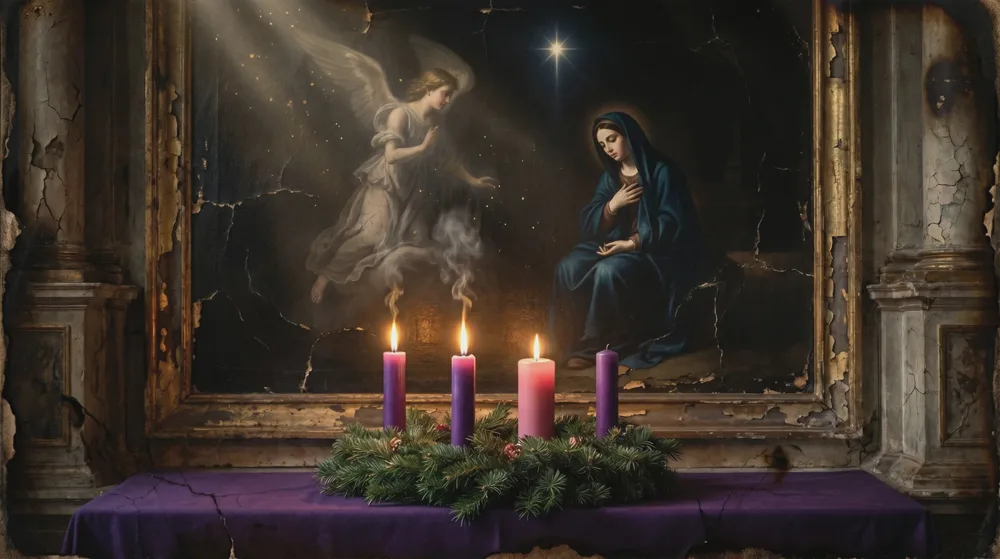
Advent is the season of four weeks before Christmas in which the Church prepares for the coming of Christ. The word comes from the Latin adventus, "a coming," and it looks to two comings at once: the coming of Our Lord in the flesh at his Nativity, and his coming again in glory to judge the living and the dead. Advent opens the liturgical year and sets its tone: it is a penitential season, marked by violet vestments and a turning of the heart toward the Lord who comes.
What is Advent
Advent is the time the Church sets aside to make ready for Christmas. The Catechism of St Pius X teaches plainly why the season exists: "The fast of Advent was instituted to dispose us to celebrate holily the feast of Christmas." It is, in the traditional Roman calendar, a season of preparation by penance — not yet a season of rejoicing, but the road that leads to it. In the older Roman books, Advent was kept as a fast; even where that fast has been softened, the season keeps its penitential character.
The season runs from the First Sunday of Advent — the nearest Sunday to the feast of St Andrew on the 30th of November — to the Vigil of Christmas on the 24th of December. Because the date of the First Sunday shifts each year, Advent is never of exactly equal length, but it always holds four Sundays.
When does Advent start in 2025 and 2026
To find the date for any year, take the Sunday nearest to the 30th of November; that is the First Sunday of Advent. For Advent 2025, the First Sunday falls on the 30th of November 2025, and the four Sundays are 30 November, 7, 14 (Gaudete), and 21 December, with the Vigil of Christmas on the 24th. For Advent 2026, the First Sunday falls on the 29th of November 2026. The earliest the season can begin is the 27th of November, the latest the 3rd of December.
Advent meaning: the two comings of Christ
To grasp the meaning of Advent, one must see that the Church looks both backward and forward. She remembers the long ages before the Incarnation, when the patriarchs and prophets awaited the promised Redeemer, and she joins her voice to their longing. And she looks ahead to the Last Day, when Christ will come not as an infant but as the Judge. The liturgy of Advent holds both: the cry of the prophet, "Drop down dew, ye heavens, from above, and let the clouds rain the just" (Isaias 45:8), and the warning of the Gospel, "Watch ye therefore, because you know not what hour your Lord will come" (St Matthew 24:42).
This is why Advent is penitential and not merely festive. The coming we prepare for is the coming of the Lord, and a soul cannot meet him fittingly without doing penance for sin. The season is a small Advent of the whole Christian life, which is itself a watching for the Lord.
Advent definition, in a line
The plain definition of Advent is this: the four-week penitential season of the Church that prepares for the feast of Christ's Nativity at Christmas, while also looking forward to his second coming in glory. The name is from the Latin adventus, "a coming" or "an arrival." It is the opening season of the liturgical year and is kept in violet, the colour of penance.
The season of Advent in the traditional calendar
In the traditional Roman calendar — the calendar of the traditional Latin Mass — Advent has marks that the eye and the ear can recognize.
Violet vestments
The priest wears violet, the color of penance, throughout Advent, as he does in Lent. The altar is unadorned; the Gloria is not sung at Sunday Mass; the organ is restrained. On the Third Sunday — Gaudete Sunday, named from the Introit "Rejoice in the Lord always" (Philippians 4:4) — rose vestments may be worn, and the penance of the season is briefly lightened in anticipation of the joy that is coming. The same relief is given on Laetare Sunday in Lent.
The Ember Days of Advent
The traditional calendar keeps the Ember Days — three days of fasting and prayer in each of the four seasons of the year. The winter Ember Days fall in the third week of Advent, on the Wednesday, Friday, and Saturday after the Third Sunday. The Catechism of St Pius X lists "the Ember days" among the days of commanded fasting, and the season's vigils — chiefly the Vigil of Christmas — among them as well. These are part of the older discipline that the traditional calendar preserves, alongside Septuagesima before Lent and the other ancient observances dropped in the later reform.
Marriages not celebrated
The penitential character of Advent reaches even to the Church's law on marriage. Among the precepts of the Church, the Catechism of St Pius X teaches that the faithful are "not to celebrate marriages at the forbidden times, that is to say, from the first Sunday of Advent to the Epiphany." A wedding with its solemn nuptial blessing is not held during the season of preparation; it waits for the season of joy. (See the precepts of the Church.)
The Advent wreath
The Advent wreath is a circle of evergreen holding four candles, one lit for each Sunday of Advent, so that the growing light marks the nearing of Christmas. Three of the candles are violet, the color of the season; the fourth, lit on Gaudete Sunday, is rose. As each week passes, another candle is kindled, and the increasing flame answers the words of the prophet: "The people that walked in darkness have seen a great light" (Isaias 9:2).
The wreath is a sacramental of the home, a help to keep the season in the household and to teach children its meaning. It is not part of the Mass itself, but it carries the Mass's lesson into the family: the light that grows toward Christmas is Christ, the Light of the world, drawing near.
The Advent candles and their colours
The four Advent candles stand for the four Sundays of the season, and the meaning of the four candles follows the colours of the liturgy. Three are violet, the colour of penance worn at Mass throughout Advent; the fourth is rose, lit on the Third Sunday, Gaudete Sunday, when the Church briefly lightens her penance in anticipation of the joy that is near. One candle is kindled on the First Sunday, two on the Second, and so on, so that each week the light grows.
The custom of a single white candle set in the centre — sometimes called the "Christ candle," lit on Christmas night — is a later and devotional addition, not part of the older Roman discipline; the season's own sign is the four candles of violet and rose. A short prayer may be said as each candle is lit, drawn from the season's own liturgy:
Drop down dew, ye heavens, from above, and let the clouds rain the just: let the earth be opened, and bud forth a Saviour. (Rorate caeli, after Isaias 45:8)
The growing flame answers the prophet's word read at Advent Mass: "The people that walked in darkness have seen a great light" (Isaias 9:2).
Not the secular "advent calendar"
The Advent wreath should not be confused with the commercial advent calendar, the printed card with little doors or, more recently, pockets of chocolate counted down to the 25th. That object borrows the name of the season but empties it of its purpose. Advent in the Church is not a countdown to a holiday; it is a season of penance and watching, a preparation of the soul. The wreath, lit and prayed beside, keeps that purpose; the chocolate calendar merely numbers the days.
How we keep Advent
Advent is kept by penance, prayer, and watching. The Catechism of St Pius X gives the use of the Advent fast — to dispose us to celebrate Christmas holily — and the same end is served by any mortification we take up in the season. Confession is fitting before Christmas, that the soul may meet the newborn Lord in grace. And the daily prayer of the Church through Advent — her Introits, her Rorate caeli, her great antiphons of the final days — turns the heart toward the One who comes. Those last antiphons, the O Antiphons, are the source of the Advent hymn O Come, O Come, Emmanuel.
The season asks one thing of us, in the words of its Gospel: that we watch, and be ready.
Frequently Asked Questions
What is Advent?
Advent is the season of four weeks before Christmas in which the Church prepares for the coming of Christ. The word comes from the Latin adventus, "a coming," and the season looks to two comings at once: Our Lord's coming in the flesh at his Nativity, and his coming again in glory to judge the living and the dead. The Catechism of St Pius X teaches that "the fast of Advent was instituted to dispose us to celebrate holily the feast of Christmas"; it is a penitential season, marked by violet vestments and a turning of the heart toward the Lord who comes.
When does Advent start?
Advent begins on the First Sunday of Advent — the Sunday nearest to the feast of St Andrew on November 30 — and runs to the Vigil of Christmas on December 24. Because that first Sunday shifts with the calendar, Advent is never of exactly equal length, but it always holds four Sundays. The earliest it can begin is November 27, the latest December 3.
What does Advent mean?
Advent means "a coming," from the Latin adventus. Its meaning is the twofold coming of Christ: the Church remembers the long ages when the patriarchs and prophets awaited the promised Redeemer, and she looks ahead to the Last Day, when Christ will come not as an infant but as the Judge. This is why Advent is penitential and not merely festive — a soul cannot meet the Lord fittingly without doing penance for sin.
What is an Advent calendar — and is it the same as the Advent wreath?
No. The commercial "advent calendar" — the printed card with little doors, or pockets of chocolate counted down to the 25th — borrows the name of the season but empties it of its purpose. The Catholic sign of the season is the Advent wreath: a circle of evergreen holding four candles, one lit for each Sunday, three violet and the fourth rose for Gaudete Sunday, so that the growing light marks the nearing of Christmas. The wreath keeps the season's purpose of penance and watching; the chocolate calendar merely numbers the days.
The Iter Fidei app carries the traditional calendar, the Mass of each day of Advent, and the prayers of the season. Join early access here.
Sources. Catechism of St Pius X, Part III, ch. 4, The Precepts of the Church (on the fast of Advent, the Ember days, the commanded vigils, and the times in which marriages are not celebrated); the Roman Missal and the Proper of the Time of the traditional Roman calendar (the First Sunday of Advent to the Vigil of Christmas, Gaudete Sunday, the violet vestments, and the winter Ember Days); Holy Scripture, Douay-Rheims (Isaias 45:8; 9:2; St Matthew 24:42; Philippians 4:4).