
The Saints
The St Gertrude Prayer for the Souls in Purgatory
The famous prayer of St Gertrude the Great for the holy souls in purgatory — its full text, the 1,000 souls tradition honestly weighed, her chaplet, her life as a Benedictine mystic, and her feast day, November 16.
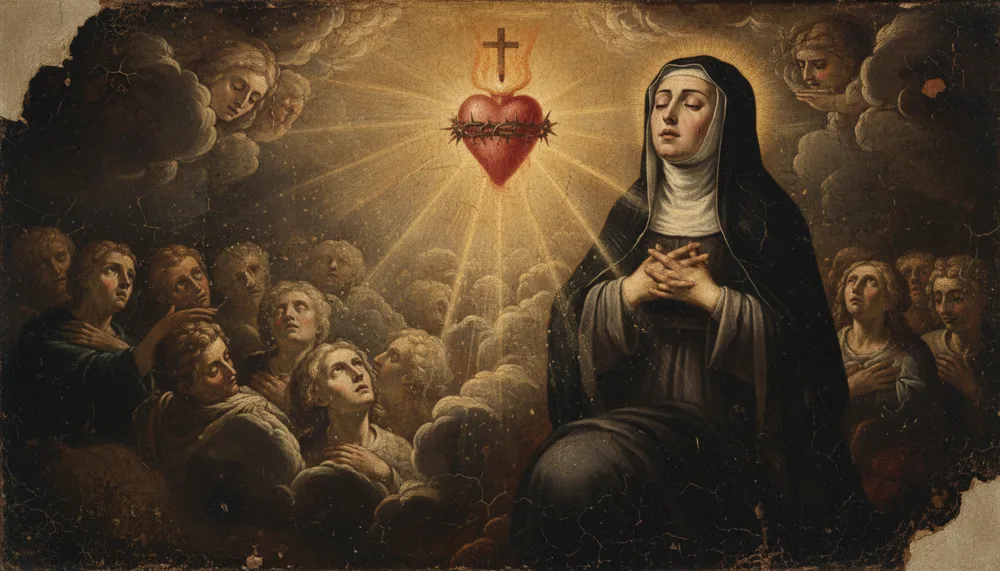
The St Gertrude prayer is a short offering of the Most Precious Blood of Jesus to the Eternal Father for the holy souls in purgatory, attributed to St Gertrude the Great, the thirteenth-century Benedictine mystic of Helfta. Its full text begins "Eternal Father, I offer Thee the Most Precious Blood of Thy Divine Son" and is given below, together with what can honestly be said of the tradition that it releases a thousand souls each time it is prayed. Gertrude herself — nun, visionary, and one of the first apostles of the Sacred Heart — is kept in the traditional Roman calendar on November 16.
The prayer of St Gertrude for the souls in purgatory
The prayer as it has come down on countless holy cards reads:
Eternal Father, I offer Thee the Most Precious Blood of Thy Divine Son, Jesus, in union with the Masses said throughout the world today, for all the holy souls in purgatory, for sinners everywhere, for sinners in the universal Church, those in my own home and within my family. Amen.
Everything in it is solidly Catholic. It is addressed to the Father, not to the saint; it pleads the one offering that avails, the Blood of Christ; and it unites itself to the Holy Sacrifice of the Mass, which the Council of Trent teaches is offered for the living "and also for those departed in Christ who are not yet fully purified" (Session XXII, chapter 2). Scripture itself commends the intention: "It is therefore a holy and wholesome thought to pray for the dead, that they may be loosed from sins" (2 Machabees 12:46, Douay-Rheims). Whoever prays these words is doing exactly what the Church has always done for her dead — as we explain in our article on what purgatory is.
The 1,000 souls tradition, honestly stated
The prayer usually circulates with a promise: that Our Lord told St Gertrude He would release a thousand souls from purgatory each time it is devoutly said. What should a Catholic make of this?
Honestly, this. The promise is not found in the authentic writings of St Gertrude — the Legatus Divinae Pietatis, or Herald of Divine Love, set down at Helfta from her own account — nor does the Church teach it as doctrine. It belongs to the prayer-card tradition of later centuries, and no one is bound to believe it. The Church has never fixed an arithmetic of grace; the fruit of any prayer for the dead is measured by God, and the application of satisfactions to particular souls remains in His hands.
But note what does not depend on the promise. That prayer for the holy souls is powerful and pleasing to God is certain doctrine, defined at Trent: the souls detained in purgatory "are helped by the suffrages of the faithful, but principally by the acceptable sacrifice of the altar" (Session XXV, Decree on Purgatory). And that St Gertrude had a burning charity toward the holy souls is authentic history — the Herald records her constant intercession for the dead.
The pious tradition of the thousand souls is an ornament on a solid wall: pray the prayer for what it certainly is — a plea of the Blood of Christ for the dead — and leave the counting to God. Those who wish to extend this intercession will find the older forms in the litany of the poor souls in purgatory and the Eternal Rest prayer, the Church's own constant suffrage.
Who was St Gertrude the Great?
Gertrude was born in 1256 in Thuringia, in what is now Germany, and at the age of five was placed in the Benedictine monastery of Helfta, near Eisleben, then governed by the abbess Gertrude of Hackeborn — a different Gertrude, with whom the saint is often confused. There she was formed by St Mechtilde and became one of the most learned women of her age, given first to letters and study.
In her twenty-sixth year, in 1281, Our Lord appeared to her and reproached her gently for having built, as she later wrote, a wall of vanities between her heart and Him. From that night her life was wholly converted: she left secular studies for the Scriptures, the Fathers, and the liturgy, and entered upon an intimacy with Christ that the Church has ranked among the highest of the mystics. Her revelations were set down in the Legatus Divinae Pietatis — the Herald of Divine Love — partly by her own hand, partly by her sisters at her dictation. She died at Helfta about 1302. Rome attached her name to the Roman Martyrology under Innocent XI, and her Office and Mass were later extended to the universal Church; she is the only woman saint whom the Church styles "the Great."
Her recorded prayer reaches constantly outward — for sinners, for the Church, and above all for the dead, whom she saw relieved by the offering of the Precious Blood and the fruits of the Mass. The famous prayer, whatever its exact literary pedigree, is a faithful summary of her spirit. Those who wish to pray for the departed as she did will find the Church's fuller provision in our prayer for the dead.
St Gertrude and the Sacred Heart — centuries before Paray-le-Monial
Gertrude's surest title to greatness is this: she was given the devotion to the Sacred Heart of Jesus almost four hundred years before Our Lord showed His Heart to St Margaret Mary Alacoque at Paray-le-Monial in 1673. The Herald of Divine Love records that on the feast of St John the Evangelist she was permitted, like the beloved disciple, to rest her head near the wound in the Saviour's side and to hear the beating of His Heart. She asked St John why he, who had rested there at the Last Supper, had written nothing of it; the answer given her was that the revelation of those sweet pulsations was reserved for later times, when the world, grown cold, would need to be rekindled by them.
After Paray-le-Monial the Church read this vision as a prophecy. St Gertrude thus stands at the head of the line of witnesses to the Sacred Heart of Jesus, and her prayers everywhere plead that Heart and the Blood that flows from it — which is exactly the movement of the purgatory prayer that bears her name.
The chaplet of St Gertrude
The chaplet of St Gertrude is the same offering multiplied. It is commonly prayed on ordinary rosary beads: the Eternal Father prayer is repeated on each bead, slowly and deliberately, as a sustained intercession for the holy souls, for sinners, and for one's own household. No special beads are required, and no fixed rule binds it; it is a private devotion, not a liturgical office.
Some versions of the chaplet carry the arithmetic of the holy cards to its conclusion — a thousand souls per prayer, fifty thousand per chaplet. We repeat what was said above: the Church teaches no such computation, and the value of the chaplet does not rest on it. Its value rests on what the prayer actually does — it pleads the Most Precious Blood, in union with the Masses of the whole world, for the dead who can no longer help themselves. Prayed in that spirit, on the anniversary of a departed parent, through the month of November, or on All Souls' Day, it is a work of mercy of the most traditional kind.
St Gertrude the Great or St Gertrude of Nivelles?
Two great saints share the name, and search engines confuse them daily; the old calendar does not.
St Gertrude the Great (1256–c. 1302) is the Benedictine mystic of Helfta described above — virgin, visionary, herald of the Sacred Heart, intercessor for the holy souls. Her feast in the traditional Roman calendar is November 16.
St Gertrude of Nivelles (626–659) lived six centuries earlier: daughter of Blessed Itta and of Pepin of Landen, she became abbess of the monastery of Nivelles in Brabant founded by her mother, renowned for learning, hospitality to pilgrims, and severe austerity; she died at thirty-three. Her feast is March 17. Butler's Lives of the Saints records that she was invoked by travellers and against plagues of rats and mice — old images show vermin fleeing at her prayer — and from this later ages have popularly styled her a patroness of cats. The old sources know the mice; the cats are a modern extension of the same patronage, a pious usage rather than anything the Church has defined.
The purgatory prayer belongs to Gertrude the Great, not to Gertrude of Nivelles. Whoever asks for "the prayer of St Gertrude" is almost always asking for the Eternal Father offering given above.
The feast of St Gertrude: November 16
In the traditional Roman calendar the feast of St Gertrude the Great, Virgin, is kept on November 16 — fittingly, in the very month the Church devotes to the holy souls. A Catholic who wishes to keep her feast well has her own devotion ready to hand: hear Mass if possible, and offer the Precious Blood for the souls in purgatory, above all for the most forgotten. Those who wish to prepare for her feast may keep the novena to St Gertrude the Great in the nine days before it.
Frequently Asked Questions
Who was St Gertrude?
St Gertrude the Great (1256–c. 1302) was a Benedictine nun and mystic of the monastery of Helfta in Germany, whose revelations are recorded in the Herald of Divine Love. She is the only woman saint the Church calls "the Great," and her feast is November 16.
What is the St Gertrude prayer?
It is a short offering to the Eternal Father of the Most Precious Blood of Jesus, in union with all the Masses said throughout the world that day, for the holy souls in purgatory, for sinners everywhere, and for one's own family. It is attributed to St Gertrude the Great and is one of the most widespread Catholic prayers for the dead.
Does the St Gertrude prayer really release 1,000 souls from purgatory?
The Church does not teach this, and the promise is not found in St Gertrude's authentic writings; it is a pious tradition of the holy cards, which no Catholic is bound to believe. What is certain doctrine, defined at Trent, is that the souls in purgatory are truly helped by the prayers of the faithful and above all by the Sacrifice of the Mass.
What is the chaplet of St Gertrude?
It is the Eternal Father prayer repeated on the beads of an ordinary rosary as a sustained intercession for the holy souls. It is a private devotion with no fixed rule; the claim that one chaplet frees fifty thousand souls is the same pious arithmetic as the thousand-souls tradition and carries no doctrinal weight.
When is St Gertrude's feast day?
St Gertrude the Great is kept on November 16 in the traditional Roman calendar — in November, the Church's month of the holy souls. St Gertrude of Nivelles, the seventh-century abbess with whom she is often confused, is named in the Roman Martyrology on March 17 (in the 1962 calendar that day is the feast of St Patrick).
Is St Gertrude the patron saint of cats?
The association belongs to St Gertrude of Nivelles, the seventh-century Brabantine abbess, whom the old sources record as invoked against plagues of rats and mice; the extension to cats is a modern popular usage, not an ancient title. St Gertrude the Great, the mystic of Helfta to whom the purgatory prayer is attributed, has no connection with cats.
What is St Gertrude the Great the patron of?
She is invoked above all as an intercessor for the souls in purgatory, on account of her recorded charity toward the dead, and she is honoured in the West Indies as a patroness. She is also counted among the first witnesses of devotion to the Sacred Heart of Jesus, revealed to her four centuries before St Margaret Mary.
The Iter Fidei app carries the prayers for the holy souls, the litanies, and the traditional calendar with the feast of St Gertrude on November 16. Join early access here.
Sources. St Gertrude the Great, Legatus Divinae Pietatis (The Herald of Divine Love), especially Book IV on the vision of St John and the Heart of Jesus. Council of Trent, Session XXII, chapter 2, and Session XXV, Decree on Purgatory. 2 Machabees 12:46, Douay-Rheims Bible. Roman Martyrology, November 16 and March 17. Alban Butler, The Lives of the Fathers, Martyrs, and Other Principal Saints, under March 17, St Gertrude of Nivelles, and November 16, St Gertrude the Great.