
The Saints
St Francis de Sales, Bishop of Geneva and Doctor of the Church
St Francis de Sales, Bishop of Geneva and Doctor of the Church — his life, the conversion of the Chablais, the Introduction to the Devout Life, his teaching on prayer, his Be at Peace prayer, and his feast day, January 29.
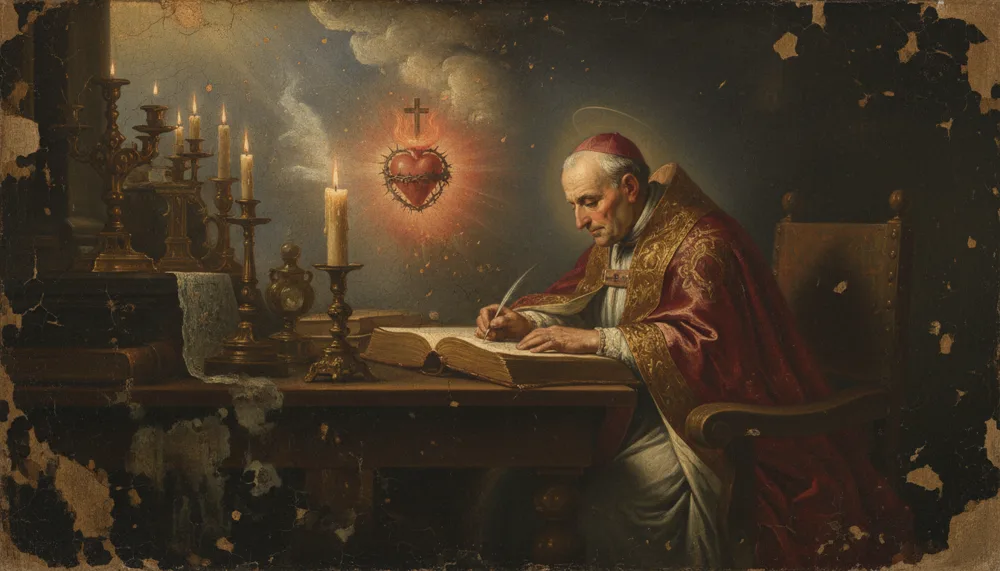
St Francis de Sales (1567–1622) was Bishop of Geneva, a Doctor of the Church, and the author of the Introduction to the Devout Life, the classic proof that holiness is possible in every state of life. Renowned for the gentleness by which he brought tens of thousands of Calvinists back to the Catholic Church, he is the patron saint of writers and journalists, and his feast is kept on the 29th of January in the traditional calendar.
Who was St Francis de Sales
Francis was born on the 21st of August 1567 at the Château de Sales in Savoy, the eldest son of a noble family. He studied with the Jesuits at the Collège de Clermont in Paris and took his doctorate in law at Padua, where he also gave himself seriously to theology. His father intended him for a magistrate's career and an advantageous marriage; Francis refused both, and in 1593 was ordained priest and made provost of the cathedral chapter of Geneva.
As a student in Paris he had passed through a violent interior trial: for weeks he was tormented by the conviction that he was destined to be damned. The crisis broke before an image of Our Lady, where he prayed the Memorare and surrendered the question of his eternity into the hands of God, resolving to love Him in this life whatever should come. From that abandonment came the unshakable serenity that marked everything he later wrote, and the doctrine of confident, generous love of God that runs through all his works.
In 1602 he was consecrated Bishop of Geneva. Since the city itself was held by the Calvinists, he governed his diocese from Annecy in Savoy, where he preached, catechized children himself, formed his clergy, and directed souls until his death at Lyons on the 28th of December 1622. He was canonized by Alexander VII in 1665, and Pius IX declared him a Doctor of the Church in 1877.
The apostle of the Chablais: converting Calvinists by gentleness
In 1594 Francis volunteered for the mission of the Chablais, a province on the south shore of Lake Geneva that had gone over almost entirely to Calvinism. He entered it on foot, with his cousin for sole companion, under threat of assassination and with doors closed against him. Since the people would not come to hear him, he wrote: leaflet by leaflet he set out the Catholic doctrine of the Church, the Rule of Faith, and the Sacraments, copying the sheets by hand and slipping them under doors. These pages, gathered after his death, form the work known as The Catholic Controversy.
After four years of this patient warfare — preaching, disputing, and above all refusing every bitterness — the province returned to the Faith; the number of converts is commonly reckoned in the tens of thousands. His method was deliberate and is preserved in his own saying, that one catches more flies with a spoonful of honey than with a barrel of vinegar. The gentleness was not softness of doctrine; on doctrine he yielded nothing. It was charity applied as a weapon, and it succeeded where force and polemic had failed.
The Introduction to the Devout Life: devotion for every state of life
Published in 1609, the Introduction to the Devout Life grew out of letters of direction to a laywoman living at court. Its thesis was, for the time, startling: true devotion is not the preserve of monks and nuns but the obligation and the possibility of every Christian. Francis states it plainly: "It is an error, nay rather a heresy, to wish to banish the devout life from the soldier's camp, the mechanic's workshop, the prince's court, or the household of the married" (Part I, ch. 3). Devotion, he teaches, must be exercised differently by the gentleman, the tradesman, the servant, the prince, the widow, and the wife — but exercised by all.
The book leads the reader in order: from the purgation of mortal sin and of affection to sin, through the practice of prayer and the Sacraments, to the virtues proper to one's state — with celebrated chapters on patience, humility, gentleness towards oneself, friendship, and the sanctification of ordinary duties. Alongside the Imitation of Christ, it remains one of the two books most constantly placed in the hands of the laity. His longer and deeper work, the Treatise on the Love of God (1616), traces the whole life of charity from its birth in the soul to its perfection; with the Controversy and his letters of direction, these are the books of St Francis de Sales that the Church has never let fall out of print.
St Francis de Sales on prayer
The Introduction devotes its second part to prayer, and it is here that Francis is most practical. He prescribes for every soul, whatever its state, a daily exercise of mental prayer — an hour a day, before the midday meal and preferably in the morning — and teaches a simple method: place yourself in the presence of God, ask His assistance, represent the mystery to the imagination, draw affections and resolutions from it, and end with a spiritual nosegay, some thought gathered from the meditation and carried through the day. Those who wish to begin this practice will find the same traditional method set out in our guide on how to meditate.
Two counsels of his stand out. First, that distraction and dryness do not ruin prayer: to return the heart quietly to God a hundred times is itself an excellent prayer. Second, that meditation must issue in resolution — a prayer that changes nothing in the day's conduct has miscarried. He asks of beginners not raptures but fidelity.
The prayer of St Francis de Sales: "Be at peace"
The prayer most often sought under his name is not a formal prayer but a passage adapted from his letters of spiritual direction; the wording below is the popular English form, and it breathes his whole doctrine of confidence in Providence:
Do not look forward in fear to the changes of life; rather look to them with full hope that as they arise, God, whose very own you are, will lead you safely through all things; and when you cannot stand it, God will carry you in His arms. Do not fear what may happen tomorrow; the same everlasting Father who cares for you today will take care of you then and every day. He will either shield you from suffering, or He will give you unfailing strength to bear it. Be at peace, then, and put aside all anxious thoughts and imaginations.
The counsel is not sentiment but doctrine: anxiety about the future usurps a providence that belongs to God, and the soul's business is the duty of the present moment. Those who wish to school themselves in this confidence may make a novena to St Francis de Sales, asking his intercession over nine days.
Quotes of St Francis de Sales
His sayings circulate widely because they compress his spirit into a line. Two are from the Introduction; the two others are popular renderings of thoughts from his letters:
- "It is an error, nay rather a heresy, to wish to banish the devout life from the soldier's camp, the mechanic's workshop, the prince's court, or the household of the married." (Introduction to the Devout Life, I, 3)
- "Have patience with all things, but first of all with yourself."
- "Nothing is so strong as gentleness, nothing so gentle as real strength."
- "Make yourself a seller when you are buying, and a buyer when you are selling, and you will sell and buy justly." (Introduction, III, 36)
The recurring note is gentleness — with others, with oneself, with events — resting on an unshaken confidence in God. It is the same spirit that a later saint, St John Bosco, took as the pattern of his own work, naming his congregation the Salesians in his honour; the Oblates of St Francis de Sales and the Visitation Order, which Francis himself founded with St Jane Frances de Chantal in 1610, carry the same patrimony.
Feast day and patronage
In the traditional Roman calendar the feast of St Francis de Sales is kept on the 29th of January, the anniversary of the bringing of his body to the convent of the Visitation at Annecy in 1623 (Butler, Lives of the Saints, 29 January); he died on the 28th of December 1622, the feast of the Holy Innocents, within the octave of Christmas. In the 1962 calendar it is a feast of the third class. The reformed calendar of 1969 moved his memorial to January 24; those who follow the traditional calendar keep January 29.
Pope Pius XI, in the encyclical Rerum Omnium Perturbationem (1923), written for the third centenary of his death, declared him patron of writers and journalists — the missionary of the Chablais leaflets being the fitting protector of all who defend the truth by the pen. He is also invoked as a patron of the deaf, having personally catechized a deaf servant, and he stands among the saints of the Church as the great director of souls living in the world. He should not be confused with St Francis of Assisi, the founder of the Friars Minor, who lived four centuries earlier.
Frequently Asked Questions
Who is St Francis de Sales?
St Francis de Sales (1567–1622) was a priest of Savoy who became Bishop of Geneva in 1602, governing his diocese from Annecy since Geneva itself was held by the Calvinists. He is remembered for the conversion of the Chablais, for his spiritual classics the Introduction to the Devout Life and the Treatise on the Love of God, and for founding the Visitation Order with St Jane Frances de Chantal. He was canonized in 1665 and declared a Doctor of the Church by Pius IX in 1877.
What was the major achievement of St Francis de Sales?
Two achievements stand out. As a missionary he recovered the province of the Chablais from Calvinism, winning back tens of thousands by preaching, written leaflets, and unfailing gentleness. As a spiritual writer he established, in the Introduction to the Devout Life, that true devotion belongs to every state of life — to the married, the tradesman, and the courtier as truly as to the religious.
When is the feast day of St Francis de Sales?
In the traditional Roman calendar his feast is the 29th of January, the anniversary of the translation of his relics to Annecy. He died on the 28th of December 1622, but as that day falls within Christmastide his feast was assigned to January. The 1969 calendar keeps his memorial on January 24.
What is the prayer of St Francis de Sales?
The prayer most associated with him is the "Be at peace" prayer, drawn from his letters of spiritual direction: "Do not look forward in fear to the changes of life... Be at peace, then, and put aside all anxious thoughts and imaginations." It teaches abandonment to Providence: God will either shield the soul from suffering or give it strength to bear it.
What books did St Francis de Sales write?
His principal works are the Introduction to the Devout Life (1609), a complete guide to holiness for those living in the world; the Treatise on the Love of God (1616), on the life of charity in the soul; and The Catholic Controversy, the collected leaflets of his Chablais mission defending Catholic doctrine against Calvinism. His many letters of spiritual direction and his conferences to the Visitation nuns were also gathered and published.
What is St Francis de Sales the patron saint of?
Pius XI declared him patron of writers and journalists in 1923, on account of the leaflets by which he converted the Chablais. He is also invoked as a patron of the deaf, having himself catechized a deaf man, and is honoured more broadly as a patron of spiritual directors and of the devout life lived in the world.
The traditional method of meditation St Francis de Sales taught, with the prayers and the traditional calendar of feasts, is carried in the Iter Fidei app. Join early access here.
Sources. St Francis de Sales, Introduction to the Devout Life (1609), Part I, ch. 3; Part II; Part III, ch. 36. St Francis de Sales, Treatise on the Love of God (1616). St Francis de Sales, The Catholic Controversy (Chablais leaflets, 1594–1598). Letters of spiritual direction of St Francis de Sales. Roman Martyrology, 29 January. Alban Butler, The Lives of the Fathers, Martyrs, and Other Principal Saints, 29 January, St Francis de Sales. Pius IX, decree declaring St Francis de Sales a Doctor of the Church (1877). Pius XI, encyclical Rerum Omnium Perturbationem (1923).