
The Saints
Saint John Bosco (Don Bosco)
Saint John Bosco, Don Bosco, founder of the Salesians and father of the young — his life, his preventive system, his dreams, what he is patron of, his feast on 31 January, and a traditional prayer.
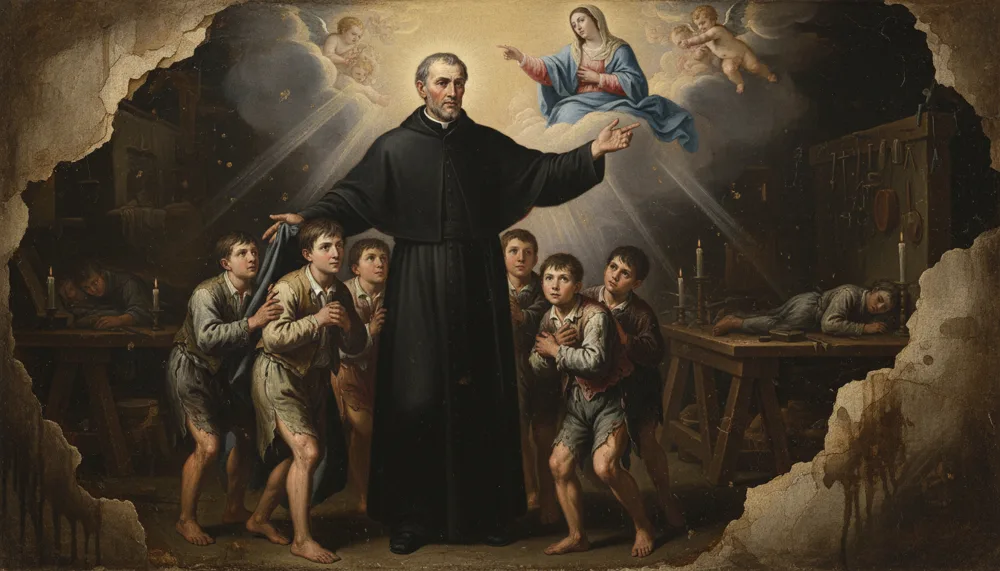
Saint John Bosco — known the world over as Don Bosco — was a priest of Turin who gave his whole life to poor and abandoned boys, founded the Salesians to carry that work after him, and is honoured as the patron saint of youth, of apprentices, and of Catholic editors and publishers. He was born in 1815, died in 1888, and was canonized in 1934. His feast is kept on 31 January. He is remembered for three things above all: his tireless charity toward the young, the gentle method of education he called the preventive system, and the long series of prophetic dreams that guided his life's work.
Who Saint John Bosco was
John Bosco was born on 16 August 1815 at Becchi, a hamlet near Castelnuovo in Piedmont, the son of poor peasant farmers. His father died when he was two, and his mother, Margaret, a woman of strong and simple faith, raised him in want but in great piety. From boyhood he had to labour in the fields, and he learned early what it was to be poor and to go without schooling.
His vocation was set before him in a dream he had at the age of nine — the first and most famous of many. He saw himself among a crowd of rough, quarrelling boys, and a Man of majestic bearing told him that he would win these boys not with blows but with gentleness and charity. A Lady of great dignity then showed him the boys changed into wild beasts and then into lambs, and told him: "In time you will understand." He spent the rest of his life understanding it.
Ordained a priest in 1841, he settled in Turin, then swollen with poor youths drawn from the countryside by the new factories — boys with no family, no trade, and no faith, many ending in the prisons he visited. For these he opened his Oratory, first a roving Sunday gathering and then a permanent home at Valdocco, where he housed, fed, taught, and catechized them, and apprenticed them to honest trades. His mother came to keep house and was loved by the boys as "Mamma Margaret." From this single work grew schools, workshops, and missions that would one day reach across the world.
The Salesians and the missions
To make the work outlast him, Don Bosco founded in 1859 the Society of St Francis de Sales — the Salesians — placing his priests and brothers under the patronage of that gentle Doctor of charity whose spirit he wished them to breathe. With St Mary Mazzarello he founded in 1872 the Daughters of Mary Help of Christians, the Salesian Sisters, for the same work among girls, and he gathered devout laymen into the Salesian Cooperators to support it. By the time he died the Salesians numbered over a thousand, with houses in Europe and the Americas; today they are among the largest religious orders in the Church.
Don Bosco had a particular love for the foreign missions, sending his first band of missionaries to Argentina in 1875, and he foretold in dreams the spread of the faith in Patagonia long before his sons set foot there. He was also a builder of churches — above all the great Basilica of Mary Help of Christians at Turin — and a tireless writer of cheap, sound Catholic books for the people, which is why the Church honours him as patron of Catholic editors and publishers, the very labour to which we ourselves are bound.
The preventive system
The heart of Don Bosco's method was what he called the preventive system, set against the older "repressive" system of rule by punishment. He summed it in three words: reason, religion, and loving-kindness (ragione, religione, amorevolezza). Rather than wait for a boy to do wrong and then punish him, the educator was to surround him with such constant, fatherly care that the occasions of sin were taken away before they could harm him.
This meant living among the boys, watching over them with affection rather than from a distance, drawing them by encouragement and trust, and grounding everything in the practice of religion — frequent Confession and Holy Communion, devotion to Our Lady, and a cheerful, busy life that left no room for idleness. "It is not enough that the young should be loved," he wrote; "they must know that they are loved." His was a discipline of the heart, won by patience and presence, and it has shaped Catholic education ever since. Readers will recognise in it the same gentle spirit that animates the Sacred Heart of Jesus, to whom Don Bosco was deeply devoted, and the same trust in Confession and the Eucharist as the daily medicine of the soul.
The dreams of Saint John Bosco
Few saints are so bound up with dreams as Don Bosco. From the dream of the nine-year-old to the dreams of his last years, he received in sleep a stream of visions — some plainly allegorical, some prophetic — which he recounted to his boys and which were carefully written down. He never claimed them as articles of faith and submitted them entirely to the Church; but their fruits were such that they cannot be lightly dismissed.
The most celebrated is the dream of the two columns: Don Bosco saw the ship of the Church, captained by the Pope, beset in a furious sea by enemy vessels, and brought to safety only when the Pope anchored her between two great columns rising from the waters — one bearing the Blessed Sacrament, crowned Salus credentium (the Salvation of believers), the other the image of the Immaculate Virgin, Auxilium Christianorum (the Help of Christians). The lesson he drew was plain and lasting: that the Church is saved in every storm by devotion to the Holy Eucharist and to the Blessed Virgin Mary. It is a vision worth holding before the eyes in any troubled age.
What Saint John Bosco is patron saint of
Saint John Bosco is the patron saint of youth and of young people, of schoolboys and students, of apprentices and young workers, of Catholic editors, publishers, and the Catholic press. As a boy he learned acrobatics and conjuring tricks to gather a crowd, and then preach to it and lead it in prayer. He is invoked by teachers, by parents anxious for their children, and by all who labour to bring the young to God.
The reason the Church gives one saint as patron of a particular work or need is never arbitrary. The saints in glory see God, and in God they see and love us; their charity does not cease at death but is perfected. So the faithful ask Don Bosco to watch over the young as he did in life, just as they ask St Monica for wayward children or St Joseph for the protection of the home. To invoke a saint is not to credit him with power of his own, but to ask his intercession before the one God who works all good — the doctrine of the communion of saints professed in the Creed.
Don Bosco and Dominic Savio
The surest proof of Don Bosco's method is the kind of boy it formed. Among the pupils of his Oratory was Dominic Savio, a frail youth of extraordinary holiness who took as his motto "Death rather than sin," and who died at not quite fifteen in 1857. Don Bosco himself wrote his life, and the Church has since raised the pupil to the altars as a saint — a boy canonized largely on the witness of his master. Those who wish to see the preventive system bear its perfect fruit should read the short life of Saint Dominic Savio, the schoolboy saint, beside that of his teacher.
A prayer to Saint John Bosco
The faithful turn to Don Bosco above all for the young — for their faith, their purity, their choice of state in life, and their perseverance. The surest prayer to him is the prayer of the Church on his feast, the Collect of his Mass in the Roman Missal of 1962:
Collect of the feast, 31 January
Deus, qui sanctum Joánnem Confessórem tuum adolescentium patrem et magístrum excitásti, ac per eum, auxiliatríce Vírgine María, novas in Ecclésia tua famílias floréscere voluísti: concéde, quǽsumus; ut eódem caritátis igne succénsi, ánimas quærere, tibíque soli servíre valeámus. Per Dóminum nostrum Jesum Christum, Fílium tuum: qui tecum vivit et regnat in unitáte Spíritus Sancti Deus, per ómnia sǽcula sæculórum. Amen.
O God, Who in Your Confessor, blessed John, raised up a father and teacher of youth, and willed that through him, with the help of the Virgin Mary, new religious families should bloom in the Church, grant, we beseech You, that, inflamed by the same fire of love, we may seek to win souls and to serve You alone. Through Jesus Christ, thy Son our Lord, Who liveth and reigneth with thee, in the unity of the Holy Ghost, God, world without end. Amen.
Prayer to the saints is petition, never a charm, and is properly said in resignation to God's will. A nine-day novena to Don Bosco, ending on his feast, is a fitting way for parents and teachers to commend the young to his care.
The feast of Saint John Bosco — 31 January
The feast of Saint John Bosco is kept on 31 January. Don Bosco died on that day in 1888, worn out at seventy-two by a lifetime of unsparing labour, and the Church fixed his feast on the anniversary of his death. He was beatified in 1929 and canonized by Pope Pius XI on Easter Sunday, 1 April 1934 — and so, while the man himself and the whole shape of his work belong wholly to the nineteenth century, his raising to the altars falls in the early twentieth, well within the tradition the Church has always kept. Pius XI, who had known Don Bosco in life, called him a giant of sanctity.
To honour the feast well is to do what the saint himself did without ceasing: to care for the young, to draw them to Confession and the Eucharist, to entrust them to Mary Help of Christians, and to believe, as he believed, that no soul is beyond the reach of patient charity. Under that very title, which he set at the head of his whole work, the faithful keep the novena to Mary Help of Christians before her feast on 24 May. St John Bosco takes his place among the saints of the year in our guide to the Catholic saints, listed by feast day.
Frequently Asked Questions
Who is Saint John Bosco (Don Bosco)?
Saint John Bosco was an Italian priest of Turin, born in 1815 and died in 1888, who devoted his life to poor and abandoned boys. He founded the Salesians in 1859 and the Daughters of Mary Help of Christians in 1872, pioneered the gentle method of education called the preventive system, and was famous for a long series of prophetic dreams. He was canonized in 1934, and his feast is kept on 31 January.
What is Saint John Bosco the patron saint of?
Saint John Bosco is the patron saint of youth and young people, of schoolboys and students, of apprentices and young workers, and of Catholic editors, publishers, and the Catholic press. He is invoked by teachers and by parents anxious for their children.
When is the feast of Saint John Bosco?
The feast of Saint John Bosco falls on 31 January, the anniversary of his death in 1888. It is the day the Church set aside to honour him after his canonization in 1934.
What was Saint John Bosco's preventive system?
The preventive system was Don Bosco's method of education, built on three things: reason, religion, and loving-kindness. Instead of governing the young by punishment, the educator was to surround them with such constant, fatherly care, and ground them so firmly in religion, that the occasions of sin were removed before they could do harm. "It is not enough that the young should be loved," he said; "they must know that they are loved."
What are the dreams of Saint John Bosco?
Don Bosco received throughout his life a series of vivid dreams, some allegorical and some prophetic, which he recounted to his boys and submitted entirely to the Church. The most famous are the dream of the nine-year-old, in which his vocation to the young was foretold, and the dream of the two columns, in which the Church is brought safely through a storm by anchoring herself to the Holy Eucharist and to the Blessed Virgin, Help of Christians.
What prayer do you say to Saint John Bosco?
The faithful pray to Don Bosco chiefly for the young — for their faith, purity, and perseverance. The Collect of his feast asks that, inflamed by the same fire of charity, we may seek souls and serve God alone. It is a prayer of petition, said in trust in God's will, and is often made as a nine-day novena ending on his feast.
For more, see saint john vianney.
Iter Fidei serves the prayers, the Divine Office and the liturgical calendar, in Latin and English with audio. Join early access here.
Sources. Butler, Lives of the Saints (St John Bosco, 31 January); The Roman Martyrology (31 January); the Biographical Memoirs of St John Bosco (G. B. Lemoyne and others); the life of St Dominic Savio written by St John Bosco; Roman Missal (1962), Proper of Saints, 31 January (Collect).