
Prayer
Prayers Before and After Communion
The traditional Catholic prayers before and after Holy Communion: the acts of preparation and the Domine non sum dignus before; the thanksgiving of St Thomas Aquinas, the Anima Christi and the Suscipe after — and why the Church insists on the time of thanksgiving.
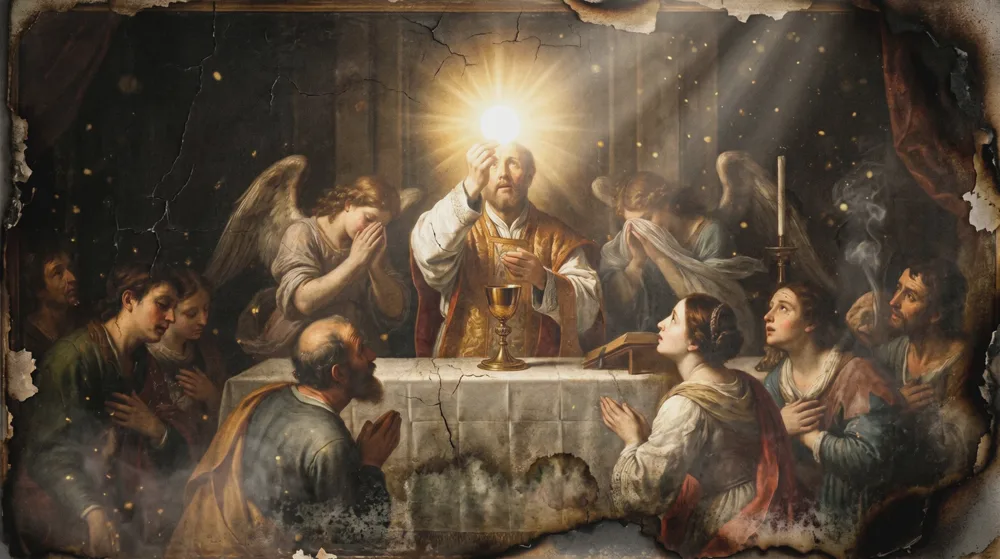
The classic Catholic prayer after Communion is the thanksgiving of St Thomas Aquinas — "I give Thee thanks, O holy Lord, Father almighty, everlasting God" — together with the Anima Christi; before Communion, the Church gives the acts of faith, contrition and desire, and the centurion's words, Domine, non sum dignus. We give all of these texts below, in the order the traditional missals print them, and then explain why the Church attaches such weight to these minutes. For in Holy Communion the faithful receive not a symbol but the true Body and Blood of Christ, as the Church has always taught of the Eucharist; no moment of the Christian's day asks more preparation or deserves more gratitude.
Why prepare before and give thanks after
The Apostle lays down the law of preparation: "But let a man prove himself: and so let him eat of that bread, and drink of the chalice. For he that eateth and drinketh unworthily, eateth and drinketh judgment to himself, not discerning the body of the Lord" (1 Corinthians 11:28-29). The Council of Trent, in its thirteenth session (1551), made the same demand: no one conscious of mortal sin may approach the holy table without sacramental Confession, and all should come "with such faith and devotion" as befits so great a Sacrament. If you have been away from the confessional, our guide on how to go to confession walks through the rite step by step.
Thanksgiving afterwards rests on the same doctrine. Trent defined that the true Body of the Lord remains in the consecrated species after Communion (Session XIII, canon 4): while the species endure, Christ is corporally present within the communicant. This is transubstantiation carried to its practical conclusion — the soul holds its God as a guest, and to walk out at once, without a word, is to leave the King standing in the hall.
Prayers before Communion
The acts of faith, contrition and desire
The traditional missals and prayer books place short acts on the communicant's lips in the pew, before approaching the rail. The act of contrition among them is one of perfect contrition, sorrow for sin because it offends God, who is all good. They may be said in these or similar words:
Act of faith. O Lord Jesus Christ, I firmly believe that Thou art truly present in this Blessed Sacrament — Thy Body and Blood, Thy Soul and Divinity — because Thou hast said it, and Thy word is truth.
Act of contrition. O my God, I am heartily sorry for having offended Thee, and I detest all my sins, because they displease Thee, my God, who art all good and deserving of all my love.
Act of desire. O Jesus, my God and my all, my soul longs for Thee. Come into my heart, and make it Thine for ever.
These acts are not padding; they are the "proving of oneself" the Apostle commands, compressed into a form a child learns before First Holy Communion and keeps for life.
The prayer of St Thomas Aquinas before Communion
The Roman Missal prints among the priest's preparatory prayers this prayer of St Thomas, which the faithful have always made their own:
Almighty and everlasting God, behold I come to the Sacrament of Thine only-begotten Son, our Lord Jesus Christ. I come as one sick to the physician of life, as one unclean to the fountain of mercy, as one blind to the light of eternal brightness, as one poor and needy to the Lord of heaven and earth. I ask, therefore, of the abundance of Thy boundless bounty, that Thou wouldst vouchsafe to heal my sickness, to wash my uncleanness, to enlighten my blindness, to enrich my poverty, and to clothe my nakedness. Amen.
Domine, non sum dignus
Immediately before receiving, the Church puts on every tongue the words of the centurion of Capharnaum: "Lord, I am not worthy that thou shouldst enter under my roof: but only say the word, and my servant shall be healed" (Matthew 8:8). At Mass the words become personal — say but the word, and my soul shall be healed — said three times. No one is worthy; the Sacrament is received not as a right but as a mercy asked for and granted.
Prayer after Communion: the traditional thanksgiving
The prayer of St Thomas Aquinas after Communion
The first of the Church's thanksgiving prayers is again from St Thomas, the Doctor of the Eucharist, whose life and writings we treat in our article on St Thomas Aquinas:
I give Thee thanks, O holy Lord, Father almighty, everlasting God, who hast vouchsafed to feed me, a sinner, Thine unworthy servant, for no merits of my own, but only out of the goodness of Thy mercy, with the precious Body and Blood of Thy Son, our Lord Jesus Christ. And I pray that this Holy Communion may not be to me a condemnation unto punishment, but a saving intercession for pardon. May it be to me an armour of faith and a shield of good will. May it root out from me all vice, extinguish in me all evil desires, increase charity and patience, and bring me to the everlasting joys of Thy kingdom. Amen.
To the same saint the Church owes the hymn Adoro te devote — "I devoutly adore Thee, O hidden Deity" — which many pray as a further thanksgiving, adoring the Lord still veiled under the species. From the same pen comes the Creator ineffabilis, the traditional prayer before an exam and before study, which generations of students have made their own. All of these, with his Concede mihi, are gathered in Latin and English in the prayers of St Thomas Aquinas.
The Anima Christi
The Anima Christi is the thanksgiving prayer after Communion most familiar to the faithful — a fourteenth-century prayer that St Ignatius of Loyola placed at the head of his Spiritual Exercises:
Soul of Christ, sanctify me. Body of Christ, save me. Blood of Christ, inebriate me. Water from the side of Christ, wash me. Passion of Christ, strengthen me. O good Jesus, hear me. Within Thy wounds hide me. Suffer me not to be separated from Thee. From the malicious enemy defend me. In the hour of my death call me, and bid me come unto Thee, that with Thy saints I may praise Thee for ever and ever. Amen.
Every petition supposes the Real Presence: the soul speaks to the Christ it has just received. For its history and a phrase-by-phrase explanation, see The Anima Christi.
The Suscipe of St Ignatius
Where the Anima Christi asks, the Suscipe gives. St Ignatius composed it as the total offering of the creature to the Creator, and it belongs naturally to the moment when Christ has given Himself first:
Take, O Lord, and receive all my liberty, my memory, my understanding, and my entire will — all that I have and possess. Thou hast given all to me; to Thee, O Lord, I return it. All is Thine: dispose of it wholly according to Thy will. Give me Thy love and Thy grace, for this is enough for me. Amen.
A simple prayer after Communion
Nothing obliges the communicant to a long formula. A simple prayer after receiving Holy Communion can be a single sentence, held in silence: "My Lord and my God, I thank Thee; stay with me, and never let me be separated from Thee." What the Church asks is not length but attention.
The Padre Pio prayer after Communion
Many searchers ask for the prayer after Communion of Padre Pio of Pietrelcina (1887-1968), the Capuchin friar of San Giovanni Rotondo, canonized in 2002. Among his writings is a thanksgiving built entirely on one petition, drawn from the disciples at Emmaus — mane nobiscum, Domine, "stay with us, Lord" (Luke 24:29). It begins:
Stay with me, Lord, for it is necessary to have Thee present, that I may not forget Thee. Thou knowest how easily I abandon Thee. Stay with me, Lord, because I am weak, and I need Thy strength, that I may not fall so often.
The older prayers given above ask the very same thing, and they remain the classical thanksgiving of the Roman missals: whoever prays the Aquinas thanksgiving and the Anima Christi is already asking, with the whole tradition, that the Lord stay.
How long should the thanksgiving last
The traditional counsel is to remain in prayer after Mass for as long as the sacramental species may be presumed to endure — about a quarter of an hour — since during that time Christ remains corporally present within the soul. St Alphonsus Liguori, Doctor of the Church, taught that no time is more precious for prayer than the moments after Communion, when the soul treats with its God present within it. To leave at once without a word of thanks is not forbidden by law; it is simply unworthy of what has happened. On the days when one cannot receive sacramentally, the Church commends the act of spiritual Communion — the same desire and the same thanksgiving, offered to the same Lord.
Frequently Asked Questions
What is the prayer after Communion of St Thomas Aquinas?
It is the thanksgiving beginning "I give Thee thanks, O holy Lord, Father almighty, everlasting God" (Gratias tibi ago), printed in the Roman Missal. It thanks God for the Body and Blood of Christ and asks that the Communion be a pardon, not a condemnation. The full text is given above.
Is the Anima Christi a prayer after Communion?
Yes. Though it may be prayed at any time, the Anima Christi is by long custom the thanksgiving prayer after Holy Communion, because every petition — "Body of Christ, save me," "within Thy wounds hide me" — addresses the Christ the communicant has just received. It dates from the fourteenth century and was beloved of St Ignatius of Loyola.
What is the Padre Pio prayer after Communion?
It is the thanksgiving of Padre Pio of Pietrelcina (1887-1968) built on the repeated petition "Stay with me, Lord," echoing the disciples at Emmaus in Luke 24:29. It asks that the Lord who has just come in Communion remain, because the soul is weak and forgets Him easily.
What is a simple prayer after Communion?
A single sentence suffices if it is said with attention: "My Lord and my God, I thank Thee; stay with me, and never let me be separated from Thee." Short aspirations of thanks, adoration and petition, repeated slowly while Christ is sacramentally present, are a thanksgiving the saints themselves commended.
What prayers should I say before Communion?
The traditional preparation is the acts of faith, contrition and desire, the prayer of St Thomas Aquinas ("Almighty and everlasting God, behold I come..."), and the centurion's words, "Lord, I am not worthy that Thou shouldst enter under my roof" (Matthew 8:8). Anyone conscious of mortal sin must first go to Confession, as the Council of Trent requires.
How long should I stay after Mass to give thanks?
The traditional counsel is about a quarter of an hour — the time during which the sacramental species, and therefore the corporal presence of Christ within the communicant, may be presumed to endure. St Alphonsus Liguori held these moments to be among the most precious of the whole day for prayer.
The Iter Fidei app carries the traditional prayers before and after Communion, in Latin and English with audio, ready in the pew. Join early access here.
Sources. 1 Corinthians 11:28-29; Matthew 8:8; Luke 24:29 (Douay-Rheims); Council of Trent, Session XIII (1551), on the Most Holy Eucharist; Catechism of the Council of Trent (1566), on the Sacrament of the Eucharist; the prayers of St Thomas Aquinas before and after Communion, Roman Missal; the Anima Christi (14th century); the Suscipe of St Ignatius of Loyola, Spiritual Exercises; St Alphonsus Liguori on thanksgiving after Communion.