
Prayer
Spiritual Communion Prayer: The Act of St Alphonsus
The spiritual communion prayer of St Alphonsus Liguori in full, with his own short form and the Italian original, the teaching of St Thomas and the Council of Trent, and how and when to make an act of spiritual communion.
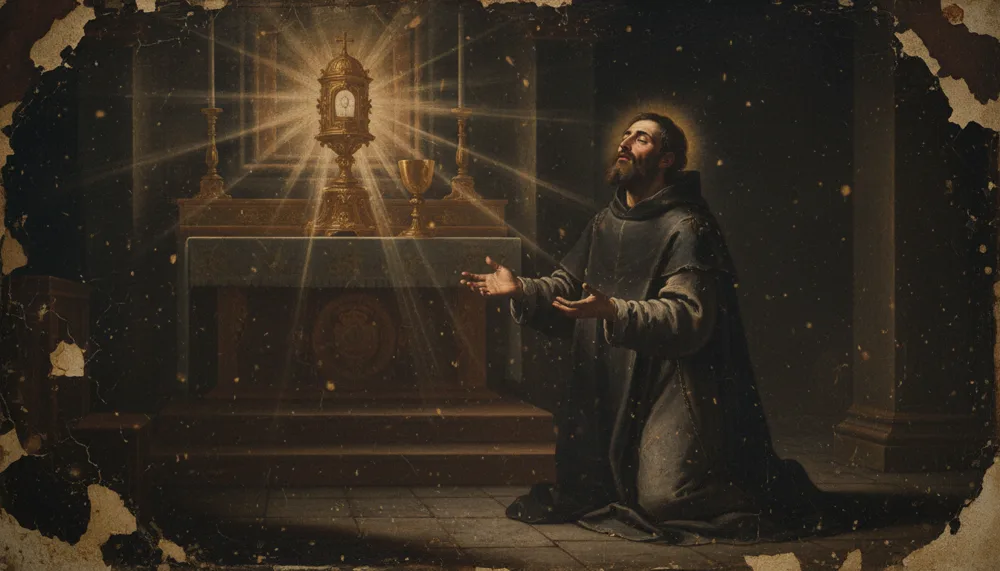
A spiritual communion is an ardent desire to receive Jesus Christ in the Blessed Sacrament, made by one who cannot at that moment receive Him sacramentally, together with a loving embrace of Him as though He had already come. It is not a modern stopgap but an old practice of the saints, praised by the Council of Trent and explained by St Thomas Aquinas. Below we give the best-loved spiritual communion prayer, the Act of St Alphonsus Liguori, exactly as he wrote it, with his own shorter form and the original Italian, then what a spiritual communion is, how to make one well and when.
The Act of Spiritual Communion of St Alphonsus Liguori
St Alphonsus Liguori (1696–1787), bishop, founder of the Redemptorists and Doctor of the Church, placed this act in his little book Visits to the Most Blessed Sacrament and to the Blessed Virgin Mary, and asked that it be made at every one of the thirty-one visits. This is the classic nineteenth-century English translation of his works:
My Jesus, I believe that Thou art present in the Most Holy Sacrament. I love Thee above all things, and I desire to possess Thee within my soul. Since I am unable now to receive Thee sacramentally, come at least spiritually into my heart. I embrace Thee as already there, and unite myself wholly to Thee; never permit me to be separated from Thee. Amen.
Many prayer books print it with slight variations: "truly present", "I desire to receive Thee into my soul", "I embrace Thee as if Thou wert already there". In contemporary English it usually reads "My Jesus, I believe that You are present in the Most Holy Sacrament…". The substance is the same in every version, and it is the saint's: an act of faith in the Real Presence, an act of love, an act of desire, the invitation, and the embrace with the resolve never to be parted from Him.
The short form of the Act
Right after the act, St Alphonsus adds a shorter form ("E più breve", "and more briefly"), for repeating many times a day or at a crowded moment of Mass:
I believe that Thou, O Jesus, art in the Most Holy Sacrament! I love Thee and desire Thee! Come into my heart. I embrace Thee; oh, never leave me!
Learned by heart, these few words turn a sleepless hour or a sickbed into a communion of desire.
The original Italian
St Alphonsus wrote in Italian. For those who pray in that language, or who wish to see the words he actually set down, here is the act as it stands in the Visite al SS. Sacramento, followed by the shorter form:
Gesù mio, credo che voi state nel SS. Sacramento. V'amo sopra ogni cosa e vi desidero nell'anima mia. Giacché ora non posso ricevervi sacramentalmente, venite almeno spiritualmente al cuore mio. Come già venuto io v'abbraccio, e tutto mi unisco a voi. Non permettete ch'io m'abbia mai a separare da voi.
Vi credo, Gesù, nel SS. Sacramento, v'amo e vi desidero. Venite al cuore mio. Io v'abbraccio, non vi partite più da me.
Is there a Latin Act of Spiritual Communion?
The Act was never composed in Latin, so any "Latin original" one meets is a later translation. St Alphonsus does, however, follow his two forms with a Latin prayer that he gives under the name of St Francis, a short aspiration in which the soul asks to be wholly taken up by the love of Christ. It makes a fitting close to a spiritual communion:
Absorbeat, quaeso, Domine Iesu Christe, mentem meam ignita et melliflua vis amoris tui, ut amore amoris tui moriar, qui amore amoris mei dignatus es mori.
May the burning and most sweet power of Thy love, O Lord Jesus Christ, I beseech Thee, absorb my mind, that I may die through love of Thy love, who wast graciously pleased to die through love of my love.
The prayer of spiritual communion attributed to Cardinal Merry del Val
A second form, longer and more penitential, is attributed to Cardinal Rafael Merry del Val (1865–1930), Secretary of State to St Pius X. Its opening act of contrition makes it especially suited to those who feel their unworthiness keenly:
At Thy feet, O my Jesus, I prostrate myself and I offer Thee repentance of my contrite heart, which is humbled in its nothingness and in Thy holy presence. I adore Thee in the Sacrament of Thy love, the ineffable Eucharist. I desire to receive Thee into the poor dwelling that my heart offers Thee. While waiting for the happiness of sacramental Communion, I wish to possess Thee in spirit. Come to me, O my Jesus, since I, for my part, am coming to Thee! May Thy love embrace my whole being in life and in death. I believe in Thee, I hope in Thee, I love Thee. Amen.
Either prayer may be used, or none. A spiritual communion can be made entirely without words, in one movement of the heart toward the tabernacle; the formulas only help us to make that movement complete.
What is a spiritual communion?
St Alphonsus opens his chapter on the subject with a definition he takes from St Thomas: "A spiritual Communion, according to St. Thomas, consists in an ardent desire to receive Jesus in the Most Holy Sacrament, and in lovingly embracing Him as if we had actually received Him." The Baltimore Catechism puts the same thing in plain catechism terms: a spiritual communion is "an earnest desire to receive Communion in reality, by which desire we make all preparations and thanksgivings that we would make in case we really received the Holy Eucharist."
The teaching of St Thomas Aquinas
St Thomas explains why such a desire is not empty. In the Summa Theologiae (III, q. 80, a. 1, ad 3) he writes that "the effect of the sacrament can be secured by every man if he receive it in desire, though not in reality," and he draws the comparison every catechism student knows: "just as some are baptized with the Baptism of desire, through their desire of baptism, before being baptized in the Baptism of water; so likewise some eat this sacrament spiritually ere they receive it sacramentally."
Elsewhere (III, q. 73, a. 3) he teaches that the inmost reality of the Eucharist, its res, is the unity of the Mystical Body, the charity that joins us to Christ, and that this grace can be had by desire before the Sacrament itself is received. A spiritual communion is that desire, made deliberate and set on fire.
The Council of Trent (Session XIII, chapter 8)
The Council of Trent, in its decree on the Most Holy Eucharist, gives the classic division of the three ways of receiving: "some receive it sacramentally only, to wit sinners: others spiritually only, those to wit who eating in desire that heavenly bread which is set before them, are, by a lively faith which worketh by charity, made sensible of the fruit and usefulness thereof: whereas the third (class) receive it both sacramentally and spiritually, and these are they who so prove and prepare themselves beforehand, as to approach to this divine table clothed with the wedding garment." The phrase "faith which worketh by charity" is St Paul's (Galatians 5:6), and it names the two conditions of a fruitful spiritual communion: living faith in the Real Presence and the charity of a soul in God's grace.
The same Council returns to it in Session XXII, chapter 6, on the Mass: the holy Synod "would fain indeed that, at each mass, the faithful who are present should communicate, not only in spiritual desire, but also by the sacramental participation of the Eucharist." Spiritual communion is taken for granted as the practice of the faithful at Mass, with sacramental Communion as its fulfilment. This is what St Alphonsus means when he writes that "the holy Council of Trent greatly praises spiritual Communions, and encourages the faithful to practise them."
Why the saints made it so often
In the same chapter St Alphonsus gathers the examples that made the practice dear to generations of Catholics. Our Lord, he relates from her life, showed Sister Paula Maresca, foundress of the convent of St Catherine of Siena in Naples, two precious vessels, one of gold and one of silver, and told her that in the gold He kept her sacramental Communions and in the silver her spiritual ones. To Blessed Jane of the Cross He said that each time she communicated spiritually she received a grace of the same kind as when she really communicated. Blessed Agatha of the Cross made two hundred spiritual communions a day, and Blessed Peter Faber, first companion of St Ignatius, held them of the highest use for receiving sacramental Communion well.
Behind all this stands the plea of the Canaanite woman: "Yea, Lord; for the whelps also eat of the crumbs that fall from the table of their masters" (Matthew 15:27). The soul that cannot come to the altar asks for no less than she did, and it is not refused. Our Lord's promise is given to every faithful heart: "I am the living bread which came down from heaven. If any man eat of this bread, he shall live for ever" (John 6:51-52).
How to make a spiritual communion
A spiritual communion needs no priest, no church, no fast and no set words. Blessed Jane of the Cross, as St Alphonsus quotes her, said that it "can be made without any one remarking it, without being fasting, without the permission of our director, and that we can make it at any time we please: an act of love does all." Made well, it unfolds in three movements, which are the three parts of the Act itself.
First, an act of faith and adoration. We recall that Jesus is truly present in the Blessed Sacrament, present this moment in every tabernacle on earth, and we adore Him there. My Jesus, I believe that Thou art present in the Most Holy Sacrament.
Second, an act of love and desire. We tell Him that we love Him above all things and long to receive Him. This desire is the soul of the whole act: without it the words are empty, and with it even the shortest aspiration is a true communion of heart. "As the hart panteth after the fountains of water; so my soul panteth after thee, O God" (Psalm 41:2). I love Thee above all things, and I desire to possess Thee within my soul.
Third, an invitation and union. Since we cannot receive Him sacramentally, we beg Him to come spiritually, we embrace Him as though He were already within us, and we ask never to be separated from Him. Then we stay with Him a few moments in thanksgiving, as we would after Holy Communion, with the Anima Christi or simply in silence. Come at least spiritually into my heart… never permit me to be separated from Thee.
At Mass
St Alphonsus urges those who wish to grow in the love of Jesus Christ to make a spiritual communion at least once at every visit to the Blessed Sacrament and at every Mass they hear, and better still three times: at the beginning, the middle and the end. At the traditional Latin Mass the most natural moment is the priest's Communion: when he has said the Domine, non sum dignus three times and consumed the Host, those who are not going up to the altar rail make their act of spiritual communion. The full sequence of these prayers is set out in the Order of the Mass in Latin. On days when we do receive, the traditional prayers before and after Communion carry the same acts of faith and desire up to the altar rail itself.
Through the day
There is no limit to the number of spiritual communions one may make. They belong especially to a visit before the tabernacle or an hour of Eucharistic adoration, but they can just as well be joined to the morning offering on waking, made at the noon Angelus, on the road, at work or in bed at night. The Act sits naturally among the other daily Catholic prayers that every family once knew by heart, and it is a fine practice to teach children preparing for their First Holy Communion: they learn to long for the Sacrament before they receive it.
When to make a spiritual communion
A spiritual communion is fitting whenever sacramental Communion is desired but cannot be had. The Catholic who is kept from Mass, by sickness, by distance from any church, by the duties of state that keep a mother or a labourer at home, by old age or imprisonment, can still receive Christ in spirit. Those who live far from the traditional rite can make one on Sundays when they cannot reach it, while they look for the nearest Latin Mass near them.
The same holds for the one who is at Mass but does not go to Communion: because he has already received that day, because he has broken the Eucharistic fast, or because he is not in a state to receive. Rather than leave the Lord's table empty-handed, he makes a spiritual communion and does not go away without grace.
It also concerns those conscious of grave sin. One in mortal sin must not receive sacramentally before a good confession. He may nevertheless, with sorrow for his sins and a firm purpose of amendment, kindle the desire of Communion, and the Act of Contrition, prayed from love of God, belongs naturally beside it. That holy desire, joined to true contrition and the resolve to confess, disposes the soul toward the grace it longs for. A spiritual communion is a bridge back to the altar, never a way around the confessional: the desire always seeks to become possession.
Spiritual communion prayer card and PDF
Many people look for a spiritual communion prayer card or a printable PDF. The full text of the Act of St Alphonsus, his short form, the Italian original and the prayer attributed to Cardinal Merry del Val are all given above, and they print exactly as they stand from this page, small enough to slip into a missal, a breviary or a wallet.
Better still than a printed card, the Iter Fidei app keeps these prayers with you: the daily text, a reminder at the hour you choose, available offline, in Latin and in English. You can install Join early access here. and pray your spiritual communion at the same hour every day.
Frequently Asked Questions
What is spiritual communion in the Catholic Church?
It is the act by which a Catholic who cannot receive the Holy Eucharist at a given moment unites himself to Christ in the Blessed Sacrament by faith, love and desire. The Church has always taught that this desire bears real fruit: the Council of Trent counts "spiritual only" reception as one of the three ways of receiving the Sacrament.
What is an act of spiritual communion?
It is the prayer, spoken or silent, by which a spiritual communion is made. Any words will do if they express faith, love, desire and the invitation to Christ. The formula of St Alphonsus has become the standard because it holds all of these in five short sentences.
What is the prayer for spiritual communion?
The traditional prayer for spiritual communion is the Act of St Alphonsus Liguori, beginning "My Jesus, I believe that Thou art present in the Most Holy Sacrament." His shorter form, "I believe that Thou, O Jesus, art in the Most Holy Sacrament! I love Thee and desire Thee!", is ideal for repeating during the day.
Who wrote the spiritual communion prayer?
St Alphonsus Liguori wrote it in Italian in the eighteenth century, in his Visits to the Most Blessed Sacrament. The practice itself is far older: St Thomas Aquinas explained it in the thirteenth century, and the Council of Trent taught it in 1551. The longer prayer beginning "At Thy feet, O my Jesus" is attributed to Cardinal Merry del Val.
How do you make a spiritual communion?
Turn your heart toward the nearest tabernacle and pray the Act above, or your own words of faith, love and desire, then thank Him as after Holy Communion.
How do you receive spiritual communion fruitfully?
By being in the state of grace, or at least by sincere contrition with the resolve to confess, and by real desire rather than routine words. St Paul's "faith that worketh by charity" (Galatians 5:6), quoted by Trent, is the measure: the more living the faith and the more ardent the love, the greater the fruit.
The Iter Fidei app gives you the traditional prayers, the Breviary and the 1962 calendar every day, in Latin and in English. Join early access here.
Sources. Matthew 15:27; John 6:51-52; Galatians 5:6; Psalm 41:2 (Douay-Rheims); Council of Trent, Session XIII, Decree on the Most Holy Eucharist, ch. 8, and Session XXII, Doctrine on the Sacrifice of the Mass, ch. 6; St Thomas Aquinas, Summa Theologiae III, q. 73, a. 3 and q. 80, a. 1, ad 3; St Alphonsus Liguori, Visite al SS. Sacramento ed a Maria Santissima (Visits to the Most Blessed Sacrament), "Of Spiritual Communion" and "Act of Spiritual Communion"; Baltimore Catechism, on Holy Communion; prayer of spiritual communion attributed to Cardinal Rafael Merry del Val.