
The Saints
St Anthony of Padua, Finder of Lost Things
St Anthony of Padua is the patron saint invoked for lost things — his life, what he is patron of, a traditional prayer to St Anthony, and his feast day on 13 June.
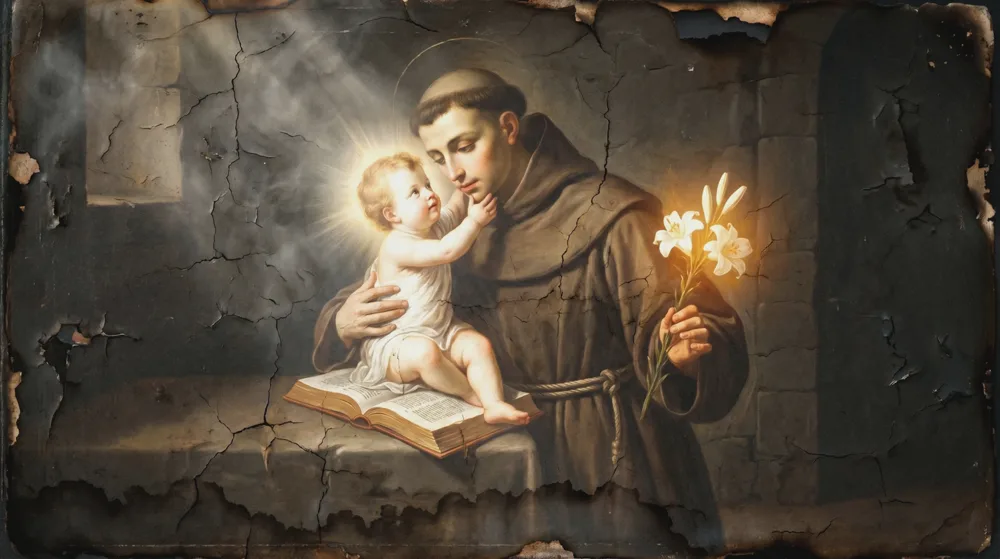
St Anthony of Padua is the saint the faithful invoke when something is lost — a possession, and by extension a soul or a grace gone astray. He is honoured as patron saint of lost things, of the poor, and of preachers, and his feast falls on 13 June. The custom of turning to St Anthony to recover what is lost is old, sober, and rooted not in superstition but in the Church's long confidence in the intercession of her saints.
Who St Anthony was
A Portuguese by birth and a native of Lisbon, St Anthony takes his surname from the Italian city of Padua, where he made his last home and where his relics are still venerated. He was born in 1195 and baptized Ferdinand. He first entered the Canons Regular of St Augustine, but on seeing the bodies of the first Franciscan martyrs brought home from Morocco, he was set on fire for the same apostolate and took the name Anthony on entering the Order of Friars Minor in 1221.
He was gifted with an extraordinary knowledge of Scripture — Pope Gregory IX called him "the Ark of the Testament" — and with a burning eloquence. He became one of the greatest preachers of his age, converting the heretics who abounded in northern Italy and France. He was also the first lector in theology of his order, an appointment confirmed by St Francis himself, who wrote to him that he was content for Anthony to teach the brethren sacred theology, provided this study did not extinguish the spirit of prayer. That condition is the whole measure of the man: a great scholar who remained first a friar.
He died on the outskirts of Padua on 13 June 1231, worn out by labour, aged only thirty-six. He was canonized within the year by Gregory IX — one of the swiftest canonizations in the Church's history — a sign of how plainly his sanctity and his miracles had been seen. Pope Pius XII declared him a Doctor of the Church in 1946, under the title Doctor Evangelicus, the Evangelical Doctor, for the thoroughly scriptural substance of his preaching. Venerated everywhere as "the Wonder-worker," he stands beside his father St Francis as one of the most beloved sons of the Franciscan family. Those drawn to St Anthony will recognise the same spirit in the life of St Francis of Assisi, the founder whose poverty and love of the Gospel shaped him.
What St Anthony is patron saint of
Saint Anthony is patron saint of the poor, of preachers, of the hungry, of sailors and travellers, and — most widely known — of lost and stolen things. He is also invoked for women seeking a husband, and against shipwreck. Bread is given to the poor in his name to this day, the "Bread of St Anthony," a custom of almsgiving offered in thanksgiving for his help.
The reason the Church honours one saint as patron of a particular need is not arbitrary. The saints in glory see God, and in God they see and love us; their charity does not cease at death but is perfected. So the faithful turn to St Christopher for safe travel, to St Cecilia for music, to St Lucy for the eyes, to St Monica for wayward children, and to St Anthony for what is lost.
When the faithful ask a saint to pray for them, they ask exactly what they would ask of a holy friend still living — that he carry the request to God. This is the doctrine of the communion of saints, professed in the Creed, and it is the same confidence voiced when the whole Church calls on her saints by name in the Litany of the Saints. To invoke St Anthony is not to credit him with power of his own, but to ask his intercession before the one God who works all good.
Why St Anthony is invoked for lost things
The patronage of lost things is bound to an event in St Anthony's own life. A novice who had grown discontented left the friary and took with him a valuable psalter that St Anthony was using. St Anthony prayed for its return, and the account handed down in the Chronicle of the Twenty-Four Generals is that the novice was driven by a fearful apparition to bring back the book (Butler, Lives of the Saints, 13 June). From this the faithful learned to bring to St Anthony every loss, small and great: keys and rings, but also peace, faith, and the soul of one who has wandered off, as that novice had.
This is the deeper sense the tradition has always kept. The lost coin and the lost sheep of the Gospel are recovered by seeking; St Anthony, the great preacher who spent his life calling the strayed back to the Church, is fittingly the saint we ask to help us find what is gone. The recovery of an object is the smallest of his favours and a sign of the greater one — the recovery of a soul. For a cause that seems past all hope the faithful join to him St Jude, patron of lost causes, and for a need that brooks no delay they turn to St Expedite, patron of urgent causes, each a holy friend asked to carry the same petition to God.
The responsory of St Anthony for lost things
The best-known invocation is the short responsory drawn from the office of St Anthony, composed by his fellow friar Julian of Speyer in the thirteenth century. It opens with the words Si quaeris miracula, "If then thou seekest miracles":
Si quaeris miracula,
mors, error, calamitas,
daemon, lepra fugiunt,
aegri surgunt sani.Cedunt mare, vincula,
membra resque perditas
petunt et accipiunt
iuvenes et cani.Pereunt pericula,
cessat et necessitas :
narrent hi qui sentiunt,
dicant Paduani.Gloria Patri, et Filio, et Spiritui Sancto.
Cedunt mare, vincula,
membra resque perditas
petunt et accipiunt
iuvenes et cani.V. Ora pro nobis, beate Antoni.
R. Ut digni efficiamur promissionibus Christi.
In English:
If then thou seekest miracles: death, error, all calamities, the demon and the leprosy flee away, and the sick arise made whole.
The sea gives way, the fetters break; the lost of limb and the lost of goods ask and receive again, both young and old.
Perils perish, want departs: let them tell it who have felt it, let the men of Padua say it.
Glory be to the Father, and to the Son, and to the Holy Ghost.
The sea gives way, the fetters break; the lost of limb and the lost of goods ask and receive again, both young and old.
V. Pray for us, O blessed Anthony.
R. That we may be made worthy of the promises of Christ.
This responsory is properly said in a spirit of resignation to God's will, not as a charm for guaranteed return — the same trust shown by St Bernadette, who left every grace in the hands of the Lady she had seen, and by St Catherine of Siena, who spent her whole life pleading the cause of the Church before God. We ask; God answers as is best for the soul.
A short prayer to St Anthony for a lost object
For the smallest of losses, a popular rhyme of recent origin is on the lips of many of the faithful; it is not part of the responsory, but a simple petition:
St Anthony, St Anthony, please come around. Something is lost and cannot be found. Pray to the Lord that I may find what I have lost; and if it be His will, restore it to me. Amen.
This little rhyme is a child's way of asking a holy friend to pray, and it works exactly as the longer prayers do — by carrying the request to God, who alone restores.
The Tuesday devotion to St Anthony
Many of the faithful make their petitions to St Anthony on a Tuesday, and the Tredicina — thirteen consecutive Tuesdays, or the thirteen days before his feast — is the best-known of these devotions. The custom rests on the tradition that the saint was buried on a Tuesday and that many favours followed prayers offered on that day. It is simply a fixed habit of prayer, like any novena, that keeps the soul faithful in asking. Those who wish to pray a structured cycle will find the same shape in any novena to a saint.
The Basilica of St Anthony of Padua and his relics
The bodily remains of St Anthony rest in the great Basilica of St Anthony in Padua — known to the people of the city simply as il Santo, "the Saint" — a vast Romanesque-Gothic church begun within a few years of his death in 1231 and completed in the following century. His tomb stands in a side chapel, and pilgrims have come to it without interruption for nearly eight hundred years to ask his intercession and to give thanks for favours received, the walls of the chapel hung with their tokens of gratitude.
Among the relics venerated there is the saint's incorrupt tongue, found whole when his body was examined some thirty years after his death, while the rest had returned to dust. St Bonaventure, present at the translation, is said to have taken it up and cried out that here was the tongue that had ever blessed the Lord and led others to bless Him. For a Doctor of the Church honoured above all as a preacher of the Gospel, the sign was fitting, and it is venerated to this day as a witness to the power of holy speech. To venerate such a relic is not to worship it but to honour God in His saint, the same reverence the Church gives to the relics of all her holy ones.
The feast of St Anthony — 13 June
The feast of St Anthony of Padua is kept on 13 June, the day of his death, as a feast of the third class in the 1962 calendar (a Double before the reform of 1960), with the Mass of a Doctor of the Church. In Padua and across the Franciscan world the day is marked with the blessing of the "Bread of St Anthony" and with the Tredicina, the thirteen days of devotion leading up to it, a remembrance of the Tuesdays on which his help has so often been sought. To honour the feast well is to do what the saint himself did: to hear the Gospel, to give to the poor, and to seek above all things the one good that cannot be lost.
Frequently Asked Questions
Who is St Anthony of Padua?
St Anthony of Padua was a Portuguese-born Franciscan friar, born at Lisbon in 1195 and baptized Ferdinand, who took the name Anthony on entering the Order of Friars Minor in 1221. He became one of the greatest preachers of his age and the first lector in theology of his order, and was called by Pope Gregory IX "the Ark of the Testament" for his mastery of Scripture. He died near Padua on 13 June 1231, was canonized within the year, and was declared a Doctor of the Church by Pope Pius XII in 1946.
What is St Anthony of Padua the patron saint of?
St Anthony is patron saint of the poor, of preachers, of the hungry, of sailors and travellers, and — most widely known — of lost and stolen things. He is also invoked by women seeking a husband and against shipwreck. To ask his patronage is not to credit him with power of his own, but to seek his intercession before the one God who works all good, in keeping with the Church's doctrine of the communion of saints.
When is the feast day of St Anthony of Padua?
The feast day of St Anthony of Padua falls on 13 June, the anniversary of his death in 1231. In the 1962 calendar it is a feast of the third class, kept as the feast of a Doctor of the Church. It is preceded in many places by the Tredicina, the thirteen days of preparation.
What prayer do you say to St Anthony for lost things?
The classic prayer is the responsory Si quaeris miracula ("If then thou seekest miracles") of Julian of Speyer; many also use a popular rhyme of recent origin, which is not part of the responsory: "St Anthony, St Anthony, please come around; something is lost and cannot be found." Both ask the saint to pray that what is lost may be restored, if it be God's will. They are prayers of petition, never charms, and are properly said in resignation to that will.
Why is St Anthony pictured holding the Child Jesus and a lily?
St Anthony is most often shown holding the Christ Child, after an account that the Infant Jesus appeared to him as he prayed; the lily in his hand signifies his purity, and the book the Scriptures he mastered and preached. These are the marks by which the faithful recognise him in painting and statue.
Where are the relics of St Anthony kept?
The relics of St Anthony rest in the Basilica of St Anthony in Padua, where his tomb has drawn pilgrims since the thirteenth century. His incorrupt tongue is venerated there as a sign of his preaching, found whole when his body was examined after his death.
The Iter Fidei app carries the prayers to the saints, the litanies, and the traditional calendar of feasts, so that the day of St Anthony and the prayers to him are at hand wherever you are. Join early access here.
Sources. Butler, Lives of the Saints (St Anthony of Padua, 13 June); the Roman Martyrology (13 June); the responsory Si quaeris miracula of Julian of Speyer, from the proper Office of St Anthony.