
The Saints
St Benedict and the St Benedict Medal
Who St Benedict is, the meaning of the St Benedict medal, the traditional St Benedict prayer against evil, and his feast on 21 March.
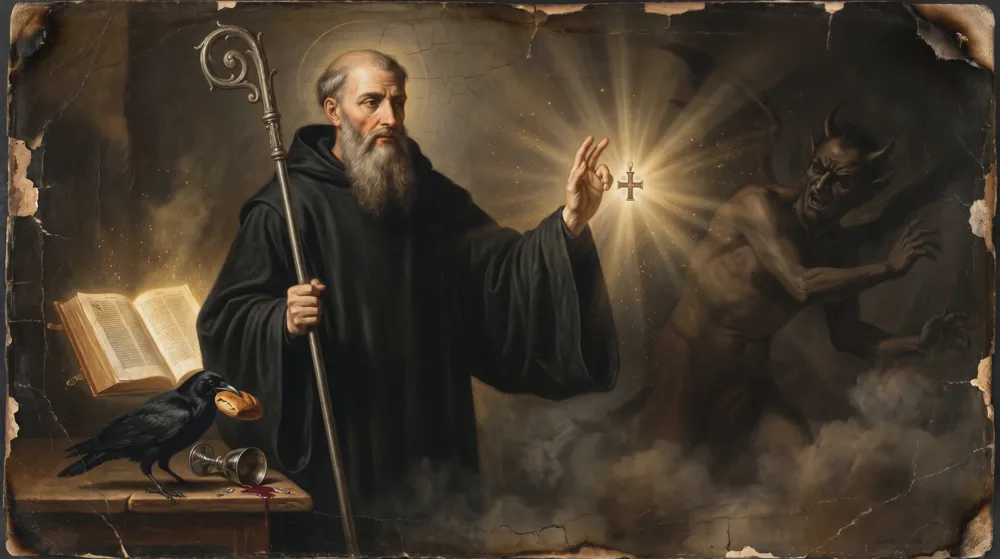
St Benedict (c. 480–547) is the father of Western monasticism, author of the Holy Rule, and the saint invoked against evil, against poison and temptation, and for the grace of a happy death. The St Benedict medal is a sacramental whose letters spell out a short Latin prayer of exorcism, by which the Church begs his protection against the devil. His feast is kept on 21 March.
Who St Benedict was
He was born of good family at Nursia, the ancient Sabine town now called Norcia; his sister (by tradition his twin) was St Scholastica, who is honoured in the novena to St Scholastica. Sent to Rome for his studies, the young Benedict was revolted by the licentiousness of his companions and, fearing the corruption of his soul, resolved to leave the city. He withdrew first to the village of Enfide in the mountains, then, seeking complete solitude, climbed further among the hills to Subiaco. There the monk Romanus clothed him in a sheepskin habit and led him to a cave, where Benedict lived three years as a hermit, unknown to all but Romanus, who each day lowered bread to him by a rope.
He was discovered at last by shepherds, and from that hidden life his renown spread. Men came to him for instruction and counsel, and he founded his monasteries — twelve small communities about Subiaco, and finally the great house of Monte Cassino. There he composed the Rule that bears his name, the legislation that would form the monks of the West for centuries and earn him the title of patriarch of Western monasticism. He died at Monte Cassino about the year 547, standing in the oratory, supported by his brethren, his hands raised toward Heaven.
This is the sober account the tradition hands down to us in Butler's Lives of the Saints and in the Dialogues of St Gregory the Great, our chief witness to his life. We do not embellish it. The saint's greatness lies not in marvels but in the thing he built: a school of the Lord's service, in which the soul learns obedience, prayer, and the patient war against its own disordered will — the same spiritual combat every Christian is bound to wage.
What St Benedict is patron of
St Benedict is honoured above all as a protector against the powers of darkness. His Rule and his life are a sustained discipline against the devil, and the Church has long invoked him against the snares of the evil one, against temptation, and against the malice of sorcery and poison. The tradition of his life relates that he was once handed a cup of poisoned wine; he made the sign of the cross over it, and the cup shattered. From such accounts grew his patronage against poison and against every hidden assault of the enemy. In this the faithful follow the Church's old instinct of entrusting each need to a particular intercessor, as she entrusts diseases of the eyes to the virgin martyr St Lucy.
He is likewise a patron of a happy death. Benedictine piety has always set before the monk the remembrance of his last hour, and the saint himself died in prayer, on his feet, his eyes lifted to God. For this reason the dying have long been commended to his intercession, that they may pass from this life fortified by the sacraments and at peace with God. What death means for the Christian, and why it is to be prepared for rather than feared, is the matter of what happens after death.
His monasteries also preserved the letters of Christendom through dark centuries. Above all he is the patron of monks and of all who seek God in earnest — a guide for anyone resolved to take up the spiritual life in truth rather than in name only.
The St Benedict medal and its meaning
The St Benedict medal is a sacramental of the Church, blessed by a prescribed rite and worn or carried as a defence against the devil and his temptations. Its design is not ornamental but doctrinal: every letter upon it is the initial of a word, and the words together form prayers against the evil one. Pope Benedict XIV approved the medal by briefs of 1741 and 1742; the form most common today, the "Jubilee medal," was struck at Monte Cassino in 1880 for the fourteenth centenary of the saint's birth. The Rituale Romanum gives the proper rite for blessing it.
On one face the medal bears the image of St Benedict, holding the cross in one hand and the book of his Rule in the other; the Jubilee medal adds around him the words Eius in obitu nostro praesentia muniamur — "May we at our death be fortified by his presence" — which is why the medal is so closely bound to the grace of a happy death.
On the other face is the cross, and the letters set about it carry the medal's whole meaning:
- Around the margin: V R S N S M V — S M Q L I V B, standing for Vade Retro Satana, Numquam Suade Mihi Vana; Sunt Mala Quae Libas, Ipse Venena Bibas — "Begone, Satan, never tempt me with vanities; what you offer me is evil, drink the poison yourself."
- On the arms of the cross: C S S M L — N D S M D, that is, Crux Sacra Sit Mihi Lux, Non Draco Sit Mihi Dux — "May the Holy Cross be my light, let not the dragon be my guide."
- In the four angles of the cross, C S P B, Crux Sancti Patris Benedicti — "The Cross of our holy father Benedict."
- And often above, the word PAX, "peace," the ancient motto of his sons.
This is the meaning of the St Benedict medal: a confession of the Cross of Christ and a renunciation of the devil, worn upon the body. It works no magic; it is no charm. Like every sacramental, it avails through the prayer of the Church and the faith of the one who uses it, turning the heart to Christ crucified, in whose Cross alone is our protection.
What St Benedict's cross means
What is often called St Benedict's cross is the same cross that fills the reverse of the medal, sometimes struck as a cross in its own right rather than as a round medallion. It is not a distinct symbol with a separate meaning: it carries the very letters described above. On the upright and the cross-beam stand C S S M L — N D S M D, Crux Sacra Sit Mihi Lux, Non Draco Sit Mihi Dux — "May the Holy Cross be my light, let not the dragon be my guide"; and in the four angles of the cross stand C S P B, Crux Sancti Patris Benedicti, "the Cross of our holy father Benedict."
The point of the design is that the protection is wholly the protection of the Cross. St Benedict's cross does not put the saint in the place of Christ; it sets the words of his confession around the wood of the Redeemer, so that the one who wears it carries a constant renunciation of the dragon and a constant appeal to the Light. Whether worn as a medal or as a plain cross, blessed by the prescribed rite, it is the same sacramental and the same prayer.
A traditional St Benedict prayer
The St Benedict prayer most proper to him is the very verse encoded upon the medal, which the faithful may say against temptation and the assaults of the enemy:
Crux sacra sit mihi lux, non draco sit mihi dux. Vade retro Satana, nunquam suade mihi vana; sunt mala quae libas, ipse venena bibas.
May the holy Cross be my light; let not the dragon be my guide. Begone, Satan! Never counsel me vain things; what thou offerest me is evil: drink thou thine own poison.
This is a turning of the soul to the Cross under the patronage of a saint who waged the same warfare and won it.
The feast of St Benedict
In the 1962 Roman calendar the feast of St Benedict, Abbot, is kept on 21 March, the day of his death — his dies natalis, his birth into Heaven — as a feast of the third class (in Lent it is reduced to a commemoration). The 11 July date found in modern calendars comes from the reform of 1969; the traditional feast is 21 March. The Roman Martyrology commemorates him on this day, and his sons keep it with solemnity. It is a fitting day to take up the medal, say his prayer, and ask his protection against evil and his help toward a holy death.
He is what his Rule sought to make of every monk: a man who put nothing whatever before the love of Christ. That is the whole of his patronage, and of what the medal preaches in its silent letters.
St Benedict, the Benedictines, and churches under his name
A St Benedict Catholic church takes its title from the saint as patron, in the same way a parish may be dedicated to St Joseph or St Anne. Such a church need not be served by his monks, though many are; the dedication asks the saint's intercession over the place and its people, and a church so named will often keep his feast on 21 March with particular care, and may possess a relic or an image of him holding the cross and the book of his Rule.
His true house, however, is the monastery. The order that springs from his Rule — the Benedictines, the black monks, with their motto ora et labora, "pray and work" — has carried his name across the West since the sixth century, from Monte Cassino to Subiaco to the abbeys of every Catholic land. From the same Rule grew later reforms, among them the hermits of Camaldoli founded by St Romuald, who joined the solitary life to the Benedictine tradition.
To honour St Benedict is therefore not only to wear his medal but to revere the form of life he founded: a stable community gathered under an abbot, ordered to the Divine Office and to manual labour, seeking God in the obedience of every hour. Anyone drawn to that spirit may begin where the monk begins, in the daily prayer of the Church and the patient discipline of the spiritual life. Our guide to the Catholic saints sets St Benedict in the company of the other saints of the traditional calendar, month by month.
Frequently Asked Questions
Who was St Benedict?
St Benedict (c. 480–547) is the father of Western monasticism and the author of the Holy Rule. Born at Nursia, he withdrew from the corruption of Rome to live as a hermit at Subiaco, then founded twelve monasteries and finally the great house of Monte Cassino, where he wrote the Rule that formed the monks of the West for centuries. (He is not Pope Benedict, nor any modern figure of the name; he is the sixth-century abbot.)
What is St Benedict the patron saint of?
He is honoured above all as a protector against the powers of darkness — against temptation, sorcery, and poison — and as a patron of a happy death, for he died standing in prayer with his eyes lifted to God. He is also the patron of monks and of all who seek God in earnest.
What does the St Benedict medal mean?
It is a sacramental whose every letter is the initial of a word, the words forming prayers against the devil. The cross bears Crux Sacra Sit Mihi Lux, Non Draco Sit Mihi Dux — "May the Holy Cross be my light, let not the dragon be my guide" — and around the margin Vade Retro Satana — "Begone, Satan." It works no magic; it avails through the prayer of the Church and the faith of the one who uses it.
What is the St Benedict prayer against evil?
The prayer most proper to him is the verse encoded on the medal: "May the holy Cross be my light; let not the dragon be my guide. Begone, Satan! Never counsel me vain things; what thou offerest me is evil: drink thou thine own poison." It is a turning of the soul to the Cross of Christ, said against temptation and the assaults of the enemy.
What is St Benedict's cross?
It is the cross that fills the reverse of the St Benedict medal, sometimes struck as a cross in its own right. It bears the letters Crux Sacra Sit Mihi Lux, Non Draco Sit Mihi Dux — "May the Holy Cross be my light, let not the dragon be my guide" — with Crux Sancti Patris Benedicti, "the Cross of our holy father Benedict," in its four angles. It is the same sacramental as the medal: the protection it asks is wholly the protection of the Cross of Christ.
What is a St Benedict Catholic church?
It is a parish or church dedicated to St Benedict as its patron, asking his intercession over the place and its people; some are served by his monks, many are not. His proper house is the monastery, and the order founded on his Rule — the Benedictines, with their motto ora et labora — has carried his name across the West since the sixth century.
When is the feast of St Benedict?
In the 1962 Roman calendar the feast of St Benedict, Abbot, is kept on 21 March, the day of his death — his dies natalis, his birth into Heaven (11 July is the date of the 1969 calendar). It is a fitting day to take up the medal, say his prayer, and ask his protection against evil and his help toward a holy death.
The Iter Fidei app carries the prayers to the saints, the blessing of the St Benedict medal from the Rituale, and the traditional calendar of feasts. Join early access here.
Sources. Butler, Lives of the Saints (St Benedict, Abbot, 21 March); St Gregory the Great, Dialogues, Book II; the Roman Martyrology (21 March); the Roman calendar of 1962; the Rule of St Benedict; Rituale Romanum, blessing of the medals of St Benedict; Benedict XIV, briefs approving the medal (1741–1742).