
The Saints
St Expedite: Prayer, Novena and the Martyr's Story
St Expedite, the martyr of Melitene named in the Roman Martyrology on April 19: what history knows of him, the crow and the HODIE, the Church's prayer for him, the novena, and how to invoke him for urgent causes.
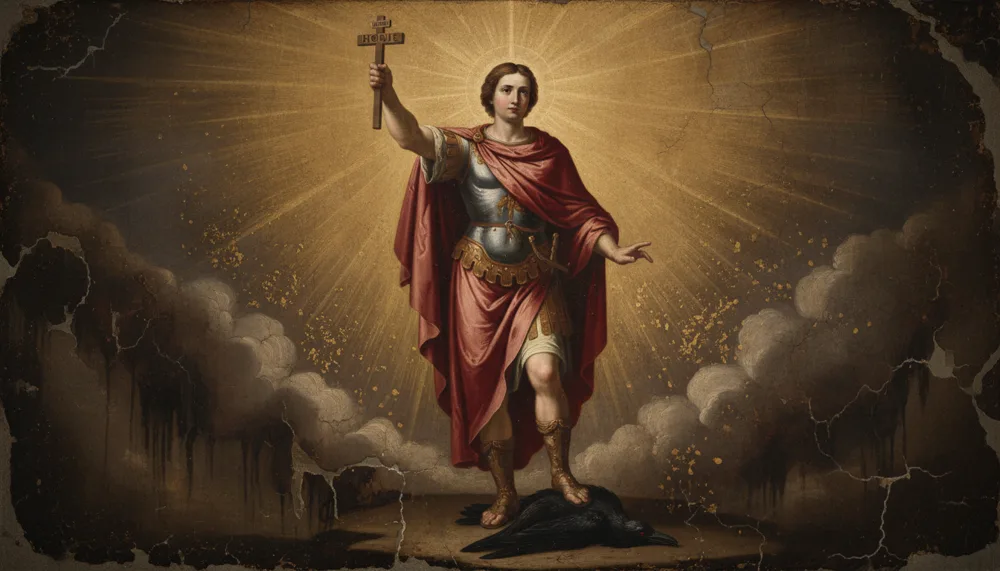
St Expedite is a martyr named in the Roman Martyrology on April 19, among the saints of Melitene in Armenia, and invoked by Catholics as the patron of urgent causes. History knows almost nothing of his life; the devotion to him, on the other hand, is old and widespread, from France and Sicily to New Orleans and Latin America. Here is what can be said of him with certainty, what belongs to legend, the Church's own prayer for him, and how to invoke him as a Catholic. The full nine days are in our novena to St Expeditus.
Who St Expedite was: what the Martyrology says
The Roman Martyrology reads, on April 19:
Melitínæ, in Arménia, sanctórum Mártyrum Hermógenis, Caji, Expedíti, Aristoníci, Rufi et Gálatæ, qui omnes una die sunt coronáti.
In the English of the old Martyrology: "At Malathia, in Armenia, the holy martyrs Hermogenes, Caius, Expeditus, Aristonicus, Rufus, and Galata, who were all crowned upon one and the same day." Melitene is the modern Malatya, in Turkey. This entry, inherited from the ancient martyrology called the Hieronymian, is the only document we have: no acts of his martyrdom survive. What is usually added (that he was a Roman soldier, an officer of the legion stationed at Melitene, beheaded under Diocletian about the year 303) comes from later tradition, not from the early sources.
Honesty requires that we say so plainly. The Bollandist Hippolyte Delehaye, in a 1906 study entitled "Saint Expédit et le martyrologe hiéronymien", examined the entry and doubted that the name stands for a distinct martyr. The tale of a packing case of relics stamped spedito ("sent"), mistaken for a saint's name, is likewise a legend without foundation. What remains is what the Church attests: a name received in her catalogue of martyrs and honoured on April 19. That is enough to ground a sober devotion, and it forbids embroidering one.
St Expedite has no feast in the universal calendar of the 1962 Missal: his memory is kept in the Martyrology, read in the Divine Office.
Why St Expedite is the patron of urgent causes
The patronage grew from his name. Expeditus in Latin means one who is unencumbered, ready, free to act: the soldier stripped for the march. Iconography turned this into an image: a young legionary holding aloft a cross marked HODIE, "today", and trampling a crow that croaks CRAS, "tomorrow". It is an allegory, not a record of his death, but the lesson is sound.
The crow is the temptation to put off conversion; the cross is the prompt answer to God. "Behold, now is the acceptable time: behold, now is the day of salvation" (2 Corinthians 6:2, Douay-Rheims); "To day if you shall hear his voice, harden not your hearts" (Psalm 94:8, Douay-Rheims). St Augustine knew the crow's voice well: in the Confessions (VIII, 12) he reproaches himself with his long "tomorrow, and tomorrow" (cras et cras) before his conversion.
From this hodie the faithful came to invoke him whenever a matter could not wait: a debt falling due, a decision to be made, a delay that had to be broken. The devotion spread above all between the seventeenth and nineteenth centuries. For a cause that is not only urgent but humanly hopeless, the tradition joins to him the great patrons of hard cases, with the prayer to St Jude and the novena to St Rita.
The Church's prayer for St Expedite and his companions
The Church never composed a proper collect for St Expedite. The liturgical prayer that fits him is the collect from the Common of Several Martyrs in the Roman Breviary, given here with the names from the Martyrology:
Da, quǽsumus, omnípotens Deus: ut, qui beatórum Mártyrum tuórum Hermógenis, Expedíti et Sociórum solémnia cólimus, eórum apud te intercessiónibus adjuvémur. Per Dóminum nostrum Jesum Christum, Fílium tuum, qui tecum vivit et regnat in unitáte Spíritus Sancti, Deus, per ómnia sǽcula sæculórum. Amen.
In English (our translation):
Grant, we beseech Thee, almighty God, that we who honour the memory of Thy holy martyrs Hermogenes, Expeditus and their companions, may be helped before Thee by their intercession. Through our Lord Jesus Christ, Thy Son, who liveth and reigneth with Thee in the unity of the Holy Ghost, God, world without end. Amen.
Name your petition, then add an Our Father, a Hail Mary and a Glory Be. In a moment of haste a single invocation is enough: St Expedite, martyr of Christ, pray for us. And for sudden danger the Church has her own cry, the verse that opens every Hour of the Office: "O God, come to my assistance; O Lord, make haste to help me" (Psalm 69:2, Douay-Rheims).
A prayer to St Expedite for urgent needs
For an urgent need, say the collect above, name the need plainly, and keep the invocation on your lips through the day. If the matter allows nine days, pray the novena to St Expeditus, which gives a prayer for each day. The urgency belongs to the need, not to the soul: the same Lord who bids us ask for our daily bread tells us not to be solicitous for tomorrow.
The "St Expedite miracle prayer"
Some booklets circulate a "St Expedite miracle prayer". If the phrase means a fervent prayer made in hope of an extraordinary favour, it is harmless; if it means words that compel a miracle, it is false. No prayer to any saint has such power. We may pray with great confidence, for "all things are possible to him that believeth" (Mark 9:22, Douay-Rheims), but we ask; we do not command.
A prayer to St Expedite for money
It is no fault to bring a money worry to God: a debt that falls due, a bill that cannot be met, work that must be found. Ask for what is needful, not for riches, join your own honest labour to the prayer, and keep the Gospel's order: "Seek ye therefore first the kingdom of God, and his justice, and all these things shall be added unto you" (Matthew 6:33, Douay-Rheims).
The novena to St Expedite
A novena is nine days of prayer for one intention, after the nine days the Apostles spent in prayer with Our Lady between the Ascension and Pentecost; on the form itself, see what a novena is. Our novena to St Expeditus gives the complete text of the nine days. It may be begun at any time, or on April 11 so as to end on the 19th. Its best support is what the Church herself gives: a good confession (see how to go to confession), Holy Communion, and an alms according to one's means.
Candles and offerings
To light a candle before a saint's image is an old and good custom: a small visible sign of the prayer we cannot keep on our lips all day. The candle has no power of its own, and the colour of the wax means nothing. Likewise, a thank-offering after a prayer has been heard (an alms, a Mass offered in gratitude, a gift to the Church) is right and praiseworthy.
What is not Catholic is everything that turns the devotion into a transaction or a charm: an offering vowed in advance as the price of a favour, public notices of thanks demanded as a condition, copies to be made a set number of times, rules about which day or which object "works". That is superstition, which the Catechism of the Council of Trent counts among the sins against the First Commandment. St Expedite intercedes; God grants. The offering he would have of us is first of all our today: our conversion and prompt obedience. For the other saints of the traditional calendar, month by month, see our guide to the Catholic saints.
Frequently Asked Questions
Who is St Expedite?
A martyr named in the Roman Martyrology on April 19 among the martyrs of Melitene in Armenia, with Hermogenes, Caius, Aristonicus, Rufus and Galata. No acts of his life survive; that he was a soldier comes from later tradition.
When is the feast of St Expedite?
The Roman Martyrology commemorates him on April 19. He has no feast in the universal calendar of the 1962 Missal.
What is the prayer to St Expedite?
The Church's own prayer is the collect of the Common of Several Martyrs, given above with his name. Popular devotion adds the short invocation "St Expedite, martyr of Christ, pray for us", followed by an Our Father, a Hail Mary and a Glory Be.
Is St Expedite a real saint?
His name stands in the Roman Martyrology, so the Church honours him as a martyr. Scholars such as Delehaye have questioned how much the name tells us, and the crow and the packing case are legends; we venerate a martyr, not a story.
How do I pray a novena to St Expedite?
Pray for nine consecutive days for the same intention, following the daily prayers of our novena to St Expeditus, with an Our Father, a Hail Mary and a Glory Be each day.
Can I pray to St Expedite for money?
Yes, for what is needful and lawful, joined to honest work and trust in Providence. Never treat the saint as a patron of wealth, gambling or speculation.
Can I light a candle or make an offering to St Expedite?
Yes, as a sign of prayer and as thanks after a favour. An offering promised as the price of a favour, or any rule that makes the candle "work", is superstition.
Iter Fidei carries the novenas, prayers to the saints and the traditional 1962 calendar, in Latin and English with audio. Join early access here.
Sources. Martyrologium Romanum, April 19, and its English translation; Breviarium Romanum, Common of Several Martyrs (collect Da, quǽsumus); H. Delehaye, "Saint Expédit et le martyrologe hiéronymien", Analecta Bollandiana 25 (1906); St Augustine, Confessions, VIII, 12; Catechism of the Council of Trent, on the First Commandment; Holy Scripture, Douay-Rheims (2 Corinthians 6:2; Psalm 94:8; Psalm 69:2; Mark 9:22; Matthew 6:33).