
Novenas
Novena to St Faustina
The full nine-day novena to St Faustina Kowalska — the daily prayer said for her intercession, how to keep it before her feast on 5 October, and how it differs from the Divine Mercy Novena.
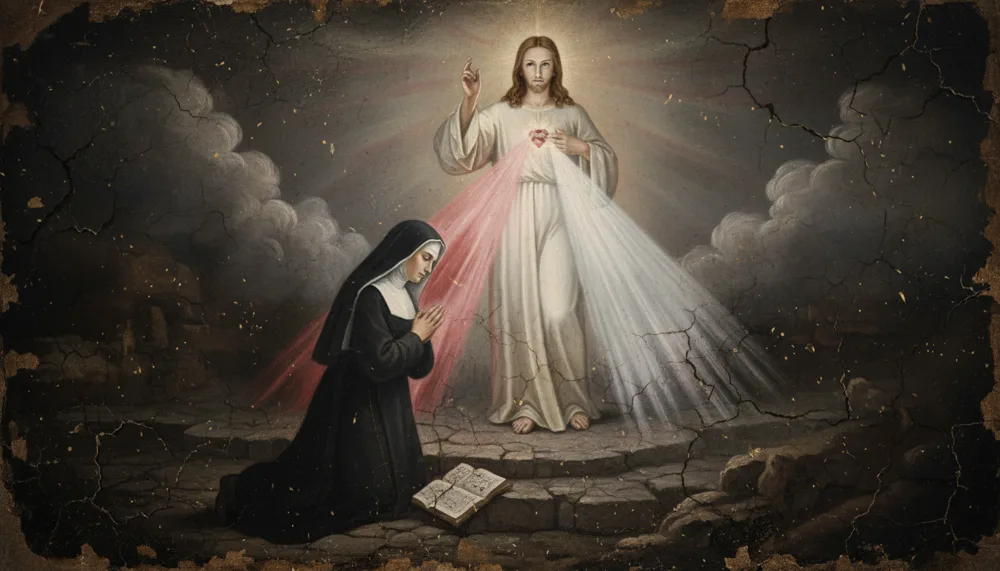
The novena to St Faustina is a nine-day prayer asking the Polish sister St Maria Faustina Kowalska — the apostle of the Divine Mercy — to carry one intention to Our Lord and obtain a grace through her intercession. The same short prayer is said once a day for nine days, with your own request named within it; it is most often kept in the nine days leading up to her feast on 5 October, that is, from 26 September to 4 October.
Below we give the full prayer, the way to keep the novena, the story of the humble nun who, according to her Diary, received a message of mercy from Christ, and the difference between this novena to St Faustina and the Divine Mercy Novena which, according to her Diary, Our Lord dictated to her.
A note on this devotion
St Faustina died in 1938 and was canonized in the year 2000; her feast is not in the 1962 calendar, and the novena to her, in its present form, is a modern prayer. We give it here in full because it is widely and rightly sought, and because it is entirely orthodox — it asks only what any novena to a saint asks: not that she grant anything of herself, but that she pray for us before the throne of the God of mercy. Those attached to the 1962 books will find its spirit continuous with the whole tradition of trust in the mercy of God, from the Psalms to the Sacred Heart. If the very idea of a nine-day prayer is new to you, see our short explainer on what is a novena.
The full novena to St Faustina
This is the prayer at the heart of the devotion. Say it once on each of the nine days, naming your own intention where marked. The words do not change from day to day; what deepens is the trust with which they are said.
In the name of the Father, and of the Son, and of the Holy Ghost. Amen.
O Jesus, who filled St Faustina with profound veneration for Your boundless Mercy, deign, if it be Your holy will, to grant me, through her intercession, the grace for which I fervently pray:
(Here name your request.)
My sins render me unworthy of Your Mercy, but be mindful of St Faustina's spirit of sacrifice and self-denial, and reward her virtue by granting the petition which, with childlike trust, I present to You through her intercession.
St Faustina, pray for us.
Then say:
Our Father… Hail Mary… Glory be to the Father…
In the name of the Father, and of the Son, and of the Holy Ghost. Amen.
Many add at the close the aspiration which, according to her Diary, Our Lord gave St Faustina to keep always on her lips, and which is written across the image of the Divine Mercy:
Jesus, I trust in You.
That single line is the whole spirit of the novena. St Faustina's mission was not to teach a new prayer so much as a new confidence — that no soul, however sinful, is beyond the reach of the mercy of God, provided it will come.
The nine-day novena and its "distinct" days
Some who search for a 9 day novena to St Faustina expect nine different prayers or nine separate meditations, one for each day. The novena to St Faustina does not work that way: it is the single prayer above, repeated faithfully for nine consecutive days, with your intention held steady throughout. There is no special text for day 1 or day 6 that differs from the rest — the constancy is deliberate, a small school of perseverance in asking, as Our Lord taught us to knock and keep knocking (Luke 11:9).
If instead you are looking for a novena with nine distinct days — a different intention and a different prayer assigned to each — you are almost certainly thinking of the Divine Mercy Novena, which is a different devotion. We keep the two clearly apart below.
The St Faustina Divine Mercy novena — and how it differs
Here is the distinction that trips up most people who search st faustina divine mercy novena. There are two devotions, and they are not the same prayer:
- The novena to St Faustina — the prayer given above. You ask St Faustina, as a canonized saint in heaven, to intercede for one intention of yours. It may be prayed at any time, and is especially kept before her feast on 5 October.
- The Divine Mercy Novena — the novena which, according to her Diary, Our Lord dictated to St Faustina (a private revelation). Here you do not pray to Faustina at all; you pray to the merciful Heart of Jesus, bringing Him a different group of souls each of the nine days — all mankind, then priests and religious, then the devout, sinners, the separated, the meek, those who honour His mercy, the souls in purgatory, and the lukewarm. According to the Diary, it is to be prayed from Good Friday through the following Saturday, in preparation for Divine Mercy Sunday, the octave day of Easter — instituted in 2000; in the 1962 calendar that Sunday is Low Sunday.
So: if you wish to ask St Faustina to pray for your intention, use the novena on this page. If you wish to pray the nine days she recorded before Divine Mercy Sunday, see our full guide to the Divine Mercy Novena, which sets out all nine days and their intentions. Both flow from the same fountain, and both are commonly joined to the Divine Mercy Chaplet, the short chaplet of mercy that she also recorded.
The novena to St Faustina for a specific intention
The novena is made for a particular need. Name it plainly within the prayer — a healing, a conversion, a reconciliation, work, a soul in danger, a grace of your own. St Faustina is invoked with special confidence by those who feel themselves unworthy of what they ask, for that was the whole burden of her message: that the mercy of God is greatest precisely toward the greatest need. "The greater the sinner," Our Lord told her, "the greater the right he has to My mercy." Bring to her, then, not only what seems deserving but what seems hopeless; and add, as she would have you, Jesus, I trust in You. For another sure friend of anxious and trusting souls, many pair this novena with the Litany of Trust or the confidence of the Little Way of St Thérèse.
The St Faustina feast day novena (26 September – 4 October)
The most fitting time to keep the novena is in the nine days before St Faustina's feast. Her feast falls on 5 October; counting nine days back, the novena begins on 26 September and ends on 4 October, the eve of the feast — so that the ninth day closes as her day dawns. Communities devoted to her — including the Marians of the Immaculate Conception, who have long spread the Divine Mercy message, and many parishes named for Our Lady — keep these days each autumn. You need no special setting to join them: the same nine days, prayed at home before her image or the image of the Divine Mercy, unite you to the whole Church honouring her. Simply begin on 26 September, or count back nine days from whatever feast or need is before you.
How to pray this novena
A novena is not a formula that forces a result; it is nine days of steady, trusting prayer, and its power lies in perseverance and faith, not in the counting.
- Choose your start day. For the feast, begin on 26 September. Otherwise, count back nine days from the day you most wish to have the grace, or simply start today and pray nine days running.
- Pray once each day, at a fixed hour if you can — morning or evening — for nine consecutive days without breaking the chain.
- Name one intention and hold to it through all nine days. Say the novena prayer above, name your request, then the Our Father, Hail Mary, and Glory Be.
- Add "Jesus, I trust in You," and, where you can, join the novena to Mass, Confession, or the Divine Mercy Chaplet.
- Ask in submission: Thy will be done. Trust that St Faustina will obtain either the grace you named or the better thing God chooses to send.
Who is St Faustina Kowalska?
She was born Helena Kowalska on 25 August 1905, the third of ten children of a poor and pious peasant family in the village of Głogowiec, in central Poland. She had little schooling and went into domestic service as a girl; but from childhood she felt the call to the cloister, and at twenty she was received into the Congregation of the Sisters of Our Lady of Mercy in Warsaw, taking the name Sister Maria Faustina of the Most Blessed Sacrament. For thirteen years she served in the humblest offices of the house — as cook, gardener, and portress — in Kraków, Płock, and Vilnius, hidden, obedient, and unremarkable to those around her.
Within that ordinary life she received an extraordinary mission. Beginning in 1931, at Płock, according to her Diary, Our Lord appeared to her clothed in white, with rays of red and pale light streaming from His Heart, and bade her have an image painted after that pattern with the words Jesus, I trust in You.
Over the following years, she wrote, He entrusted to her the message of His Divine Mercy: the image, the chaplet, the novena, and the desire for a feast of mercy on the Sunday after Easter. At the command of her confessors she wrote down these graces in a diary, published under the title Divine Mercy in My Soul — the record of a soul of deep prayer, penance, and hidden suffering. Worn by tuberculosis, she died in Kraków on 5 October 1938, only thirty-three years old.
Her cause was long delayed — for a time her writings were under a cloud of caution — but the message she carried spread across the world, borne especially by her countryman, the future Pope John Paul II. He beatified her on 18 April 1993 and canonized her on 30 April 2000, the first saint raised to the altars in the Great Jubilee and the new millennium; on the same day he established the Second Sunday of Easter as Divine Mercy Sunday for the universal Church.
Her feast is kept on 5 October, the day of her death. She is honoured as the apostle and secretary of the Divine Mercy — not a foundress of anything, but a soul so small and trusting that God made her the herald of His mercy to a violent century. Her whole life, and this novena with it, is a witness that mercy is greater than sin, and that the sure way to it is trust. It is the same mercy the Church has always adored in the Sacred Heart of Jesus.
Through the eyes of tradition
St Faustina died in 1938. In 1958–1959 the Holy Office forbade the spreading of the images and writings that presented the Divine Mercy devotion in the forms proposed by Sister Faustina; the prohibition was lifted in 1978. She was beatified in 1993 and canonized on 30 April 2000, and on that day Divine Mercy Sunday was instituted on the octave of Easter — the Sunday the 1962 calendar keeps as Low Sunday, Dominica in Albis, with its own ancient Mass, Quasi modo geniti infantes. Neither her feast nor the feast of Mercy is found in the 1962 books; private devotion to her remains lawful, as to any saint the Church has canonized.
For those who keep the traditional calendar, the Church already gives the same trust in God's mercy its own devotions: the Sacred Heart of Jesus, whose pierced side poured out blood and water; the Precious Blood, honoured in the 1962 calendar on 1 July; and the Holy Face, a devotion of reparation for sinners. Each leads to the same merciful Heart, by roads the saints were walking long before our century.
Frequently Asked Questions
What is the novena to St Faustina?
It is a nine-day prayer asking St Maria Faustina Kowalska, the saint of the Divine Mercy, to intercede for one intention before Our Lord. The same short prayer — O Jesus, who filled St Faustina with profound veneration for Your boundless Mercy… — is said once a day for nine consecutive days, with your own request named within it, and closed with an Our Father, Hail Mary, and Glory Be.
When should I pray the novena to St Faustina?
You may pray it at any time of need, but the customary time is the nine days before her feast: begin on 26 September and finish on 4 October, the eve of her feast day on 5 October. Otherwise, count back nine days from whenever you most wish to have the grace, or simply begin today and pray nine days running.
Is there a novena to St Faustina for each of the nine days — a day 1, day 6, and so on?
The novena to St Faustina is the same prayer repeated for all nine days; there is no different text for day 1, day 6, or any other. If you are looking for a novena with a different intention on each of the nine days, you want the Divine Mercy Novena, which assigns a distinct group of souls to each day.
What is St Faustina the patron saint of?
She is honoured above all as the apostle of the Divine Mercy — the saint whose Diary records the message, image, chaplet, and feast of mercy. She is invoked especially by sinners and by those who feel unworthy of the grace they ask, for the heart of her message is that no one is beyond the mercy of God. She is also often named a patroness of the young.
How is this different from the Divine Mercy Novena?
The novena on this page is prayed to St Faustina, asking her to intercede for your intention. The Divine Mercy Novena is prayed to Jesus — according to her Diary, Our Lord dictated it to St Faustina, and it brings Him a different group of souls each of the nine days, from Good Friday to Divine Mercy Sunday. They are two distinct devotions from the same source; see our Divine Mercy Novena guide for the full nine days.
When is St Faustina's feast day, and when was she canonized?
Her feast is 5 October, the anniversary of her death in 1938. She was beatified on 18 April 1993 and canonized on 30 April 2000 by Pope John Paul II — the first saint of the new millennium — who on the same day established Divine Mercy Sunday for the whole Church.
Is there a printable PDF of the St Faustina novena?
The complete text is the prayer given above, said once on each of the nine days with your intention named within it and closed with an Our Father, Hail Mary, and Glory Be — you may copy it to keep beside you for the nine days. The Iter Fidei app also carries the full devotion with day-by-day reminders and audio, so it can be prayed from a phone without a printed sheet.
Pray this novena with day-by-day reminders and audio, alongside the Divine Mercy Chaplet and the whole treasury of the Church's prayers, in the Iter Fidei app. Join early access here.
Sources. Diary of St Maria Faustina Kowalska, Divine Mercy in My Soul (her primary writing, on the Divine Mercy image, chaplet, and novena, and the words she attributes to Our Lord on His mercy toward sinners); Holy Scripture (Luke 11:9); the modern novena prayer to St Faustina as carried in Catholic prayer-books; Pope John Paul II, homily at the canonization of St Faustina Kowalska and institution of Divine Mercy Sunday (30 April 2000); her beatification (18 April 1993) and feast (5 October).