
Novenas
Novena to St Dymphna
The full nine-day novena to St Dymphna, patroness of the mentally and nervously afflicted — the complete prayers said for mental health, anxiety, depression and insomnia, with her life, her feast on 15 May, and the chaplet.
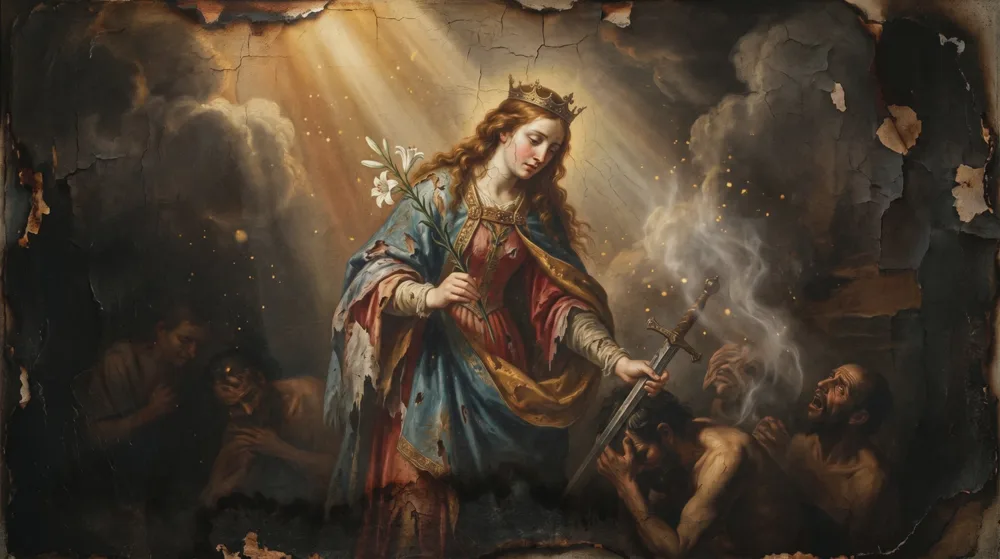
The novena to St Dymphna is a nine-day prayer to the young Irish virgin-martyr whom the Church has long invoked as the patroness of those afflicted in mind and nerves — for mental illness, anxiety, depression, emotional distress, and the sleepless nights that go with them. Beheaded by her own father at fifteen rather than consent to sin, she has been sought at her shrine in Geel for centuries by the troubled and the desperate, and her intercession is asked especially by those who suffer, or love someone who suffers, in the mind.
Her feast falls on 15 May (a local feast, not in the universal calendar of 1962), and the novena is commonly begun on 7 May so that its ninth day lands on her feast; but it may be prayed at any time of need. Below is the complete devotion — the daily prayer, the older "wonder-worker" prayer, the invocation, the chaplet, and her life.
The full novena to St Dymphna
The heart of this devotion is a single prayer, said once on each of the nine days, with your own intention named where the prayer invites it. If you have never prayed a nine-day devotion before, our guide to what is a novena explains the nine days and how to keep them. Its prayers are a devotional composition, with no liturgical text and no approval of their own that we can cite.
Begin each day with the Sign of the Cross — In the name of the Father, and of the Son, and of the Holy Spirit. Amen. — then pray:
O God, we humbly beseech You through Your servant, St. Dymphna, who sealed with her blood the love she bore You, to grant relief to those who suffer from mental afflictions and nervous disorders, especially (here name those for whom you pray).
Grant, through the prayers of this pure, youthful martyr, consolation and healing to all who suffer such trials, and especially those for whom we pray. We beg You, Lord, to hear the prayers of St. Dymphna on our behalf. Grant all those for whom we pray patience in their sufferings and resignation to Your divine will. Fill our hearts with hope, and grant us the relief and strength we so much desire.
We ask this through Christ our Lord. Amen.
Close each day with the invocation, repeated three times:
St. Dymphna, helper of the mentally afflicted, pray for us.
Many add the Our Father, Hail Mary, and Glory Be, and name their intention once more before the Sign of the Cross. That is the whole of the daily prayer, said the same for all nine days.
The nine daily invocations, day by day
The novena said at her shrine keeps the same prayer above every day, but adds one further invocation proper to each of the nine days. If you like a day-by-day form, add the day's line to the closing invocation:
- Day 1 — St. Dymphna, virgin and martyr, pray for us.
- Day 2 — St. Dymphna, patroness of those with nervous and emotional illness, pray for us.
- Day 3 — St. Dymphna, crowned with glory in heaven, pray for us.
- Day 4 — St. Dymphna, faithful to your covenant with Christ, pray for us.
- Day 5 — St. Dymphna, precious in the eyes of the Lord, pray for us.
- Day 6 — St. Dymphna, our helper in every need, pray for us.
- Day 7 — St. Dymphna, our friend at the court of heaven, pray for us.
- Day 8 — St. Dymphna, faithful through great suffering, pray for us.
- Day 9 — St. Dymphna, help of those in mental distress, pray for us.
Whether you use these invocations or simply repeat helper of the mentally afflicted all nine days, it is one and the same devotion.
The older prayer to St Dymphna, wonder-worker
Beside the short novena prayer, prayer-books carry a longer and more personal petition to St Dymphna, prayed for generations at her shrine. Many say it in place of, or alongside, the daily prayer above:
St. Dymphna, great wonder-worker in every affliction of mind and body, I humbly implore your powerful intercession with Jesus through Mary, the Health of the Sick, in my present need. (Mention it.)
St. Dymphna, martyr of purity, patroness of those who suffer with nervous and mental afflictions, beloved child of Jesus and Mary, pray to them for me and obtain my request.
You are filled with love and compassion for the thousands of patients brought to your shrine. You chose to be martyred by your own father's sword rather than consent to sin. Give me strength and courage in fighting off the temptations of the world and evil desires. As you have given all the love of your heart to Jesus, help me to love God with my whole heart and to serve Him faithfully.
As you bore the persecution of your father and the sufferings of an exile so patiently, obtain for me the patience I need to accept the trials of my life with loving resignation to the will of God. St. Dymphna, through your glorious martyrdom for the love of Christ, help me to be loyal to my faith and my God as long as I live.
And when my hour of death comes, stand at my side and pray for me that I may at last merit the eternal crown of glory in God's Kingdom. Good St. Dymphna, I beg you to recommend my request to Mary, the Health of the Sick and Comforter of the Afflicted, that both of you may present it to Jesus, the Divine Physician. Amen.
The novena to St Dymphna for mental health
More souls come to St Dymphna for the mind than for anything else, and rightly: she is the patroness the Church herself has given to the mentally afflicted. To pray the novena to St Dymphna for mental health is to bring a real and often invisible suffering to a saint who understands it — not a stigma to be hidden, but a cross to be carried with grace and, God willing, lifted. Name the person plainly in the prayer above, whether it is yourself or one you love, and ask for two things at once: healing, if it be God's will, and the patience and hope to bear the illness in the meantime.
The St Dymphna novena for anxiety
For anxiety — the racing heart, the dread that has no name, the mind that will not rest — St Dymphna is a particular friend. She herself fled in fear across the sea from a father turned monstrous, and lived as an exile before her death; she knows the weight of fear on a young soul. Praying her novena for anxiety, ask especially for the line in the prayer that begs patience in suffering and resignation to Your divine will and that God would fill our hearts with hope. Anxiety is often a wound to trust, and the remedy the saints teach is the deliberate surrender of the future into God's hands — the same spirit as the Litany of Trust, which pairs well with this one for a fearful heart.
The novena for anxiety and depression to St Dymphna
Where anxiety and depression come together — the fear and the darkness at once — the novena for anxiety and depression to St Dymphna is among the most-asked forms of this devotion. Depression is not a failure of faith; it is a genuine affliction, and the saint who is patroness of "mental afflictions and nervous disorders" is patroness of this too. Pray for the sufferer by name over the nine days, asking for relief, for hope against the darkness, and for the strength to endure until light returns. For those whose burden includes bodily illness alongside the mental one, the Novena to Our Lady of Lourdes, Health of the Sick, is a fitting companion.
For insomnia
The St Dymphna novena for insomnia brings her the sleeplessness that so often shadows anxiety and grief — the lying awake night after night that wears the mind down and feeds the very fears that keep us waking. Commend your rest to St Dymphna, asking that God grant the peace of body and mind that sleep requires. Many pray the daily prayer at night, before sleep, offering the wakeful hours themselves to God rather than fighting them.
The Chaplet of St Dymphna
Some join to the novena, or pray in its place, the Chaplet of St Dymphna — a short beaded devotion built around the fifteen years of her life. It consists of:
- One Our Father, for the intentions of the Holy Father;
- One Hail Mary, for the intentions of all Christians;
- Fifteen Glory Be, one in honour of each of the fifteen years St Dymphna lived;
- A closing prayer, in which the intention is named:
Lord, our God, You graciously chose St. Dymphna as patroness of those afflicted with mental and nervous disorders. She is thus an inspiration and a symbol of charity to the thousands who ask her intercession. Please grant, Lord, through the prayers of this pure, youthful martyr, relief and consolation to all suffering such trials, and especially those for whom we pray. (Mention those for whom you wish to pray.) We beg You to accept and grant the prayers of St. Dymphna on our behalf. Grant to those we have particularly recommended patience in their sufferings and resignation to Your divine will. Please fill them with hope, and grant them the relief and cure they so much desire. We ask this through Christ our Lord, Who suffered agony in the garden. Amen.
How to pray this novena
A novena is nine days of steady asking, in imitation of the nine days the Apostles and Our Lady prayed between the Ascension and Pentecost. To pray the 9-day novena to St Dymphna well:
- Choose your days. To end on her feast, begin on 7 May so that day 9 falls on 15 May. Otherwise begin whenever the need is present.
- Keep a fixed hour. Pray at the same time each day, morning or night, in a quiet place before an image of the saint if you have one.
- Name your intention. Say plainly, each day, the person and the grace you ask for, and do not change your petition halfway through.
- Pray in submission. Ask boldly for healing, but end always with Thy will be done. The prayer itself begs resignation to Your divine will; a novena is answered not only when it grants what we name, but when it obtains the grace to bear what God permits.
- Use the ordinary means. Join the novena to a Mass, a Communion, or the Rosary where you can, and keep using the medicine and care God provides.
Who is St Dymphna? Her life and martyrdom
What follows is the story told by her Life, written long after her death; we give it as a pious legend, not as established history. St Dymphna was born in the seventh century in Oriel, a small kingdom of Ireland. Her father, Damon, was a pagan chieftain or petty king; her mother, of great beauty, was a devout Christian who had her daughter secretly baptized and raised in the Faith, giving her into the care of a holy priest, Father Gerebernus. When Dymphna was about fourteen, she consecrated her virginity to Christ.
Then her mother died. Damon's grief unhinged him. His counsellors urged him to remarry, and he consented only on the condition that a woman be found as beautiful as his dead wife. None could be found — save his own daughter, who bore her mother's likeness. In a mind darkened by loss and unnatural passion, the king resolved to marry Dymphna herself. This is why she is invoked also as patroness of victims of incest and of those whose homes have become places of fear.
Warned of her father's intention, Dymphna fled — across the sea with Father Gerebernus, the court jester and his wife, landing at last on the Continent and settling near the town of Geel, in what is now Belgium. There they lived quietly and gave alms to the poor. But Damon tracked her by the coins she had spent, and came to Geel with his men. He ordered the priest Gerebernus killed, and confronted his daughter, commanding her to return with him. When Dymphna refused — steadfast in her faith and her vow — her father drew his sword and, in a final rage, struck off her head with his own hand. She was about fifteen years old. The tradition places her death around the year 620.
Her body, buried by the people of Geel, was rediscovered centuries later, and healings — especially of the mad and the epileptic — began to be reported at her tomb. A church was raised in her honour in 1349, and pilgrims afflicted in mind streamed to Geel in such numbers that the townsfolk took them into their own homes to care for them. That charity became a settled way of life: for over six hundred years Geel has sheltered the mentally ill among its families, a living monument to the saint who is their patroness. This ancient patronage — long predating our own age's rediscovery of mental suffering — is why the Church invokes St Dymphna, virgin and martyr, as helper of the mentally afflicted, and keeps her feast on 15 May.
For other saints sought in illness and desperate straits, see the Novena to St Peregrine, patron of the sick, and the Novena to St Jude, patron of hopeless and impossible causes.
Frequently Asked Questions
What is the St Dymphna novena prayed for?
It is prayed above all for mental and emotional health — for mental illness, anxiety, depression, nervous and emotional disorders, insomnia, and the peace of a troubled mind, whether for oneself or for a loved one. Because St Dymphna fled and died to escape her father's incestuous designs, she is also patroness of victims of abuse, of runaways, and of those whose family life has become a source of suffering. She is invoked, too, by the families and caregivers of the mentally ill.
When should I pray the novena to St Dymphna?
You may pray it at any time of need. To end on her feast day, begin on 7 May so that the ninth day falls on 15 May, the feast of St Dymphna. Many begin the novena the moment a crisis of mind or nerves arises, without waiting for the feast.
What do I pray on day 1 of the St Dymphna novena?
Day 1 uses the same daily prayer as every other day: the Sign of the Cross, the prayer "O God, we humbly beseech You through Your servant, St. Dymphna..." with your intention named, and the closing invocation "St. Dymphna, helper of the mentally afflicted, pray for us." The shrine form adds one further invocation proper to the day — on day 1, "St. Dymphna, virgin and martyr, pray for us." The novena's power lies not in a wholly different prayer each day but in nine days of the same steady petition. On the first day, simply name plainly the person and the grace you are asking for, and resolve to keep that same intention through to day nine.
Is St Dymphna a real saint recognized by the Church?
Yes. St Dymphna is a saint venerated since the Middle Ages, whose relics and shrine are at Geel in Belgium and whose feast is kept on 15 May where it is celebrated (she is not in the universal calendar of 1962); her story comes from a Life written long after her death. Her cult is ancient and approved; she is no modern invention. What is more recent is only the present wording of these particular novena prayers, drawn from the devotional prayer-books that spread her cult — but the saint, her martyrdom, and her patronage of the afflicted in mind are old indeed.
Can I pray the St Dymphna novena for someone else?
Yes, and it is one of the most common ways it is prayed. The prayer itself is worded to ask relief "to those who suffer" and lets you name "those for whom you pray." Praying a novena on behalf of a family member, friend, or one who cannot pray for themselves is a true work of mercy, and St Dymphna, herself the child of a suffering household, hears such prayers with particular tenderness.
Does praying to St Dymphna replace seeing a doctor?
No. The Church teaches that grace works through nature, not against it. To pray the novena while also seeking proper medical and psychological care is exactly right; to refuse treatment and demand a miracle instead would be to tempt God. Bring your affliction to St Dymphna and to the doctor God has provided — the prayer itself asks for "relief and strength," which God often grants precisely through good care, patient endurance, and time.
Is there a printable PDF of the St Dymphna novena?
The full text is on this page — the daily prayer, the wonder-worker prayer, the invocation, and the chaplet — so you can copy it to keep beside you for the nine days. The Iter Fidei app also carries the complete devotion with day-by-day reminders and audio, so it can be prayed from a phone without a printed sheet.
Pray this novena to St Dymphna with day-by-day reminders and audio, alongside the chaplets, litanies, and prayers of the whole tradition, in the Iter Fidei app. Join early access here.
Sources. The Roman Martyrology and traditional accounts of St Dymphna, virgin and martyr of Geel (feast 15 May); the novena prayer O God, we humbly beseech You through Your servant, St. Dymphna, the traditional prayer St. Dymphna, great wonder-worker in every affliction of mind and body, the invocation St. Dymphna, helper of the mentally afflicted, pray for us, and the Chaplet of St Dymphna, as carried in the Catholic prayer-books of her shrine.