
The Liturgical Year
The Epiphany: The Manifestation of the Lord
What is the Epiphany? The feast of January 6 on which the Church celebrates the manifestation of Christ to the world — the adoration of the Magi (Three Kings Day), the Baptism in the Jordan, and the wedding at Cana — closing the Twelve Days of Christmas.
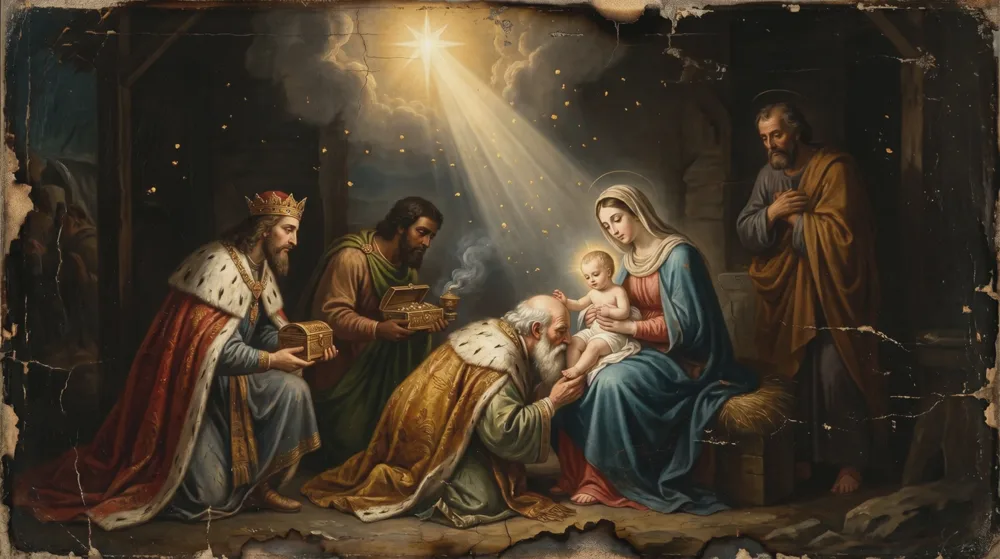
The Epiphany is the feast of January 6 on which the Catholic Church celebrates the manifestation of God made man to the world. The word itself means "appearance" or "manifestation," and the feast gathers three showings of Christ as God: the adoration of the Magi at Bethlehem, his Baptism in the Jordan, and his first miracle at the wedding feast of Cana. It is, in the traditional Roman calendar, the close of the Twelve Days of Christmas.
What is the Epiphany?
If Christmas celebrates an event — the birth of Christ at Bethlehem — the Epiphany celebrates a truth: mankind acknowledging this Child as God. As Dom Pius Parsch states it, on Christmas God appeared as man; on the Epiphany this Man manifests himself as God to the world. The name signifies Manifestation, and implies the apparition of God to his creatures (Dom Guéranger, The Liturgical Year).
The feast is one continuous mystery with Christmas, yet it wears its own character. For several centuries the Nativity itself was kept on this same January 6, until the Holy See obliged all Churches to keep the Nativity on December 25. The Sixth of January was not thereby stripped of its glory: it kept the celebration of three great manifestations of the Word made flesh. This is why the Epiphany season, in the traditional calendar, prolongs the joy of the Incarnation rather than beginning something new.
Epiphany meaning: what does the word mean?
The meaning of the word epiphany is straightforward. It comes from the Greek epiphaneia, "appearance" or "showing-forth," and in ordinary speech a synonym would be a sudden revelation or manifestation. The Church takes the word in its full and proper sense: the Epiphany is the manifestation of God himself. So the definition has two layers. As a common noun, an epiphany means a moment when something hidden is suddenly made plain. As the name of the feast, the Epiphany means the showing-forth of the eternal Word, clothed in our flesh, as true God — first to the Magi, then at the Jordan, then at Cana. The feast does not borrow the word loosely; it gives the word its original and highest meaning.
The Epiphany of the Lord
In the calendar the feast is titled the Epiphany of the Lord — Epiphania Domini. The wording matters. It is not the epiphany of the Magi, nor of the star, but of the Lord: the Magi, the dove, the Father's voice, and the water made wine are all so many ways in which the Lord shows who he is. The whole feast is centred on him.
This is why the traditional Roman rite ranks the Epiphany of the Lord as a feast of the first class with a privileged Octave, on a level with the greatest days of the year, and why its proper preface and the solemn proclamation of the movable feasts (the Noveritis) belong to it. By that ancient chant the Church announces from the Epiphany the dates of the moveable feasts to come — Septuagesima, Ash Wednesday, Easter, Pentecost — so that the faithful know in good time when Shrove Tuesday, the eve of the great fast, will fall. To call the day the Epiphany of the Lord is to say that everything in it points to one Person.
Three Kings Day: the adoration of the Magi
The first and most famous of the three manifestations is the adoration of the Magi, from which the popular name Three Kings Day comes. Led by a star, wise men came from the East to Bethlehem, "and falling down they adored him; and opening their treasures, they offered him gifts; gold, frankincense, and myrrh" (Matthew 2:11, Douay-Rheims). These Magi were the first-fruits of the Gentiles — the first pagans called to faith. The Church reads in their journey our own vocation: the Epiphany is the feast of faith and of grace, the day the nations were summoned to belief (Dom Pius Parsch).
The three gifts are read by tradition as a confession of who the Child is: gold for a King, frankincense for God, myrrh for the man who would die and be buried. The star that led them, and the kneeling of kings before an infant, declare that the salvation born at Bethlehem is offered not to one people but to all. To honor the Mother who held him, see Mother of God; to grasp the mystery they adored, see the Immaculate Conception of her who bore him. Those who would keep the feast in the spirit of the Wise Men may pray the novena of the Epiphany and the Holy Magi.
3 Kings Day: customs and traditions of January 6
Under its popular name — Three Kings Day, or Día de los Reyes in the Spanish-speaking world — January 6 has gathered customs of its own. Scripture does not number the Magi; tradition counted three from the three gifts, and from ancient times has called them Caspar, Melchior, and Balthasar. In Spain, Mexico, and elsewhere, children receive their gifts on this day rather than at Christmas, in memory of the gifts laid before the Child, and families share the Rosca de Reyes, a ring-shaped kings' cake in which a small figure of the Infant is hidden.
The traditional books also provide for the blessing of chalk on the Epiphany, with which the faithful mark the lintel of their door — 20 + C + M + B + 26 — the initials of the three kings, which are also read as Christus mansionem benedicat, "may Christ bless the house." These customs are not folklore detached from the feast: each one carries the mystery of the Magi into the home, so that the household too may adore.
The Baptism in the Jordan
The second manifestation is the Baptism of our Lord in the Jordan. In the East, where the Epiphany began, the emphasis fell here above all: at the Jordan the Holy Ghost overshadowed the Saviour as a dove, and the Father proclaimed from heaven, "This is my beloved Son, in whom I am well pleased" (Matthew 3:17, Douay-Rheims). This is a manifestation in the fullest sense — the whole Holy Trinity is shown at once: the Son in the water, the Spirit descending, the Father speaking. For the doctrine this scene reveals, see the Holy Trinity.
Christ had no need of baptism; he willed it to sanctify the waters and to manifest himself. Cardinal Schuster notes that the grand antiphon of the Office at dawn binds all three manifestations together: the Church is joined to her heavenly Spouse, since Christ washed away her sins in the Jordan, and the Magi run with gifts to the royal nuptials.
The wedding at Cana
The third manifestation is the first miracle, at the marriage feast of Cana, where Christ changed water into wine. Saint John records its purpose plainly: "This beginning of miracles did Jesus in Cana of Galilee; and manifested his glory, and his disciples believed in him" (John 2:11). Here the glory hidden in the carpenter's son breaks into the open, and faith is born in those who see. The three facts the Church chose — a star leading the Magi to the manger, water made wine at Cana, and the Baptism at the Jordan — together show that God has truly appeared among us (Dom Pius Parsch).
The Twelve Days of Christmas
The Epiphany closes the Twelve Days of Christmas, the span from the Nativity on December 25 to January 6. These days are not a countdown but a single, sustained feast: the Church keeps one and the same mystery of the Incarnation before her eyes throughout, undistracted even by the many saints' days that fall within it (Dom Guéranger). The Christmas season itself does not end at the Epiphany but runs on to the Purification of the Blessed Virgin on February 2 — see Candlemas — when the forty days of the Nativity are fulfilled.
The Epiphany has its own honored place within the liturgical year, standing as a great feast in its own right. As the close of Christmastide it answers, from the far side, the season of waiting kept in Advent: what was longed for is now manifested and adored.
When is the Epiphany in 2026? Is it a holiday of obligation?
In 2026, as every year, the Epiphany falls on January 6. The date is fixed: twelve days after the Nativity, it does not move with the calendar the way Easter does. In the traditional Roman calendar the Epiphany is a holy day of obligation — a feast on which the faithful are bound to assist at Mass and to keep the day holy, as on a Sunday. (Where the civil setting makes this impractical, some local Churches have transferred the obligation to the nearest Sunday; the feast itself, however, remains anchored to January 6.) Calling the Epiphany a "holiday" is fitting in the older sense of the word — a holy day — for that is exactly what it is: not a secular break but one of the great festivals of the Church's year.
Why the Church keeps this feast
Saint Leo the Great gives the reason with classic brevity: "Whom the Virgin brought forth on Christmas, the world acknowledged today" (cited in Dom Pius Parsch). The Epiphany is not primarily the memory of an event but the celebration of a truth — that the eternal Word, clothed in flesh, has shown himself to be God, and that the Gentiles, in the persons of the Magi, have been called to confess him.
The three manifestations together teach one lesson. To the Magi, Christ is shown as King and God; at the Jordan, as the beloved Son of the Father; at Cana, as the Lord whose glory commands creation. We who keep the feast stand with the Magi, the first of the nations to kneel, and with them we are asked for the same gift: faith.
Frequently Asked Questions
What is the Epiphany?
The Epiphany is the feast of January 6 on which the Catholic Church celebrates the manifestation of God made man to the world. The word means "appearance" or "manifestation," and the feast gathers three showings of Christ as God: the adoration of the Magi at Bethlehem, His Baptism in the Jordan, and His first miracle at the wedding feast of Cana. In the traditional Roman calendar it closes the Twelve Days of Christmas.
What does Epiphany mean?
The word "Epiphany" means appearance or manifestation. If Christmas celebrates an event — the birth of Christ at Bethlehem — the Epiphany celebrates a truth: mankind acknowledging this Child as God. As Dom Pius Parsch puts it, on Christmas God appeared as man; on the Epiphany this Man manifests Himself as God to the world.
When is the Epiphany?
The Epiphany is kept on January 6 in the traditional Roman calendar, twelve days after the Nativity on December 25. This is its fixed and proper place each year, including in 2026. The Christmas season itself does not end at the Epiphany but runs on to the Purification of the Blessed Virgin (Candlemas) on February 2.
Why is the Epiphany called Three Kings Day?
The popular name Three Kings Day comes from the first and most famous of the three manifestations, the adoration of the Magi. Led by a star, wise men came from the East to Bethlehem and "falling down they adored him; and opening their treasures, they offered him gifts; gold, frankincense, and myrrh" (Matthew 2:11, Douay-Rheims). These Magi were the first-fruits of the Gentiles, the first pagans called to faith.
When is the 3 Kings Day?
Three Kings Day is January 6 — it is the popular name of the Epiphany itself, so the two always fall on the same day. The date is fixed, twelve days after Christmas, and does not move with the calendar the way Easter does; in 2026, as every year, it is kept on January 6. In many countries this, not December 25, is the day children receive their gifts.
What three events does the Epiphany celebrate?
The Epiphany gathers three manifestations of Christ as God: the adoration of the Magi, who confess Him as King and God by their gifts; the Baptism in the Jordan, where the whole Trinity is shown and the Father proclaims "this is my beloved Son"; and the wedding at Cana, where Christ changed water into wine and "manifested his glory, and his disciples believed in him" (John 2:11). Together they teach one lesson: that God has truly appeared among us.
The Iter Fidei app carries the prayers, the traditional calendar of feasts, and the catechism, so the feast of the Epiphany and the whole Christmas season may be kept day by day. Join early access here.
Sources. Holy Scripture, Douay-Rheims (Matthew 2:1–12; Matthew 3:13–17; John 2:1–11). Dom Prosper Guéranger, The Liturgical Year (Epiphany). Blessed Cardinal Ildefonso Schuster, The Sacramentary (Liber Sacramentorum) (Epiphany). Dom Pius Parsch, The Church's Year of Grace (Epiphany; with Saint Leo the Great, Sermons on the Epiphany).