
Apologetics
Why Do Catholics Pray to Mary?
Do Catholics pray to Mary? Yes — but they do not worship her. They ask her to pray for them, as one asks a friend, because she is the Mother of God and our most powerful advocate with her Son.
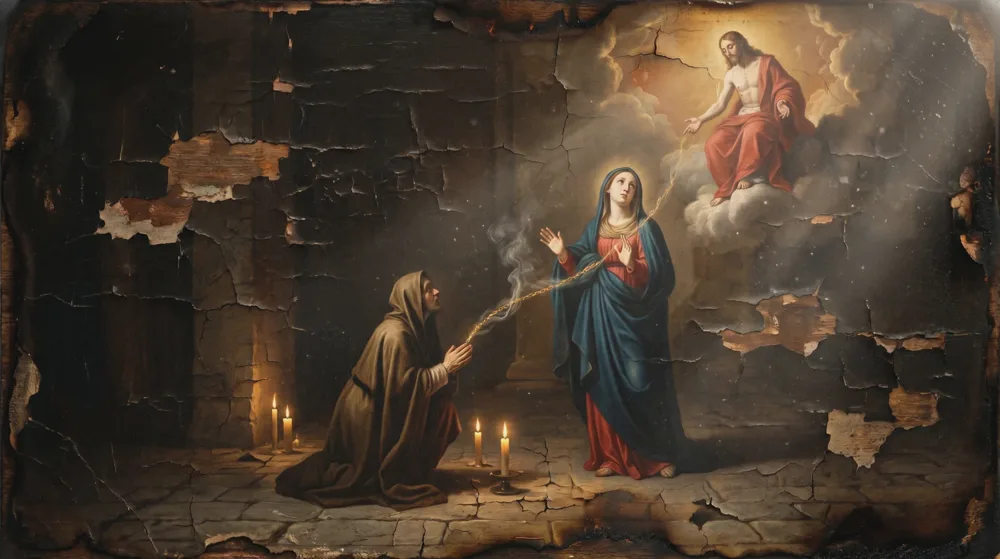
Yes, Catholics pray to Mary — but they do not worship her. To worship a creature would be idolatry, a sin against the First Commandment. When Catholics pray to Mary, they ask her to pray for them, exactly as one asks a friend on earth to pray for him. The Catechism of Saint Pius X states the reason plainly: "the Most Blessed Virgin is our most powerful Advocate with Jesus Christ," and so "we pray the Most Blessed Virgin to obtain for us the graces we have asked for."
Do Catholics pray to Mary, or worship her?
This is where the confusion lies, and it is worth removing it carefully, for the objection is sincerely felt by many of our separated brethren. The English word "pray" once simply meant "to ask" — as in the old phrase "I pray thee." When Catholics pray to Mary, they are asking her something: they ask her to intercede for them before God. They are not adoring her, not treating her as God, not offering her the worship due to the Creator alone.
The Church has always marked this distinction sharply. The Roman Catechism, drawn up by the Council of Trent, teaches that "the worship and invocation of the Saints, of the Angels, and of the blessed Souls who enjoy the Glory of heaven... are in no wise contrary to the spirit of this first Commandment." It gives the homely comparison of a king: a sovereign who forbids his subjects to call themselves king does not thereby forbid that his magistrates be honoured. The honour given to a magistrate and the homage due to the king are not the same thing, and no one confuses them.
So the answer to "do Catholics worship Mary?" is: no, and to do so would be a grave sin. The answer to "do Catholics pray to Mary?" is: yes, in the sense of asking her prayers.
The difference between worship and honour
The older theology used two distinct words, and they clear the whole matter at once.
- Latria is adoration — the worship due to God alone, because He alone is the Creator, the author of grace, the last end of man. To give latria to any creature is idolatry.
- Dulia is the honour given to the saints — not because they are gods, but because God has made them holy and they reign with Him. Mary, as Mother of God, receives a higher degree of this honour, but it remains honour given to a creature, infinitely below adoration.
The Roman Catechism states the principle with precision: "Although it is said that Christians... adore the Angels, nevertheless this worship which they render them differs essentially from that which they offer to God." The two are not different in degree only; they differ in kind. The First Commandment forbids us to give a creature the worship that belongs to God. It does not forbid us to honour those whom God Himself has honoured.
Why pray to Mary rather than directly to God?
Here an honest objection arises, and we will not pretend it away: we do have one Mediator, Jesus Christ. The Roman Catechism affirms it without flinching: "we have but one Mediator, Our Lord Jesus Christ, who has reconciled us by His Blood with the heavenly Father." Catholics believe this firmly. Every grace comes from God, through the one redemptive merit of Christ.
But it does not follow that we may not ask others to pray for us. The same Catechism answers the objection directly: "But this in no wise proves that we ought not to have recourse to the intercession of the Saints." Saint Paul, who wrote that there is one Mediator, constantly begged the prayers of the living Christians around him. If asking a fellow Christian on earth to pray for me does not insult Christ's mediation, then neither does asking a saint in heaven, who is more alive in God than I am, and whose charity is greater.
To ask Mary's prayers, then, is not to bypass Christ — it is to go to Christ in the company of His Mother. We pray to God as "the author of graces," says the Catechism of Saint Pius X; we pray to the saints "that they may intercede for us as our advocates with God." When a saint grants a grace, the Catechism is careful to add, "we mean that this Saint has obtained it from God." Nothing comes from Mary that does not come, at its source, from God.
This recourse to Mary's prayers is one of the many practices that puzzle those outside the Church, which we set in their wider context in why do Catholics do the things they do. And why Mary above the other saints? Because she is the Mother of God. "The Most Blessed Virgin is so powerful," the Catechism of Saint Pius X teaches, "because she is the Mother of God, and it is impossible that He should not hear her." On the title of her motherhood, see Mary, the Mother of God.
The Communion of Saints
All of this rests on an article of the Creed: the Communion of Saints. The Church is one Body, and Christ is the Head. The Roman Catechism teaches that because the Church "is governed by one and the same spirit, all the goods which she has received necessarily become a common fund." Death does not sever a member from this Body. The faithful on earth, the holy souls being purified, and the saints in heaven are one family, and charity binds them so closely that, as the Catechism says of the members of one body, "if one of these members suffers any pain whatsoever, all the others feel it likewise."
To ask Mary and the saints to pray for us is simply to live this article of the Creed. They are not dead and gone; they "behold the face of the Father who is in heaven," and they "pray continually for the salvation of men." We treated this union at greater length in The Communion of Saints.
Why do Catholics pray to Mary and the saints?
The same principle that governs prayer to Mary governs prayer to all the saints: we ask them to intercede for us before God. The Catechism of Saint Pius X puts the two together in a single answer — we honour the saints and "we pray to them that they may intercede for us as our advocates with God." Mary is not an exception to the rule but its summit; she is the first and greatest of the saints, the Queen of all of them.
Why, then, ask the saints at all, and not only God directly? Because God Himself wills to give His graces through the prayers of His friends. Scripture is full of it: God tells Abimelech that Abraham "shall pray for thee, and thou shalt live" (Genesis 20); Job's friends are spared because Job prays for them; Saint James commands the faithful to "pray one for another, that you may be saved" (James 5). If the living are to pray for one another, how much more the saints, who are more alive in God than we are and whose charity is perfect.
Among all these advocates Mary holds the first place, because she is the Mother of God. "The Most Blessed Virgin is so powerful," teaches the Catechism of Saint Pius X, "because she is the Mother of God, and it is impossible that He should not hear her." So Catholics ask the saints; and of the saints they ask Mary above all.
Why do Roman Catholics pray to Mary?
The phrase "Roman Catholics" names no different doctrine here — it is simply the Catholic Church in communion with the See of Rome, holding the faith of the Council of Trent and the catechisms drawn from it. Roman Catholics pray to Mary for the reason every Catholic does: she is the Mother of God and the most powerful advocate with her Son. The Roman Catechism, drawn up by Trent in 1566, defends the invocation of Mary and the saints precisely as a recourse to their intercession, never as adoration. There is no separate "Roman" cult of Mary distinct from the ancient veneration of the whole Church; there is one Catholic faith, which honours the Mother whom God Himself honoured.
What the Hail Mary actually asks
Nothing shows the Catholic mind more clearly than the prayer itself. The Hail Mary is largely Scripture: the angel Gabriel's greeting and Saint Elizabeth's words, joined at the end to a single petition added by the Church. And that petition is not adoration. It is a request for prayer: Holy Mary, Mother of God, pray for us sinners, now and at the hour of our death. The Catechism of Saint Pius X explains that by these last words "we ask the protection of the Most Blessed Virgin during this life and especially at the hour of death." We ask her to pray for us — the very thing we ask of any friend. On the prayer itself, see The Hail Mary; on the devotion the Church most recommends in Mary's honour, How to Pray the Rosary.
Why do Catholics and Orthodox pray to Mary?
Catholics and the Eastern Orthodox share this practice because they share the ancient faith that lay behind it long before the divisions among Christians. Both hold the article of the Creed on the Communion of Saints; both confess Mary as the Theotokos, the "God-bearer" or Mother of God — a title defined at the Council of Ephesus in 431, when East and West were one Church. The Orthodox call her also Panagia, the "All-Holy," and her name fills their liturgy and hymns.
When the Orthodox sing to Mary, they ask the same thing Catholics ask: her prayers. The most beloved of their hymns, the Sub Tuum Praesidium — "Beneath thy protection we take refuge, O Holy Mother of God" — is in fact the oldest surviving prayer to Our Lady, found on a papyrus older than most of the great heresies, and it is prayed in both East and West to this day.
Where the two traditions agree, then, they agree because they are both drawing on something older than their separation: the conviction that Mary, Mother of God, prays for us before her Son, and that to ask her prayers is no betrayal of the one Mediator but the exercise of His Body's charity. We do not say the divisions do not matter; we say that on this point the witness is common and very ancient.
To our separated brethren
We say this plainly and without rancour. Those who object to "Catholics praying to Mary" are very often objecting to a thing the Church herself condemns — the worship of a creature. On that point we agree entirely: Mary is not God, and she is not adored. The real difference is narrower and more honest than the caricature: it is whether the saints in heaven, living in Christ, can be asked to pray for us. We hold, on the constant witness of Scripture and the Fathers, that they can and do. We do not say all roads lead to God; we say this one — honouring the Mother whom God Himself honoured — is no road away from Him, but a road that leads through her straight to her Son.
Frequently Asked Questions
Why Do Catholics Pray to Mary?
Catholics pray to Mary in order to ask her to pray for them, as one asks a friend on earth to pray. The Catechism of Saint Pius X gives the reason plainly: "the Most Blessed Virgin is our most powerful Advocate with Jesus Christ," and so "we pray the Most Blessed Virgin to obtain for us the graces we have asked for." Because she is the Mother of God, "it is impossible that He should not hear her."
Do Catholics Pray to Mary?
Yes — in the older sense of the word "pray," which simply meant "to ask," as in the phrase "I pray thee." When Catholics pray to Mary, they ask her to intercede for them before God; they do not adore her or treat her as God. It is the same thing Saint Paul did when he constantly begged the prayers of the living Christians around him.
Do Catholics Worship Mary?
No, and to worship her would be a grave sin against the First Commandment, the sin of idolatry. The older theology distinguished latria, the adoration due to God alone, from dulia, the honour given to the saints. Mary receives the highest degree of this honour as Mother of God, but it remains honour given to a creature, infinitely below the worship reserved to the Creator.
Why Do Catholics Worship Mary?
Catholics do not worship Mary — the charge rests on a misunderstanding of what they do. The Roman Catechism, drawn up by the Council of Trent, teaches that the honour given to the saints and angels "differs essentially from that which they offer to God." The two are not different in degree only; they differ in kind. Mary is honoured, not adored.
Why Do Catholics Pray to Mary Instead of Jesus?
Catholics do not pray to Mary instead of Jesus; they ask her to pray with them and for them to her Son. Every grace comes from God through the one Mediator, Our Lord Jesus Christ, and the Catechism of Saint Pius X is explicit that when a saint obtains a grace "we mean that this Saint has obtained it from God." To seek Mary's intercession is no more to bypass Christ than asking a friend on earth to pray for us — except that her charity is greater and, as Mother of God, "it is impossible that He should not hear her."
Why Do Catholics Pray to Mary and the Saints?
Catholics ask both Mary and the saints to intercede for them before God, because God wills to give His graces through the prayers of His friends. Scripture commands the faithful to "pray one for another, that you may be saved" (James 5), and the saints in heaven, living in Christ, do this with a charity greater than ours. The Catechism of Saint Pius X teaches that we pray to the saints "that they may intercede for us as our advocates with God." Mary is not an exception to this but its summit, the first and greatest of the saints, asked above all the rest because she is the Mother of God.
Why Do Roman Catholics Pray to Mary?
For exactly the reason every Catholic does: Mary is the Mother of God and the most powerful advocate with her Son. "Roman Catholics" simply means the Catholic Church in communion with Rome, holding the faith of the Council of Trent; there is no separate "Roman" cult of Mary distinct from the ancient veneration of the whole Church. The Roman Catechism defends the invocation of Mary as recourse to her intercession, never as adoration.
Why Do Catholics and Orthodox Pray to Mary?
Both Catholics and the Eastern Orthodox honour Mary and ask her intercession because both hold the ancient faith in the Communion of Saints — the article of the Creed that the Church is one Body in Christ, undivided by death. The saints in heaven "behold the face of the Father" and "pray continually for the salvation of men," and so the faithful ask their prayers. This belief is older than the divisions among Christians, and the Orthodox revere Mary as the Theotokos, the God-bearer.
Do Orthodox Pray to Mary?
Yes. The Eastern Orthodox venerate Mary deeply, calling her Theotokos ("Mother of God") and Panagia ("All-Holy"), and they ask her intercession in their prayers and hymns just as Catholics do. This shared veneration reflects a faith held in common from antiquity: that Mary, as Mother of God, is the most powerful advocate among the saints who pray for us before her Son.
The Iter Fidei app carries the Catholic Faith — the prayers, the catechism, and the traditional liturgy — to live it and to defend it. Join early access here.
Sources. Catechism of the Council of Trent (Roman Catechism, 1566): Part I, Ninth Article of the Creed, "The Communion of Saints"; Part III, on the First Commandment, "On the worship and invocation of the Angels and the Saints." Catechism of Saint Pius X (1908): Part II, ch. 3, "The Hail Mary"; ch. 4, "The Invocation of the Saints." Scripture (Douay-Rheims): Gospel of Saint Luke 1; Genesis 20; Job 42; Epistle of Saint James 5. Council of Ephesus (431): definition of Mary as Theotokos. Sub Tuum Praesidium (third-century Greek papyrus, Rylands 470).