
Prayer
Ave Maris Stella: Hail, Star of the Sea
Ave Maris Stella — the ancient Marian hymn of Vespers — in its full Latin text and English translation, with its meaning, its history, and how the Church sings it.
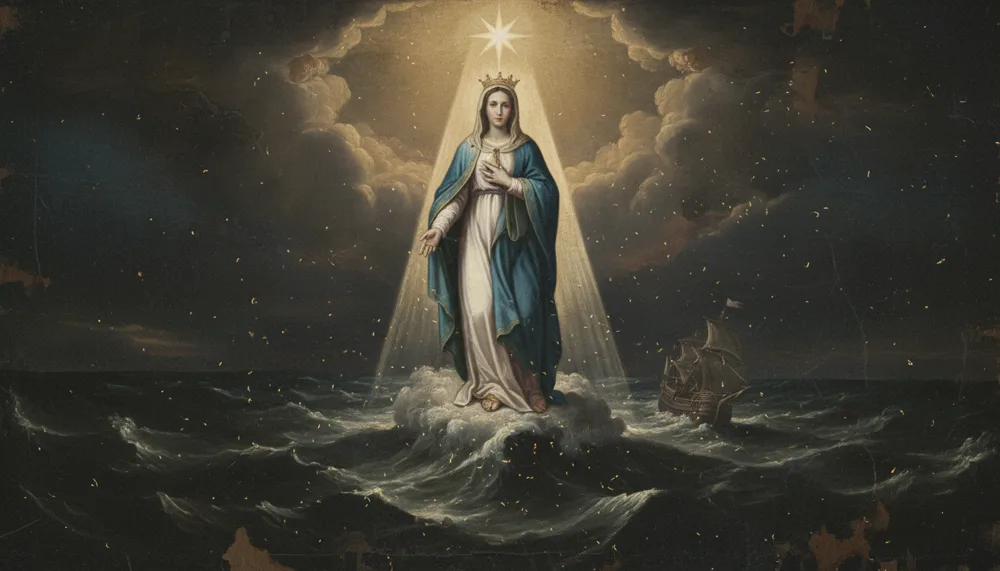
Ave Maris Stella — "Hail, Star of the Sea" — is one of the oldest and best-loved hymns the Church sings to the Blessed Virgin Mary. For more than a thousand years it has been chanted at Vespers, the Church's evening prayer, on the feasts of Our Lady and throughout the seasons given to her honour. It is a hymn of seven short verses, each one a plea to the Mother of God who shines, like a fixed star over a dark sea, to guide her children safely home. Here we give the full text of Ave Maris Stella in Latin and in English, and then explain its words, its history, and the place it holds in the prayer of the Church.
Ave Maris Stella in English
This is the hymn in full, rendered into English close to the Latin so that the sense of each verse stands clear.
Hail, star of the sea,
nurturing Mother of God,
and ever Virgin,
happy gate of heaven.Receiving that Ave
from the mouth of Gabriel,
establish us in peace,
changing the name of Eve.Loose the chains of the guilty,
bring light to the blind,
drive away our evils,
and obtain for us all good things.Show thyself a Mother,
and may He receive through thee our prayers,
who, born for us,
deigned to be thine.Unique Virgin,
meek above all others,
deliver us from our faults,
make us meek and chaste.Grant us a pure life,
prepare for us a safe way,
that seeing Jesus,
we may rejoice eternally.Praise be to God the Father,
glory to Christ Most High,
and to the Holy Ghost,
one same honour to the Three.
Amen.
Ave Maris Stella in Latin
The Latin is the text the Church has sung since at least the ninth century, set to its own grave and gentle Gregorian melody.
Ave maris stella,
Dei Mater alma,
atque semper Virgo,
Felix caeli porta.Sumens illud Ave
Gabrielis ore,
Funda nos in pace,
Mutans Hevae nomen.Solve vincla reis,
Profer lumen caecis,
Mala nostra pelle,
Bona cuncta posce.Monstra te esse Matrem,
Sumat per te preces
Qui pro nobis natus,
Tulit esse tuus.Virgo singularis,
Inter omnes mitis,
Nos culpis solutos,
Mites fac et castos.Vitam praesta puram,
Iter para tutum,
Ut videntes Jesum,
Semper collaetemur.Sit laus Deo Patri,
Summo Christo decus,
Spiritui Sancto,
Tribus honor unus.
Amen.
What "Star of the Sea" means
The title that opens the hymn — maris stella, star of the sea — is one of the most ancient names given to Our Lady. The image is plain and beautiful: a sailor crossing a dark and dangerous sea fixes his eye on a steady star to keep his course; so the Christian, crossing the perilous sea of this life toward the harbour of heaven, looks to Mary to keep him from being lost. She does not give her own light, as a star reflects the sun; she shines with the light of her Son and points always to Him. To call her Star of the Sea is to confess that she leads souls not to herself but to Christ.
The Church has loved this name in every age. The faithful have sung it over storms, over sickness, and over the slower storms of temptation and grief, trusting the one whom God Himself gave us as a Mother from the Cross.
The verses and their meaning
The first verse greets Mary by four titles at once — Star of the Sea, nurturing Mother of God, ever Virgin, and felix caeli porta, the happy gate of heaven, because through her the Saviour came into the world and through her grace we pass to Him.
The second verse turns on a word. The angel Gabriel's greeting at the Annunciation was Ave (Luke 1:28); read backwards, Ave spells Eva — Eve. The hymn prays that Mary, who received that Ave, would reverse the ruin of Eve: "changing the name of Eve." Where Eve brought disobedience and death, Mary brought obedience and the Author of life. The Fathers called her the New Eve for exactly this reason.
The middle verses are a string of petitions, simple and bold: loose our chains, give light to the blind, drive away our evils, obtain every good. Then comes the hinge of the whole hymn — Monstra te esse Matrem, "Show thyself a Mother" — that she would prove her motherhood by carrying our prayers to the Son who, born for us, willed to be her own.
The last petitions ask for a pure life and a safe road, so that we may at last see Jesus and rejoice with Him for ever. The hymn closes, as all the Church's hymns do, with the doxology: glory to the Father, the Son, and the Holy Ghost, one honour to the Three.
When the Church sings Ave Maris Stella
Ave Maris Stella is above all the hymn of Vespers in the Office of the Blessed Virgin Mary. It is sung at her feasts through the year — the Assumption, the Nativity of Our Lady, the Immaculate Conception, and the rest — and on Saturdays, the day the Church keeps in her honour. It also belongs to her votive Office and is woven into many local Marian devotions. To pray it at evening, as the day closes, is to commend oneself once more to the Star that does not set.
Its companion at Vespers is the Magnificat, Mary's own song; and like the great Te Deum and the hymn Veni Creator, it is one of the fixed treasures of the Divine Office. You will find a fuller account of that evening prayer in our piece on the Divine Office.
The chant: how Ave Maris Stella is sung
Ave Maris Stella is, first and above all, a sung hymn — a chant, not merely a text to be read. The melody the Church carries down to us is a Gregorian setting in the first mode (Dorian), grave and tender at once, rising gently at the opening of each verse and settling at its close. It is the kind of tune a whole congregation can take up, for it moves by small steps and keeps within an easy compass; this is part of why it has been loved and sung in parishes and monasteries for a thousand years.
In the chant books the hymn is given more than one melody. The most familiar is the simple syllabic tune used at ordinary feasts of Our Lady; a more solemn, more ornamented setting is reserved for greater festivals. In every case the same Gregorian principle holds: the music serves the words, lifting the seven verses toward heaven without ever drawing attention to itself. To sing Ave Maris Stella is to let the melody carry the prayer.
If you wish to learn the chant, the surest way is to sing it verse by verse with a recording, following the Latin text given above. The hymn's regular four-line verses make it easy to memorise; once the first verse is in the ear, the rest follow the same shape. Iter Fidei gives the hymn with its chant and audio, so that the melody and the meaning may be learned together.
"Ave Maris Stella" and "Ave Stella Maris"
The hymn's first three words are sometimes written as Ave Stella Maris rather than Ave Maris Stella. The hymn's true and ancient title is Ave Maris Stella — "Hail, Star of the Sea" — in that order, and this is the form found in the chant books and the Divine Office. The variant Ave Stella Maris simply reverses maris (of the sea) and stella (star); in Latin the meaning is unchanged, since the words still read "Hail, Star of the Sea," but the received liturgical text is Ave Maris Stella. If you are looking for the hymn under either spelling, it is the same prayer.
A word on saying it: in the ecclesiastical Latin of the Church, Ave Maris Stella is pronounced AH-veh MAH-rees STEL-lah — the c in caeli soft like ch, the vowels pure and open. The whole title rolls easily off the tongue, which is one more reason it has stayed on the lips of the faithful.
A hymn within the family of Marian prayer
Ave Maris Stella does not stand alone. It belongs to a whole household of prayers the Church places on her children's lips when they turn to the Mother of God — chief among them the Hail Mary, the evening antiphon the Hail Holy Queen, and the trustful Memorare. Whoever loves this hymn will find these near to it in spirit, all of them teaching the same lesson: that to honour Mary is to be led, surely and gently, to Christ.
Frequently Asked Questions
What does Ave Maris Stella mean in English?
Ave Maris Stella means "Hail, Star of the Sea." It is a Marian hymn addressed to the Blessed Virgin Mary under one of her most ancient titles, Star of the Sea, the steady light that guides souls across the sea of this life to the safe harbour of heaven.
When is Ave Maris Stella sung?
It is the hymn sung at Vespers, the Church's evening prayer, in the Office of the Blessed Virgin Mary. The Church chants it on Our Lady's feasts throughout the year and on Saturdays, which are kept in her honour.
Who wrote Ave Maris Stella?
The author is unknown. The hymn appears in manuscripts from at least the ninth century, and tradition has long associated it with the early medieval Church. It has been sung continuously ever since, set to its own Gregorian melody.
Why is Mary called the Star of the Sea?
Because, as a star guides a sailor safely across dark and dangerous waters, Mary guides the faithful through the perils of this life to Christ. She does not shine with her own light but reflects the light of her Son, and so she always points the soul toward Him.
How many verses does Ave Maris Stella have?
The hymn has seven verses of four short lines each: an opening greeting, a series of petitions to Our Lady, and a closing doxology giving glory to the Holy Trinity.
Is Ave Maris Stella a chant or a hymn?
It is both: a hymn — a sung poem of praise in regular verses — set to a Gregorian chant melody. The most familiar setting is a simple tune in the first mode used at Our Lady's feasts, with a more solemn melody for greater festivals. It is meant to be sung, not merely read.
Is it "Ave Maris Stella" or "Ave Stella Maris"?
The true and ancient title is Ave Maris Stella, "Hail, Star of the Sea," and this is the form used in the Divine Office and the chant books. Ave Stella Maris is simply the same words in a different order; the meaning is identical, but the received liturgical title is Ave Maris Stella.
Iter Fidei serves the prayers, psalms and devotions, in Latin and English with audio. Get the app link by email here.
Sources. Ave Maris Stella, hymn of Vespers in the Office of the Blessed Virgin Mary, traditional Roman use; English Scripture from the Douay-Rheims Bible (Luke 1:28).