
The Faith
What Does God Say About Superstition?
What does God say about superstition, luck, and karma? That they put a false power in the place of His providence and break the First Commandment. We give the Douay-Rheims, St. Thomas, and the catechisms.
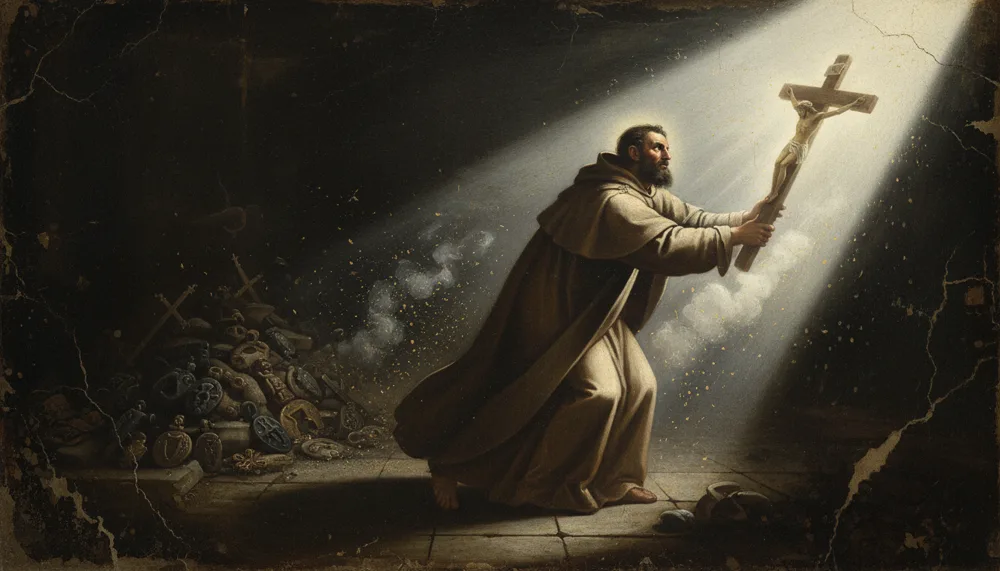
God forbids superstition, and He does so in the very first of His commandments: Thou shalt not have strange gods before me (Exod. xx. 3, Douay-Rheims). Superstition is condemned because it takes the power that belongs to God alone and hands it to dreams, charms, the stars, "luck," or some impersonal force — putting a counterfeit god where the living God should reign. The Pius X catechism defines it plainly: superstition is every devotion contrary to the doctrine and usage of the Church, as also the attributing to any action or thing whatsoever a supernatural virtue which it does not possess.
So the Bible's answer to superstition, to luck, and to karma is one answer, because the error is one: a false power set in the place of God's providence. We set it out here from the Douay text, St. Thomas, and the catechisms the Church gave us before the upheavals of our own day — firm against the error, charitable toward the many who have absorbed it without knowing what it is. This is part of how we read the Ten Commandments and the First above all.
What does the Bible say about superstition?
Scripture treats superstition not as a harmless habit but as a betrayal of God. There shall not be found among you any one... that consulteth soothsayers, or observeth dreams and omens, neither let there be any wizard, nor charmer, nor any one that consulteth pythonic spirits, or fortune tellers, or that seeketh the truth from the dead. For the Lord abhorreth all these things (Deut. xviii. 10-12). The same God who made all things will not share His sovereignty with auguries.
The Roman Catechism of Trent lists, among those who sin against the First Commandment, those who put faith in dreams, in auguries, and in all the vain superstitions of this kind. The sin is twofold: it is a lie about the world (these things have no power), and it is an injury to God (it credits His gifts to something else).
For this reason the Pius X catechism teaches that the First Commandment forbids us idolatry, superstition, sacrilege, heresy, and every other sin against religion — and forbids us to have dealings with the devil. To court hidden powers is no small thing: he who should have recourse to the devil or invoke him would commit an enormous sin. This is the same territory we treat under witchcraft, and it belongs among the seven deadly sins under the head of false worship.
What does God say about luck?
There is no "luck" in the Christian universe — there is providence. Are not two sparrows sold for a farthing? and not one of them shall fall on the ground without your Father (Matt. x. 29). What men call chance is the part of God's plan they cannot see. To trust in "luck," in lucky charms or omens, is to imagine a corner of reality God does not govern, and then to try to manage it ourselves with rituals He never gave.
St. Thomas faces this directly: events outside our own intention may be called chance with respect to us, but referred to God, nothing in the world happens by chance (Summa Theologiae I, q. 22, a. 2). Trent's catechism warns against the man who relies only upon riches, upon health, and upon the strength of the body — the same disordered trust in a respectable coat. The Catholic does not knock on wood; he commends his way to God. Have confidence in the Lord with all thy heart, and lean not upon thy own prudence (Prov. iii. 5). This confidence is a fruit of sanctifying grace, not of a rabbit's foot.
What does God say about karma?
"Karma" names a real intuition badly. It senses that the moral order is not mocked — and Scripture agrees: Be not deceived, God is not mocked. For what things a man shall sow, those also shall he reap (Gal. vi. 7). But karma misnames the sower's harvest as an impersonal, automatic payback, a cosmic accounting machine with no face and no mercy. That is exactly what God is not.
The Catholic answer is divine justice and divine mercy together, and the Cross between them. Justice is real: who will render to every man according to his works (Rom. ii. 6). But there is no impersonal wheel — there is a Father who will have all men to be saved (1 Tim. ii. 4), who forgives the contrite, and who so loved the world, as to give his only begotten Son (John iii. 16).
Karma offers no pardon and no Saviour; it can only return your deed to you. The Gospel offers confession, absolution, and a debt paid not by you but by Christ. Where karma says you will pay, the Cross says it is consummated (John xix. 30). To prepare for what really awaits us, we look not to a wheel of rebirth but to the four last things.
Manifesting and the law of attraction
The newer superstitions wear self-help clothing, but the structure is identical: a false power in the place of God's providence. "Manifesting" and "the law of attraction" teach that your thoughts and desires bend reality to deliver what you want — that the universe is a vending machine answering to the intensity of your wanting. This is superstition by the catechism's own definition: it attributes to any action or thing whatsoever a supernatural virtue which it does not possess. And it is a quiet idolatry, because it makes the self the god whose will commands all things.
The Christian answer is not a stronger technique; it is humble prayer to a personal God. We do not bend the universe — we ask a Father, and surrender the outcome to His wisdom: Thy will be done (Matt. vi. 10). Our Lord prayed it Himself in agony: not my will, but thine be done (Luke xxii. 42). Prayer is not the manipulation of cosmic energy; it is a child speaking to a Father who knows what we need before you ask him (Matt. vi. 8). This is the whole spirit of mental prayer and of the Rosary: not to seize, but to entrust.
Horoscopes, astrology, and reading the future
Astrology and the daily horoscope belong to the same forbidden family — divination, the attempt to wring the future from the stars or from omens. Scripture mocks it: Let now the astrologers stand and save thee, they that gazed at the stars... behold they are as stubble, fire hath burnt them (Isa. xlvii. 13-14). The stars are creatures, not councillors. The Pius X catechism condemns even consulting the souls of the departed by spiritism, because such practices are superstitious and... often not free from diabolical intervention. The future is God's to give; we receive it through trust, not through charts.
Why it matters — and a charitable word
These errors are rarely embraced in open rebellion. Most who keep a charm, read a horoscope, or speak of "karma" and "the universe" have simply breathed in the air of a faithless age — new-age sentiment, half-remembered individualism, fundamentalist dread of "bad energy." We do not despise such people; we answer them, as the Church always has, with the truth.
The truth is freeing. Where superstition leaves you anxiously managing unseen powers, the faith hands the whole weight to God: Cast all your care upon him, for he hath care of you (1 Pet. v. 7). You need no lucky number, no manifesting ritual, no ledger of karma — only a Father, His commandments, His sacraments, and the daily fight to trust Him, the real spiritual combat. For more, see our Catholic Bible verses and the rest of what God says.
To break with superstition is simply to keep the First Commandment: to acknowledge, to adore, to love, and to serve Him alone as our sovereign Lord, and to leave all that He has not given us to no one but Him.
Frequently Asked Questions
What does God say about superstition?
God forbids superstition in the very first of His commandments: Thou shalt not have strange gods before me (Exod. xx. 3). Superstition is condemned because it takes the power that belongs to God alone and gives it to charms, omens, the stars, or "luck," setting a counterfeit god in His place. The Catechism of St. Pius X defines it as attributing to any action or thing whatsoever a supernatural virtue which it does not possess.
The Iter Fidei app carries the Douay-Rheims Bible, the catechism, and the prayers. Get the app link by email here.
Sources. Douay-Rheims Bible (Exodus xx; Deuteronomy xviii; Proverbs iii; Isaias xlvii; Matthew vi, x; Luke xxii; John iii, xix; Romans ii; Galatians vi; 1 Timothy ii; 1 Peter v). St. Thomas Aquinas, Summa Theologiae I, q. 22, a. 2 (on providence and chance). Catechism of the Council of Trent (1566), First Commandment. Catechism of St. Pius X (1908), The First Commandment (definitions of superstition, recourse to the devil, and spiritism).