
The Faith
What Does the Church Teach About Aliens and Extraterrestrial Life?
What does the Bible say about aliens? Scripture is silent on extraterrestrial life, and the Church binds no doctrine on it. What the Faith does hold — man made in God's image, Christ's Redemption for mankind — answered soberly from the Douay-Rheims.
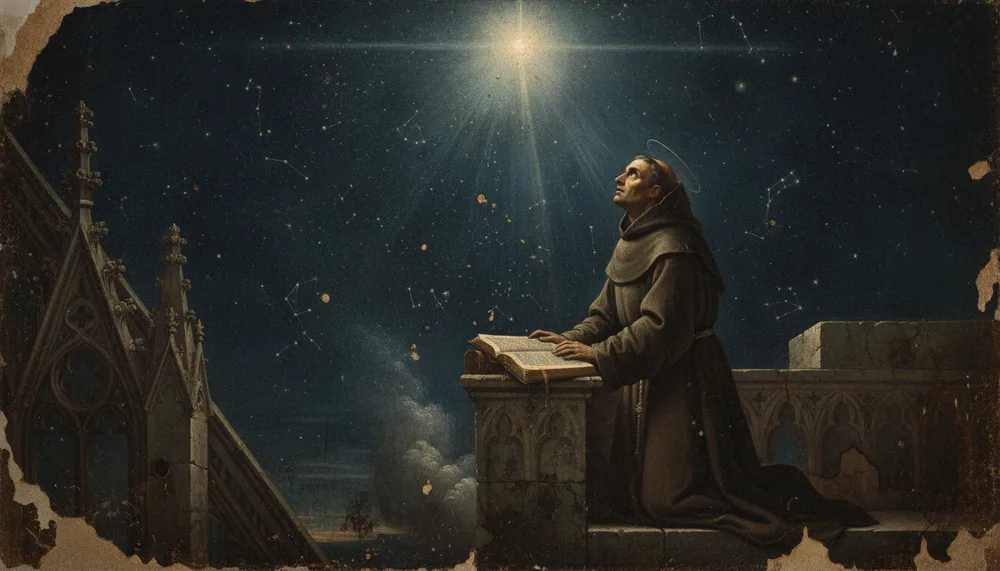
The Bible says nothing about aliens, and the Church teaches no doctrine that binds the faithful on the question. Scripture neither affirms nor denies life on other worlds; it was not given to chart the heavens but to save souls. To believe extraterrestrial life exists is no sin, and to deny it is no heresy — the matter is simply open. What the Faith does hold, and holds firmly, is this: God made man in His own image, He set him over the earth, and the Son of God became man and died for mankind. On that the Church does not bend. Around it, on the question of distant worlds, she leaves the Catholic free to wonder.
What does the Bible say about aliens?
Nothing directly. The searcher who types "what does the Bible say about aliens" wants a verse, and there is none that names a creature of another planet. Scripture speaks of the heavens, the stars, the angels, and the things of earth; it does not speak of men on Mars. The opening word of Genesis tells us who made the cosmos and why, not the full inventory of what fills it: "In the beginning God created heaven and earth" (Genesis i. 1). That "heaven and earth" is the Hebrew way of saying everything that is — visible and invisible, near and far. Whatever exists beyond our sight, if anything lives there, was made by the same hand.
The Psalmist gazed at the night sky in wonder and asked the only question that matters: "When I behold thy heavens, the works of thy fingers: the moon and the stars which thou hast founded… what is man, that thou art mindful of him?" (Psalm viii. 4–5). He did not catalogue other worlds; he marvelled that the Maker of so vast a creation should stoop to love so small a creature. That is the Bible's posture toward the cosmos — adoration, not astronomy. The silence of Scripture on aliens is not a gap to be anxiously filled but a sign that the question, while interesting, is not necessary for salvation.
Is it a sin to believe in aliens?
No. To hold that life may exist elsewhere in the universe is not a sin, nor is it contrary to the Faith. The Church has never condemned the opinion, and great Catholic minds have entertained it freely. The matter falls among the things the Church leaves open — what theologians call a question of opinion, not of doctrine. A Catholic may believe other worlds are inhabited, or believe earth alone bears life, and remain entirely faithful either way.
Where sin enters is not in the belief but in its abuse, much as with the careless use of the divine name, where the fault lies not in speaking of God but in dishonouring Him. It becomes spiritually dangerous when curiosity hardens into obsession, when a man trades the worship of God for the worship of the unknown, or when fascination with "what is out there" crowds out the one thing necessary.
Scripture warns against the restless craving for hidden knowledge that turns the heart from God: "Seek not the things that are too high for thee, and search not into things above thy ability… for it is not necessary for thee to see with thy eyes those things that are hid" (Ecclesiasticus iii. 22). The sin, when there is one, is never in admitting that God's creation may be larger than we know; it is in letting the spectacle of creation eclipse the Creator. On guarding the heart against such disordered appetite, see spiritual combat and what does God say about superstition.
What the Church does teach: man in God's image
Here the tradition draws its firm line. Whatever fills the far reaches of space, the dignity of man is not in doubt. God set him apart from every other creature by a special act and a special likeness: "Let us make man to our image and likeness: and let him have dominion over the fishes of the sea, and the fowls of the air, and the beasts" (Genesis i. 26). The Catechism of St Pius X explains that "man was created to the image and likeness of God, because the human soul is spiritual and reasonable, free in its acts, capable of knowing and loving God and of enjoying Him eternally" (First Article, On Man).
This dignity does not depend on man being alone in the universe. It is the same dignity that grounds the Church's reverence for the human body even in death: the creature God formed in His image is never reduced to mere matter. If God peopled a thousand worlds, the soul He breathed into Adam would lose none of its worth. The Catholic need not fear that a discovery in the sky could demote him; his greatness was never a matter of being the only rational creature, but of being known and loved and redeemed by God. The image of God in the soul is the unshakeable ground beneath every speculation about the stars — to understand it more deeply, see what do Catholics believe and what does God say about the soul.
Christ's Incarnation and Redemption are for mankind
The centre of the Faith is not a theory about the cosmos but a fact in history: the Son of God became man. "And the Word was made flesh, and dwelt among us" (John i. 14). He took our nature, was born of a woman of our race, suffered and died for the sins of men, and rose again. "Who for us men and for our salvation came down from heaven; and was incarnate by the Holy Ghost of the Virgin Mary; and was made man" (Nicene Creed). The Redemption is addressed to mankind. Christ "gave himself a redemption for all" (1 Timothy ii. 6), and that "all" is the family of Adam, the race that fell and the race He came to save.
What of other worlds, were any inhabited? Scripture does not say, and the Church has defined nothing. The faithful theologian answers with humility: we know that Christ redeemed us; how the boundless wisdom and mercy of God would deal with creatures we have never met is hidden in Him who "doth all things… in heaven and in earth" (Psalm cxxxiv. 6). We do not invent doctrines to fill the silence. We hold what is revealed, confess what is defined, and leave the rest to the Providence that governs all. On the great fact at the heart of it all, see the Incarnation and for God so loved the world.
Truth cannot contradict truth
There is no war between the Faith and an honest look at the heavens. God is the author of both Scripture and nature, and one truth cannot contradict another. Should men one day find microbes on a distant moon, or never find anything at all, the Creed stands untouched. The Church has long held, against the fundamentalist reflex on one side and the unbelieving panic on the other, that a fact genuinely established in creation cannot war against a genuine truth of revelation, "for both come from the same God." St Augustine warned, centuries before our telescopes, against forcing Scripture to answer questions it never set out to address. Genesis is given to make us holy, not to make us astronomers.
So the Catholic meets the question of aliens with neither fear nor fever. He does not stake the Faith on the emptiness of space, for Scripture never did. He does not abandon the Faith if the universe proves stranger than he thought, for the Creed was never built on our ignorance. He keeps the proportion the Psalmist kept: wonder at the works, worship of the Maker. For how the Faith reads the book of nature without anxiety, see what does God say about dinosaurs and what does God say about evolution.
Conclusion
The Bible says nothing of aliens, and it need not. It tells us who made the heavens, that man bears God's image, and that Christ came in the flesh to redeem mankind. Whether other worlds hold life is a question God left open, and the Catholic is free to wonder at it without anxiety and without sin. Let him hold the dogma firmly, leave the searching of the skies to the searchers, and turn the vastness of creation, as the Psalmist did, into one more reason to adore the God who made it all and yet was mindful of us.
Frequently Asked Questions
What does the Bible say about aliens?
Nothing directly — no verse names a creature of another planet. Scripture was given to save souls, not to chart the cosmos. Genesis tells us who made all things and why: "In the beginning God created heaven and earth" (Genesis i. 1), a phrase meaning everything visible and invisible. The Psalmist gazed at "the moon and the stars which thou hast founded" and marvelled not at other worlds but that God should be mindful of man (Psalm viii. 4–5). The silence of Scripture on extraterrestrial life is not a gap to be filled but a sign the question is not necessary for salvation.
Is it a sin to believe in aliens?
No. To hold that life may exist elsewhere is not a sin, nor contrary to the Faith; the Church has never condemned the opinion. It is a question of opinion, not doctrine, and a Catholic may believe other worlds are inhabited or that earth alone bears life and remain faithful either way. Sin enters only in the abuse — when curiosity hardens into obsession, or fascination with the unknown crowds out the worship of God. "Seek not the things that are too high for thee" (Ecclesiasticus iii. 22) warns against the restless craving for hidden knowledge, not against admitting that God's creation may be larger than we know.
Does the Catholic Church have a teaching on extraterrestrial life?
No binding doctrine. The Church has defined nothing on the existence of life beyond earth, and great Catholic minds have entertained the possibility freely. What she does teach, firmly, is that man is made in God's image (Genesis i. 26), that the human soul is "spiritual and reasonable, free in its acts, capable of knowing and loving God" (Catechism of St Pius X, On Man), and that the Son of God became man to redeem mankind. Those truths stand whether or not the universe holds other life. On the far reaches of space the faithful are left free to wonder.
If aliens existed, would Christ have died for them too?
Scripture does not say, and the Church has defined nothing. We know that Christ "was made man" and "gave himself a redemption for all" (1 Timothy ii. 6) — and that "all" is the race of Adam, the family of man that fell and was saved. He took our nature, was born of a woman of our race. How the wisdom and mercy of God would deal with creatures we have never met is hidden in Him "who doth all things in heaven and in earth" (Psalm cxxxiv. 6). The Catholic does not invent doctrines to fill the silence; he holds what is revealed and leaves the rest to Providence.
Does belief in aliens contradict the Catholic faith?
No. God is the author of both Scripture and nature, and one truth cannot contradict another. Whether men one day find life on a distant world or never find anything, the Creed stands untouched, because it was never built on the emptiness of space. St Augustine warned against forcing Scripture to answer questions it was never given to address. The Catholic meets the question with neither fear nor fever — wonder at the works, worship of the Maker.
Iter Fidei serves the prayers, psalms and devotions, in Latin and English with audio. Get the app link by email here.
Sources. Scripture per the Douay-Rheims Bible (Genesis i. 1, 26; Psalm viii. 4–5; Psalm cxxxiv. 6; Ecclesiasticus iii. 22; John i. 14; 1 Timothy ii. 6); the Nicene Creed; Catechism of St Pius X (1908), First Article of the Symbol, On Man; Catechism of the Council of Trent (Roman Catechism, 1566), First Article of the Creed, "Creator of Heaven and Earth"; St Augustine on not reading Scripture as a treatise of natural science (De Genesi ad litteram); St Thomas Aquinas on the senses of Sacred Scripture (Summa Theologiae I, q. 1, a. 10).