
Novenas
Novena to St Teresa Of Avila
The full nine-day novena to St Teresa of Avila — the traditional prayers of St Alphonsus Liguori for faith, hope, love, humility, the wound of love, and a good death — with her life, feast day, and how to pray it.
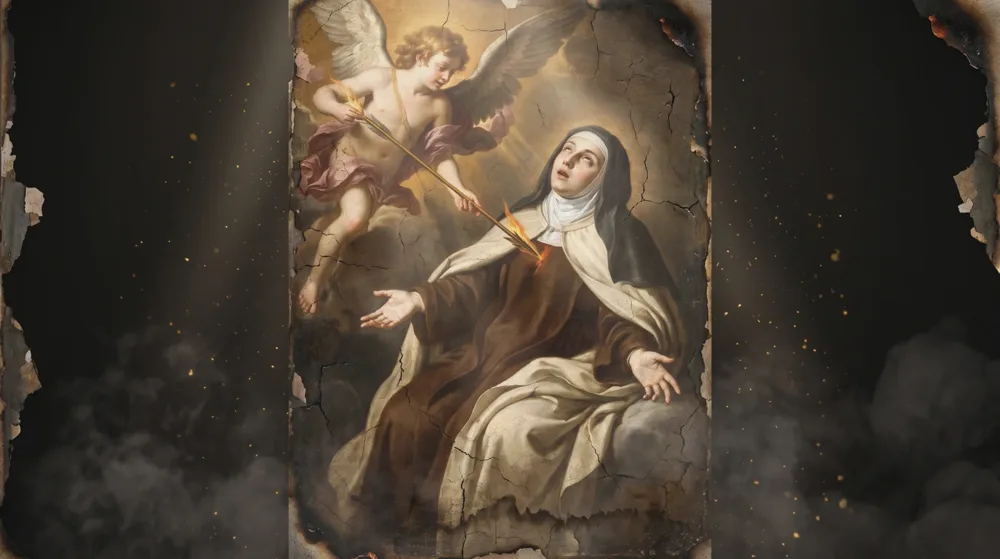
The novena to St Teresa of Avila is a nine-day prayer to the great Carmelite reformer and Doctor of the Church, asking her powerful intercession for a deeper interior life — for faith, hope, love, humility, and the grace of a holy death — and for whatever particular need we lay before her. She is the patron of Spain, of Carmelites and contemplatives, and, by long custom, of those who suffer from headaches and grave illness. The traditional novena given below in full is the one composed by St Alphonsus Liguori: it is prayed on the nine days from 6 October to 14 October, closing on the eve of her feast, 15 October.
When to pray the novena and its start date
A novena is nine days of prayer; the word comes from the Latin novem, "nine," after the nine days the Apostles and Our Lady spent in the Upper Room between the Ascension and Pentecost (Acts 1:14). If the custom is new to you, see our guide to what is a novena.
The start date of the St Teresa of Avila novena, when prayed toward her feast, is 6 October, so that the ninth day falls on 14 October and the devotion closes on the vigil of her feast, 15 October. But a novena is not bound to the calendar: begin it on any day a need presses, praying the nine days in order and naming your intention throughout.
The full novena to St Teresa of Avila
This is the traditional nine-day novena composed by St Alphonsus Liguori, Doctor of the Church. Each day follows one simple form:
Each of the nine days is said in this order:
1. The daily intention and prayer for that day (below).
2. Our Father, Hail Mary, and Glory Be.
3. V. St Teresa, pray for us,
R. that we may become worthy of the promises of Jesus Christ.4. The closing prayer:
Let us pray. Graciously hear us, O God of our salvation! that as we rejoice in the commemoration of the blessed virgin Teresa, so we may be nourished by her heavenly doctrine, and draw from it the fervor of a tender devotion; through our Lord Jesus Christ, Thy Son, Who liveth and reigneth with Thee in the unity of the Holy Ghost, God for ever and ever. Amen.
Day 1 (6 October) — The gift of faith
We thank Christ for the gift of faith, and for devotion to the Blessed Sacrament, and ask Him to increase both in us as He did in St Teresa.
O most amiable Lord Jesus Christ! we thank Thee for the great gift of faith and of devotion to the Holy Sacrament, which Thou didst grant to Thy beloved Teresa; we pray Thee, by Thy merits and by those of Thy faithful spouse, to grant us the gift of a lively faith, and of a fervent devotion toward the most Holy Sacrament of the altar; where Thou, O infinite Majesty! hast obliged Thyself to abide with us even to the end of the world, and wherein Thou didst so lovingly give Thy whole Self to us.
Day 2 (7 October) — The gift of hope
We thank Christ for the gift of hope, and ask for a great confidence in His goodness, shown to us in His Precious Blood.
O most merciful Lord Jesus Christ! we thank Thee for the great gift of hope which Thou didst grant to Thy beloved Teresa; we pray Thee, by Thy merits, and by those of Thy holy spouse, to give us a great confidence in Thy goodness, by reason of Thy Precious Blood, which Thou hast shed to its last drop for our salvation.
Day 3 (8 October) — The gift of love
We thank Christ for the gift of charity, and ask Him to perfect His love in us as He did in St Teresa.
O most loving Lord Jesus Christ! we thank Thee for the great gift of love which Thou didst grant to Thy beloved Teresa; we pray Thee, by Thy merits, and by those of Thy most loving spouse, to give us the great, the crowning gift of Thy perfect love.
Day 4 (9 October) — The desire to love Him
We ask Christ for the desire and the resolve to love Him as St Teresa did.
O most sweet Lord Jesus Christ! we thank Thee for the gift of great desire and resolution which Thou didst grant to Thy beloved Teresa, that she might love Thee perfectly; we pray Thee, by Thy merits, and by those of Thy most generous spouse, to give us a true desire, and a true resolution of pleasing Thee to the utmost of our power.
Day 5 (10 October) — The gift of humility
We ask Christ for the gift of humility, which He granted to St Teresa.
O most kind Lord Jesus Christ! we thank Thee for the great gift of humility which Thou didst grant to Thy beloved Teresa; we pray Thee, by Thy merits, and by those of Thy most humble spouse, to grant us the grace of a true humility, which may make us ever find our joy in humiliation, and prefer contempt before every honor.
Day 6 (11 October) — Devotion to Our Lady and St Joseph
We ask Christ for a tender devotion to His mother, the Blessed Virgin Mary, and to His foster-father, St Joseph — a devotion He granted to St Teresa.
O most bountiful Lord Jesus Christ! we thank Thee for the gift of devotion towards Thy sweet mother, Mary, and her holy spouse, Joseph, which Thou didst grant to Thy beloved Teresa; we pray Thee, by Thy merits, and by those of Thy most dear spouse, to give us the grace of a special and tender devotion towards Thy most holy mother, Mary, and towards Thy beloved foster-father, Joseph.
Day 7 (12 October) — The wound of love
We ask that our heart may be wounded with the love of God, as St Teresa's was in the mystery of the Transverberation.
O most loving Lord Jesus Christ! we thank Thee for the wonderful gift of the wound in the heart which Thou didst grant to Thy beloved Teresa; we pray Thee, by Thy merits, and by those of Thy seraphic spouse, to grant us also a like wound of love, that, henceforth, we may love Thee and give our mind to the love of nothing but Thee.
Day 8 (13 October) — The desire for heaven
We ask Christ for a holy desire to be with Him in the country of the blessed.
O most beloved Lord Jesus Christ! we thank Thee for the eminent gift of the desire for death which Thou didst grant to Thy beloved Teresa; we pray Thee, by Thy merits, and by those of Thy most constant spouse, to grant us the grace of desiring death, in order to go and possess Thee eternally in the country of the blessed.
Day 9 (14 October) — The grace of a good death
We ask Christ for the grace to die burning with love for Him, as St Teresa did.
Lastly, O dearest Lord Jesus Christ! we thank Thee for the gift of the precious death which Thou didst grant to Thy beloved Teresa, making her sweetly to die of love; we pray Thee, by Thy merits, and by those of Thy most affectionate spouse, to grant us a good death; and if we do not die of love, yet, that we may at least die burning with love for Thee, that so dying, we may be able to go and love Thee for evermore with a more perfect love in heaven.
The novena prayer to St Teresa for a particular intention
The Liguori novena above is complete as it stands, but many come to St Teresa with a definite request — a healing, a vocation, relief from headaches, a soul's return to prayer. There is no rival prayer to learn: keep the daily form, and after the day's prayer name your intention plainly to Our Lord through her intercession — for example:
St Teresa of Avila, seraphic spouse of Christ, who never turned away those who sought thy help, present my petition before the Lord thou didst love so ardently: (here name your request). Obtain for me, if it be for God's glory and my soul's good, the grace I ask; and if He wills otherwise, obtain for me the faith, hope, and love to accept His will as thou didst. Amen.
Because she is a teacher of prayer above all, the surest thing to ask St Teresa is that you may learn to pray as she did.
St Teresa of Avila, patron saint of headaches
One of the most-searched intentions brought to this saint is relief from headaches and painful illness, for St Teresa is by long tradition the patron of headache sufferers. The patronage is well earned: she suffered agonizing pains in the head for much of her life, along with a near-fatal illness in her youth that left her partly paralyzed for years, and bore it all as a share in the Cross. Those afflicted with migraine, head pain, or chronic illness pray this novena with confidence, asking her — who knew such suffering and sanctified it — to obtain healing if God wills, and patience if He does not.
Do not confuse the two Teresas
Searchers often mean one Teresa and find the other. St Teresa of Avila (1515–1582) is the sixteenth-century Spanish Carmelite reformer and mystic of this novena, whose feast is 15 October. St Thérèse of Lisieux (1873–1897), the "Little Flower," is the nineteenth-century French Carmelite of the "little way," whose feast is 1 October — for her, see our novena to St Thérèse of Lisieux. Both are Carmelites and Doctors of the Church, but two distinct saints; this page is the novena to the elder Teresa, of Avila.
How to pray this novena
To pray the novena to St Teresa well:
- Choose your days. To honor her feast, begin on 6 October so the ninth day falls on the vigil, 14 October. Otherwise begin whenever a need presses.
- Pray at a fixed hour — before the Blessed Sacrament if you can, since the first day's gift is devotion to the Eucharist.
- Name one intention and carry it through all nine days, joined to a Mass or Communion where possible.
- Pray in submission. Ask boldly, but end as she did: Thy will be done — her whole doctrine is that God gives Himself to the soul that abandons itself to Him.
Many join the novena to the daily Rosary, and to her beloved patrons — the Litany of the Blessed Virgin Mary and the novena to St Joseph, whom she called her special protector.
Who is St Teresa of Avila?
Teresa de Cepeda y Ahumada was born at or near Avila in Castile on 28 March 1515, one of a large and virtuous family. As a child of seven, struck by the eternity of the saints' reward, she and her brother Rodrigo set out secretly for the country of the Moors, hoping to be martyred for the Faith and to see God "for ever, for ever, for ever" — until an uncle met them on the road and brought them home. Her mother died when Teresa was fourteen, and the weeping girl went before an image of Our Lady and begged the Blessed Virgin to be her mother from that day.
After a worldly adolescence and a spell in an Augustinian convent school, it was the Letters of St Jerome that fixed her will: against her father's wishes she entered the Carmelite convent of the Incarnation outside Avila at the age of twenty, and was professed a year later. A grave illness soon after nearly killed her and left her long an invalid.
Guided by a little book on mental prayer, she began the life of prayer that would make her its greatest teacher. For a time she slackened, drawn by the worldly visiting allowed in her convent; but God won her back, and from her deep conversion in her late thirties she was carried into the highest reaches of contemplation — visions, raptures, and the celebrated Transverberation, in which she saw an angel pierce her heart with a golden dart of divine love.
Convinced that the Carmelite life had grown lax, Teresa undertook, against fierce opposition, the reform of the Order. In 1562 she founded the convent of St Joseph at Avila under the primitive Rule, its nuns going discalced (unshod) in poverty and strict enclosure. From it sprang seventeen convents she founded in her lifetime, criss-crossing Spain by mule and cart despite constant illness; and with St John of the Cross, whom she drew into the reform, she extended it to the friars — the origin of the Discalced Carmelites.
At her confessors' command she wrote the masterpieces that are her enduring gift to the Church: her Life, the Way of Perfection, the Book of the Foundations, and above all the Interior Castle, the map of the soul's seven "mansions" of prayer on the way to union with God. Of her partner in the reform we write in St John of the Cross.
She died at Alba de Tormes on the night of 4 October 1582, worn out by her labors, murmuring that she was a daughter of the Church and rejoicing to go at last to her Spouse. By a providence long loved by her devotees, that was the very night the reformed Gregorian calendar took effect: the day after 4 October was reckoned 15 October — which is why her feast falls on 15 October, not the day she died.
She was beatified in 1614 and canonized by Pope Gregory XV in 1622, alongside St Ignatius, St Francis Xavier, and St Philip Neri. In 1970 Pope Paul VI declared her a Doctor of the Church — the first woman so honored — for a teaching on prayer that had for centuries already earned her the popular title Doctor of Mystical Theology. She intercedes powerfully because she loved powerfully; the saint who "would not be content with loving Him a little" does not leave a soul to seek Him alone.
Frequently Asked Questions
When should I start the St Teresa of Avila novena?
To pray it toward her feast, begin on 6 October, so that the ninth day falls on 14 October and the novena ends on the vigil of her feast day, 15 October. But a novena may be begun on any day of the year — simply pray the nine days in order and carry your intention through them.
What is St Teresa of Avila the patron saint of?
She is the patroness of Spain and of the Carmelite Order, of contemplatives and all who seek to learn mental prayer, and — by long tradition, because she suffered so much from it — the patron saint of those who have headaches and of the sick. She is also invoked by those whose prayer has grown cold, for she is the great teacher of the interior life.
Who wrote the novena to St Teresa of Avila?
The traditional nine-day novena given here — the one most widely prayed and reproduced — was composed by St Alphonsus Liguori (1696–1787), Doctor of the Church and founder of the Redemptorists. Its nine days thank Our Lord for nine gifts He gave St Teresa and ask them for ourselves, ending with the grace of a holy death.
Is St Teresa of Avila a Doctor of the Church?
Yes. She was canonized by Pope Gregory XV in 1622, and in 1970 Pope Paul VI declared her a Doctor of the Church — the first woman ever given that title — for her authoritative teaching on prayer in works such as the Interior Castle and the Way of Perfection. Long before that declaration she was popularly called the Doctor of Mystical Theology.
What is the difference between St Teresa of Avila and St Thérèse of Lisieux?
They are two different Carmelite saints. St Teresa of Avila (1515–1582) is the Spanish reformer and mystic of this novena, feast 15 October. St Thérèse of Lisieux (1873–1897) is the young French nun of the "little way," feast 1 October. Both are Doctors of the Church, but this novena is to the elder Teresa, of Avila.
Can I pray this novena for healing or for someone who is sick?
Yes. St Teresa knew years of grave illness and constant head pain, and she is a natural intercessor for the sick and for headache sufferers. Pray the nine days above, naming the sick person and your petition, and ask her to obtain healing if it is God's will — and, either way, the faith and patience to bear the Cross as she did.
Is there a PDF of the St Teresa of Avila novena?
The complete nine-day text is given in full above and may be copied to keep beside you for the nine days, so no separate PDF is needed. In the Iter Fidei app the whole novena is carried in Latin and your own language with audio, so it can be prayed from your phone, one day at a time, without a printed sheet.
Pray this novena to St Teresa of Avila with day-by-day reminders and audio, one gift a day through the nine days, in the Iter Fidei app. Download it here.
Sources. The nine-day Novena to St Teresa of Avila of St Alphonsus Liguori (with the closing collect Graciously hear us, O God of our salvation); Butler's Lives of the Saints (St Teresa of Avila, Virgin, 15 October); the writings of St Teresa herself — the Life, the Way of Perfection, and the Interior Castle; Acts 1:14; the canonization of St Teresa by Pope Gregory XV (1622).