
The Saints
St John the Baptist: Life, Death, Feast Days and Prayer
St John the Baptist, the Forerunner of Christ: his birth to Zachary and Elizabeth, his preaching and baptism at the Jordan, his beheading by Herod, his two feasts on 24 June and 29 August, his place in the Mass, his patronages, the St John's fires, and the collect of his feast.
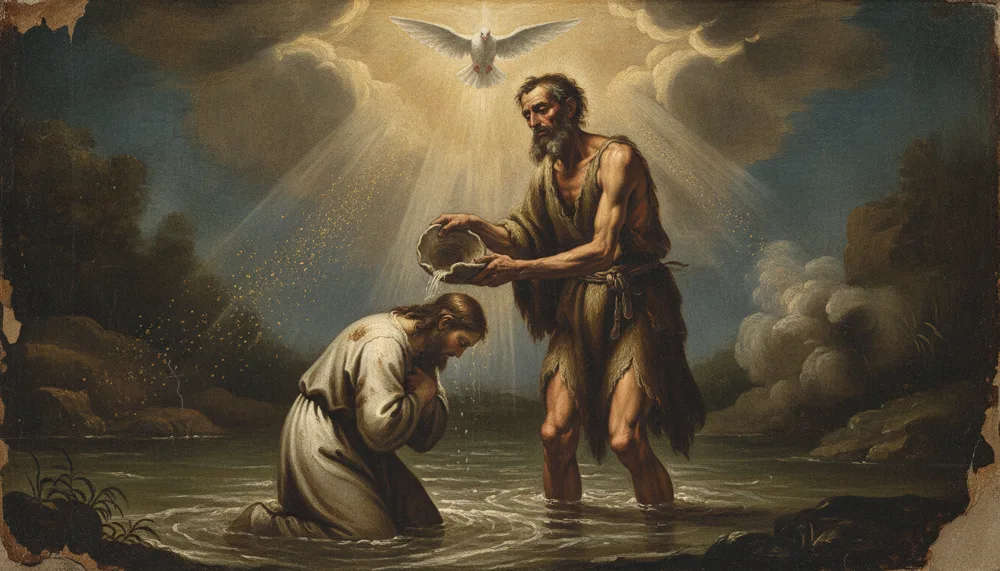
St John the Baptist is the Forerunner of Our Lord: the son of the priest Zachary and of St Elizabeth, the kinsman of Christ, the last of the prophets, who preached penance in the desert, baptized in the Jordan, pointed out Jesus as "the Lamb of God", and was beheaded by Herod for rebuking an adulterous marriage. Our Lord said of him that "there hath not risen among them that are born of women a greater than John the Baptist" (Matthew 11:11). The Church keeps two feasts of him: his Nativity on 24 June, a feast of the first class, and his Beheading on 29 August.
Who was St John the Baptist?
His birth, announced by the angel Gabriel
All that we know with certainty of St John's life is in the four Gospels, as Butler's Lives of the Saints reminds us. His father Zachary was a priest of the course of Abia; his mother Elizabeth was of the daughters of Aaron and a kinswoman of the Blessed Virgin. Both "were just before God", and both were old, and Elizabeth was barren. While Zachary offered incense in the Temple, the angel Gabriel appeared to him at the right of the altar:
"Fear not, Zachary, for thy prayer is heard: and thy wife Elizabeth shall bear thee a son. And thou shalt call his name John. And thou shalt have joy and gladness: and many shall rejoice in his nativity. For he shall be great before the Lord and shall drink no wine nor strong drink: and he shall be filled with the Holy Ghost, even from his mother's womb" (Luke 1:13–15, Douay-Rheims).
Because Zachary doubted, he was struck dumb until the child was born. In the sixth month of Elizabeth's pregnancy, Mary, who had just conceived the Son of God, went "into the hill country with haste into a city of Juda" to visit her cousin, and "when Elizabeth heard the salutation of Mary, the infant leaped in her womb" (Luke 1:39, 41). The Fathers and the common teaching of theologians hold that at that moment John was cleansed of original sin and sanctified before his birth, by the presence of the Saviour hidden in His Mother. This is why, as St Augustine observes, the Church keeps the earthly birthday of John, whereas for every other saint except Our Lady she keeps only the day of death, their birth into heaven.
On the eighth day the relatives wished to call the child Zachary. Elizabeth said, "Not so. But he shall be called John", and Zachary wrote on a tablet, "John is his name". At once his tongue was loosed and he broke into the canticle the Church sings every morning at Lauds, the Benedictus: "And thou, child, shalt be called the prophet of the Highest: for thou shalt go before the face of the Lord to prepare his ways" (Luke 1:76).
Where was St John the Baptist born?
St Luke names only "a city of Juda" in the hill country. An old and constant tradition places it at Ain Karim, a village in the hills west of Jerusalem, where churches of the Visitation and of St John's birth have stood since early times.
The voice crying in the desert
"The child grew and was strengthened in spirit: and was in the deserts until the day of his manifestation to Israel" (Luke 1:80). About the fifteenth year of Tiberius, the word of the Lord came to him in the desert, and he went out into all the country about the Jordan. "The same John had his garment of camel's hair, and a leathern girdle about his loins: and his meat was locusts and wild honey" (Matthew 3:4). He preached one thing: "Do penance: for the kingdom of heaven is at hand" (Matthew 3:2). Crowds went out to him from Jerusalem and all Judea, "and were baptized by him in the Jordan, confessing their sins" (Matthew 3:6).
His baptism was not yet the sacrament: it was a sign of repentance, preparing for the baptism Christ would institute "in the Holy Ghost". When the priests and Levites came from Jerusalem to ask whether he was the Christ, he confessed and did not deny: "I am the voice of one crying in the wilderness, make straight the way of the Lord" (John 1:23), and of the One coming after him, "the latchet of whose shoe I am not worthy to loose" (John 1:27). He baptized "in Bethania, beyond the Jordan" (John 1:28).
"Behold the Lamb of God"
When Jesus came from Galilee to be baptized, John would have stopped him: "I ought to be baptized by thee, and comest thou to me?" (Matthew 3:14). Christ was baptized, not to be cleansed, but, as St Ambrose says, to sanctify the waters, and the Holy Ghost descended upon Him. The next day John saw Jesus coming and said: "Behold the Lamb of God. Behold him who taketh away the sin of the world" (John 1:29). He sent his own disciples after Him, among them Andrew and, by tradition, John the Evangelist, and he summed up his whole vocation in one sentence: "He must increase: but I must decrease" (John 3:30).
How did St John the Baptist die?
Herod Antipas, tetrarch of Galilee, had taken Herodias, the wife of his half-brother Philip. John told him to his face: "It is not lawful for thee to have thy brother's wife" (Mark 6:18). Herod, urged on by Herodias, had him bound and imprisoned, according to the historian Josephus in the fortress of Machaerus, east of the Dead Sea. Yet Herod "feared John, knowing him to be a just and holy man", and heard him willingly.
On Herod's birthday he gave a supper to the princes and chief men of Galilee. The daughter of Herodias, named Salome by Josephus, danced and pleased him, and he swore to give her whatever she asked, to the half of his kingdom. Her mother told her what to ask: "the head of John the Baptist". The king "was struck sad. Yet because of his oath, and because of them that were with him at table, he would not displease her" (Mark 6:26). He sent an executioner, who beheaded John in the prison and brought his head in a dish to the girl, and she gave it to her mother. "Which his disciples hearing came, and took his body, and laid it in a tomb" (Mark 6:29). St Augustine calls Herod's oath a double sin, rashly taken and criminally kept.
So St John the Baptist was killed because he told the truth about marriage to a king: he is a martyr for the law of God and for the indissolubility of marriage. He died before the Passion, around the year 29 or 30, a little over thirty years old, being six months older than Our Lord.
The feast days of St John the Baptist
The Nativity of St John the Baptist: 24 June
The Nativity of St John the Baptist is one of the oldest feasts of the Church, fixed on 24 June from the fourth century, six months before Christmas, because the angel told Mary that it was "the sixth month" with Elizabeth (Luke 1:36). St Augustine already preached on it, and noted that from that day the days grow shorter, while from Christmas they grow longer: "He must increase, but I must decrease." In the 1962 Missal it is a feast of the first class, preceded by its vigil on 23 June. The Introit opens with the words of Isaias: De ventre matris meae vocavit me Dominus in nomine meo, "the Lord hath called me by my name from my mother's womb."
The collect of 24 June, from the Roman Missal:
Deus, qui praesentem diem honorabilem nobis in beati Ioannis nativitate fecisti: da populis tuis spiritualium gratiam gaudiorum; et omnium fidelium mentes dirige in viam salutis aeternae. Per Dominum nostrum Iesum Christum Filium tuum, qui tecum vivit et regnat in unitate Spiritus Sancti Deus, per omnia saecula saeculorum. Amen.
O God, who hast made this day honourable to us by the birth of blessed John: give to Thy peoples the grace of spiritual joys, and direct the minds of all the faithful into the way of eternal salvation. Through our Lord Jesus Christ, Thy Son, who liveth and reigneth with Thee in the unity of the Holy Ghost, God, world without end. Amen.
The Beheading of St John the Baptist: 29 August
The second feast, the Beheading of St John the Baptist (Decollatio), on 29 August, is a feast of the third class in the 1962 calendar. It is very ancient in the East and in Gaul and was taken up at Rome later; it is linked to the finding of the saint's head and to his tomb at Sebaste in Samaria, where St Jerome's age believed him buried. Its collect asks:
Sancti Ioannis Baptistae Praecursoris et Martyris tui, quaesumus, Domine, veneranda festivitas: salutaris auxilii nobis praestet effectum: qui vivis et regnas cum Deo Patre in unitate Spiritus Sancti Deus, per omnia saecula saeculorum. Amen.
May the venerable festival of St John the Baptist, Thy Forerunner and Martyr, we beseech Thee, O Lord, bring us the effect of saving help: who livest and reignest with God the Father in the unity of the Holy Ghost, God, world without end. Amen.
How St John the Baptist Day is celebrated
From the Middle Ages, St John's Eve (23 June) was celebrated across Christendom with bonfires, the "St John's fires", lit on hilltops and in village squares near midsummer. The Church did not merely tolerate the custom; she sanctified it. The Rituale Romanum gives a blessing of the bonfire on the vigil of the Nativity of St John the Baptist, done by the clergy outside the church, with this prayer:
O Lord God, Father almighty, unfailing light, who art the creator of all lights: sanctify this new fire, and grant that we may come with pure hearts, after the darkness of this world, unto Thee, who art the light that never fails. Through Christ our Lord. Amen.
The fire is then sprinkled with holy water and the clergy sing the hymn of the feast, Ut queant laxis, written by Paul the Deacon in the eighth century, whose first stanza runs:
Ut queant laxis resonare fibris
Mira gestorum famuli tuorum,
Solve polluti labii reatum,
Sancte Ioannes.That thy servants may sound forth with loosened voices the wonders of thy deeds, take away the guilt of our stained lips, O holy John.
The syllables that open each half-line, Ut, Re, Mi, Fa, Sol, La, were taken by Guido of Arezzo in the eleventh century to name the notes of the scale: the whole Western musical tradition still sings St John's hymn without knowing it, as the voice of Zachary was loosed at his son's birth. In Quebec and French Canada, where he is patron, 24 June remains a national holiday; in Florence, Malta, Puerto Rico and much of Spain and Latin America it is a great popular feast.
St John the Baptist in the Mass
Few saints are so present in the traditional Mass:
- In the Confiteor, said at the foot of the altar, he is named twice among the intercessors: "I confess to Almighty God, to blessed Mary ever Virgin, to blessed Michael the Archangel, to blessed John the Baptist, to the holy Apostles Peter and Paul…".
- At the Agnus Dei, the Church sings three times his own words, Agnus Dei, qui tollis peccata mundi, and before giving Communion the priest holds up the Host and says, "Ecce Agnus Dei, ecce qui tollit peccata mundi": Behold the Lamb of God, behold Him who taketh away the sins of the world. Every Communion repeats the Baptist's gesture of pointing out Christ. For the whole rite, see the order of the Tridentine Mass.
- In the Canon, at the Nobis quoque peccatoribus, he heads the second list of saints: "with John, Stephen, Matthias, Barnabas…".
- In the Litany of the Saints he is invoked immediately after the angels, before the patriarchs, prophets and apostles: Sancte Ioannes Baptista, ora pro nobis.
What is St John the Baptist the patron saint of?
St John the Baptist is the patron of a remarkable number of peoples and works: of French Canadians (declared by St Pius X in 1908) and of Quebec; of the city of Florence, whose Baptistery bears his name; of Puerto Rico, whose capital is San Juan; of the Knights of Malta, the Sovereign Military Order of St John of Jerusalem, born from a hospital dedicated to him in Jerusalem; and of many dioceses, cathedrals and countless parishes. Because of his life in the desert he is the patron of monks and hermits; because of his baptism, of baptism itself and of converts; and he is invoked by those preparing for Catholic baptism and for Confession, since his whole preaching was the call to penance.
The great number of churches named after him, from the Lateran basilica in Rome, the cathedral of the Pope, which is dedicated to the Saviour and to both Saints John, down to the many St John the Baptist Catholic churches and parishes of America, all look back to the one Forerunner. Even the parish church of Knock in Ireland, where Our Lady of Knock appeared with the Lamb on the altar in 1879, is dedicated to him.
A prayer to St John the Baptist
Beyond the collects of his two feasts, the faithful have long prayed to him for the grace of true repentance, for courage to speak the truth, and for those preparing for baptism. The fullest form is the novena to St John the Baptist, from the Raccolta, made from 15 to 23 June before his Nativity: three prayers honouring him as the saint in the wilderness, the zealous preacher and the invincible martyr.
For his mother, there is also the novena to St Elizabeth. A simple prayer for every day is the Church's own collect of 24 June, given above, or the first stanza of Ut queant laxis, which asks him to cleanse our lips, that we may speak of God worthily. St John the Baptist takes his place among the saints of the year in our guide to the Catholic saints, listed by feast day.
Frequently Asked Questions
When is the feast day of St John the Baptist?
He has two feasts. His Nativity is kept on 24 June, a first-class feast in the 1962 calendar with a vigil on 23 June; his Beheading on 29 August, a third-class feast. He is the only saint besides the Blessed Virgin whose birth the Church celebrates.
When was St John the Baptist born?
About six months before Our Lord, since the angel told Mary at the Annunciation that Elizabeth was in her sixth month. This is why his Nativity falls on 24 June, six months before Christmas.
Why was St John the Baptist killed?
Because he rebuked Herod Antipas for taking Herodias, his brother Philip's wife: "It is not lawful for thee to have thy brother's wife." Herodias had him imprisoned and, through her daughter's request at Herod's birthday feast, obtained his head.
How old was St John the Baptist when he died?
The Gospels give no age. Since he was six months older than Christ and was put to death during Our Lord's public ministry, before the Passion, he was a little over thirty.
When was St John the Baptist canonized?
Never by a formal act, because he did not need one. Formal canonization began only in the Middle Ages. St John was venerated as a saint from the beginning, on the testimony of Christ Himself, and his feast was kept everywhere by the fourth century.
Is St John the Baptist the same person as St John the Apostle?
No. St John the Baptist is the Forerunner, son of Zachary and Elizabeth, beheaded by Herod before the Passion. St John the Apostle and Evangelist, son of Zebedee, is the beloved disciple who stood at the Cross and wrote the fourth Gospel and the Apocalypse; see the novena to St John the Apostle. John the Apostle was first a disciple of the Baptist.
What did St John the Baptist eat?
"His meat was locusts and wild honey" (Matthew 3:4), and he drank no wine nor strong drink, as the angel had foretold. His life of fasting in the desert, clothed in camel's hair, made him the model of Christian penance.
The Iter Fidei app carries the 1962 calendar with both feasts of St John the Baptist, the propers of the Mass and the prayers to the saints in Latin and English. Join early access here.
Sources. Holy Scripture, Douay-Rheims version (Luke 1; Matthew 3, 11 and 14; Mark 6:17–29; John 1 and 3); Butler's Lives of the Saints, 24 June (the Birthday of St John the Baptist) and 29 August (the Beheading of St John the Baptist); the Roman Missal of 1962, collects of 24 June and 29 August; the Order of Mass (Confiteor, Agnus Dei, Nobis quoque peccatoribus); the Rituale Romanum, blessing of the bonfire on the vigil of St John the Baptist; Paul the Deacon, hymn Ut queant laxis.