
The Saints
St Anne, Mother of the Blessed Virgin Mary
St Anne was the mother of the Blessed Virgin Mary and grandmother of Our Lord; her feast is kept on 26 July, and she is the patron saint of mothers, grandmothers, and women in childbirth.
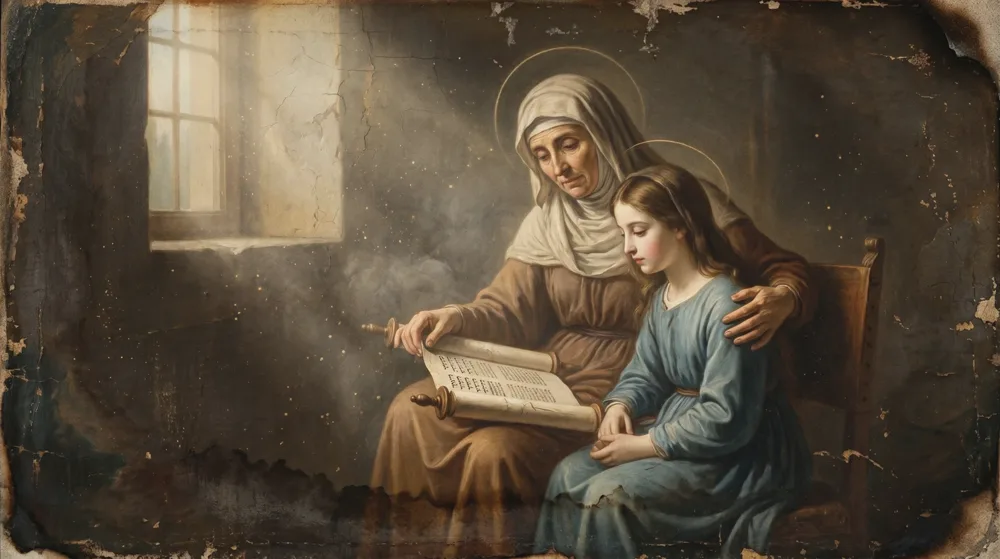
St Anne was the mother of the Blessed Virgin Mary and, therefore, the grandmother in the flesh of Our Lord Jesus Christ. The Church keeps the feast of saint Anne on 26 July, and she is honoured as the patron saint of mothers, grandmothers, married women, and those who labour in childbirth. Together with her husband St Joachim, she stands at the head of the holy lineage from which the Mother of God was born.
Who St Anne was
Scripture does not record the names of the parents of the Blessed Virgin. Even the names Anne (Hannah, which signifies "grace") and Joachim come to us from an ancient writing outside Scripture, the Protevangelium of James, which the Church has never received as inspired. Her cult is attested in Constantinople by the sixth century, when the Emperor Justinian dedicated a shrine to her; it reached Rome in the eighth century and became very popular in the West from the late Middle Ages (Butler, Lives of the Saints, 26 July). According to this tradition, Anne and Joachim were devout and advanced in years, had long been without a child, and obtained Mary by prayer and the gift of God.
Their place in the divine plan is greater than their obscurity might suggest. From them came the one who was to be the Mother of God. We honour St Anne not for deeds of her own that the Gospels relate, but for the fruit she bore: the Immaculate Virgin, conceived without stain, who would in turn give the world its Redeemer.
For this reason the Church has long held St Anne in particular affection. Pope Urban VI enjoined her feast for England in 1382, and it was extended to the whole Western Church in 1584; churches were raised under her name across Christendom, and the faithful came to her as to a grandmother of the household of faith. The Roman Martyrology commemorates her on 26 July, the day on which the Roman Rite keeps her feast.
What St Anne is patron saint of
St Anne is the patron saint of mothers and of grandmothers, and this for a plain reason: she was both. She bore and raised the Blessed Virgin Mary, and she was grandmother to the Word made flesh. The Christian instinct has therefore turned to her in everything that touches the begetting and rearing of children.
She is invoked as patroness of:
- Mothers — those who carry, bear, and raise children, who look to the mother of Mary as a model of the holy upbringing of a child.
- Grandmothers — the older women of a family, who hand on the faith to a third generation as Anne did to the household into which the Saviour was born.
- Married women and those longing for children — for tradition holds that Anne herself, long barren, received her child from God after persevering prayer.
- Women in childbirth — who commend their labour to her, that they and their children may be brought safely through.
Behind every one of these patronages stands one truth: St Anne is the mother of Mary. Devotion to the grandmother flows always toward the daughter, and through the daughter to Christ. We do not honour Anne apart from this order. As we have written of the Mother of God and of the Immaculate Conception, the dignity of Mary is the cause and measure of the honour we render to her parents. St Anne is great because Mary is greater still, and Mary because of her Son.
This is also why the cult of St Anne belongs so naturally to the Christian household and to Catholic marriage. The family that asks her intercession asks the patroness of mothers and grandmothers to obtain for it the same fidelity, patience, and hope by which she herself was given a holy child.
The prayer of the Church to St Anne
The surest prayer to St Anne is the prayer of the Church on her feast, the Collect of her Mass in the Roman Missal of 1962, where 26 July is a feast of the second class:
Collect of the feast, 26 July
Deus, qui beátæ Annæ grátiam conférre dignatus es, ut Genetrícis unigéniti Fílii tui mater effici mererétur: concéde propítius; ut, cujus sollémnia celebrámus, ejus apud te patrocíniis adjuvémur. Per eúndem Dóminum nostrum Jesum Christum Fílium tuum, qui tecum vivit et regnat in unitáte Spíritus Sancti, Deus, per ómnia sǽcula sæculórum. Amen.
O God, Who in Your kindness gave blessed Anne the grace to be the mother of her who mothered Your only-begotten Son, graciously grant that we who keep her feast may be helped by her intercession with You. Through the same Jesus Christ, thy Son, Our Lord, Who liveth and reigneth with thee in the unity of the Holy Ghost, God, world without end. Amen.
This prayer asks nothing apart from God. It asks St Anne's intercession; and true devotion to her carries our needs to her daughter, and through her daughter to Christ, in whom alone every request is granted. So all true devotion to the saints is ordered: the litany of the saints names them not as powers in themselves but as friends of God who plead our cause before Him.
A novena to St Anne
A novena is nine days of prayer made in preparation for a feast or for a particular grace. The novena to St Anne is commonly made from 17 to 25 July, ending on the eve of her feast; some begin on 18 July, so that the ninth day falls on the feast itself, 26 July. It may also be made at any season of need. Each day one says the following prayer, names the intention, and closes with an Our Father and a Glory be:
Remember, O good St Anne, thou whose very name signifieth Grace, that never was it known that any one who had recourse to thy protection, implored thy assistance, or sought thy help, was left forsaken. Animated with a like confidence, O good and tender Mother, I fly unto thee; sinner though I am, I take refuge at thy feet, and dare to appear before thee, groaning under the weight of my sins. Despise not my prayers, O good St Anne, mother of the Immaculate Virgin Mary, and above all the prayer I make to obtain this grace: (here name the intention).
But hearken to them favourably, and vouchsafe to grant them. O good St Anne, mother of her who is our life, our sweetness, and our hope, pray to thy Daughter for us, and obtain for us our request. Amen.
What is asked in such a novena is never a thing apart from God's will. The nine days are themselves a school of the very patience by which Anne, long without a child, obtained Mary. Those who keep the novena should remember that the answer to all prayer is finally measured by the good of the soul, and that the surest grace to beg is a holy death.
St Joachim and Anne, the parents of the Virgin
St Anne is rarely honoured alone. With her stands St Joachim, her husband and, with her, the father of the Blessed Virgin Mary. Tradition gives the two together as devout and aged spouses of the house of David, long childless, who received Mary from God after persevering prayer. In the 1962 Roman calendar St Joachim has his own feast, kept on 16 August, the day after the Assumption of his daughter, as a feast of the second class.
To invoke St Joachim and Anne together is to commend to them the whole Christian household — husband and wife, parents and grandparents — as to the model of a marriage made fruitful by God and ordered wholly toward the raising of holy children. This is why their cult belongs so closely to Catholic marriage and to the family that asks their intercession. Christian parents have long imitated them in offering their children to God from the earliest years, as the parents of St Hildegard of Bingen gave their daughter to the Benedictine cloister while she was still a small girl.
Shrines of St Anne: Beaupré, Arvada, and the churches of her name
From the Middle Ages onward, churches, parishes, and shrines without number have been raised under the name of St Anne across Christendom. Any St Anne Catholic church or parish dedicated to her keeps alive the memory of the grandmother of the Lord; to enter one on her feast is to join the unbroken line of the faithful who have come to her as to a grandmother of the household of faith.
Two shrines are especially known to English-speaking pilgrims. The Shrine of St Anne de Beaupré, in Quebec, has been a place of pilgrimage since the seventeenth century, when French settlers raised the first chapel and many graces were reported there; it remains among the oldest pilgrimage sites in North America. The Shrine of St Anne in Arvada, Colorado, likewise draws the faithful who seek her intercession, particularly mothers and grandmothers and those longing for children.
Pilgrimage to such places is no superstition. It is the ancient instinct of the Church, which venerates the relics and memory of the saints and asks their prayers in the places set apart for that purpose. The grace is God's; the saint intercedes; the shrine is only the appointed meeting-place of the faithful with their patroness.
The feast of St Anne — 26 July
In the 1962 Roman calendar the feast of St Anne is kept on 26 July as a feast of the second class, in white vestments (before the reform of 1960 it was ranked a double of the second class). The day before, 25 July, is the feast of St James the Greater; St Joachim, her husband, has his own feast on 16 August.
The Epistle of the Mass sets before us the praises of the valiant woman of the Book of Proverbs, applied to Anne as to her who reared the Mother of God. It is a day to thank God for the gift of Mary through Anne, and to commend to the grandmother of the Lord the families, mothers, and children of the Church. St Anne takes her place among the saints of the year in our guide to the Catholic saints, listed by feast day.
Frequently Asked Questions
Who is St Anne?
St Anne was the mother of the Blessed Virgin Mary and, in the flesh, the grandmother of Our Lord Jesus Christ. Scripture does not name the parents of the Virgin; their names come from an ancient non-scriptural writing, the Protevangelium of James, and her cult is attested in the East from the sixth century.
What is St Anne the patron saint of?
She is the patron saint of mothers, of grandmothers, of married women and those longing for children, and of women in childbirth. The reason is plain: she both bore and raised the Blessed Virgin and was grandmother to the Word made flesh, and tradition holds she received her own child after long, persevering prayer.
When should the novena to St Anne be made?
A novena to St Anne is nine days of prayer. It is commonly made from 17 to 25 July, ending on the eve of her feast (some begin on 18 July so that the ninth day falls on 26 July); but it may be made at any season of need. Each day one may say the collect of her feast with an Our Father and a Glory be, asking her to carry the petition to her daughter the Blessed Virgin.
How did St Anne die?
The Gospels record nothing of her death, and the Church has not fixed any account of it as certain. What tradition hands down is her place in the divine plan rather than the manner of her passing: she and Joachim were devout and advanced in years, and from them came the Mother of God. We honour her for the fruit she bore, not for deeds the Gospels relate.
When is the feast of St Anne?
In the 1962 Roman calendar the feast of St Anne is kept on 26 July as a feast of the second class, in white vestments. The day before, 25 July, is the feast of St James the Greater, and her husband St Joachim is honoured on 16 August.
Why do Catholics pray to St Anne?
Devotion to the grandmother flows always toward her daughter, and through the daughter to Christ. We do not honour Anne apart from this order. Prayers to her ask her, as a grandmother of the faith, to carry our needs to her daughter the Blessed Virgin, and through her to her Son, in whom alone every request is granted.
The Iter Fidei app carries the prayers to the saints, the litanies, and the traditional calendar of feasts, that the day of St Anne and the others may be kept in their season. Join early access here.
Sources. The Roman Martyrology, 26 July; the Roman Missal and Breviary of 1962 (feast of St Anne, 26 July, and of St Joachim, 16 August, both of the second class); Butler, Lives of the Saints (St Anne, 26 July); Sacred Scripture, Douay-Rheims version (Proverbs 31, the valiant woman, as read in the proper of the feast).