
The Saints
St Patrick, Apostle of Ireland
Who St Patrick was, what he is patron of, the St Patrick Breastplate, a traditional St Patrick prayer, and his feast day, from traditional Catholic sources.
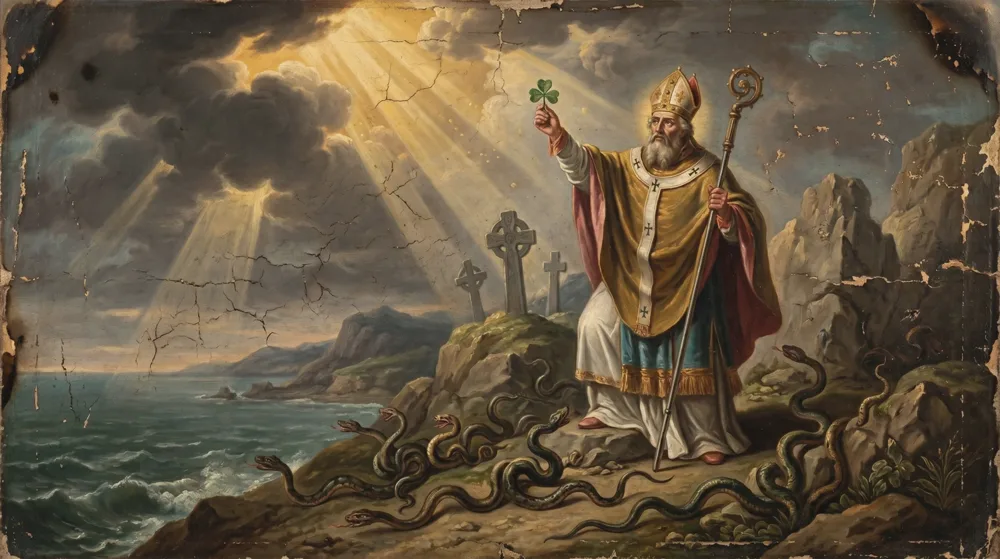
St Patrick (d. 461) was the Archbishop of Armagh and the Apostle of Ireland, a Romano-British bishop who in less than thirty years won the whole island to the faith. Who was St Patrick: not the figure of folklore and parade, but a man carried off into slavery at sixteen, formed by six years of bondage and prayer, and sent back by God to convert the people who had once enslaved him. Below we set out who saint Patrick was, what he is patron of, the St Patrick Breastplate, a traditional St Patrick prayer, and his feast day, from the traditional sources.
Who was St Patrick
St Patrick was of Romano-British origin, born about the year 389 at the village of Bannavem Taberniae. His father Calpurnius was a deacon and a municipal official, and his grandfather a priest — so the faith was already his by inheritance. About the year 403, when he was sixteen, he was carried off by raiders to be a slave among the pagan Irish, and served his master for six years; tradition places his captivity near Slemish in Antrim, or near the forest of Fochlad in Mayo (Butler, Lives of the Saints).
Those six years of bondage were the making of the saint. Amid the hardships of slavery his soul grew marvellously in holiness: he prayed, by his own testimony, a hundred times by day and nearly as many by night, in snow and frost and rain (Butler, Lives of the Saints). What the world would call a catastrophe — a boy stolen from his home and set to mind sheep on a foreign hillside — God used as a noviceship. After six years a voice in his sleep bade him escape. He travelled some two hundred miles to a ship and made an adventurous journey home.
He did not stay home. Having been restored to his family, he was called back to the very land of his captivity. In a vision he heard the Irish crying out to him to come and walk again among them. He gave himself to long preparation, was raised at last to the episcopate, and returned to Ireland as its bishop. There, in an apostolate of less than thirty years, he won the island to the faith and peopled it with saints (Butler, Lives of the Saints). The Roman Martyrology commemorates him on the seventeenth of March as bishop and confessor, who brought the Irish to the faith of Christ. His life is no tale of soft piety: it is slavery, escape, and a man returning of his own will to the people who had broken him, for their salvation.
What St Patrick is patron of: Ireland
St Patrick is the patron of Ireland, and the title is no honorary one. He is its patron because he is its apostle — the bishop under whom a pagan island became a Christian nation, and a nation so Christian that it became, in the centuries after him, a seedbed of missionaries who re-evangelised much of Europe. When we call him the Apostle of Ireland we mean it in the strict sense in which St Paul is called the apostle of the Gentiles: he is the one through whom the faith was first preached and planted there.
His patronage is therefore bound up with the conversion of a whole people and with perseverance in the faith once received. The Irish kept St Patrick's faith through centuries of trial; that fidelity is itself part of his legacy. Where other saints are invoked for a particular need — a trade, an illness, a lost cause — Patrick is invoked for a country and its faith. To honour him rightly is to pray that Ireland, and every land once Christian, hold fast to what its apostles gave it. On the communion of saints whose intercession we ask, see the litany of the saints.
The St Patrick Breastplate
The most famous prayer associated with the saint is the St Patrick Breastplate, an ancient Irish hymn of protection traditionally ascribed to him and also called the Lorica (Latin for "breastplate"). It is a lorica in the old sense: a prayer that arms the soul as armour arms the body, binding to oneself the power of God against every visible and invisible enemy. Whether every line came from Patrick's own hand or grew up in the Church he founded, the Breastplate carries his spirit — the same trust that sustained a slave praying a hundred times a day on the hills of Antrim.
Its heart is the binding-on of Christ. The most beloved portion reads:
Christ with me, Christ before me, Christ behind me,
Christ in me, Christ beneath me, Christ above me,
Christ on my right, Christ on my left,
Christ when I lie down, Christ when I sit down, Christ when I arise,
Christ in the heart of every man who thinks of me,
Christ in the mouth of every man who speaks of me,
Christ in every eye that sees me,
Christ in every ear that hears me.
This is the prayer of a man who knows he stands among enemies and clothes himself in his Lord. It confesses, line upon line, that there is no place and no moment outside the reach of Christ — and so it is also, quietly, a confession of the one God in three Persons under whom Patrick preached. On that mystery he taught the Irish, see the Holy Trinity.
A traditional St Patrick prayer
Beside the Breastplate, the Church gives us her own St Patrick prayer: the collect of his Mass in the Roman Missal of 1962, fit for his feast day or for any day on which we ask his intercession:
Deus, qui ad prædicándam géntibus glóriam tuam beátum Patrícium Confessórem atque Pontíficem míttere dignátus es: ejus méritis et intercessióne concéde; ut, quæ nobis agénda prǽcipis, te miseránte adimplére possímus. Per Dóminum nostrum Jesum Christum, Fílium tuum, qui tecum vivit et regnat in unitáte Spíritus Sancti, Deus, per ómnia sǽcula sæculórum. Amen.
O God, who didst vouchsafe to send blessed Patrick, thy Confessor and Bishop, to preach thy glory to the nations: grant, through his merits and intercession, that what thou commandest us to do, we may by thy mercy be enabled to fulfil. Through our Lord Jesus Christ, thy Son, who liveth and reigneth with thee in the unity of the Holy Ghost, God, world without end. Amen.
We ask of St Patrick what he himself received and gave: fidelity to the faith, and the courage to carry it to others. A prayer to a saint is not worship but petition — we beg his prayers before God, as one asks the prayers of any friend of God, confident that the apostle who once brought a nation to Christ will not despise the soul that asks his help.
The feast day of St Patrick
The feast of St Patrick falls on the seventeenth of March, kept by tradition as the day of his death about the year 461. In the calendar of 1962 it is a feast of the third class, that of a bishop and confessor, in white vestments — the colour of confessors and of the joy of one who is now with God; in Ireland, of which he is the principal patron, it is a feast of the first class. In Ireland the day has from of old been a holy day, and the green that marks it the world over is, at root, a memory of the bishop who clothed the island in the faith.
The seventeenth of March is therefore not, in its origin, a festival of national sentiment but the heavenly birthday of a saint. To keep it well is to do what Patrick would ask: to hear Mass, to pray for Ireland and for the conversion of the lands that have fallen away, and to bind on once more the armour of his Breastplate. The saint who returned to his captors for the love of their souls is still at work for ours.
What day is St Patrick's Day in 2026
The seventeenth of March is a fixed date, so St Patrick's Day never moves: it is always the same calendar day, only the weekday changes. In 2026 the seventeenth of March falls on a Tuesday. In the traditional calendar the seventeenth of March always falls within Lent, and in 2026 it is a Lenten weekday.
Under the rubrics of 1960, a third-class feast falling on a Lenten weekday gives way to the weekday: the Office is of the Lenten feria with a commemoration of St Patrick, and in a Mass that is not conventual the priest may take the Mass of the saint. In Ireland, where the feast is of the first class, it is kept in full (and transferred in the years when it falls in Holy Week). The point to hold is the one the date itself makes: St Patrick's Day is a saint's day, kept on the day he died, not a moveable festival.
Why there are so many parishes named St Patrick Catholic Church
A St Patrick Catholic Church can be found in nearly every land to which the Irish carried the faith — and they carried it far. When famine and emigration scattered the Irish across England, America, Australia and beyond, they built churches and named them for their apostle, so that the parish dedicated to St Patrick became a mark of the Irish diaspora and of the faith it kept abroad.
To dedicate a church to a saint is to place the parish under his patronage and to ask his intercession over those who worship there; a St Patrick's church is therefore a standing prayer that the bishop who won Ireland will keep his children faithful wherever they have gone. This is also why his name is so often given in baptism and to Catholic schools: the Church holds up her saints as patrons to be imitated and invoked, not merely remembered.
Is it Paddy or Patty? On St Patrick's name
Among the Irish the affectionate form of Patrick is Paddy, never "Patty" — Paddy comes from Pádraig, the Irish form of the saint's name, while "Patty" is a form of Patricia. The distinction is small but worth keeping, for the name belongs to the saint, and to use it rightly is a small fidelity. The Latin Patricius means "of noble birth"; the man who bore it was reckoned noble not by blood but by the souls he won, and the diminutive "Paddy" carries, in its way, the same affection the Irish have always borne their apostle.
A blessing for St Patrick's Day: "Happy St Patrick's Day"
To wish someone a happy St Patrick's Day is, at root, to wish them the saint's own gift — the faith he brought and the protection he prayed. A short blessing widely prayed on his feast, a modern adaptation of lines of the Breastplate rather than a text of the saint himself, asks exactly that:
May the strength of God pilot us,
may the wisdom of God instruct us,
may the hand of God protect us,
may the shield of God defend us,
this day and for evermore. Amen.
These lines condense the Breastplate itself, where every power of God is bound on against every danger. To greet the day so — not only with mirth but with a blessing — is to keep it as Patrick would: as a day of grace, under the armour of God.
St Patrick was a slave who became an apostle, and an apostle who made a nation. We honour him best not with sentiment but with his own faith — held whole, armed against the enemy, and handed on. St Patrick takes his place among the saints of the year in our guide to the Catholic saints, listed by feast day.
Frequently Asked Questions
When is St Patrick's Day?
St Patrick's Day falls on the seventeenth of March every year — in 2026, on Tuesday, 17 March. The date does not change from year to year, for it is the feast of the saint, kept on the day of his death about the year 461. In its origin the day is not a festival of national sentiment but the heavenly birthday of the Apostle of Ireland.
What is St Patrick's Day?
St Patrick's Day is the feast of St Patrick, the Romano-British bishop who converted Ireland to the Christian faith in the fifth century. In the calendar of 1962 his feast is a third-class feast of a bishop and confessor, in white vestments, commemorated in the Lenten Office when it falls on a Lenten weekday. In Ireland the day has from of old been a holy day; the green that marks it the world over is, at root, a memory of the bishop who clothed the island in the faith.
Who was St Patrick?
St Patrick (d. 461) was a Romano-British bishop, the Apostle of Ireland, born about 389. Carried off into slavery in Ireland at sixteen, he was formed by six years of bondage and prayer, escaped home, and was then called back as a bishop to convert the very people who had enslaved him. In an apostolate of less than thirty years he won the whole island to the faith. He is not the figure of folklore and parade, but a man who returned to his captors for the love of their souls.
Why do we celebrate St Patrick's Day?
We celebrate St Patrick's Day to honour the saint who brought the Christian faith to Ireland and made of a pagan island a Christian nation — one so Christian that it became a seedbed of missionaries who re-evangelised much of Europe. To keep the day well is to do what Patrick would ask: to hear Mass, to pray for Ireland and for the conversion of the lands that have fallen away, and to bind on once more the armour of his Breastplate.
The Iter Fidei app carries the prayers to the saints, the litanies, and the traditional calendar of feasts, so that the Breastplate and the feast of St Patrick are at hand on his day and through the year. Join early access here.
Sources. Butler, Lives of the Saints (life, captivity, and apostolate of St Patrick); the Roman Martyrology (17 March, bishop and confessor); the Lorica or Breastplate of St Patrick (tr. Kuno Meyer); the Roman Missal of 1962 (collect of 17 March).