
Novenas
Novena to St Thomas Aquinas
The novena to St Thomas Aquinas — the Angelic Doctor's own Prayer Before Study and the nine days' prayers, said for students, for clarity of mind, for purity, and for a deeper love of the truth.
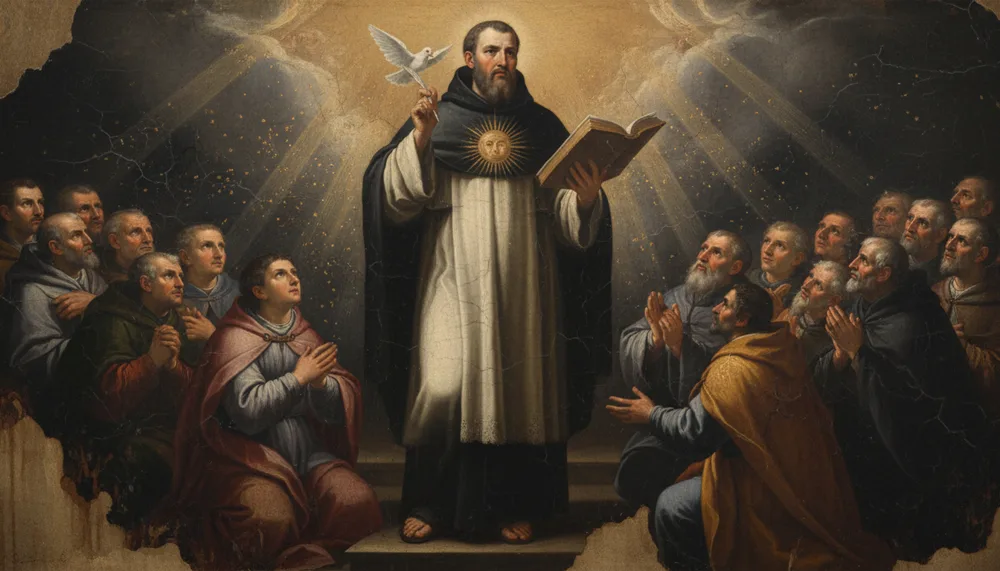
The novena to St Thomas Aquinas is nine days of prayer to the Angelic Doctor — the Dominican friar and Doctor of the Church whom Pope Leo XIII named patron of all universities, colleges, and schools. It is prayed above all by students, scholars, teachers, and anyone who must think, study, write, or examine well, asking the saint to obtain a clear mind, a retentive memory, and above all a love of the truth.
His feast falls on 7 March in the traditional calendar, and the nine days before it are the natural time to make the novena. Below we give the saint's own famous Prayer Before Study, the full nine-day devotion with a distinct intention for each day, and the variants most often sought — for students, for purity, and the short form. If you are new to this kind of prayer, see first our guide to what is a novena.
A note on the feast day
One point of confusion is worth settling at the start, because it decides when you finish the novena. In the traditional Roman calendar of 1962, St Thomas Aquinas is kept on 7 March, the day of his death in 1274. The revised calendar of 1969 moved his feast to 28 January (the day his relics were translated to Toulouse) to free 7 March from Lent. Both dates honour the same saint. Those attached to the 1962 books pray the novena in the nine days ending 6 March, to close on the eve of the traditional feast; those following the newer calendar count back from 28 January. The prayers themselves are identical either way.
The heart of the devotion: St Thomas's Prayer Before Study
St Thomas is unusual among the saints in that he left us the very prayer he said before he sat down to think and write — the prayer known by its Latin opening, Creator ineffabilis. Nothing invented, no modern composition, could better express what this novena asks. It is the anchor of the whole devotion, and it is fitting to say it each of the nine days:
Ineffable Creator, Who, of the treasures of Thy wisdom hast established three hierarchies of Angels, and set them on high above the heavens in a wonderful order, and hast exquisitely fashioned and knit together all parts of the universe; do Thou, Who art the true fountain and one principle of light and wisdom, deign to shed the brightness of Thy light upon the darkness of my understanding, and thus to disperse the twofold darkness of sin and ignorance wherein I was born.
O Thou, Who makest eloquent the tongues of babes, instruct my tongue, and pour forth on my lips the grace of Thy blessing. Grant me acuteness in understanding, power to retain, subtlety to discern its true meaning, and clearness and ease in expressing it. Do Thou order my beginnings, direct and further my progress, complete and bless my ending; Thou Who art true God and true Man, Who livest and reignest world without end. Amen.
That is the whole spirit of the novena in one prayer: not cleverness for its own sake, but light against "the twofold darkness of sin and ignorance," and the truth held for the love of God who is the Truth. The saint whose intellect towered over his age asked, at his death, for nothing but the God he had written about — and it is that same order of things the novena seeks to form in us.
The nine-day novena to St Thomas Aquinas
Each day, make the sign of the Cross, say the daily prayer below, then read the day's intention, then close with the Prayer Before Study above and a Glory Be. Name your own request at the place marked.
Daily prayer (said every day):
Glorious St Thomas Aquinas, Angelic Doctor and Angel of the Schools, patron of students and of all who seek the truth: God enkindled in you so pure a love of Himself that your learning became a light for the whole Church, and your holiness outshone even your wisdom. From the treasury of your prayers before the altar and your labours over the sacred page, obtain for me the grace I now ask — (here name your request) — and, above all, obtain for me a mind enlightened by faith, a heart cleansed of sin, and a love of the truth that leads to the God who is Truth itself. Through Christ our Lord. Amen.
Day 1 — Called by God
St Thomas heard God's call as a boy and followed it against the fierce opposition of his own family, who imprisoned him for two years to break his Dominican vocation, and could not. We pray today for all who are discerning God's will — for young people choosing a state of life, and for the grace to answer God's call without counting the cost.
Day 2 — Lover of purity
When his brothers sent a woman to tempt him during his captivity, Thomas seized a burning brand from the hearth and drove her from the room; in the sleep that followed, tradition holds that angels girded him with a cord of perpetual chastity. We pray today for the virtue of purity — for chastity of body and of mind, and for all who struggle against temptation. This intention is the ground of the St Thomas Aquinas novena for purity many make; for the whole discipline of a life ordered to God, our reflection on the Litany of Humility is a fitting companion.
Day 3 — The humility of the "Dumb Ox"
His fellow students at Cologne, mistaking his silence and bulk for dullness, nicknamed him "the dumb Sicilian ox" — until St Albert the Great told them, "We call Brother Thomas the dumb ox, but I tell you that he will yet make his lowing heard to the uttermost parts of the earth." We pray today for humility: that we may study and serve for God's glory and not our own vanity, content to be little.
Day 4 — Devoted to the truth
Thomas gave his life to a single work — to show that faith and reason, rightly used, never contradict, because both come from the one God. We pray today for a love of the truth: to seek it honestly, to hold it firmly, and to be preserved from the errors and false teachings of our own age.
Day 5 — Afire with love for the Blessed Sacrament
Asked by Our Lord from the crucifix, "Thou hast written well of me, Thomas; what reward wouldst thou have?" the saint answered, "Nothing but Thyself, Lord." He wept at the altar, and it was he whom the Church entrusted with composing the office and hymns of Corpus Christi — the Pange Lingua, the Tantum Ergo, the Adoro te devote. We pray today for a deeper love of the Holy Eucharist; those who share this devotion will love the Divine Praises and the novena to the Sacred Heart.
Day 6 — Filled with charity
For all his learning, Thomas said at the end that everything he had written seemed "as so much straw" beside what God had revealed to him in prayer. His wisdom was the fruit of love, not the reverse. We pray today for charity: to love God above all things and our neighbour as ourselves, in deed and not in word only.
Day 7 — Defender of the Church
When the University of Paris was divided over whether the accidents of bread and wine truly remain in the Blessed Sacrament, Thomas wrote his answer, laid it on the altar before God, and it was accepted by the whole Church. We pray today for the Church — for her bishops, priests, and teachers, and for the defence of her doctrine against all who assail it.
Day 8 — Teacher of prayer
Thomas insisted that he learned more at the foot of the crucifix than from any book, and every treatise began on his knees. We pray today for the grace of prayer — that our study, our work, and our whole day may be rooted in God and offered to Him.
Day 9 — Patron of students
On the last day we bring to St Thomas the intention for which he is most invoked: we pray for all students, scholars, teachers, and examinees — that those who find study hard and those to whom it comes easily may alike be open to the truth and use their minds for God. We commend to him our own studies and the particular grace of this novena. For more on his patronage, see patron saint of students and the fuller account of his life at St Thomas Aquinas.
The novena to St Thomas Aquinas for students
Of all who seek his help, students seek it most, and rightly: Leo XIII made him the patron of all Catholic universities, colleges, and schools in 1880, and Catholic education has long called him the Angel of the Schools. The St Thomas Aquinas novena for students is simply the nine-day devotion above, made with the intention of an examination, a course of study, an admission, a thesis, or the whole work of learning named plainly on each day.
His own Prayer Before Study is the perfect daily prayer for a student: it asks not for a grade but for "acuteness in understanding, power to retain, subtlety to discern, and clearness and ease in expressing." Say it before you open a book, not only during the novena, and it becomes a habit of a lifetime. Ask him for success in your studies if you wish — but ask first, as he did, for the light of truth and the humility to hold it well.
The short novena and how to make it well
If nine full days of the long form are more than your time allows, keep the short version: each day, say St Thomas's Prayer Before Study once, name your intention, and add a Glory Be. That alone is a true and complete novena. To make any novena well:
- Choose your days. Count back nine days from the feast — ending 6 March in the traditional calendar, or 27 January in the newer one — or simply begin whenever a need presses and pray nine days running.
- Pray at a fixed hour, ideally before study or work, so the prayer orders the day rather than being squeezed into it.
- Name one intention and keep to it through all nine days.
- Join it to the Mass or Communion where you can, and pray in submission: Thy will be done. A novena does not compel God; it asks a saint to carry our need to Him and leaves the answer in His hands.
Who was St Thomas Aquinas?
Thomas was born about 1225 in the castle of Roccasecca, near Aquino, the youngest son of a noble Lombard family. At five he was placed as an oblate at the great abbey of Monte Cassino, and later studied at the University of Naples, where he was drawn to the new Order of Preachers — the Dominicans. His family, who had hoped to see him abbot of Monte Cassino, were so enraged that he had joined a mendicant order that his brothers seized him on the road and held him prisoner for two years; he did not yield, and about 1245 was allowed to return to his order.
He studied under St Albert the Great at Paris and Cologne, was ordained priest, and became the most celebrated teacher of his age, lecturing at Paris and throughout Italy. His writings — above all the Summa contra Gentiles and the great Summa Theologiae, unfinished at his death — fill some twenty volumes and remain the most influential body of theology the Church has produced. Yet his learning grew out of prayer: he wept at the altar, was more than once seen raised from the ground in ecstasy, and heard Our Lord say from the crucifix, "Thou hast written well of me."
On the feast of St Nicholas in 1273, while saying Mass, he received a revelation that so overwhelmed him that he wrote no more, saying all he had written now seemed "as so much straw." Summoned by Pope Gregory X to the Council of Lyons, he fell ill on the way and was brought to the Cistercian abbey of Fossanova, where he died in the early hours of 7 March 1274, about fifty years old, having submitted all his work to "the judgement of the holy Roman Church."
He was canonized in 1323, declared a Doctor of the Church by St Pius V, and named patron of all universities and schools by Leo XIII in 1880. His patronage extends to students, scholars, apologists, philosophers, booksellers, and — because a storm as a child and his own dread of lightning marked his life — those in danger of storms and sudden death. Among the Church's great teaching saints he stands with St Augustine and his fellow Dominican St Catherine of Siena, and his whole work was a hymn to the Holy Trinity from whose wisdom, he prayed, all light descends.
Frequently Asked Questions
What is the novena to St Thomas Aquinas prayed for?
It is prayed above all for students and studies — for examinations, admissions, theses, teaching, and any work of the mind — and for the graces St Thomas embodied: clarity of understanding, a good memory, love of the truth, purity, and humility. Because he is patron of universities and schools, his help is sought by students, scholars, teachers, and apologists; but any need may be brought to him, as to any saint.
When should I pray the St Thomas Aquinas novena?
The natural time is the nine days before his feast — ending 6 March in the traditional 1962 calendar (feast on 7 March), or ending 27 January if you follow the newer calendar (feast on 28 January). But a novena may be prayed at any time of year; students often make it in the days before an important examination, beginning nine days ahead and praying once each day.
Is St Thomas Aquinas the patron saint of students?
Yes. Pope Leo XIII declared him patron of all Catholic universities, colleges, and schools in 1880, and the Church has long honoured him as the Angel of the Schools. He is also patron of scholars, theologians, philosophers, apologists, and booksellers. See our page on the patron saint of students for the wider tradition.
What is the St Thomas Aquinas novena for purity?
It is the same nine-day novena made with the intention of the virtue of chastity, drawing on the tradition that when his brothers tried to seduce him during his captivity, Thomas drove the temptress out with a firebrand and was afterwards girded by angels with a cord of perpetual purity. On the second day especially, the novena asks his help for purity of body and mind; many keep this intention throughout the nine days.
What prayer did St Thomas Aquinas say before studying?
The prayer known as Creator ineffabilis, given in full above, which begins "Ineffable Creator... deign to shed the brightness of Thy light upon the darkness of my understanding." It asks God for understanding, memory, discernment, and clear expression — the graces every student needs — and it is the ideal daily prayer of this novena and of study itself.
Is there a printable PDF of the 9-day novena to St Thomas Aquinas?
The complete text is on this page — the daily prayer, the nine days' intentions, and St Thomas's Prayer Before Study — so it can be copied out or printed as your own sheet. The Iter Fidei app also carries the full devotion with day-by-day reminders and audio, so it can be prayed from a phone without a printed page.
How many days is the novena, and can I make a short version?
A novena is nine days, from the Latin novem, "nine," said once a day with one intention. The short form of this devotion is simply St Thomas's Prayer Before Study said each day with your intention and a Glory Be — a complete and worthy novena when time is short.
Pray the novena to St Thomas Aquinas with day-by-day reminders and audio, alongside the litanies, chaplets and prayers of the traditional treasury, in the Iter Fidei app. Download it here.
Sources. St Thomas Aquinas, Prayer Before Study (Creator ineffabilis); Butler's Lives of the Saints (7 March, St Thomas Aquinas, Doctor of the Church); the Corpus Christi office and hymns of St Thomas (Pange Lingua, Tantum Ergo, Adoro te devote); Pope Leo XIII, declaration of St Thomas as patron of universities, colleges, and schools (1880); the traditional Roman calendar of 1962 (feast of 7 March).