
Prayer
The Divine Praises: 'Blessed Be God'
The Divine Praises — 'Blessed be God, blessed be His holy Name' — the traditional prayer of reparation said after Benediction of the Blessed Sacrament, making amends for blasphemy and profane speech. The full text and its meaning.
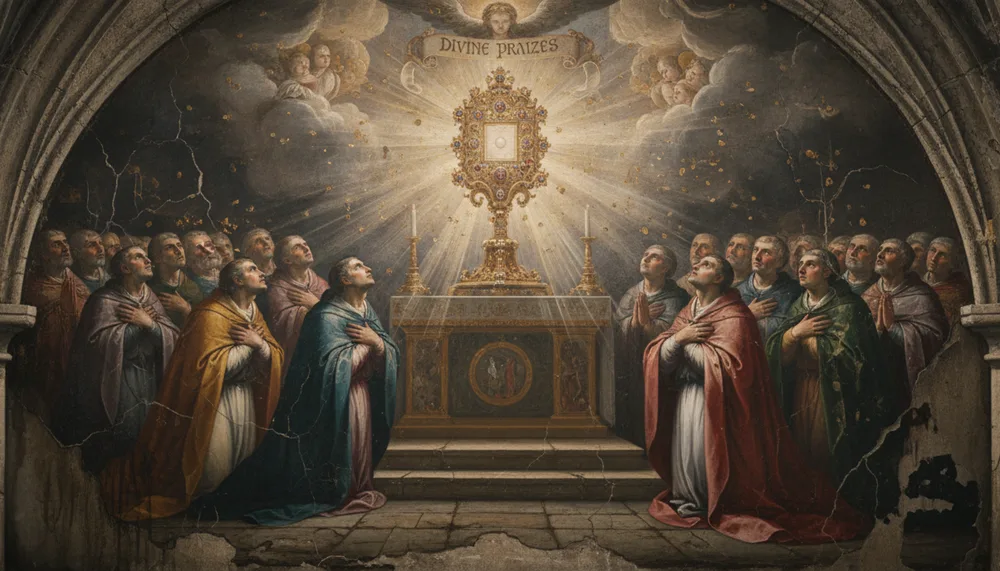
The Divine Praises are a short prayer of reparation that begins "Blessed be God. Blessed be His holy Name," recited by the faithful after the Benediction of the Blessed Sacrament. They are a series of blessings, said in answer to the priest, by which we make amends for blasphemy, cursing, and profane speech — sins against the holiness of God's Name. To bless His Name aloud is the direct repair for hearing it cursed. Here is the full traditional text, with its origin and its meaning.
The full text of the Divine Praises
The Divine Praises are said responsively: the priest pronounces each line and the people repeat it. In the traditional Roman form they read:
Blessed be God.
Blessed be His holy Name.
Blessed be Jesus Christ, true God and true man.
Blessed be the Name of Jesus.
Blessed be His most Sacred Heart.
Blessed be His most Precious Blood.
Blessed be Jesus in the most holy Sacrament of the altar.
Blessed be the great Mother of God, Mary most holy.
Blessed be her holy and Immaculate Conception.
Blessed be her glorious Assumption.
Blessed be the name of Mary, Virgin and Mother.
Blessed be Saint Joseph, her most chaste spouse.
Blessed be God in His angels and in His saints.
Each line is a blessing pronounced upon God, His Holy Name, the Sacred Humanity of Christ, the Blessed Sacrament, His Mother, and His saints. The prayer asks nothing for ourselves. It only blesses — and that is the point of it.
Where the Divine Praises come from
The Divine Praises were composed in Italian in 1797 by Father Luigi Felici, a Jesuit priest of Rome, under the title Lodi in riparazione delle bestemmie — "Praises in reparation for blasphemies." The years of the French Revolution had loosed open mockery of God and public cursing through the streets of Rome, and the prayer was written as a direct answer to it: where the Holy Name was cursed, the faithful would bless it.
The prayer grew over time. Pope Pius VII enriched it in 1801, and later additions through the eighteenth and nineteenth centuries brought in the blessings of the Most Sacred Heart, the Most Precious Blood, the Immaculate Conception, and Saint Joseph; the blessing of the glorious Assumption was added after Pope Pius XII defined that dogma in 1950. The prayer was carried in the Raccolta, the Church's official collection of indulgenced prayers, and from there it passed into the rite of Benediction as the prayer the people say while the Blessed Sacrament rests upon the altar after the blessing has been given.
Why we say them: reparation for blasphemy
The whole purpose of the Divine Praises is reparation — the repairing, by an act of honour, of an injury done to God by sin. The injury in question is named in the Second Commandment: "Thou shalt not take the name of the Lord thy God in vain. For the Lord will not hold him guiltless that shall take the name of the Lord his God in vain" (Exodus xx. 7, Douay-Rheims).
The Roman Catechism teaches that this commandment does not merely forbid; it commands. It forbids us to dishonour the Name of God by blasphemy, false oaths, and profane speech, and it commands us positively to honour that Name. In its words, in honouring the Name of God "it is not the letters, nor the syllables, that must be considered, nor the name in itself, but the thing expressed by that name" — the omnipotence and eternal Majesty of God Himself (Roman Catechism, On the Second Commandment). To bless His Name, then, is to render Him the honour the commandment claims; and Scripture commands exactly this: "Bless the Lord, O my soul: and let all that is within me bless his holy name" (Psalm cii. 1, Douay-Rheims).
The Divine Praises take their pattern straight from this. The world curses the Name; the Christian answers by blessing it, line by line, aloud, in company. This is the same instinct expressed in our devotion to the Holy Name of Jesus, where the same syllables save when adored and offend when profaned. Blasphemy and the cursing of holy things are grave sins against God; the man who has heard such words, or let them slip from his own mouth, makes amends by these blessings. The Divine Praises are, in the plainest sense, the antidote to a curse.
"Blessed be His holy Name"
The second line — "Blessed be His holy Name" — is the heart of the prayer and the reason it exists. The Holy Name is the thing the blasphemer profanes, and so it is the first thing the faithful bless after God Himself. The Church does not bless a sound; she blesses the One the Name names.
This is why the prayer moves at once from the Name of God to the Name of Jesus: "Blessed be the Name of Jesus" — the Name which Saint Paul says is "above all names: That in the name of Jesus every knee should bow, of those that are in heaven, on earth, and under the earth" (Philippians ii. 9-10, Douay-Rheims). To bless the Holy Name is the most direct reparation a Christian can make, because it returns to that Name precisely the honour the curse tried to take from it.
Benediction and the Blessed Sacrament
The Divine Praises belong above all to Benediction of the Blessed Sacrament. At Benediction the Sacred Host is exposed in the monstrance, incensed, and the priest blesses the people with it; the Divine Praises are then said by all, kneeling, before the Sacrament is reposed. The line "Blessed be Jesus in the most holy Sacrament of the altar" is no accident of place: the prayer is addressed to the Lord truly present there. We who adore the Holy Eucharist — true Body and Blood, Soul and Divinity of Christ under the appearances of bread and wine — answer the blessing we have received by blessing Him in return.
This is why the Divine Praises sit so naturally within Eucharistic adoration. The whole act of adoration is reparation as well as homage: the faithful kneel before the Lord neglected and offended by the world, and make amends. The Divine Praises give that reparation words. They are the public, spoken form of what the silent adorer holds in his heart — a blessing offered to the Real Presence in the face of a world that curses Him.
When else may they be said
Though their proper home is Benediction, the Divine Praises were given to the faithful for use at any time. The traditional counsel is to say them after one has heard, seen, or even oneself uttered blasphemy or profanity — as an immediate act of reparation. A Christian who hears the Holy Name flung out as a curse in the street may answer, under his breath, "Blessed be God, blessed be His holy Name," and so turn an offence into an act of worship. They may also be said as a daily devotion, in thanksgiving or in homage. Like the Act of Contrition, they are short enough to be known by heart and grave enough to be meant.
A prayer that asks nothing
The Divine Praises ask for no favour. They make no petition for ourselves. They do one thing: they bless God, His Name, His Sacred Humanity, His Mother, and His saints. In a world quick to curse what is holy, the faithful are taught to be quick to bless it — and to do so aloud, where the curse was loud. That is the whole of this prayer, and it is enough.
Frequently Asked Questions
What are the Divine Praises?
The Divine Praises are a short prayer of reparation that begins "Blessed be God. Blessed be His holy Name," recited by the faithful after the Benediction of the Blessed Sacrament. They are a series of blessings, said in answer to the priest, by which we make amends for blasphemy, cursing, and profane speech — sins against the holiness of God's Name. The prayer asks nothing for ourselves; it only blesses.
What is the full text of the Divine Praises?
In the traditional Roman form they read: Blessed be God; Blessed be His holy Name; Blessed be Jesus Christ, true God and true man; Blessed be the Name of Jesus; Blessed be His most Sacred Heart; Blessed be His most Precious Blood; Blessed be Jesus in the most holy Sacrament of the altar; Blessed be the great Mother of God, Mary most holy; Blessed be her holy and Immaculate Conception; Blessed be her glorious Assumption; Blessed be the name of Mary, Virgin and Mother; Blessed be Saint Joseph, her most chaste spouse; Blessed be God in His angels and in His saints.
Why are the Divine Praises said?
Their whole purpose is reparation — the repairing, by an act of honour, of an injury done to God by sin. The injury is the dishonouring of God's Name forbidden by the Second Commandment. The world curses the Name; the Christian answers by blessing it, line by line, aloud, in company. They are, in the plainest sense, the antidote to a curse.
When are the Divine Praises recited?
Their proper home is Benediction of the Blessed Sacrament, said by all kneeling before the Host is reposed. But they were given to the faithful for use at any time — especially after one has heard, seen, or even oneself uttered blasphemy or profanity, as an immediate act of reparation. They may also be said as a daily devotion in thanksgiving or homage.
Who wrote the Divine Praises?
They were composed in Italian in 1797 by Father Luigi Felici, a Jesuit priest of Rome, under the title Lodi in riparazione delle bestemmie — "Praises in reparation for blasphemies," written against the open cursing of the French Revolutionary years. Pope Pius VII enriched the prayer in 1801, and later pontiffs added further blessings, with the Assumption added after Pope Pius XII defined that dogma in 1950.
The Iter Fidei app carries the Douay-Rheims Bible, the catechism, and the traditional prayers. Join early access here.
Sources. Holy Bible, Douay-Rheims version: Exodus xx. 7; Psalm cii. 1; Philippians ii. 9-10. Catechism of the Council of Trent (Roman Catechism, 1566), On the Second Commandment ("Thou shalt not take the name of the Lord thy God in vain"). The Divine Praises (Laudes Divinae), composed by Fr. Luigi Felici, S.J., 1797; enriched by Pope Pius VII (1801) and later pontiffs; as carried in the Raccolta of indulgenced prayers.