
Novenas
Novena to St Januarius
The traditional St Januarius novena (San Gennaro) — the full nine-day prayer to the martyr-bishop of Benevento whose blood liquefies at Naples, prayed for a steadfast faith, protection from disaster, and the intention you carry.
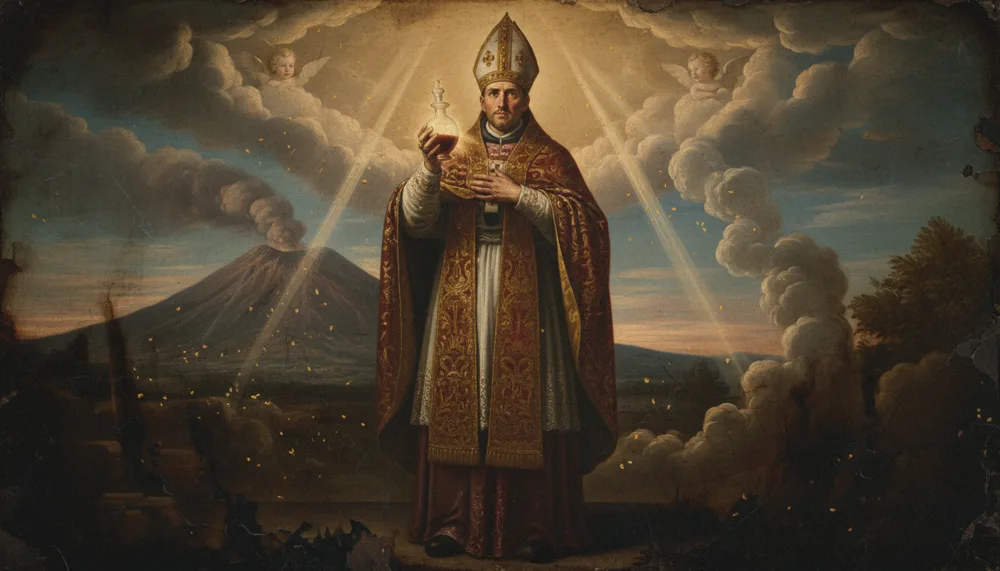
The novena to St Januarius is nine days of prayer to the martyr-bishop of Benevento — known to the whole world of Naples as San Gennaro — asking his intercession for a firm and fruitful faith, for protection against disaster, and for the particular grace we carry to his feet. It is prayed above all in the nine days leading to his feast on 19 September, beginning on the 10th, when Naples waits each year for the ancient miracle by which the dried blood of the saint, sealed in a glass phial, turns to liquid before the people. Below we give the complete daily prayer, the story of the saint and of that "standing miracle," how to keep the nine days, and answers to what people most ask.
The novena prayer to St Januarius
This is the prayer said once on each of the nine days. Name your intention where it is marked, and pray it slowly, with the confidence of the Neapolitans who have brought San Gennaro their fears and their thanksgiving for sixteen centuries.
In the Name of the Father, and of the Son, and of the Holy Ghost. Amen.
O Januarius, brave in the faith of Jesus Christ, glorious patron of Catholic Naples, look upon us benignly and accept our prayers, for today we lie at your feet with total confidence in your powerful patronage.
How many times have you run to help your fellow citizens — now staying the course of the destructive lava of Vesuvius, now saving us from plague, earthquake, famine, and the many other chastisements that terrify us. The perpetual miracle of the liquefaction of your blood is a sure and most eloquent sign that you live among us, that you know our needs, and that you protect us in a singular way.
O we beg you, pray for us, certain that we shall be heard, and saved from every evil that presses upon us from every side. (Here mention your request.)
Save us from unbelief, and you will see that the faith for which you generously sacrificed your life produces among us, always and always, the fertile fruits of holiness. Amen.
Our Father… Hail Mary… Glory Be…
St Januarius, pray for us.
In the Name of the Father, and of the Son, and of the Holy Ghost. Amen.
Many close the nine days, and the feast itself, with the traditional collect of the Roman Missal for 19 September:
O God, who dost gladden us by the yearly solemnity of blessed Januarius, Thy Martyr and Bishop, and of his companions: mercifully grant that we who rejoice in their merits may be kindled by their example. Through our Lord Jesus Christ. Amen.
If you are new to this form of prayer — nine days in a row for one intention — see our short guide to what is a novena.
The novena for a specific intention
The prayer above is complete in itself, and the line (Here mention your request) is where the whole weight of the nine days rests. Whatever you rightly need — a grave illness, a threat to home or livelihood, a soul far from the Church, a fear that will not lift — name it there, plainly, on each of the nine days, and let it stand within the larger petition the prayer already makes: save us from unbelief. That is the grace San Gennaro obtains most surely, for it is the grace he died to keep. Ask for the thing you came for; ask first that your faith not fail whatever the answer.
The novena for protection from disaster
San Gennaro is invoked before all else as the guardian of a city that lives in the shadow of a volcano. The novena has been prayed in Naples against the lava of Vesuvius, against earthquake, plague, and famine — and the saint's most famous intervention, the aversion of the threatened eruption of 1631, is kept to this day as one of the three great occasions of the miracle. To pray the novena for protection is to place a house, a family, or a whole city under the patronage of the martyr who has so often "run to help his fellow citizens." He shares this office with another great intercessor of the volcanic south, St Agatha of Catania, whose veil has likewise been carried against the fires of Etna.
Who is St Januarius? The story of San Gennaro
St Januarius — Gennaro in Italian, Januarius in Latin — was, by the constant tradition of the Church, the Bishop of Benevento at the time the persecution of Diocletian broke out early in the fourth century. When word came that a company of Christians — Sossus, a deacon of Miseno; Proculus, deacon of Pozzuoli; and the laymen Euticius and Acutius — had been imprisoned at Pozzuoli for confessing the faith, the bishop went to comfort and encourage them. His visit did not escape the keepers. Januarius was arrested, together with his deacon Festus and his lector Desiderius, and brought before the governor of Campania at Nola, where they underwent interrogation and torment.
The confessors, loaded with irons, were made to walk before the governor's chariot to Pozzuoli and thrown into the same prison as the others. All had been condemned to be torn by wild beasts in the amphitheatre — but when the day came, the tradition holds, not one of the animals could be provoked to touch them. The people cried magic; the martyrs were condemned instead to the sword, and beheaded near Pozzuoli, about the year 305. They were buried near that town, and St Januarius was later venerated as the principal patron of Naples, to which his relics were eventually brought.
The learned tradition is honest about how much we know: the surviving "acts" of the martyrdom are late and untrustworthy in their details, and much of the story cannot be verified. But of the essential fact there is no serious doubt — a bishop named Januarius was truly martyred near Naples in the persecutions and venerated from an early date, named in the ancient calendars of both East and West, and depicted with the martyr's halo in a fifth-century catacomb at Naples that already bore his name.
He is a genuine martyr of the early Church, honoured on this day for more than sixteen hundred years, and he takes his place with the great confessor-bishops of the age, among them St Blaise, who suffered in the same era. His courage under Diocletian belongs to the same treasury as all the martyrs the Church remembers in the Litany of the Saints.
The miracle of the blood
No saint's fame rests so wholly upon a single wonder. Preserved in the treasury chapel of the cathedral of Naples is a small glass phial, half-filled with a dark, solid, opaque mass believed to be the blood of St Januarius. Eighteen times a year — chiefly on the feast of the translation of his relics (the Saturday before the first Sunday of May), on his feast of 19 September, and on 16 December, the anniversary of the averting of the 1631 eruption of Vesuvius — the sealed relic is brought out and held by a priest before what is venerated as the martyr's head.
After a varying interval, while the people pray, the dark solid mass detaches itself from the glass, becomes liquid and red, and sometimes bubbles and increases in volume; the priest announces, "The miracle has happened," the Te Deum is sung, and the relic is venerated.
Few reputed marvels have been examined so often, or by observers of such divergent views. The relic's volume and even its weight have been recorded to vary; the speed of the liquefaction bears no steady relation to the temperature of the day; no natural explanation has yet been found that answers all the facts. The Church has never bound the faithful to believe in it, and the traditional counsel is a sober one: private miracles are not articles of faith as the miracles of Scripture are, and prudence weighs the evidence carefully before assenting.
But where the evidence stands, such a wonder should stir us the more to worship God and to honour Him in His saints. That is the spirit in which the novena is prayed — not to marvel at a prodigy, but to ask the intercession of a martyr whose blood, the Neapolitans say, still answers when his people call.
What is St Januarius the patron saint of?
St Januarius is, first and above all, the principal patron of the city of Naples, whose people have looked to him against every public calamity for centuries. From that patronage flow his other titles: he is invoked against the eruptions of Vesuvius and against volcanic disaster, against earthquake, plague, and famine — and, because of the enduring miracle of his liquefying blood, he has come in modern times to be honoured as a patron of blood banks and blood donors. Wherever men live under the threat of the earth's own violence, or beg a steadfast faith in the face of it, San Gennaro is a natural and ancient recourse.
How to pray the novena to St Januarius
The devotion is simple and asks only steadiness.
- Start date. The classic time is the nine days before the feast — 10 to 18 September, so that the novena closes on the eve of 19 September, San Gennaro's day. But the novena may be prayed at any time of year for any grave need; you need only begin nine days before the day you wish to end.
- Each day. Pray the daily prayer above once, at a fixed hour if you can, naming your intention at the marked line. Add the Missal collect at the close if you wish. Many join a decade of the Rosary or attend Mass on one of the days.
- Disposition. Ask plainly, and ask in submission — Thy will be done. A novena does not compel God; it commends a need, through a martyr's hands, to the Providence that governs even the fire of the mountain.
- The feast. Keep 19 September as the crown of the nine days, uniting your own petition to the prayer of the whole Church for the martyrs of Benevento. For our dead and for the souls in purgatory, this and every martyr's feast is a fitting day to pray the novena for the dead.
Frequently Asked Questions
When is the novena to St Januarius prayed?
Traditionally in the nine days before his feast, from 10 to 18 September, closing on the eve of 19 September. It may also be prayed at any time of year for a pressing need — simply begin nine days before the day on which you wish it to end.
When is the feast day of St Januarius?
His feast is kept on 19 September, the anniversary honoured across the Church for the martyr-bishop of Benevento and his companions. Two other days are famous at Naples for the miracle of his blood: the Saturday before the first Sunday of May (the translation of his relics) and 16 December (the aversion of the 1631 eruption of Vesuvius).
Who was St Januarius?
He was the Bishop of Benevento, martyred near Pozzuoli in the persecution of Diocletian, about the year 305, together with several deacons and laymen. Arrested for visiting imprisoned Christians, he was condemned to the beasts and, when they would not touch him, beheaded. He has been venerated as the principal patron of Naples since ancient times.
What is St Januarius the patron saint of?
He is the patron of Naples and is invoked against volcanic eruptions, earthquake, plague, and famine. Because of the miracle of his liquefying blood, he is also honoured in our day as a patron of blood banks and blood donors.
What is the miracle of St Januarius's blood?
A phial of what is venerated as his dried blood, kept in the cathedral of Naples, turns to liquid many times a year — chiefly on his feast, on the May feast of his relics, and on 16 December. The change has been examined for centuries and never fully explained by natural means. The Church leaves the faithful free regarding it; it is not an article of faith, but a wonder that has strengthened the devotion of Naples for four hundred years of record.
Is St Januarius the same as San Gennaro?
Yes. San Gennaro is simply the Italian name of St Januarius; Gennaro, Januarius, and January are the same name. The great feast of San Gennaro celebrated in Naples — and by Italian communities abroad — is the feast of this saint.
Does the novena guarantee the grace I ask?
No true novena binds God or forces an outcome; to pray as though it did would be superstition, which the Church condemns. The novena commends your intention, through the intercession of a faithful martyr, to God's wisdom, and asks first the grace San Gennaro obtained by his death — a faith that does not fail. Pray it in trust, and leave the answer to Providence.
Pray this novena with day-by-day reminders and audio, alongside the litanies and prayers of the Church, in the Iter Fidei app. Download it here.
Sources. Butler's Lives of the Saints, 19 September (SS. Januarius, Bishop of Benevento, and his Companions, Martyrs); the Roman Missal, collect for the feast of St Januarius and Companions (19 September); the traditional novena prayer to San Gennaro as carried in the Neapolitan devotion; on the veneration of the martyrs and the prudent assent due to private miracles, the constant teaching of the Church.