
Novenas
Novena to Our Lady Of Mt Carmel
The nine-day novena to Our Lady of Mount Carmel — the Flower of Carmel prayer, the Miraculous Prayer popularly called 'never known to fail,' and a three-day form — prayed to July 16, the feast of the Brown Scapular.
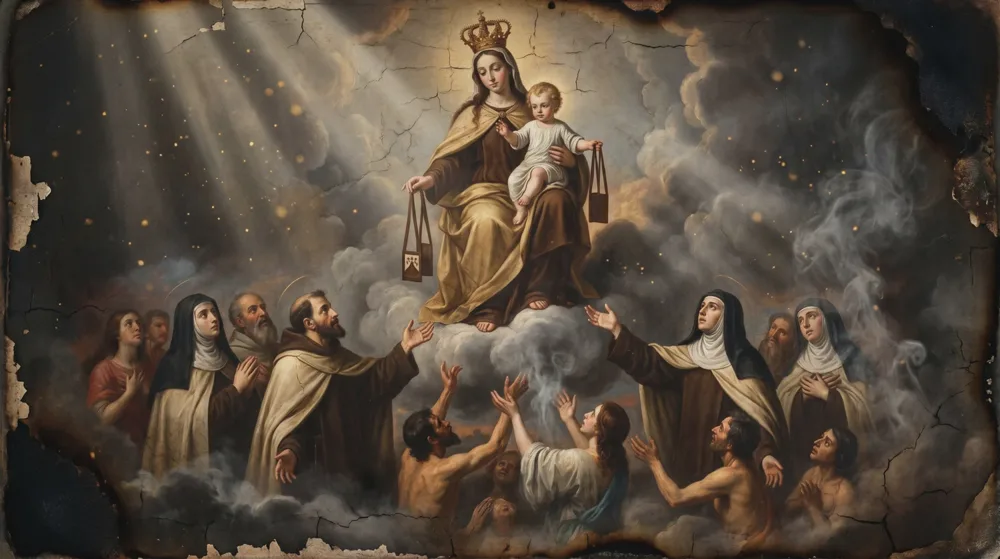
The novena to Our Lady of Mount Carmel is a nine-day prayer to the Blessed Virgin under the title she bears as Queen and Beauty of Carmel — the Mother who gave the Brown Scapular to the Carmelites and promised her protection to all who wear it. It is prayed for whatever grace a soul rightly needs, but above all for her motherly protection in life and at the hour of death, and it is most fittingly begun on 7 July so that the ninth day falls on 16 July, her feast. Below we give the full novena — the daily prayer, the ancient Flower of Carmel, and the popular prayer called "never known to fail" — together with the three-day form, and the story of the scapular that stands behind the whole devotion.
When to pray the novena to Our Lady of Mount Carmel
Our Lady of Mount Carmel is honoured on 16 July (in the calendar of 1962, by a commemoration, its rank since the reform of 1960), so the usual nine days run from 7 July through 15 July, ending on the eve of the feast. But the novena may be made at any time of year, for any grave need; Our Lady does not wait for the calendar to help her children. If you are new to this form of prayer, see our short guide to what is a novena — nine days of persevering prayer, in imitation of the Apostles and Our Lady who waited nine days in the Upper Room for the coming of the Holy Ghost.
The full novena to Our Lady of Mount Carmel
The heart of this devotion is a single prayer of confidence in the Mother of Carmel, said once on each of the nine days. This daily prayer and the Miraculous Prayer below are devotional compositions, with no liturgical text and no approval of their own that we can cite. Begin each day with the Sign of the Cross, name the grace you seek, and pray:
O most beautiful Flower of Mount Carmel, splendor of Heaven, Blessed Mother of the Son of God, Immaculate Virgin, and Mother of mine: support me in this my necessity by your never-failing love, and help me and protect me. Show me herein that you are my Mother.
O Mary, conceived without sin, pray for us who have recourse to thee. O Mary, my Mother, I consecrate myself to you forever. I offer you my body with all its miseries, my soul with all its imperfections, and my heart with all its affections and desires. I offer you all my prayers, works, joys and sufferings, and especially my death, with all that it will entail; and I beg you, by the merits of your Divine Son, to obtain for me the grace I now ask. (Here name your intention.)
Grant me, O Queen and Beauty of Carmel, that I may one day exchange the scapular I have the privilege to wear for the wedding garment of Heaven, and dwell with you and all the saints of Carmel in the kingdom of your Son. Amen.
Close each day with one Our Father, one Hail Mary, and one Glory Be, and the invocation Our Lady of Mount Carmel, pray for us.
The Flower of Carmel (Flos Carmeli)
The oldest prayer of this devotion is the Flos Carmeli — "Flower of Carmel" — a sequence attributed by tradition to St Simon Stock himself, and used by the Carmelites for centuries. It is a fitting close to each day of the novena:
Flower of Carmel, tall vine blossom-laden; splendor of Heaven, childbearing yet maiden. None equals thee.
Mother so tender, whom no man didst know, on Carmel's children thy favors bestow. Star of the Sea.
Strong stem of Jesse, who bore one bright flower, be ever near us and guard us each hour, who serve thee here.
Purest of lilies, that flowers among thorns, bring help to the true heart that in weakness turns and trusts in thee.
Strongest of armor, we trust in thy might; under thy mantle, protect us in fight. Amen.
The prayer to Our Lady of Mount Carmel that was never known to fail
Many keep the novena in the form of the celebrated Miraculous Prayer to Our Lady of Mount Carmel, popularly called "the prayer that was never known to fail" — a phrase to be read with the caution every novena requires, since no prayer compels God. It is short, and is said three times a day for the nine days (or, in the three-day form, for three days), with three closing invocations each time:
O most beautiful Flower of Mount Carmel, Fruitful Vine, Splendor of Heaven, Blessed Mother of the Son of God, Immaculate Virgin, assist me in this my necessity. O Star of the Sea, help me and show me herein you are my Mother.
O Holy Mary, Mother of God, Queen of Heaven and earth, I humbly beseech you from the bottom of my heart to succor me in this necessity. There are none that can withstand your power.
O show me herein you are my Mother. O Mary, conceived without sin, pray for us who have recourse to thee. (three times)
Sweet Mother, I place this cause in your hands. (three times)
Like every sound devotion, this prayer does not bind God or compel an answer — to pray as though the right words forced Heaven's hand would be superstition, which the Church condemns. Its old reputation rests on something surer: the power of the Mother of God to obtain from her Son whatever is truly good for us. Pray it in trust, and add always, thy will be done.
The nine days: intentions for each day
To pray the novena more fully, the same daily prayer may be joined to a short meditation, taking up one facet of Carmel's devotion each day. These themes are drawn from Scripture and the tradition of the Order, and give the nine days their shape.
- Day 1 — Mount Carmel. We remember the holy mountain where the prophet Elias defended the honor of the true God (3 Kings 18), and saw in the little cloud rising from the sea a figure of the Virgin who would bring the rain of grace to a parched world. We ask Our Lady to raise our hearts to God.
- Day 2 — the Immaculate. We honor Mary conceived without sin, the Flower of Carmel, and beg her to obtain for us purity of heart. See also our guide to the Immaculate Conception.
- Day 3 — Star of the Sea. Stella Maris — we ask her to guide us through the storms of this life to the harbor of Heaven.
- Day 4 — the Scapular given. We recall her gift to St Simon Stock, and thank her for the sign of her protection; we renew our fidelity to it.
- Day 5 — the will of God. With Mary we say fiat — let it be done — and ask the grace to accept whatever God sends.
- Day 6 — armor in battle. Strongest of armor — we place ourselves under her mantle against the enemy of our souls.
- Day 7 — Help of Christians. We ask her aid for the whole Church and for all who are in danger, sorrow, or sin.
- Day 8 — the holy souls. We beg her intercession for the faithful departed, trusting her promise to the souls in Purgatory (see our novena for the dead).
- Day 9 — a holy death. We ask, above all, the grace of final perseverance: to die in her scapular, in the friendship of her Son, and to enter the kingdom of Carmel's saints.
The three-day novena to Our Lady of Mount Carmel
Alongside the nine-day form, a three-day novena to Our Lady of Mount Carmel is widely prayed — most often the Miraculous Prayer above, said three times each day for three days. It is a favorite of those who bring Our Lady an urgent need, or who begin late and wish to reach the feast. The prayer and the disposition are the same as the nine-day form; only the length differs. Whether you keep three days or nine, the devotion is one: confident, persevering recourse to the Mother of Carmel.
How to pray this novena well
A novena is measured not by its words but by the soul that prays them. Choose a fixed hour each day and keep it. Name your intention plainly at the start and again at the close. Where you can, join the novena to Holy Mass, to a Communion, or to a decade of the Rosary — Our Lady of Mount Carmel is honored by the Rosary above all, and you may find our guides to how to pray the Rosary and the 54-day Rosary novena a help.
If you are enrolled in the Brown Scapular, wear it through the nine days as a token of the trust you profess. And ask in submission: the novena that avails is the one prayed by a soul resigned to God's wisdom, content to receive either the grace it named or the better thing He chooses to send.
The story of Our Lady of Mount Carmel and the Brown Scapular
The devotion takes its name from Mount Carmel in the Holy Land, the ridge above the sea where the prophet Elias confounded the priests of Baal and where, tradition holds, hermits later gathered in his spirit. From these came the Carmelite Order, whose rule was approved by Pope Honorius III in 1226. The Carmelites took the Blessed Virgin as their patroness and Mother, and kept her feast — at first the Assumption itself, and later, from the late fourteenth century, a special commemoration fixed for 16 July.
That date is bound up with the Brown Scapular. According to the Carmelite tradition, on 16 July 1251 Our Lady appeared to St Simon Stock, an Englishman and prior general of the Order, in a time of great trial for the Carmelites, and gave him the scapular — a small habit of brown cloth worn over the shoulders — with the promise: "Whosoever dies wearing this scapular shall not suffer eternal fire." It is a promise not of presumption but of protection: the scapular is the sign of a soul consecrated to Mary and living, or dying, in her friendship, for no one who wears it faithfully as an emblem of true devotion can persevere unrepentant to the end.
Tradition adds the Sabbatine Privilege — the confidence that Our Lady will come to the aid of the souls in Purgatory who wore her scapular and kept her requests, hastening their entrance into Heaven. From the seventeenth century the day became known as the "scapular feast," and in 1726 Pope Benedict XIII extended it to the whole Western Church.
The scapular devotion belongs to the same treasury as the Rosary — the two great gifts of Our Lady to her children — and Carmel has given the Church some of her greatest contemplatives, from St Teresa of Avila, reformer of the Order, to the Little Flower, St Thérèse of Lisieux. To wear the scapular and pray this novena is to place oneself under the mantle of the Mother whom all of Carmel calls its Queen and its Beauty.
Frequently Asked Questions
What is the novena to Our Lady of Mount Carmel prayed for?
For any grace a soul rightly needs — but above all for Our Lady's protection in life and at the hour of death, for a holy death in her scapular, for the conversion of sinners, for the souls in Purgatory, and for the particular intention the person carries. It is a prayer of confident recourse to the Mother of Carmel, who promises her aid to those devoted to her.
When should I start the novena to reach the feast on July 16?
Begin on 7 July. Nine days of prayer, counting the 7th through the 15th, bring the last day to the eve of the feast; some count the ninth day as the 16th itself and begin on the 8th. Either way, the novena is timed so that its final day falls on or just before 16 July, the feast of Our Lady of Mount Carmel.
Is there a three-day novena to Our Lady of Mount Carmel?
Yes. The three-day form is usually the Miraculous Prayer — "O most beautiful Flower of Mount Carmel" — said three times a day for three consecutive days, with the two closing invocations repeated three times each. It carries the same intentions as the nine-day novena and is a favorite for urgent needs.
What is the Brown Scapular and its promise?
The Brown Scapular of Our Lady of Mount Carmel is a small habit of brown cloth, worn over the shoulders, given by tradition to St Simon Stock in 1251. The promise recorded by the Carmelite tradition is that whoever dies wearing it faithfully shall not suffer eternal fire — that is, shall be granted the grace of final perseverance. It is a sign of consecration to Mary, not a charm; it protects those who live the devotion it professes, not those who treat it as a talisman.
Who was St Simon Stock?
St Simon Stock was an English Carmelite and prior general of the Order in the thirteenth century, to whom, according to Carmelite tradition, Our Lady appeared on 16 July 1251 and gave the Brown Scapular. His name is joined for all time to the scapular devotion, and the ancient Flos Carmeli prayer is attributed to him.
Can I pray this novena at any time, not just in July?
Yes. Though 16 July is the feast, the novena may be made whenever a soul has need of Our Lady's help. The nine days before 16 July are the most fitting time, but the Mother of Carmel hears her children in every season.
Is there a PDF of the novena to Our Lady of Mount Carmel?
The complete text is given in full on this page — the daily prayer, the Flower of Carmel, and the Miraculous Prayer — so it may be prayed straight from your screen or copied out for the nine days. The Iter Fidei app also carries the whole devotion with day-by-day reminders and audio, so no printed sheet is needed.
Pray this novena to Our Lady of Mount Carmel with day-by-day reminders and audio in the Iter Fidei app. Join early access here.
Sources. Holy Scripture (3 Kings 18, the prophet Elias on Carmel); Butler's Lives of the Saints (the Commemoration of Our Lady of Mount Carmel, July 16; St Simon Stock, May 16); the approbation of the Carmelite rule by Pope Honorius III (1226) and the extension of the feast to the Western Church by Pope Benedict XIII (1726); the Flos Carmeli (Flower of Carmel), sequence attributed to St Simon Stock; and the devotional novena and Miraculous Prayer to Our Lady of Mount Carmel as carried in the Carmelite prayer-books.