
Novenas
St Bonaventure Novena: Nine Days for Light and Peace
The full novena to St Bonaventure, Seraphic Doctor: the complete nine-day prayer with the daily invocation, the meditations, the Missal collect, and how to pray it from 6 to 14 July.
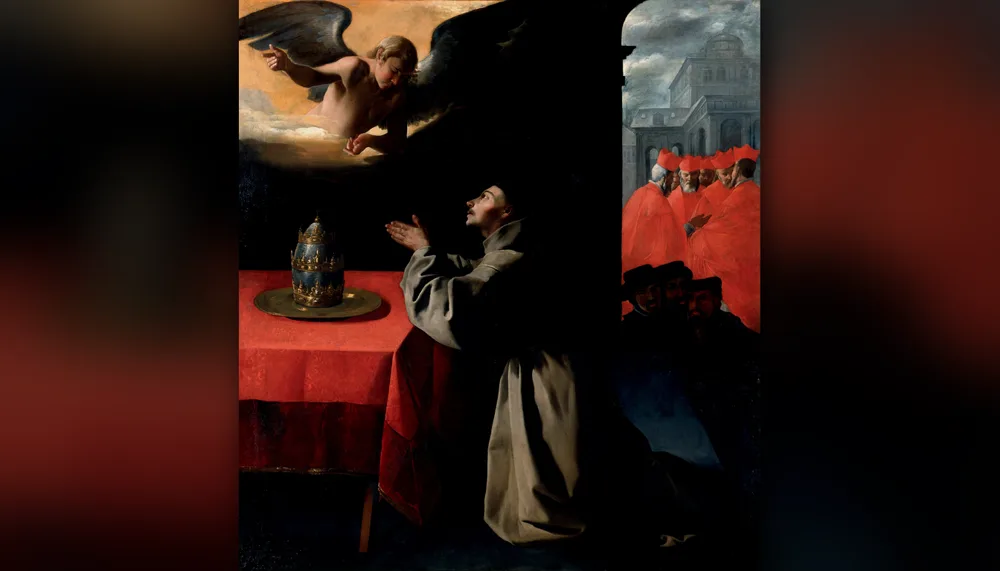
The novena to St Bonaventure is a nine-day prayer asking the Seraphic Doctor to obtain from God what we cannot obtain for ourselves: light in study, peace where there is division, and a heart that loves more than it argues. It is made to the intercession of St Bonaventure of Bagnorea (c. 1218-1274), Friar Minor, master of Paris, minister general of his Order and cardinal-bishop of Albano, whose feast the Roman Missal keeps on 14 July. It is traditionally begun on 6 July so that the ninth day falls on the feast itself, though it may be prayed at any time of year.
Each day has the same shape: the Sign of the Cross, the daily invocation with your intention named, a short meditation on one stage of the saint's life, the petition proper to the day, and then the Our Father, three Hail Marys and the Glory Be. On the ninth day the novena closes with the versicle and the collect of his Mass.
The Novena to St Bonaventure
The Daily Prayer to St Bonaventure
Said on each of the nine days, before the meditation proper to the day.
In the name of the Father,
and of the Son,
and of the Holy Ghost.
Amen.
Recollect thyself a moment in silence, then say the daily invocation, which is recited on each of the nine days before the meditation proper to the day.
St Bonaventure, Seraphic Doctor, thou who didst join the highest learning to the most ardent love, I trust in thy powerful intercession before God. Obtain for me a living faith, a wisdom enlightened by charity, and a desire for the goods that alone endure; and I earnestly beseech thee to obtain for me also, if it please God and if it be good for my soul, the grace I so ardently ask in this novena.
Here name, simply and plainly, the intention thou entrustest to St Bonaventure — the same throughout the nine days.
St Bonaventure, Seraphic Doctor, pray for us. Amen.
Day 1 — The child healed by St Francis
St Bonaventure was born about 1218 at Bagnorea, in Roman Tuscany, and received at baptism the name John of Fidanza. As a small child he fell gravely ill, and his mother vowed him to St Francis of Assisi, then passing through the country. The Poverello prayed over him, and the child was healed; tradition tells that Francis, foreseeing his greatness, hailed him as a good fortune to come, a buona ventura, whence, it is said, his name remained to him. From this cure was born a lifelong love for St Francis and for his Order.
St Bonaventure, healed as a small child by the prayer of St Francis and given to God from the cradle, obtain for the children of our households health of body and, above all, of soul, and engrave early in their hearts the love of Our Lord and of His saints.
Our Father, who art in heaven,
hallowed be Thy name.
Thy kingdom come.
Thy will be done
on earth as it is in heaven.
Give us this day
our daily bread.
And forgive us our trespasses,
as we forgive
those who trespass against us.
And lead us not into temptation,
but deliver us from evil.
Amen.
Then three times:
Hail Mary, full of grace;
the Lord is with thee.
Blessed art thou amongst women,
and blessed is the fruit of thy womb, Jesus.
Holy Mary, Mother of God,
pray for us sinners,
now and at the hour of our death.
Amen.
Glory be to the Father, and to the Son,
and to the Holy Ghost.
As it was in the beginning,
is now, and ever shall be,
world without end.
Amen.
Day 2 — The Friar Minor, master of Paris
About 1243 the young John entered the Order of Friars Minor and took the name Bonaventure. Sent to Paris, he studied under Alexander of Hales, the Irrefragable Doctor, and became in turn a master of theology, teaching in the same university as St Thomas Aquinas. To the widest learning he joined the poverty and humility of his Order, knowing that the first fruit of knowledge is to make the heart lowlier before God.
St Bonaventure, thou didst join the highest learning to the poverty and humility of the Friar Minor: obtain for those who study and teach that they seek the truth uprightly, and draw from it never pride, but a deeper love of God and of their neighbour.
Then the Our Father, three Hail Marys and the Glory Be, as on the first day.
Day 3 — The Seraphic Doctor
All the teaching of Bonaventure is aflame with love. He teaches that knowledge does not suffice, but must pass into charity: we study not to know alone, but to love and to become holy. For this ardent wisdom, wholly turned toward God, the Church has given him the fair name of Seraphic Doctor, like the seraph that burns before the throne of the Most High.
St Bonaventure, Seraphic Doctor, thou didst teach that knowledge must be perfected in love: obtain for us that every light received from God may be turned within us into charity, and that our heart may burn for Him more even than our mind may know Him.
Then the Our Father, three Hail Marys and the Glory Be, as on the first day.
Day 4 — The minister general who steadied the Order
In 1257, being not yet forty, Bonaventure was elected minister general of the Friars Minor, then torn between those who sought relaxation and those who sought an excessive rigour. For seventeen years he governed with prudence and gentleness, reconciling minds, restoring discipline and fervour, and returning ceaselessly to the first spirit of St Francis. He is justly called the second founder of the Order.
St Bonaventure, thou didst bring peace back to a divided Order, not by harshness but by patience and gentleness: obtain for those who bear the charge of others — fathers, superiors, pastors — that they may govern with wisdom, restore unity, and lead all hearts toward God.
Then the Our Father, three Hail Marys and the Glory Be, as on the first day.
Day 5 — The journey of the mind to God
Withdrawn upon Mount La Verna, where St Francis had received the stigmata, Bonaventure wrote the Journey of the Mind to God, a mystical ladder by which the spirit rises through creatures, then within itself, until it comes to rest in God. He shows there that the way of ascent is love, and that Christ crucified is the door through which one passes.
St Bonaventure, thou didst trace for souls the path that mounts from creation to rest in God: obtain for us to know the Creator in His works, to enter within ourselves to find His light there, and to pass through Christ crucified unto the peace that has no end.
Then the Our Father, three Hail Marys and the Glory Be, as on the first day.
Day 6 — The biographer of St Francis
Charged by his Order to tell the life of St Francis, Bonaventure composed the great Legend, gathering for all ages the memory of the Poverello. He loved to trace how Francis, by poverty and by love of the Cross, had made himself like to Christ even to bearing His wounds; and thus he made the saint of Assisi known and loved throughout the Church.
St Bonaventure, thou didst faithfully keep and hand on the memory of St Francis, never seeking thine own glory: obtain for us fidelity to the example of the saints, and the desire, like thine, to make known and loved not ourselves, but Our Lord.
Then the Our Father, three Hail Marys and the Glory Be, as on the first day.
Day 7 — The cardinal-bishop of Albano
In 1273 Pope Gregory X, despite his refusals, created him cardinal-bishop of Albano. Tradition tells that the legates, come to bring him the red hat, found him busy washing the dishes at a convent near Florence: he begged them to hang the hat on a tree near by until he had finished his task. Thus he bore the high dignity as a servant, and not as a lord.
St Bonaventure, raised to the greatest honours, thou didst remain humble and busy at the lowliest tasks: obtain for us never to seek honours for their own sake, to serve in all things, and to keep, amid dignities, the heart of one poor after St Francis.
Then the Our Father, three Hail Marys and the Glory Be, as on the first day.
Day 8 — The worker for unity at the Council of Lyons
At the Second Council of Lyons, in 1274, Bonaventure laboured with all his strength for the reunion of the Greek and Latin Churches, long divided. He preached, he calmed, he reconciled hearts; and it was in great part through him that the union was concluded, brief though it proved to be. He spent himself wholly for the peace and unity of the Church of Christ.
St Bonaventure, thou didst wear out thy last strength to draw together those whom division had parted and to give the Church back her unity: obtain the reconciliation of divided Christians, peace in torn families and peoples, and for us all a heart open to those who think otherwise.
Then the Our Father, three Hail Marys and the Glory Be, as on the first day.
Day 9 — The death at Lyons and the glory
Worn out by his labours, Bonaventure died at Lyons during the Council, on 15 July 1274, mourned by the pope, the cardinals, and the Greeks themselves. Held holy by time and by the veneration of the faithful, he was canonized by Sixtus IV in 1482, and proclaimed a Doctor of the Church by Sixtus V in 1588. He awaits us at the end of this novena, he who taught that knowledge is nothing without love, in the rest of God where all light becomes charity.
St Bonaventure, come by love to the rest of God where thou awaitest us, bend down toward us at the end of this novena: obtain for us the grace we have entrusted to thee, if it please God and if it be good for our soul; and above all, obtain for us to love God in this life, that we may see Him in the next.
Then the Our Father, three Hail Marys and the Glory Be, as on the first day.
Closing of the novena
V. Pray for us, O holy Bonaventure.
R. That we may be made worthy of the promises of Christ.
Let us pray.
O God, who didst give to Thy people blessed Bonaventure as a minister of eternal salvation: grant, we beseech Thee, that we may deserve to have as our intercessor in Heaven him whom we have had as a teacher of life on earth. Through our Lord Jesus Christ, Thy Son, who liveth and reigneth with Thee in the unity of the Holy Ghost, God, world without end. Amen.
In Latin, as it stands in the Missal:
Deus, qui populo tuo aeternae salutis beatum Bonaventuram ministrum tribuisti: praesta, quaesumus; ut, quem Doctorem vitae habuimus in terris, intercessorem habere mereamur in caelis. Per Dominum nostrum Iesum Christum Filium tuum, qui tecum vivit et regnat in unitate Spiritus Sancti Deus, per omnia saecula saeculorum. Amen.
In the name of the Father,
and of the Son,
and of the Holy Ghost.
Amen.
A short form, a printable copy, and praying day by day
The novena above is the whole prayer, and it takes about five minutes a day. If you are pressed — a break at work, a wait in a car — the shortest honest form is the daily invocation, your intention, the petition of the day, and a single Our Father, Hail Mary and Glory Be. Say the rest when you can. What must not be dropped is the intention: it is what makes nine scattered days into one novena.
To keep the novena as a printable copy, use your browser's print command on this page (or "Save as PDF" in the print dialogue) and you will have the nine days in your hand, no download required. Many people prefer paper for a novena, and there is nothing rustic about it: a page in a missal or on the kitchen table is seen and prayed, whereas a file in a folder is forgotten by the third day.
Praying it day by day is the whole point, and it is also the whole difficulty. The classical remedy is to attach the novena to something already fixed in the day — the morning offering, the return from work, the last minutes before bed — rather than trusting yourself to remember. A missed day is not a broken novena and does not oblige you to start again; pick up where you left off, and if you wish, add the omitted day at the end.
Praying it for a particular intention
St Bonaventure is not a saint one goes to only for schoolwork. The nine meditations show the reach of his patronage, and the intentions naturally entrusted to him fall roughly into four kinds:
- For study and for teaching — examinations, a thesis, a seminarian's course, a teacher's classroom. He is a patron saint of students precisely because he refused to let learning become an end in itself. A prayer before an exam fits well alongside the novena.
- For peace where there is division — a family at odds, a parish quarrelling, a religious community pulled between rigour and laxity. This is the eighth day, and it is the work that killed him.
- For those who govern — fathers, superiors, pastors, anyone carrying others. The fourth day is theirs.
- For sick children — the first day, and the ancient reason for his patronage of bowel ailments, which came to him through a healing attributed to his intercession.
Name the intention aloud, or in a word, at the same place each day. Then leave it with him. The novena is not a machine that produces results; it is nine days of confidence in a friend of God who knows what our own good is better than we do.
When to pray the novena to St Bonaventure
The feast of St Bonaventure falls on 14 July in the calendar of 1962 — S. Bonaventurae Episcopi Confessoris et Ecclesiae Doctoris, a double feast. Counting nine days backwards so that the last falls on the feast itself, the novena begins on 6 July and ends on 14 July. That is the traditional reckoning.
There is no obligation to wait for July. A novena is a private devotion, and this one may be begun on any day of the year — before an examination, at the start of a term, when a household is at war with itself. If you would rather understand the shape of the practice before beginning, see what a novena is and how the nine days are counted; and if you keep the old calendar, the traditional Latin Mass calendar will show you where his feast sits in July.
Who was St Bonaventure?
Butler's is candid: of Bonaventure's youth nothing is known beyond that he was born at Bagnorea, near Viterbo, son of John Fidanza and Mary Ritella — Butler's gives 1221, other traditional accounts about 1218. The famous cure by St Francis and the buona ventura etymology of his name come from Franciscan tradition and the acts of his canonization, not from any contemporary life; they are told on the first day of the novena as the Order has always told them, and it is honest to say that they are not historically established.
What is documented begins at Paris. He was clothed a Friar Minor, studied under the Englishman Alexander of Hales, and taught theology and Scripture in the university from 1248 to 1257 — the years in which the secular masters, led by William of Saint-Amour, tried to drive the mendicants out of the schools. Bonaventure had to suspend his lectures, answered with a treatise on evangelical poverty, and was vindicated when Alexander IV ordered Saint-Amour's book burnt. In 1257 he and St Thomas Aquinas received the doctorate together; the same year, aged not yet thirty-six, he was elected minister general.
His writings are why the Church calls him a Doctor: the Commentary on the Sentences, the Breviloquium, the Itinerarium mentis in Deum, the Soliloquy, On the Threefold Way, and the prayer after Mass beginning Transfige, dulcissime Domine Iesu, which the Roman Missal still puts in every priest's hands. Alexander of Hales said of him that he "seemed not to have sinned in Adam". Clement IV wanted him archbishop of York in 1265 and he escaped it; Gregory X made him cardinal-bishop of Albano in 1273 and he could not.
He died at Lyons in the night of 14-15 July 1274, during the council whose union with the Greeks he had secured — a union Constantinople repudiated within a few years, which his eyes were spared. Sixtus IV canonized him in 1482; Sixtus V declared him a Doctor of the Church in 1588. He is patron of theologians, of the Franciscan Order, of students, of reconcilers and of sacred learning: of everyone, that is, who must think for a living and is in danger of forgetting why. His life belongs to the Church's treasury of saints, and his devotion to Christ crucified sits in the same current as the Franciscan love of the Cross he did so much to hand on.
Frequently Asked Questions
What is the St Bonaventure novena?
Nine consecutive days of prayer asking St Bonaventure to present one named intention to God. Each day carries its own meditation and petition, and the whole is sealed on the ninth day by the collect of his Mass.
When do you pray the novena to St Bonaventure?
From 6 to 14 July, ending on his feast. Outside July it may be begun on any day; nothing in the prayer is tied to the season.
What is the St Bonaventure novena prayer?
The daily invocation — "St Bonaventure, Seraphic Doctor, thou who didst join the highest learning to the most ardent love…" — said every one of the nine days, followed by the petition proper to that day.
What is St Bonaventure the patron saint of?
Theologians, the Franciscan Order, students, reconcilers and sacred learning; also, by long custom, of bowel ailments. He is invoked wherever study and charity must be held together, or a division healed.
Why is St Bonaventure called the Seraphic Doctor?
Because his theology burns rather than merely explains: he holds that knowledge is unfinished until it becomes love. The seraphim, highest of the nine choirs of angels, are the burning ones — hence the name.
Is the novena de aguinaldos a novena to St Bonaventure?
No. The novena de aguinaldos is the Latin American Christmas novena prayed from 16 to 24 December, before the Nativity. It is only ever associated with St Bonaventure's name through parishes and schools dedicated to San Buenaventura, which pray it as everyone else does.
What if I miss a day of the novena?
Take it up again at the day you left. There is no obligation to start over — the nine days are a discipline of confidence, not a legal condition, and no grace is forfeited by a forgotten evening.
Can I pray the novena to St Bonaventure with others?
Yes, and it gains by it. Read the meditation aloud, let each name his own intention silently at the rubric, and say the petition and the Our Father, Hail Marys and Glory Be together.
Pray the nine days with day-by-day reminders and the full audio in the Iter Fidei app. Download it here.
Sources. Holy Scripture (Douay-Rheims); Butler's Lives of the Saints, 14 July; the Roman Missal, S. Bonaventurae Episcopi Confessoris et Ecclesiae Doctoris (collect); the Roman Martyrology; the writings of St Bonaventure (Itinerarium mentis in Deum, Legenda maior, Breviloquium); the acts of his canonization by Sixtus IV (1482) and his proclamation as Doctor of the Church by Sixtus V (1588).